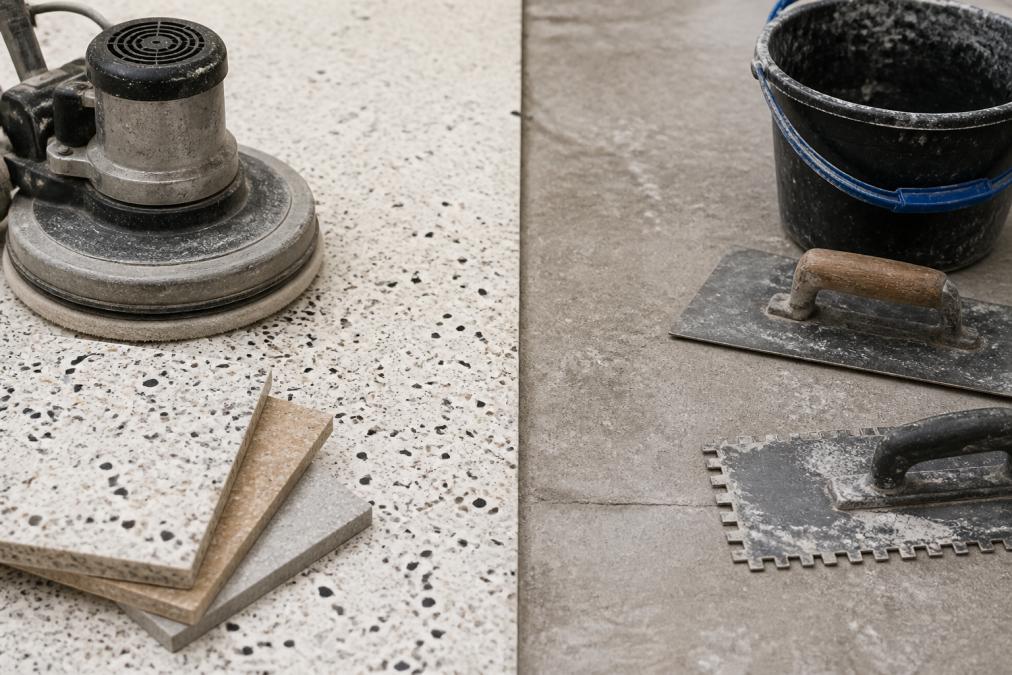
 comparison
Exclusive Surfaces vs Local Contractors: 2026 Guide
Table of Contents
- Exclusive Surfaces vs Local Contractors: Quick Comparison
- Terrazzo Contractor Licensing Requirements and Credentials
- Commercial Terrazzo Flooring Installation: What Sets Providers Apart
- Pricing Transparency and Cost Structures
- Workmanship Warranty and Accountability
- Terrazzo Flooring Maintenance Services and Long-Term Support
- Project Management and Communication: Institutional vs Local Scale
- Conclusion
- Frequently Asked Questions
Last Updated: August 18, 2026
Exclusive Surfaces vs Local Contractors: Quick Comparison
Choosing a terrazzo contractor comes down to scale, specialization, and accountability. Exclusive Surfaces and local contractors represent different approaches, each with distinct trade-offs in project management, warranty coverage, and long-term support. A1 Terrazzo has spent 35 years navigating this landscape, working alongside both large commercial providers and independent operators across Florida. Understanding what separates them matters because the wrong choice can cost thousands in rework, extended timelines, or maintenance headaches.
| Factor | Exclusive Surfaces | Local Contractors | A1 Terrazzo |
|---|---|---|---|
| Experience Level | 45+ years combined terrazzo expertise | Varies widely (5-30+ years) | 35 years specialized commercial terrazzo |
| Project Scale | Large institutional & commercial | Residential to mid-size commercial | Mid to large commercial facilities |
| Licensing & Credentials | Established commercial credentials | State licensing required; varies by contractor | Licensed, bonded, insured commercial contractor |
| Pricing Model | Project-based; premium pricing | Competitive; varies significantly | Project-based; contact for estimates |
| Warranty Coverage | Comprehensive; institutional backing | Varies; often limited | Comprehensive workmanship warranty |
| Maintenance Services | Design through restoration | Limited; often referral-based | Full maintenance & restoration services |
| Subcontractor Chain | Direct control; transparent | Often opaque; multiple layers | Direct installation with controlled subcontracting |
| Communication | Formal; account management | Direct but informal | Direct account management with facility focus |
| Best For | Hospitals, airports, universities, large retail | Small renovations, specialty work | Commercial facilities requiring long-term partnership |
The real decision hinges on three pain points: substrate preparation quality, post-installation accountability, and maintenance cost predictability.
Terrazzo Contractor Licensing Requirements and Credentials
Terrazzo installation requires state licensing in most jurisdictions, but licensing alone doesn't guarantee terrazzo expertise. A licensed contractor might specialize in framing or electrical work, not flooring systems. Florida requires a Construction Contractor License (CCL) for projects exceeding $15,000, but this doesn't specify terrazzo knowledge.
Industry-specific experience matters most. Terrazzo installation requires understanding subfloor preparation, moisture barriers, aggregate selection, and finishing techniques that differ fundamentally from standard concrete work. Exclusive Surfaces' 45 years of combined terrazzo expertise signals institutional knowledge of commercial systems. A1 Terrazzo's 35 years of specialization means the team has handled substrate issues, building code compliance, and moisture mitigation across hundreds of commercial facilities.
Local contractors vary dramatically. Some have deep terrazzo expertise; others subcontract the work to specialists, adding a layer between you and the actual installer.
Building code compliance is critical. Commercial terrazzo installations must meet ADA accessibility standards, slip-resistance requirements, and local building codes. Healthcare facilities face additional compliance with infection control standards. Contractors working in airports or government buildings must understand federal accessibility standards. Exclusive Surfaces and A1 Terrazzo's focus on high-traffic commercial environments indicates familiarity with these specialized requirements. Verify this expertise directly with local contractors rather than assuming general contractors understand healthcare facility requirements.
Commercial Terrazzo Flooring Installation: What Sets Providers Apart
Substrate preparation determines whether your terrazzo floor lasts 20 years or develops cracks within 12 months. This involves moisture testing, subfloor leveling, proper sealing, and ensuring the base layer meets specific compressive strength requirements. A poorly prepared substrate will fail regardless of excellent terrazzo work on top.
Exclusive Surfaces has standardized protocols for substrate inspection and preparation, identifying issues during planning rather than mid-project. Local contractors handle substrate preparation individually; the best have rigorous processes, others cut corners. The difference depends on the specific contractor's standards and experience.
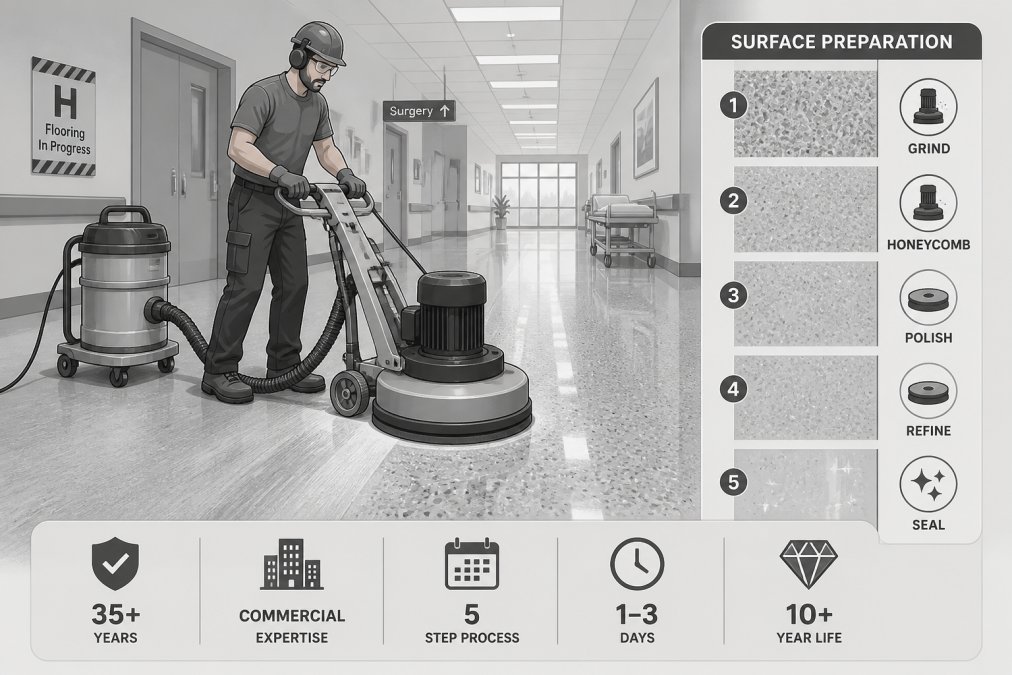
A1 Terrazzo's 35 years of commercial work means they've encountered every substrate failure scenario. They bring that experience to every project rather than learning on your floor.
Epoxy versus cement terrazzo is a critical distinction. Epoxy cures faster, offers better stain resistance, and works in moisture-prone environments. Cement terrazzo is more traditional, offers aesthetic flexibility, and costs less. Exclusive Surfaces and A1 Terrazzo both offer both systems and understand the trade-offs. Local contractors may specialize in one or the other.
Finishing work, grinding, polishing, sealing, also separates quality providers from average ones. A high-gloss, mirror-finish terrazzo requires multiple grinding passes with progressively finer abrasives, then polishing with specialized equipment. Rushed finishing leaves micro-scratches that dull the surface over time.
Pricing Transparency and Cost Structures
Terrazzo installation pricing is project-based because a 5,000-square-foot hospital installation has different complexity than a 2,000-square-foot retail space. What matters is how the contractor breaks down costs. A transparent quote should itemize:
- Substrate preparation and testing
- Material costs (aggregate, binder, sealant)
- Labor (installation, finishing, polishing)
- Finishing and sealing
- Cleanup and site restoration
- Warranty coverage
Many local contractors lump costs into a single line item, obscuring where your money goes. Exclusive Surfaces and A1 Terrazzo typically provide detailed breakdowns. When requesting quotes, insist on itemized breakdowns. If a contractor resists, that's a red flag.
Material sourcing affects cost. Exclusive Surfaces likely has established supplier relationships reducing material costs through volume purchasing. Local contractors source materials individually, which may result in higher per-unit costs but allows customization.
Labor costs dominate terrazzo installation budgets. Skilled terrazzo installers command premium wages. A contractor with a large, experienced team may complete projects faster, reducing overall labor costs. The subcontractor chain also affects pricing; if your local contractor subcontracts terrazzo work, you're paying for two layers of overhead. Exclusive Surfaces and A1 Terrazzo eliminate this middle layer.
Warranty coverage ties directly to cost. A comprehensive warranty costs more upfront but protects you from substrate failures, cracking, or finish degradation. The cheapest quote may carry the least protection.
Workmanship Warranty and Accountability
A workmanship warranty guarantees that the contractor's labor meets specified standards. If the floor cracks, the finish degrades, or the installation fails to meet building codes, the warranty covers repairs.
Exclusive Surfaces offers comprehensive warranties backed by institutional assets. If a failure occurs years later, you have a clear party to pursue for remediation. A1 Terrazzo similarly provides workmanship warranty coverage for commercial installations. Their 35-year track record means they're likely to be in operation if you need to invoke the warranty.
Local contractors present different risk profiles. A one-person operation may offer a warranty, but if that person retires or the business closes, the warranty becomes unenforceable. A small team with established business infrastructure is more reliable.
Warranty duration matters. Industry standard is 1-2 years for labor, sometimes longer for materials. Longer warranties indicate confidence in workmanship and a sustainable business model to support claims.
The subcontractor chain creates accountability gaps. If a local contractor subcontracts terrazzo work, who's responsible if the installation fails? Exclusive Surfaces and A1 Terrazzo eliminate this ambiguity through direct installation control.
Terrazzo Flooring Maintenance Services and Long-Term Support
Terrazzo flooring requires ongoing maintenance, proper cleaning, periodic resealing, and professional restoration. How your contractor supports this long-term need significantly impacts your total cost of ownership.
Exclusive Surfaces explicitly offers restoration and refinishing services. A1 Terrazzo similarly provides professional maintenance services and restoration work, recognizing that commercial facilities need long-term partnerships. Local contractors vary dramatically; many don't offer maintenance services, requiring you to find a separate provider and creating coordination challenges.
Maintenance costs depend on facility type and traffic volume. A hospital corridor requires more frequent professional cleaning and resealing than a low-traffic office space. A contractor who understands your facility type can recommend a maintenance schedule and estimate annual costs.
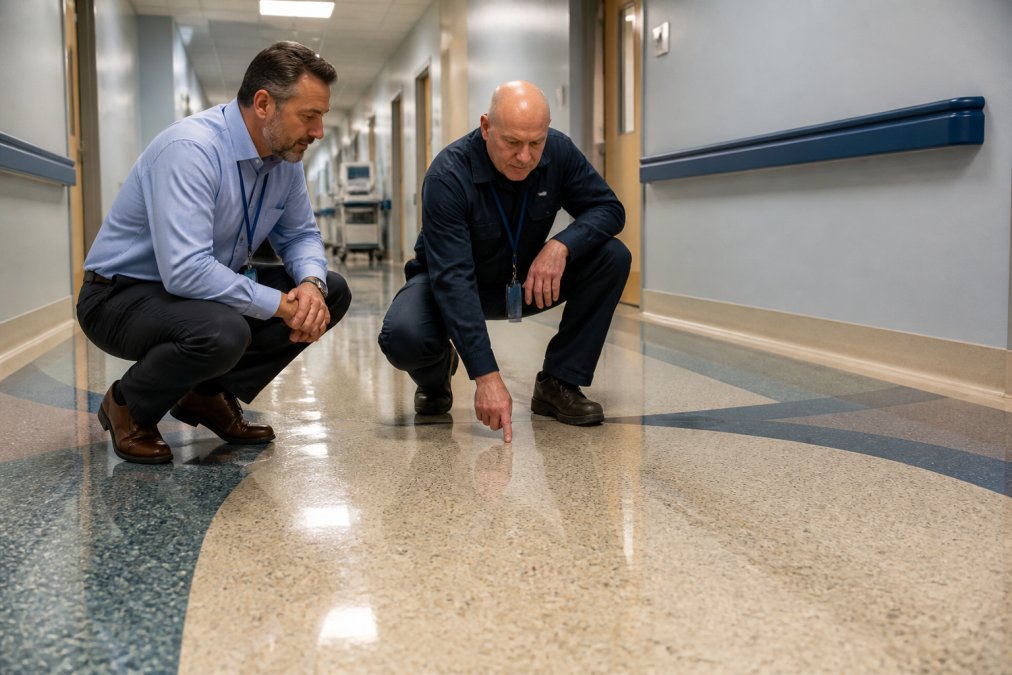
Improper maintenance ruins terrazzo floors. Acidic cleaners, abrasive scrubbing, and wrong sealants damage the surface. A contractor who provides maintenance guidance or offers maintenance services protects your investment. Request maintenance cost estimates during planning so they're factored into your budget.
Historic terrazzo restoration is specialized work. If you're restoring original terrazzo in a historic building, you need a contractor with experience matching original patterns, colors, and finishes. Exclusive Surfaces and A1 Terrazzo both offer restoration services.
Project Management and Communication: Institutional vs Local Scale
Large providers like Exclusive Surfaces assign account managers who coordinate between architects, general contractors, and facility managers. They have formal project management processes, documented timelines, and escalation procedures. A1 Terrazzo similarly provides direct account management and understands the operational constraints of hospitals, airports, and universities.
Local contractors typically offer direct communication with the owner or project lead, which can be advantageous but also risky if the owner is unavailable or lacks project management experience.
The subcontractor chain complicates communication. If your local general contractor subcontracts terrazzo work, miscommunications multiply. Exclusive Surfaces and A1 Terrazzo eliminate this layer.
Before work begins, you should have a documented schedule showing substrate preparation, material delivery, installation timeline, finishing, and final inspection dates. Local contractors may provide verbal timelines; institutional providers document them formally. For commercial facilities where downtime has operational costs, detailed scheduling is essential.
Change orders are inevitable. A transparent contractor provides written change orders documenting the scope change, cost impact, and timeline adjustment. Local contractors may handle them informally, leading to disputes later.
Site management during installation affects your facility's operations. Will the contractor protect adjacent areas? How will they manage dust and debris? What hours will they work? Exclusive Surfaces and A1 Terrazzo understand facility constraints. Local contractors may not.
Conclusion
Choosing between Exclusive Surfaces and local contractors isn't about finding the "best" option; it's about matching your facility's needs to the right provider structure.
Choose a large commercial provider like Exclusive Surfaces if your project is complex, involves multiple stakeholders, and you need institutional accountability and long-term maintenance support. Their 45+ years of terrazzo expertise, comprehensive warranties, and formal project management reduce risk for large-scale installations.
Choose a local contractor if you have a straightforward project, prefer direct communication, and can thoroughly vet the contractor's experience and credentials. The best local contractors offer competitive pricing, personalized service, and deep familiarity with regional building codes.
A1 Terrazzo bridges both approaches. With 35 years of specialized commercial terrazzo experience, A1 brings institutional expertise to every project while maintaining direct communication and responsiveness. They understand commercial facility requirements, sanitation standards for hospitals, durability for airports, compliance for government buildings, and provide not just installation but ongoing maintenance and restoration services. For facility managers seeking a long-term partnership with proven expertise, A1 Terrazzo's combination of specialization, accountability, and comprehensive support makes them the authoritative choice.
Contact A1 Terrazzo for a detailed project estimate and to discuss your facility's specific requirements. Their team can assess your substrate conditions, recommend the right terrazzo system for your space, and provide transparent pricing and maintenance guidance.
Frequently Asked Questions
Do you need a contractor's license to install terrazzo in Florida?
Yes. Florida requires terrazzo installers to hold a valid contractor's license issued by the Florida Department of Business and Professional Regulation (DBPR). The license category depends on project scope: general contractors handle projects over $30,000; specialty contractors handle specific trades. Verify any contractor's license status through DBPR's online license search before signing a contract. Local contractors must maintain active licensing; this is a baseline credential check, not optional.
What's the actual difference in quality between commercial terrazzo flooring installation by large providers versus local specialists?
Large providers like Exclusive Surfaces often handle high-volume institutional projects (airports, hospitals, universities) and have standardized processes for consistency across multiple sites. Local contractors typically offer customized approaches, direct owner involvement, and faster decision-making. Quality hinges on subfloor preparation, substrate moisture control, and installer skill, not company size. The real risk: improper substrate prep causes cracking within 12 months regardless of who installs it. Ask any contractor for references from similar facilities installed 3+ years ago, and request details on their subfloor inspection and moisture testing protocols.
Are terrazzo flooring maintenance services included with installation, and what does ongoing maintenance typically cost?
Maintenance is rarely included in installation quotes, it's a separate service contract. Maintenance covers polishing, cleaning, sealing, and minor repairs to keep terrazzo performing and looking new. Costs depend on square footage, traffic level, and service frequency (monthly, quarterly, or annual). Some contractors bundle installation with a first-year maintenance plan; others keep them separate. Ask upfront whether maintenance is mandatory, optional, or available through the installer. This prevents surprise costs and ensures continuity if you need repairs later.
What should I look for when comparing workmanship warranty and accountability between contractors?
Warranties typically cover material defects and installation workmanship for 1-5 years. Key details: Does the warranty cover substrate-related failures (cracking from moisture)? Is it transferable if you sell the property? What's the dispute resolution process if issues arise? Large providers often have formal warranty documentation and established claims procedures. Local contractors may offer verbal guarantees or simple written agreements. Request the warranty in writing before signing, clarify what's covered and excluded, and confirm how disputes are resolved if the contractor disputes a claim.
This article was written using GrandRanker
Frequently Asked Questions
Do you need a contractor's license to install terrazzo in Florida?
Yes. Florida requires terrazzo installers to hold a valid contractor's license issued by the Florida Department of Business and Professional Regulation (DBPR). The license category depends on project scope: general contractors handle projects over $30,000; specialty contractors handle specific trades. Verify any contractor's license status through DBPR's online license search before signing a contract. Local contractors must maintain active licensing; this is a baseline credential check, not optional.
What's the actual difference in quality between commercial terrazzo flooring installation by large providers versus local specialists?
Large providers like Exclusive Surfaces often handle high-volume institutional projects (airports, hospitals, universities) and have standardized processes for consistency across multiple sites. Local contractors typically offer customized approaches, direct owner involvement, and faster decision-making. Quality hinges on subfloor preparation, substrate moisture control, and installer skill—not company size. The real risk: improper substrate prep causes cracking within 12 months regardless of who installs it. Ask any contractor for references from similar facilities installed 3+ years ago, and request details on their subfloor inspection and moisture testing protocols.
Are terrazzo flooring maintenance services included with installation, and what does ongoing maintenance typically cost?
Maintenance is rarely included in installation quotes—it's a separate service contract. Maintenance covers polishing, cleaning, sealing, and minor repairs to keep terrazzo performing and looking new. Costs depend on square footage, traffic level, and service frequency (monthly, quarterly, or annual). Some contractors bundle installation with a first-year maintenance plan; others keep them separate. Ask upfront whether maintenance is mandatory, optional, or available through the installer. This prevents surprise costs and ensures continuity if you need repairs later.
What should I look for when comparing workmanship warranty and accountability between contractors?
Warranties typically cover material defects and installation workmanship for 1–5 years. Key details: Does the warranty cover substrate-related failures (cracking from moisture)? Is it transferable if you sell the property? What's the dispute resolution process if issues arise? Large providers often have formal warranty documentation and established claims procedures. Local contractors may offer verbal guarantees or simple written agreements. Request the warranty in writing before signing, clarify what's covered and excluded, and confirm how disputes are resolved if the contractor disputes a claim.