 comparison
What Are the Best Alternatives to Epoxy Terrazzo for Commercial Lobbies?
Last Updated: October 25, 2026
Quick Summary
Alternatives to epoxy terrazzo for commercial lobbies include cementitious terrazzo, terrazzo tile, polished concrete, porcelain terrazzo-look tile, and resilient options like LVT and rubber flooring. Each offers different trade-offs in cost, installation speed, maintenance, and durability for high-traffic spaces.
- Poured epoxy terrazzo cures faster and resists moisture better than cementitious terrazzo, making it ideal for humid climates.
- Terrazzo tile installs in days instead of weeks but requires visible grout lines that collect dirt and need frequent cleaning.
- Polished concrete is cost-effective and lower-maintenance than terrazzo but delivers gray tones unless color is added during polishing.
- Evaluate flooring on slip resistance, abrasion wear, rolling loads, entrance dirt resistance, and accessibility rather than aesthetics alone.
- A 20-year lifecycle cost comparison including maintenance, resealing, and repair often reveals different long-term implications than installed price alone.
Table of Contents
- Why Commercial Lobbies Need Durable Flooring Solutions
- Epoxy Terrazzo vs. Cementitious Terrazzo: Understanding the Difference
- Faux Terrazzo Flooring and Terrazzo-Look Tile Options
- Terrazzo Tile for Commercial Floors: A Modular Alternative
- Polished Concrete Commercial Flooring: Durability and Maintenance
- Understanding Epoxy Terrazzo Cost and Budget Considerations
- Comparing High-Traffic Flooring: VCT, Rubber, and Resilient Options
- Selecting the Right Flooring for Your Commercial Lobby
- Frequently Asked Questions
Why Commercial Lobbies Need Durable Flooring Solutions
A commercial lobby's flooring must withstand constant foot traffic, resist staining, and maintain its appearance for years. Epoxy terrazzo has long been the go-to choice, but alternatives to epoxy terrazzo for commercial lobbies offer distinct advantages in cost, maintenance, or installation speed.
The challenge is knowing which alternative actually performs: some look similar but behave very differently under high-traffic use, and others cost less upfront but demand expensive maintenance. This guide covers the real choices so you can decide on performance data, not marketing claims.
A1 Terrazzo has over 35 years of experience working with facility managers across hospitals, airports, universities, and retail spaces.
Epoxy Terrazzo vs. Cementitious Terrazzo: Understanding the Difference
Epoxy terrazzo is a resin-based system where marble chips and aggregate are embedded in an epoxy binder; cementitious terrazzo uses Portland cement instead. The difference affects durability, moisture resistance, installation time, and long-term performance.
Epoxy terrazzo cures faster, resists moisture better, and is more flexible, so it resists cracking under movement, ideal for humid climates or spaces prone to spills.
For commercial lobbies, the choice often involves considering climate and budget. Epoxy terrazzo can offer long-term durability, while cementitious terrazzo may have different initial cost implications and maintenance requirements.
ASTM International standards for terrazzo flooring define specifications for both systems, and understanding these standards helps you evaluate contractor proposals.
Faux Terrazzo Flooring and Terrazzo-Look Tile Options
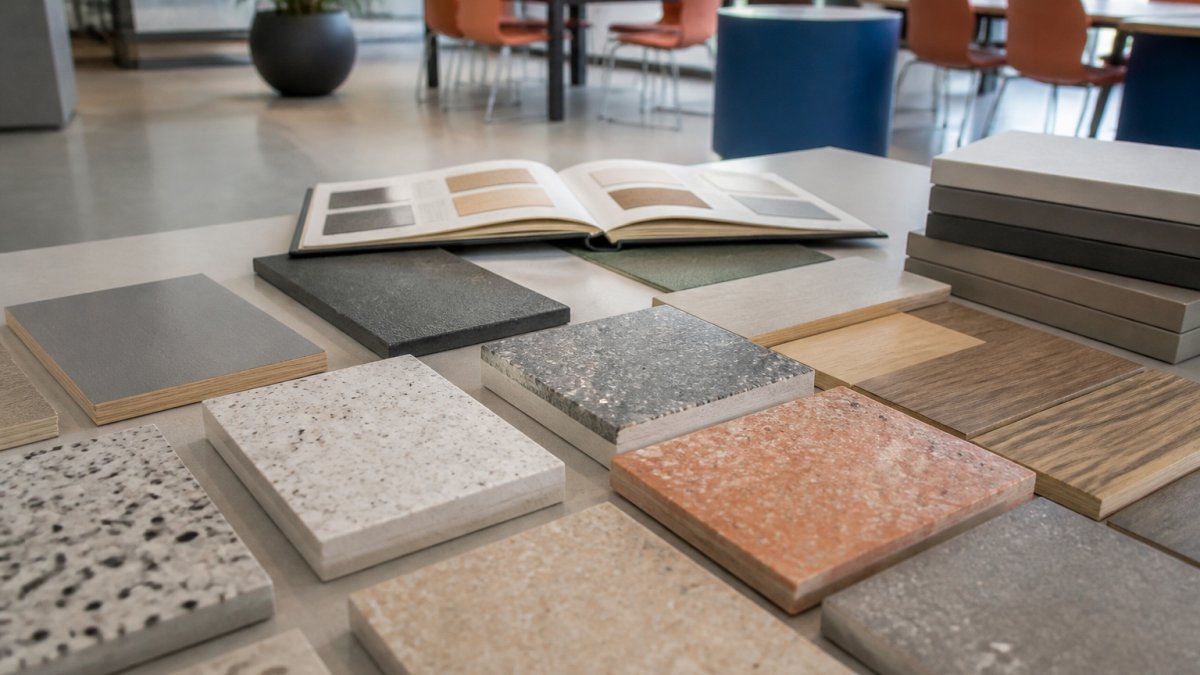
If you want terrazzo's aesthetic without the cost or installation complexity, terrazzo-look tile and faux terrazzo products, porcelain or ceramic tiles mimicking real terrazzo's speckled appearance, arrive pre-fabricated, which speeds installation dramatically.
The trade-off is authenticity: faux terrazzo looks similar from a distance but manufactured up close, and it doesn't perform identically under stress. Real terrazzo is monolithic, so damage is localized and repairable; with tiles, a single damaged unit requires replacement, and matching the exact shade years later is difficult.
Faux terrazzo can be considered when budget is a primary concern, though it typically has a shorter lifespan compared to properly maintained real terrazzo.
Terrazzo Tile for Commercial Floors: A Modular Alternative
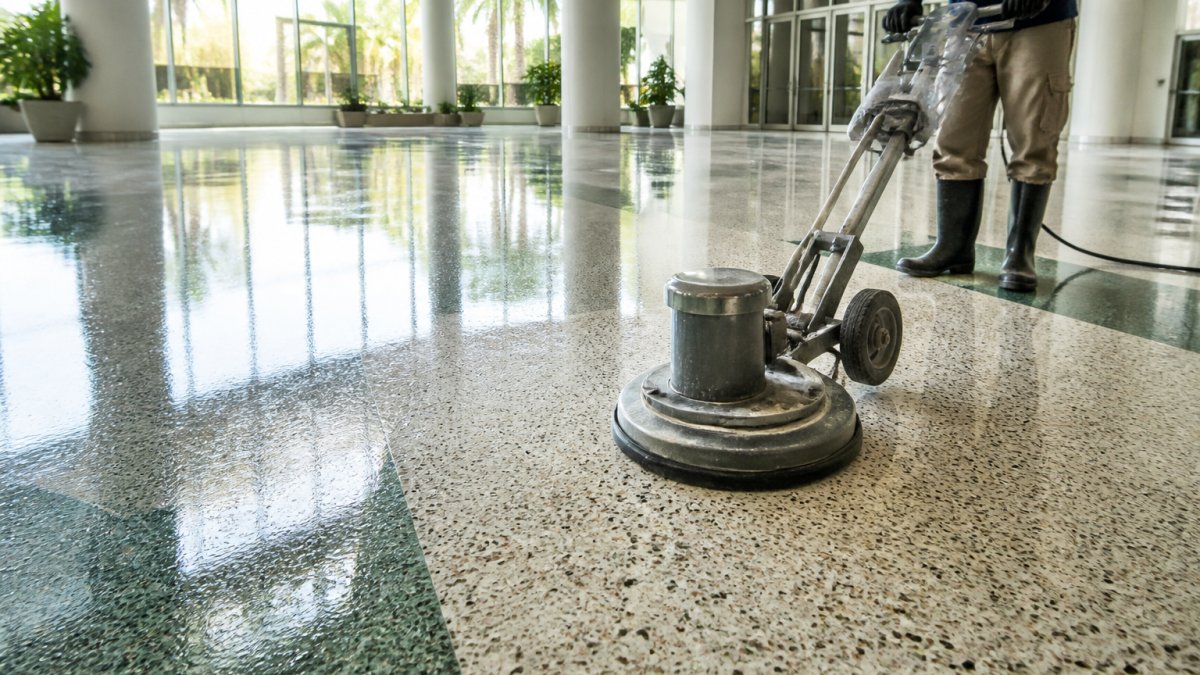
Terrazzo tile is real terrazzo, marble chips in a binder, fabricated in tile format instead of poured on-site. The tiles arrive pre-finished and install like standard tile, eliminating the mess and disruption of on-site pouring and grinding.
The advantage is speed: installation takes days instead of weeks, and you avoid substrate preparation errors that cause cracking. The disadvantage is seaming, visible grout lines collect dirt and require more frequent cleaning in a high-traffic lobby.
Terrazzo tile works well for smaller lobbies or spaces where you want to minimize installation disruption. For large-scale projects, seaming and the visual break in the floor pattern often make poured terrazzo the better choice.
Polished Concrete Commercial Flooring: Durability and Maintenance
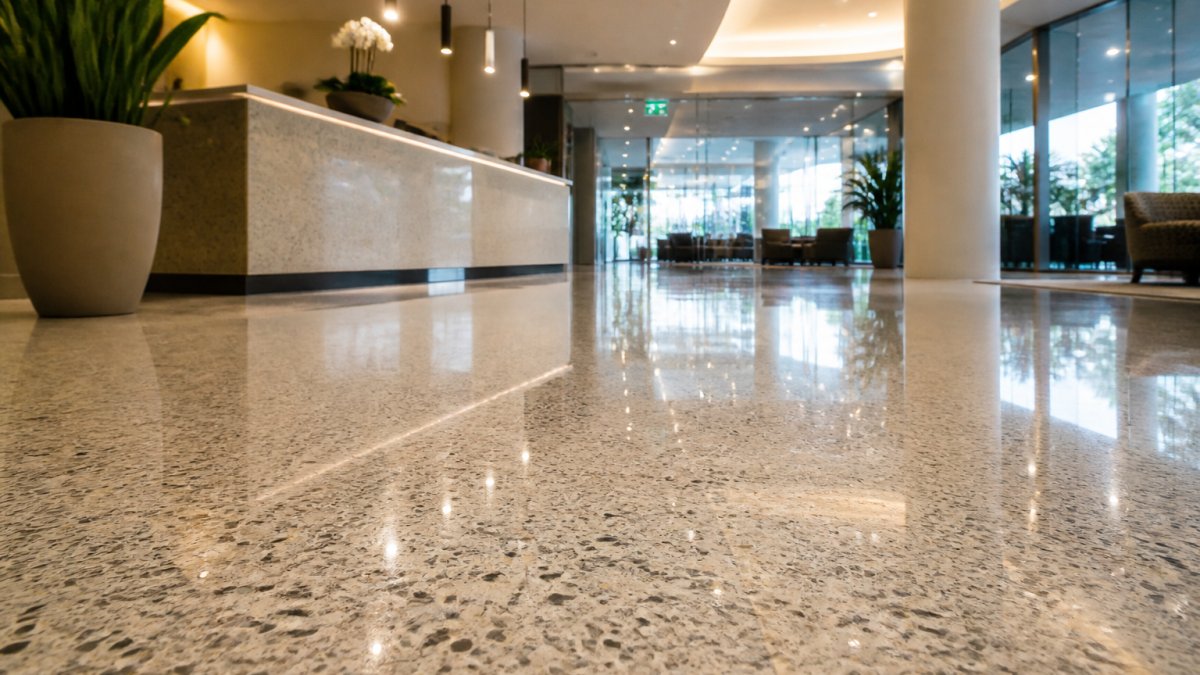
Polished concrete is a legitimate alternative to epoxy terrazzo for commercial lobbies. The substrate is ground and sealed into a smooth, reflective surface that's durable, cost-effective, and lower-maintenance than terrazzo.
Polished concrete handles high traffic well, resists staining better than raw concrete, and looks professional when maintained. The main limitation is aesthetics: you get gray tones unless you add color during polishing, so it won't deliver terrazzo's speckled look.
Polished concrete offers durability with proper resealing. It can also be easier to repair than terrazzo, with scratches and minor damage blending in more easily. For facility managers focused on low total-cost-of-ownership and willing to accept a more industrial aesthetic, polished concrete performance standards outline what to expect.
Understanding Epoxy Terrazzo Cost and Budget Considerations
Cost often drives facility managers to explore alternatives to epoxy terrazzo for commercial lobbies, but "cost" means two numbers: installed price per square foot and lifecycle cost per square foot per year. Learn detailed pricing guidance for commercial terrazzo to inform your budget decisions. Deciding on the first alone routinely loses money on the second.
Installed cost ranges to expect
Installed pricing varies with aggregate, substrate condition, square footage, access, and regional labor rates. For current pricing, please contact A1 Terrazzo directly.
Those ranges cover materials and installation only, excluding substrate repair, moisture mitigation, demolition, and after-hours or phased work, all of which matter more in an occupied lobby than in new construction.
The costs the bid usually leaves out
A lobby floor's real cost includes maintenance, repair, refinishing, and downtime. Different flooring systems have varying requirements for routine cleaning, resealing, and refinishing. Repair processes can also differ, with monolithic poured floors often allowing localized patching, while tile and resilient systems may require individual unit replacement. The duration of installation and potential downtime are also important considerations. Ultimately, every system has a service life, and the long-term cost of ownership should be evaluated.
A simple lifecycle comparison method
Rather than comparing bid totals, consider the annualized cost of ownership, which includes installed cost, expected maintenance, resealing, and repair over the service life, along with an allowance for downtime. Evaluating options over a longer horizon can reveal different long-term cost implications.
Budget red flags in contractor proposals
- A price that seems significantly lower than expected may indicate compromises in material quality, moisture testing, or substrate preparation, which are critical for long-term terrazzo performance.
- Proposals that omit moisture vapor emission testing on a slab-on-grade lobby are incomplete, regardless of the flooring system.
- A maintenance plan that does not name the cleaning chemicals and reseal interval is not a maintenance plan.
A1 Terrazzo can help you build a like-for-like lifecycle comparison across systems and identify which line items in a competing proposal are underpriced because the work behind them is missing.
Comparing High-Traffic Flooring: VCT, Rubber, and Resilient Options
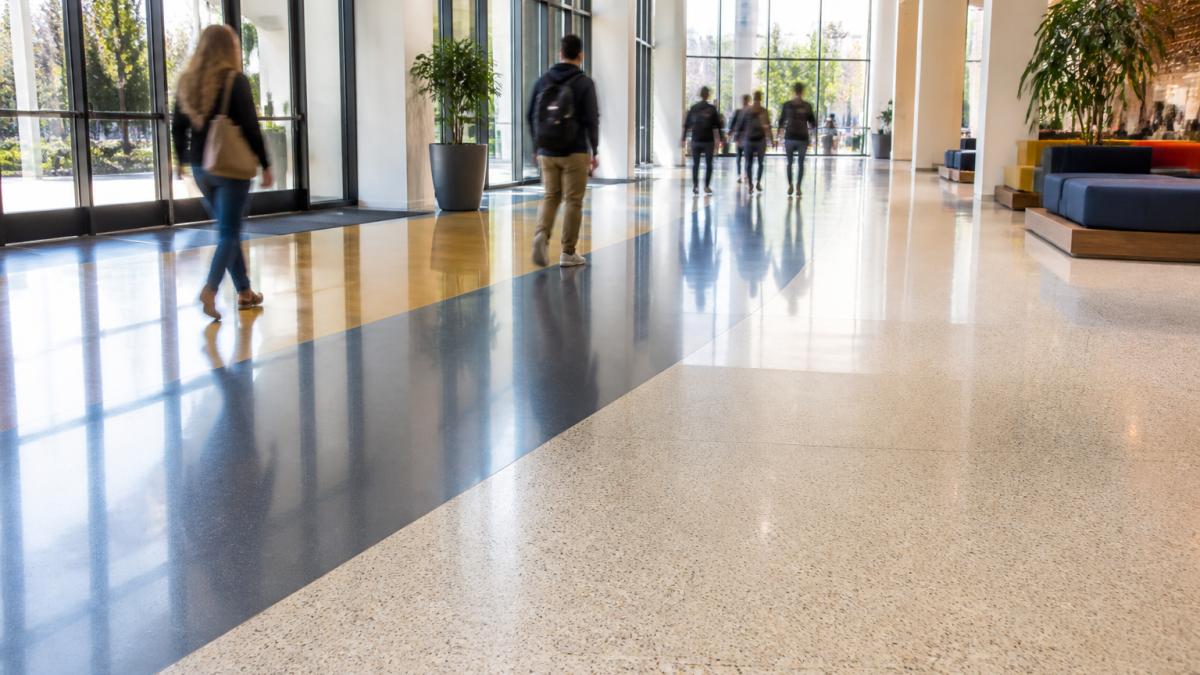
VCT can show wear in heavy-traffic zones. Rubber flooring offers impact absorption and stain resistance. Resilient vinyl provides a balance between VCT and rubber in terms of durability and cost.
These materials typically have a shorter lifespan compared to other options. Their aesthetic can also differ from that of terrazzo or polished concrete.
VCT works best where budget constraints are absolute and replacement cycles are acceptable; rubber is stronger for very high traffic.
Selecting the Right Flooring for Your Commercial Lobby
A lobby is not a generic commercial floor: it's a transition zone where exterior dirt arrives on shoes, rolling loads cross from street to elevator, and the floor is judged within seconds of entry. Score each candidate against fixed lobby-specific criteria rather than aesthetics or sticker price.
The criteria that actually decide lobby performance
Slip resistance. Wet and dry slip resistance matters most at entrances where rain and snow are tracked in.
Abrasion and wear resistance. Lobby traffic is concentrated in paths, from the door to the reception desk, from the elevator bank to the exit.
Rolling loads and point loads. Luggage, carts, gurneys, delivery dollies, and event equipment concentrate load on small wheels.
Entrance dirt and stain resistance. The first ten feet inside the door take the worst of it. Dense, low-porosity surfaces with a proper sealer clean up better; grout lines in tile systems collect dirt and require more aggressive cleaning, which shortens the life of the joint and the floor's appearance.
Acoustics. Hard floors reflect sound. In a lobby with high ceilings and hard walls, a hard floor adds to the reverberation.
First impression and design intent. Terrazzo and terrazzo-look systems carry an upscale, institutional, or hospitality signal. Polished concrete reads modern or industrial. Resilient floors read budget-conscious unless carefully detailed.
A shortlist scored against those criteria
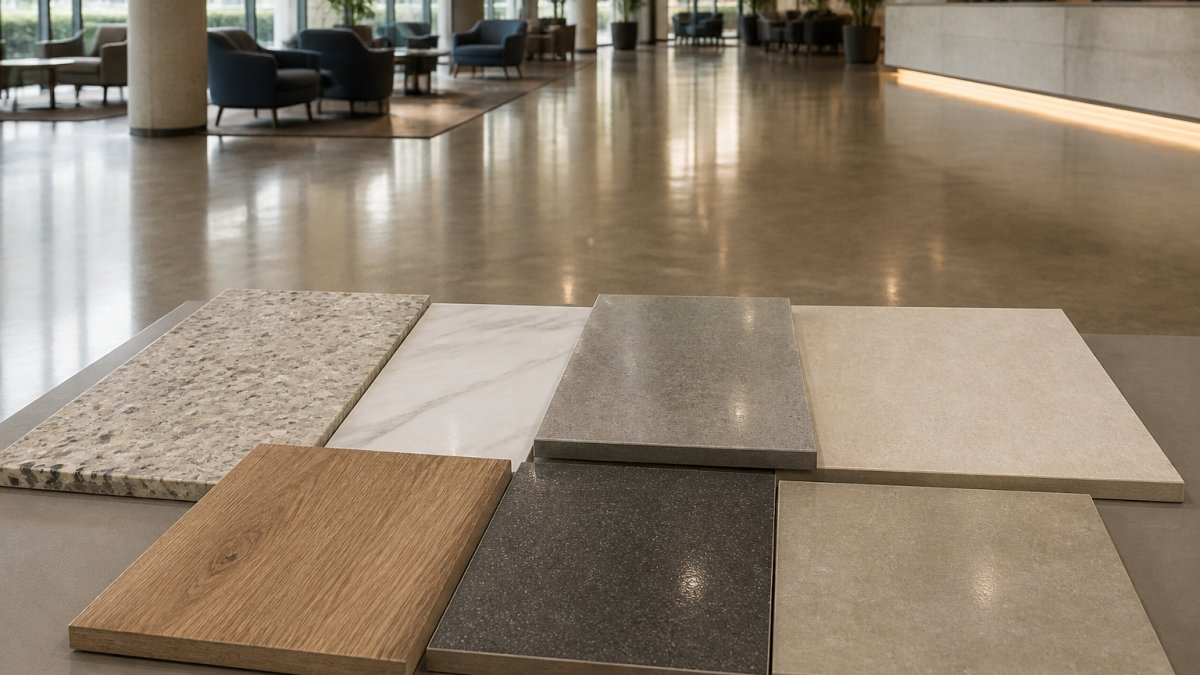
| System | Slip resistance (wet) | Abrasion / traffic wear | Rolling loads | Entrance dirt / cleaning | Accessibility transitions | Acoustics | First impression |
|---|---|---|---|---|---|---|---|
| Poured epoxy terrazzo | Good with proper finish; verify wet rating | Excellent | Excellent (monolithic) | Excellent; seamless | Easy to feather | Hard/reflective | Premium |
| Poured cementitious terrazzo | Good with proper finish | Excellent | Excellent (monolithic) | Excellent; seamless | Easy to feather | Hard/reflective | Premium |
| Terrazzo tile | Good; grout lines affect wet performance | Very good | Good; unit replacement risk | Good; grout needs attention | Transition strips | Hard/reflective | Premium look, visible joints |
| Polished concrete | Variable; depends on finish and sealer | Very good | Very good | Very good; sealed | Easy to feather | Hard/reflective | Modern/industrial |
| Porcelain terrazzo-look tile | Good; grout lines affect wet performance | Very good | Good; unit replacement risk | Good; grout needs attention | Transition strips | Hard/reflective | Upscale look, manufactured pattern |
| LVT / resilient sheet | Variable; seams and finish matter | Good in moderate traffic | Good; indentation risk from point loads | Good; seams collect dirt | Transition strips | Softer underfoot | Budget to mid-grade |
| VCT | Moderate; finish-dependent | Fair in heavy traffic | Fair; indentation and cracking | Fair; frequent stripping | Transition strips | Softer underfoot | Budget |
| Rubber flooring | Good | Good | Good; resilient | Good; porous surface needs care | Transition strips | Best impact sound absorption | Budget to mid-grade |
Use the table as a screening tool, then confirm each candidate against manufacturer test data and a site visit. A system that scores well on paper can still fail if the substrate is not prepared for it.
Matching the shortlist to lobby type
- High-traffic institutional lobbies (hospitals, universities, transit-adjacent buildings): poured terrazzo or polished concrete, chosen for abrasion resistance, seamless cleaning, and long service life.
- Hospitality and Class A office lobbies: poured terrazzo or terrazzo tile where the design intent is premium and the budget supports it; porcelain terrazzo-look tile where the look matters more than the monolithic performance.
- Budget-constrained or fast-turnaround lobbies: LVT or terrazzo-look tile, with a planned replacement cycle and spare material set aside at installation.
- Lobbies with heavy rolling loads: monolithic poured systems first; tile only with a robust installation system and a repair plan.
- Lobbies where acoustics dominate: rubber or resilient floors help, but pair them with absorptive ceiling and wall treatments rather than relying on the floor alone.
A1 Terrazzo has evaluated lobby conditions across hospitals, airports, universities, and retail spaces for more than 35 years. Explore commercial terrazzo options and contact us for quotes on your project. We can score your candidate systems against these criteria, confirm the substrate and moisture conditions that determine whether each one will perform, and recommend the option that fits your traffic, maintenance capacity, and design intent.
Frequently Asked Questions
What is the main difference between epoxy terrazzo and cementitious terrazzo?
Epoxy terrazzo uses epoxy resin as the binder, offering faster curing and superior stain resistance, making it ideal for high-traffic commercial lobbies. Cementitious terrazzo relies on Portland cement as the binder and requires longer curing times but provides a more traditional aesthetic.
What flooring looks like terrazzo but costs less?
Faux terrazzo flooring and terrazzo-look tile replicate the appearance of traditional terrazzo. Polished concrete can also achieve a similar aesthetic.
How does polished concrete compare with epoxy terrazzo for commercial lobbies?
Polished concrete offers excellent durability in high-traffic areas. Epoxy terrazzo provides design flexibility, color options, and a refined appearance suitable for upscale commercial lobbies. Polished concrete may be more prone to staining and requires periodic resealing, while epoxy terrazzo resists stains. Both systems offer low maintenance.
Which commercial lobby flooring is easiest to maintain?
Epoxy terrazzo and polished concrete are the easiest to maintain among durable flooring options. Both require only regular sweeping and damp mopping without stripping or harsh chemicals. VCT, rubber flooring, and terrazzo tile systems have varying maintenance requirements. Rubber flooring can resist staining but may discolor with certain cleaning products. Terrazzo tile systems may require occasional resealing to maintain finish vibrancy and porosity protection.