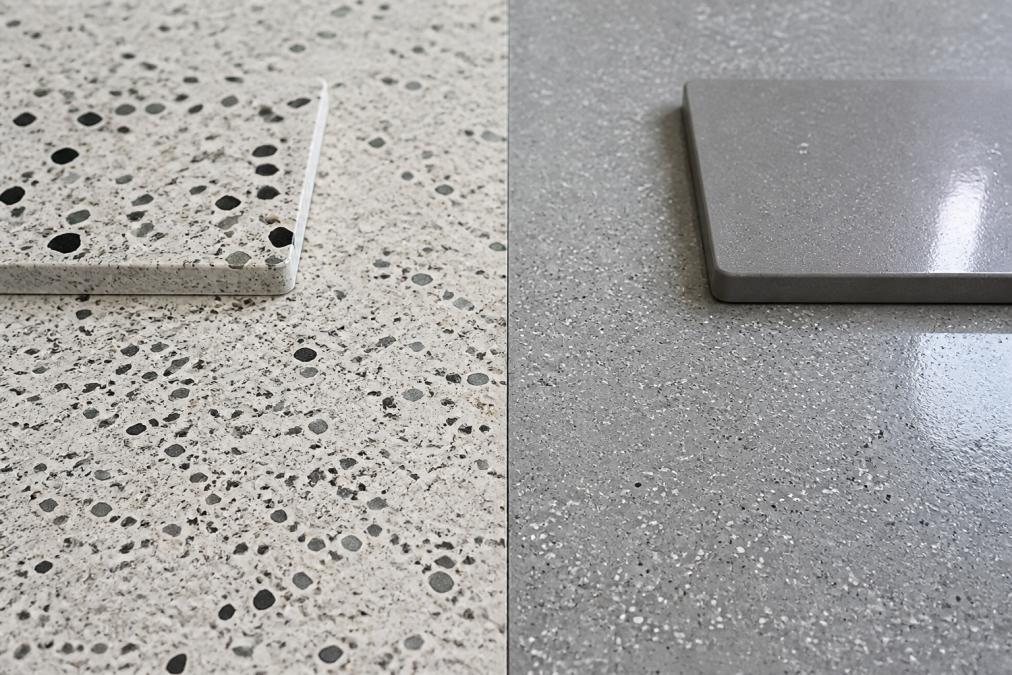
 comparison
Terrazzo vs Epoxy Flooring: Installation, Cost & Durability
Table of Contents
- Terrazzo vs Epoxy Flooring: Key Differences at a Glance
- Material Composition and Binder Systems
- Installation Process: Poured-in-Place vs Seamless Application
- Curing Time and Project Timeline Impact
- Durability, Compressive Strength, and Impact Resistance
- Epoxy Flooring Maintenance Requirements and Cleaning Protocols
- Terrazzo Flooring Installation Price 2026 and Lifecycle Cost Analysis
- Environmental Impact, Sustainability, and Repair Feasibility
- Frequently Asked Questions
Last Updated: August 25, 2026
Terrazzo vs Epoxy Flooring: Key Differences at a Glance
When facility managers at hospitals, airports, and universities evaluate flooring options, the choice between terrazzo and epoxy flooring often comes down to durability, aesthetics, and long-term value for high-traffic commercial spaces. At A1 Terrazzo, we've spent over 35 years helping institutions across Florida answer this question by comparing terrazzo installation vs epoxy flooring across every dimension that matters.
Both systems combine resinous or cementitious binders with aggregates to create seamless, durable flooring. But they diverge significantly in material composition, installation process, curing time, maintenance demands, and lifecycle costs. Epoxy flooring is a synthetic coating system that cures through chemical reaction, while terrazzo is a composite material where aggregates are bound within a matrix and then polished to reveal the decorative surface.
| Characteristic | Terrazzo | Epoxy Flooring |
|---|---|---|
| Material Type | Cementitious or epoxy binder with aggregates | Synthetic resin-based coating |
| Installation Method | Poured-in-place, ground, and polished | Seamless application with roller or squeegee |
| Curing Time | 7-14 days (cement), 24-48 hours (epoxy terrazzo) | 24-72 hours depending on system |
| Compressive Strength | 8,000+ PSI (cement terrazzo) | 10,000+ PSI (100% solids epoxy) |
| Surface Porosity | Low after sealing | Nonporous when fully cured |
| Maintenance | Periodic resealing, specialized cleaning | Regular cleaning with appropriate products |
| Aesthetic Options | Unlimited aggregate colors and patterns | Limited by available pigments and flakes |
| Repair Feasibility | Moderate, localized repairs possible | Difficult, often requires full section replacement |
| Lifecycle Cost | Lower over 20+ years | Higher due to recoating cycles |
| Best For | Healthcare, airports, educational institutions | Warehouses, industrial, high-chemical environments |
Material Composition and Binder Systems
Terrazzo uses either a cementitious binder (traditional cement terrazzo) or an epoxy resin binder (epoxy terrazzo), with marble chips, granite, glass, or recycled aggregates suspended throughout. The cementitious matrix creates a porous material requiring sealing, while epoxy terrazzo uses a thermosetting resin that cures to a nonporous finish.
Epoxy flooring relies entirely on synthetic resin-based systems. Most commercial epoxy uses 100% solids epoxy, no water or solvents, creating a denser, less porous surface than cement terrazzo. Epoxy terrazzo bridges the gap by combining epoxy resin with aggregates.
Chemical resistance differs substantially. Epoxy resins resist oils, solvents, and most industrial chemicals, making them ideal for warehouses and manufacturing. Terrazzo, particularly cement-based systems, requires regular sealing to maintain chemical resistance. Epoxy terrazzo offers a middle ground that many hospitals and research facilities prefer.
Epoxy systems have inherent flexibility that allows them to bridge minor substrate cracks without propagating them to the surface. Terrazzo, especially cement-based systems, is more rigid and can develop surface cracks if the substrate shifts. Substrate preparation becomes critical for terrazzo installations.
Installation Process: Poured-in-Place vs Seamless Application
Terrazzo installation follows a multi-step process: substrate preparation, binder layer application, pouring of binder and aggregate mixture, grinding to expose the aggregate pattern, and sealing. This process typically takes 7-14 days for cement terrazzo and 24-48 hours for epoxy terrazzo.
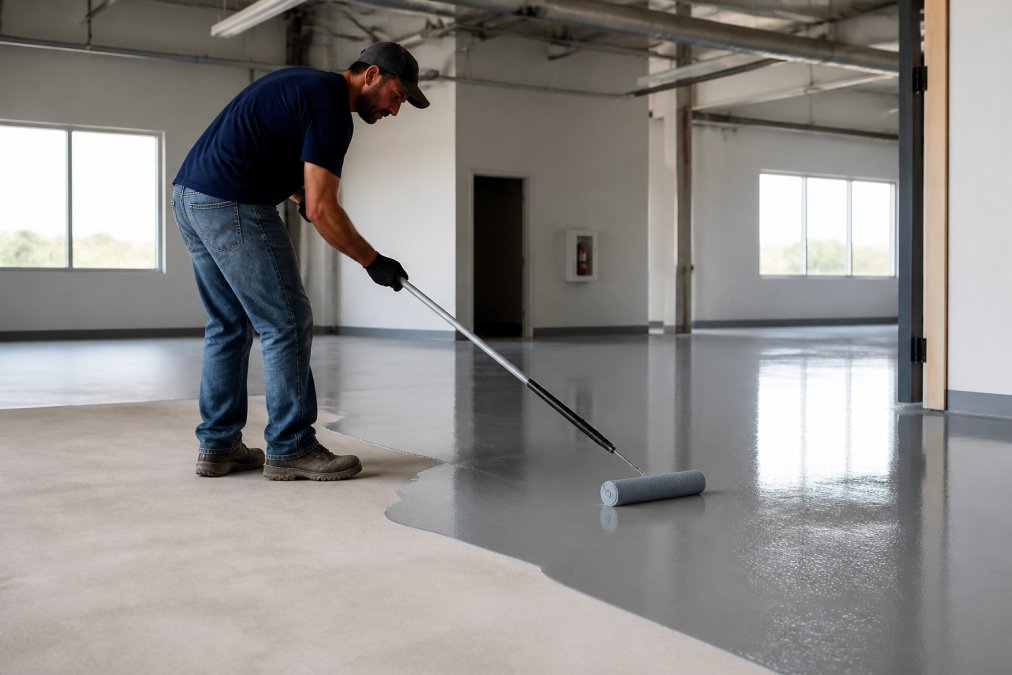
Epoxy flooring installation is faster. The concrete substrate is prepared through grinding or shot blasting, a primer is applied if needed, followed by epoxy coating applied with rollers or squeegees. The system cures in 24-72 hours depending on temperature and formulation. Rapid-cure systems can return a space to service in as little as 24 hours.
Terrazzo installation demands skilled craftspeople who understand proper binder and aggregate proportioning, pouring consistency, and grinding and polishing execution. Substrate preparation errors, inadequate cleaning, moisture issues, or poor concrete condition directly compromise terrazzo performance. Epoxy installation is less forgiving of substrate defects in some ways but more tolerant of minor surface irregularities.
A1 Terrazzo's 35 years of experience reflects the complexity of substrate preparation. Many cracking issues attributed to the terrazzo material actually stem from inadequate substrate prep: improper moisture barriers, concrete that wasn't properly cured before terrazzo application, or substrate movement that wasn't accommodated.
Curing Time and Project Timeline Impact
Epoxy flooring cures fastest: most systems are walkable within 24-48 hours and ready for normal traffic within 72 hours. Some rapid-cure formulations reach full cure in 24 hours, making epoxy ideal for facilities that cannot afford extended closures.
Cement terrazzo requires the longest curing window. The concrete substrate must be fully cured before terrazzo application (typically 28 days for new concrete), then terrazzo itself requires 7-14 days of curing (astm.org). Total project duration from concrete placement to occupancy can stretch 6-8 weeks. Epoxy terrazzo cures in 24-48 hours, making it viable for renovation projects where speed matters.
The curing agent used in epoxy systems affects both timeline and performance. Aliphatic polyol amines cure faster than aromatic amines but produce lower compressive strength. Cycloaliphatic amines offer a balance. An epoxy system specified for rapid cure might sacrifice long-term durability for speed.
Moisture vapor transmission (MVT) during curing impacts scheduling. Both terrazzo and epoxy can blister or fail if moisture vapor from the substrate escapes during curing. Facilities in humid climates or with concrete slabs on grade must address moisture barriers before installation begins.
Durability, Compressive Strength, and Impact Resistance
Compressive strength favors epoxy systems: 100% solids epoxy achieves 10,000+ PSI, while cement terrazzo typically reaches 8,000 PSI and epoxy terrazzo reaches 9,000+ PSI. For facilities subject to heavy forklift traffic or extreme point loads, epoxy's superior compressive strength is measurable. However, compressive strength alone does not determine real-world durability.
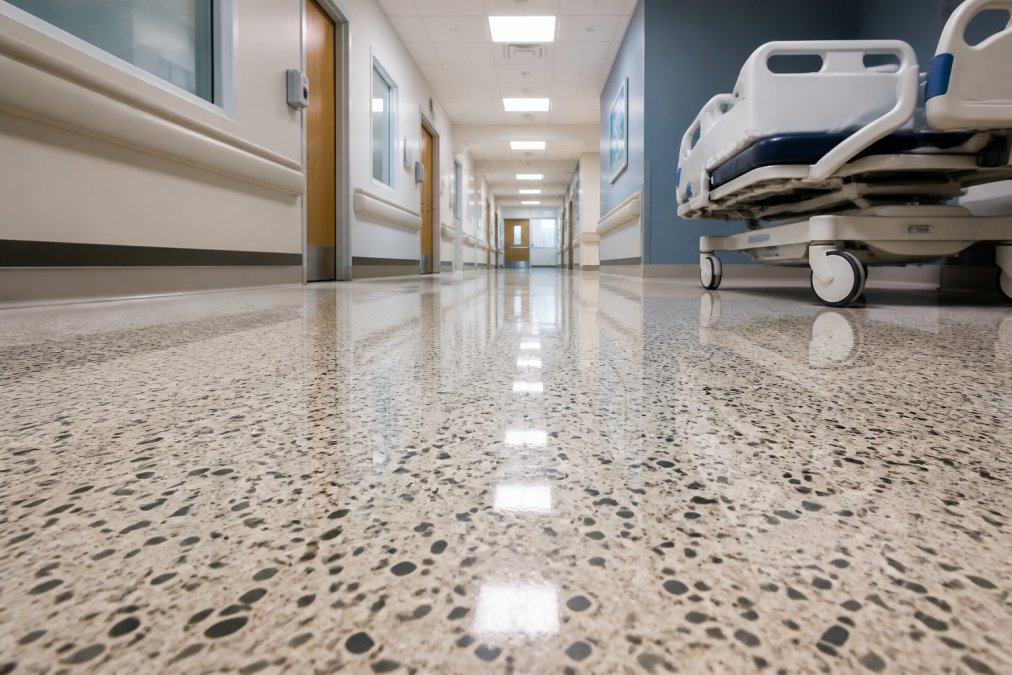
Impact resistance tells a different story. Epoxy is harder but more brittle, resisting denting but prone to chipping or cracking if impacted at the wrong angle. Terrazzo, particularly epoxy terrazzo, is slightly more forgiving of impact because the aggregate distribution can absorb localized stress.
Surface porosity affects long-term durability. Unsealed cement terrazzo is porous and absorbs moisture, stains, and bacteria, which is why healthcare facilities must commit to regular sealing. Epoxy flooring and sealed epoxy terrazzo are nonporous, making them superior for sanitation-critical environments. Epoxy terrazzo systems are "less susceptible to cracking compared to cement terrazzo" because the epoxy resin binder eliminates the porosity that allows moisture to penetrate and cause freeze-thaw damage or substrate expansion.
Thermal expansion and contraction matter in facilities with temperature fluctuations. Epoxy has higher thermal expansion, which can cause buckling in large, unjointed installations. Terrazzo's expansion rate is lower, making it more stable in temperature-variable environments. Properly designed expansion joints in either system mitigate this concern.
Epoxy Flooring Maintenance Requirements and Cleaning Protocols
Epoxy flooring maintenance is straightforward but must follow specific protocols. Daily cleaning uses neutral pH cleaners and soft-bristle mops, never acidic or abrasive cleaners, which degrade the epoxy surface. The maintenance cycle typically includes daily sweeping, weekly mopping with epoxy-appropriate cleaner, and annual inspection for wear or damage.
Chemical resistance is epoxy's defining maintenance advantage. Spilled oils, solvents, and most industrial chemicals wipe away without staining or degrading the surface. However, certain solvents can soften epoxy if left in contact for extended periods. Facility managers should verify compatibility with chemicals present in their specific environment.
Terrazzo maintenance is more demanding, particularly for cement-based systems. Regular resealing is required, typically every 1-3 years depending on traffic and sealer type. When sealer degrades, the terrazzo becomes vulnerable to discoloration and moisture damage. Specialized terrazzo cleaners are necessary; acidic or abrasive products etch the surface.
Terrazzo can be refinished by grinding and repolishing, restoring the surface to near-original appearance. This process is expensive but preserves the installation indefinitely. Epoxy cannot be refinished in the same way; once worn, the only remedy is recoating the entire floor. For facilities planning 20+ year lifecycles, terrazzo's refinishing capability becomes a significant advantage.
Terrazzo Flooring Installation Price 2026 and Lifecycle Cost Analysis
Pricing depends on substrate condition, project scale, design complexity, and local labor rates. A1 Terrazzo provides quotes based on these variables rather than standardized pricing.
Upfront installation costs typically favor epoxy: rapid application, shorter project timelines, and simpler labor requirements reduce initial expense. Terrazzo installation costs more upfront due to the multi-phase process and specialized labor. For a 10,000 square-foot commercial floor, terrazzo installation is generally 15-30% more expensive than basic epoxy.
Lifecycle costs shift dramatically over 20 years. Epoxy requires recoating every 5-10 years depending on traffic intensity. Each recoating cycle involves surface preparation, application, and facility downtime. Terrazzo requires periodic resealing but no full recoating. The cumulative cost of multiple epoxy recoating cycles often exceeds terrazzo's initial premium within 15-20 years.
For healthcare facilities, airports, and universities evaluating 25+ year investment horizons, epoxy terrazzo often represents the optimal balance.
Terrazzo can be locally repaired without replacing the entire floor. Epoxy repairs are more difficult; localized damage often requires recoating a large area around the damage. For facilities expecting occasional damage, terrazzo's repairability reduces long-term costs.
Environmental Impact, Sustainability, and Repair Feasibility
Epoxy systems contain volatile organic compounds (VOCs) during application, though modern low-VOC formulations reduce emissions (the EPA). Once cured, epoxy is inert. However, end-of-life disposal is problematic: epoxy-coated concrete cannot be easily recycled, and the epoxy layer must be mechanically removed before concrete recycling is possible.
Terrazzo, particularly cement-based systems, uses natural or recycled aggregates and has lower VOC emissions during installation. Recycled glass, recycled tile, and reclaimed materials can be incorporated into terrazzo, reducing virgin material consumption. At end of life, terrazzo-coated concrete can be ground and recycled as aggregate for new installations or road base.
Epoxy terrazzo bridges this gap: it combines epoxy's durability with terrazzo's recyclability.
Terrazzo's ability to be locally repaired and refinished means the installation can be extended indefinitely without replacement. A terrazzo floor installed 30 years ago can be repolished and returned to service, eliminating the need for removal and replacement. Epoxy systems, once worn or damaged beyond simple cleaning, require full replacement.
For institutions committed to sustainability, terrazzo's repair feasibility and recyclability present a compelling case. The longer usable life and lower end-of-life environmental burden often justify the higher upfront cost.
Choosing between terrazzo installation and epoxy flooring requires weighing installation speed against long-term durability, upfront cost against lifecycle expense, and maintenance simplicity against repair feasibility. For facility managers at hospitals, airports, and universities, the decision depends on your specific priorities: if rapid installation and chemical resistance are paramount, epoxy wins. If durability over 25+ years, aesthetic flexibility, and repair capability matter most, terrazzo or epoxy terrazzo delivers superior value. A1 Terrazzo's 35 years of commercial installation experience across Florida healthcare facilities, airports, and educational institutions positions us to guide this decision and execute whichever system aligns with your facility's long-term strategy. Contact A1 Terrazzo for a consultation on substrate evaluation, material selection, and installation planning tailored to your specific environment and performance requirements.
=== FAQ ANSWERS (audit these too, same rules) ===
[1] Q: What are the primary differences between terrazzo and epoxy flooring? A: Terrazzo is a cementitious or epoxy-based system containing aggregates bound together, while epoxy flooring is a resin-based seamless coating. Terrazzo typically involves poured-in-place installation with grinding and polishing, whereas epoxy is applied as a liquid that cures to form a monolithic surface. Terrazzo offers unlimited aesthetic versatility through aggregate selection, while epoxy provides superior chemical resistance and faster curing times. Both deliver high compressive strength, but their installation methods, maintenance cycles, and substrate preparation requirements differ significantly.
[2] Q: Is terrazzo flooring more durable than epoxy resin systems? A: Both systems offer exceptional durability for commercial environments, but in different ways. Epoxy-based terrazzo systems demonstrate superior crack bridging and tensile strength, making them less susceptible to surface cracking than cement terrazzo. Epoxy coatings excel in chemical resistance and impact resistance, ideal for healthcare and laboratory settings. Cement terrazzo offers excellent compressive strength and longevity when properly installed with correct substrate preparation. The choice depends on your specific environment: epoxy handles chemical exposure better, while terrazzo systems provide superior aesthetic versatility and historical restoration capability.
[3] Q: How does epoxy flooring maintenance differ from terrazzo care? A: Epoxy flooring requires regular cleaning with pH-neutral cleaners and periodic resealing to maintain moisture vapor transmission protection. Terrazzo demands more involved maintenance, including regular sealing cycles and specialized polishing to maintain its aesthetic finish and surface porosity control. Both systems benefit from preventive care, but epoxy offers a lower maintenance burden in high-traffic commercial settings.
[4] Q: Can epoxy be used to mimic the look of traditional terrazzo? A: Yes. Epoxy terrazzo systems can replicate traditional terrazzo's aesthetic by incorporating aggregates into the epoxy binder before curing, then polishing the finished surface. This approach combines epoxy's superior durability and crack resistance with terrazzo's visual appeal. Epoxy-based terrazzo systems offer unlimited design flexibility through aggregate distribution choices and color customization. However, the substrate preparation and installation labor requirements differ from traditional cement terrazzo, and the curing time is typically shorter. For facilities seeking terrazzo's distinctive look with improved durability and lower crack susceptibility, epoxy terrazzo provides an excellent alternative.
[5] Q: Which flooring option offers better long-term value for commercial facilities? A: Long-term lifecycle cost analysis depends on specific project requirements. Epoxy systems cure faster, reducing facility downtime and labor costs, while maintenance expenses can be lower throughout the system's lifespan. Terrazzo offers superior aesthetic versatility and restoration feasibility, making it valuable for historical buildings and facilities prioritizing design customization. For hospitals, airports, and high-traffic institutional spaces where durability and low maintenance matter most, the optimal choice depends on a detailed evaluation of upfront costs versus long-term maintenance and repair needs. Terrazzo wins when aesthetic longevity and restoration capability justify higher upfront and ongoing maintenance investments.
Frequently Asked Questions
What are the primary differences between terrazzo and epoxy flooring?
Terrazzo is a cementitious or epoxy-based system containing aggregates bound together, while epoxy flooring is a resin-based seamless coating. Terrazzo typically involves poured-in-place installation with grinding and polishing, whereas epoxy is applied as a liquid that cures to form a monolithic surface. Terrazzo offers unlimited aesthetic versatility through aggregate selection, while epoxy provides superior chemical resistance and faster curing times. Both deliver high compressive strength, but their installation methods, maintenance cycles, and substrate preparation requirements differ significantly.
Is terrazzo flooring more durable than epoxy resin systems?
Both systems offer exceptional durability for commercial environments, but in different ways. Epoxy-based terrazzo systems demonstrate superior crack bridging and tensile strength, making them less susceptible to surface cracking than cement terrazzo. Epoxy coatings excel in chemical resistance and impact resistance, ideal for healthcare and laboratory settings. Cement terrazzo offers excellent compressive strength and longevity when properly installed with correct substrate preparation. The choice depends on your specific environment: epoxy handles chemical exposure better, while terrazzo systems provide superior aesthetic versatility and historical restoration capability.
How does epoxy flooring maintenance differ from terrazzo care?
Epoxy flooring requires regular cleaning with pH-neutral cleaners and periodic resealing to maintain moisture vapor transmission protection. Terrazzo demands more involved maintenance, including regular sealing cycles and specialized polishing to maintain its aesthetic finish and surface porosity control. Both systems benefit from preventive care, but epoxy offers a lower maintenance burden in high-traffic commercial settings.
Can epoxy be used to mimic the look of traditional terrazzo?
Yes. Epoxy terrazzo systems can replicate traditional terrazzo's aesthetic by incorporating aggregates into the epoxy binder before curing, then polishing the finished surface. This approach combines epoxy's superior durability and crack resistance with terrazzo's visual appeal. Epoxy-based terrazzo systems offer unlimited design flexibility through aggregate distribution choices and color customization. However, the substrate preparation and installation labor requirements differ from traditional cement terrazzo, and the curing time is typically shorter. For facilities seeking terrazzo's distinctive look with improved durability and lower crack susceptibility, epoxy terrazzo provides an excellent alternative.
Which flooring option offers better long-term value for commercial facilities?
Long-term lifecycle cost analysis depends on specific project requirements. Epoxy systems cure faster, reducing facility downtime and labor costs, while maintenance expenses can be lower throughout the system's lifespan. Terrazzo offers superior aesthetic versatility and restoration feasibility, making it valuable for historical buildings and facilities prioritizing design customization. For hospitals, airports, and high-traffic institutional spaces where durability and low maintenance matter most, the optimal choice depends on a detailed evaluation of upfront costs versus long-term maintenance and repair needs. Terrazzo wins when aesthetic longevity and restoration capability justify higher upfront and ongoing maintenance investments.
This article was written using GrandRanker
Frequently Asked Questions
What are the primary differences between terrazzo and epoxy flooring?
Terrazzo is a cementitious or epoxy-based system containing aggregates bound together, while epoxy flooring is a resin-based seamless coating. Terrazzo typically involves poured-in-place installation with grinding and polishing, whereas epoxy is applied as a liquid that cures to form a monolithic surface. Terrazzo offers unlimited aesthetic versatility through aggregate selection, while epoxy provides superior chemical resistance and faster curing times. Both deliver high compressive strength, but their installation methods, maintenance cycles, and substrate preparation requirements differ significantly.
Is terrazzo flooring more durable than epoxy resin systems?
Both systems offer exceptional durability for commercial environments, but in different ways. Epoxy-based terrazzo systems demonstrate superior crack bridging and tensile strength, making them less susceptible to surface cracking than cement terrazzo. Epoxy coatings excel in chemical resistance and impact resistance, ideal for healthcare and laboratory settings. Cement terrazzo offers excellent compressive strength and longevity when properly installed with correct substrate preparation. The choice depends on your specific environment: epoxy handles chemical exposure better, while terrazzo systems provide superior aesthetic versatility and historical restoration capability.
How does epoxy flooring maintenance differ from terrazzo care?
Epoxy flooring requires regular cleaning with pH-neutral cleaners and periodic resealing to maintain moisture vapor transmission protection. Terrazzo demands more involved maintenance, including regular sealing cycles and specialized polishing to maintain its aesthetic finish and surface porosity control. Both systems benefit from preventive care, but epoxy offers a lower maintenance burden in high-traffic commercial settings.
Can epoxy be used to mimic the look of traditional terrazzo?
Yes. Epoxy terrazzo systems can replicate traditional terrazzo's aesthetic by incorporating aggregates into the epoxy binder before curing, then polishing the finished surface. This approach combines epoxy's superior durability and crack resistance with terrazzo's visual appeal. Epoxy-based terrazzo systems offer unlimited design flexibility through aggregate distribution choices and color customization. However, the substrate preparation and installation labor requirements differ from traditional cement terrazzo, and the curing time is typically shorter. For facilities seeking terrazzo's distinctive look with improved durability and lower crack susceptibility, epoxy terrazzo provides an excellent alternative.
Which flooring option offers better long-term value for commercial facilities?
Long-term lifecycle cost analysis depends on specific project requirements. Epoxy systems cure faster, reducing facility downtime and labor costs, while maintenance expenses can be lower throughout the system's lifespan. Terrazzo offers superior aesthetic versatility and restoration feasibility, making it valuable for historical buildings and facilities prioritizing design customization. For hospitals, airports, and high-traffic institutional spaces where durability and low maintenance matter most, the optimal choice depends on a detailed evaluation of upfront costs versus long-term maintenance and repair needs. Terrazzo wins when aesthetic longevity and restoration capability justify higher upfront and ongoing maintenance investments.