 listicle
Best Terrazzo Flooring for Hospitals: 2026 Guide
Table of Contents
- Why Terrazzo Flooring Works for Hospital Environments
- Terrazzo Flooring Infection Control: Meeting Healthcare Standards
- Terrazzo vs Vinyl for Hospitals: A Durability Comparison
- Top Terrazzo Systems for Healthcare Facilities
- 1. Epoxy Terrazzo Systems (Terroxy Resin, Sherwin-Williams General Polymers)
- 2. Troweled Epoxy Mortar (Stonhard Stonres RTZ)
- 3. Resilient Terrazzo Tiles (Fritztile, NURAZZO)
- 4. Precast Terrazzo (Tectura Designs)
- 5. Terrazzo-Look Alternatives (Daltile Multimedia, Daltile Modernist)
- 6. Sustainable Terrazzo (DURAZZO Biopolymer)
- Hospital Flooring Maintenance Requirements and Protocols
- Installation Downtime and Facility Logistics
- Life-Cycle Cost Analysis: Terrazzo vs Other Options
- Choosing the Right Terrazzo for Your Hospital
- Frequently Asked Questions
Last Updated: August 11, 2026
Why Terrazzo Flooring Works for Hospital Environments
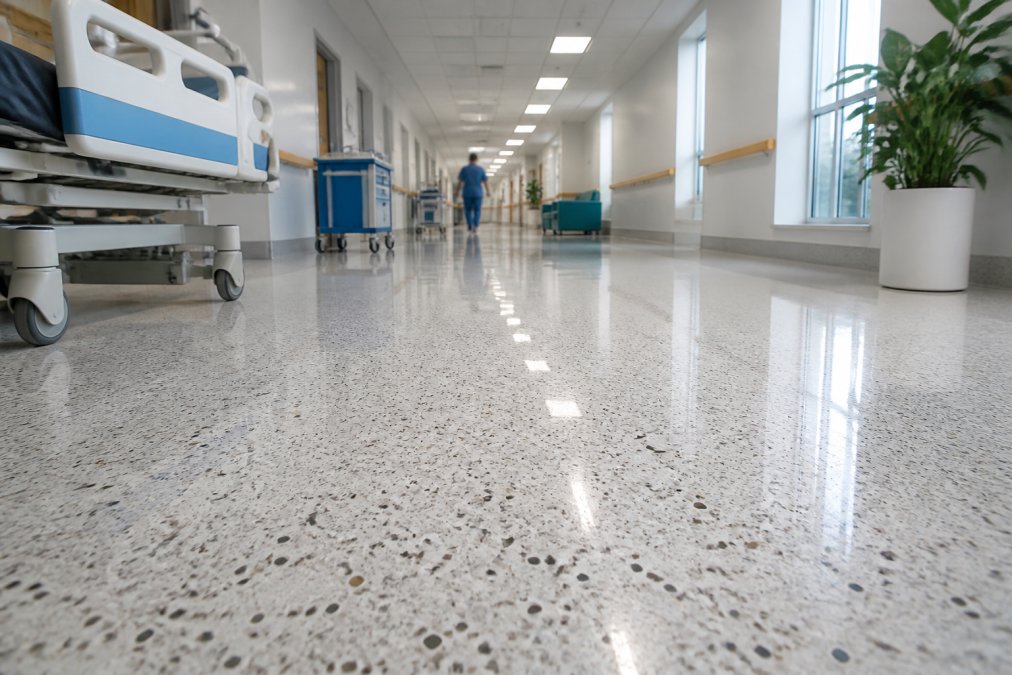
Hospitals demand flooring that withstands constant foot traffic, chemical exposure, moisture, and pathogenic contamination. Terrazzo's seamless, nonporous surface eliminates grout lines and seams where bacteria, mold, and mildew accumulate. Unlike vinyl or tile with microscopic cracks that harbor pathogens, terrazzo creates a unified barrier resistant to microbial colonization.
Terrazzo hardens with age, becoming more resistant to impact and abrasion over decades. This longevity translates to lower replacement costs and minimal disruption during renovations. A1 Terrazzo's 35 years installing commercial terrazzo across healthcare facilities demonstrates the material's proven performance. Modern terrazzo systems offer color versatility and polished finishes that brighten corridors while maintaining sanitation.
What separates high-performing terrazzo from mediocre installations is substrate preparation and resin selection. Poor subfloor prep causes moisture barriers to fail, leading to cracking and delamination within months.
Terrazzo Flooring Infection Control: Meeting Healthcare Standards
Infection control is the foundation of hospital flooring specification. Terrazzo's nonporous surface prevents liquid absorption, eliminating hidden reservoirs where antibiotic-resistant bacteria like MRSA survive for weeks. When blood contacts vinyl, liquid seeps into microscopic gaps. On terrazzo, it sits on the surface, ready for immediate disinfection.
Seamless installation prevents bacterial colonization. Traditional tile requires porous grout where bacteria colonize at rates 1,000 times higher than sealed surfaces. Seamless terrazzo eliminates this vulnerability entirely. Epoxy terrazzo systems incorporate anti-microbial additives that inhibit bacterial growth on the surface itself.
Hospital cleaning protocols use aggressive disinfectants: bleach, quaternary ammonium compounds, phenolic solutions. Vinyl degrades under prolonged exposure, becoming brittle and discolored. Terrazzo resists chemical attack, maintaining surface integrity after years of harsh sanitization without becoming a source of chemical off-gassing.
Terrazzo vs Vinyl for Hospitals: A Durability Comparison
Vinyl costs less upfront and installs faster, but this comparison breaks down when factoring in lifespan, maintenance, and replacement cycles. Vinyl typically lasts 10-15 years in high-traffic hospital environments before showing significant wear. After 10 years, hospitals have invested in installation labor twice and replaced material entirely. Terrazzo, properly installed and maintained, lasts 50+ years. Some terrazzo floors from the 1970s still perform flawlessly.
Vinyl requires stripping and rewaxing every 1-2 years, creating indoor air quality concerns in healthcare settings. Terrazzo needs damp mopping and occasional resealing, far less chemical-intensive and disruptive. Over 30 years, maintenance cost differences favor terrazzo significantly.
Hospitals have high humidity and frequent wet conditions. Vinyl traps moisture underneath, leading to mold growth and structural damage. Terrazzo's moisture barrier prevents this, protecting the building envelope itself.
| Factor | Terrazzo | Vinyl |
|---|---|---|
| Initial Cost | Higher | Lower |
| Installation Time | 7-10 days | 2-3 days |
| Lifespan | 50+ years | 10-15 years |
| Maintenance | Damp mop, reseal annually | Strip/wax every 1-2 years |
| Moisture Resistance | Excellent | Moderate |
| Chemical Resistance | Excellent | Fair |
| Infection Control | Superior (seamless, nonporous) | Limited (grout/seams) |
| Replacement Cycles (30 years) | 1 | 2-3 |
Top Terrazzo Systems for Healthcare Facilities
1. Epoxy Terrazzo Systems (Terroxy Resin, Sherwin-Williams General Polymers)
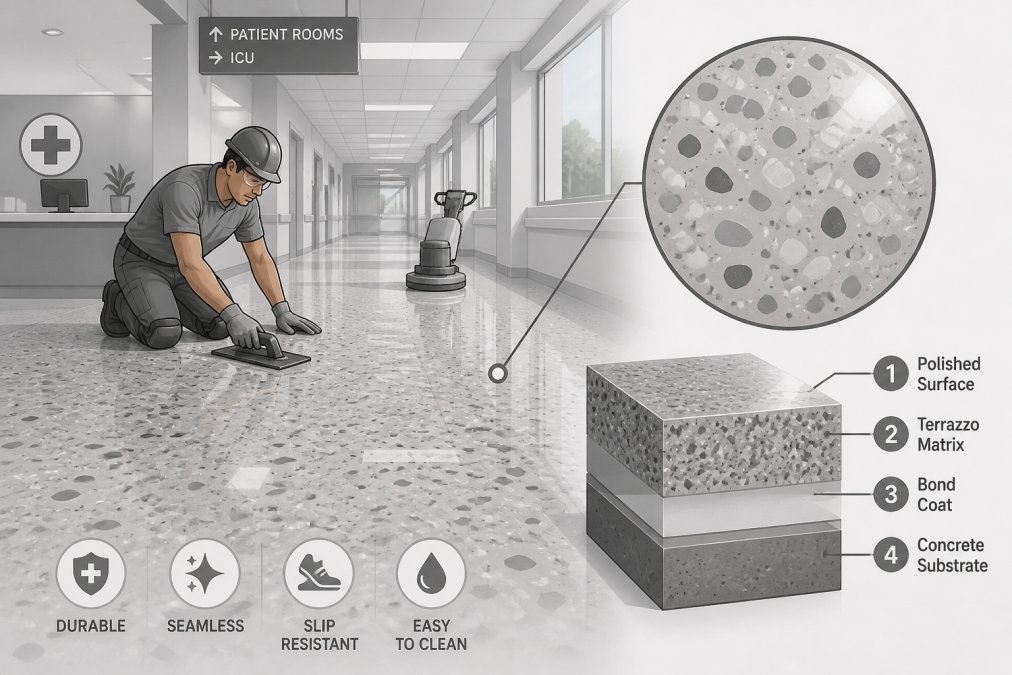
Epoxy terrazzo represents the modern standard for healthcare flooring. Systems like Terroxy Resin and Sherwin-Williams General Polymers deliver seamless, nonporous surfaces exceeding infection control requirements. These poured-in-place systems cure in days rather than weeks, reducing facility downtime. The resin matrix bonds to properly prepared substrates, creating a moisture barrier preventing water infiltration. Anti-microbial additives inhibit bacterial growth beyond the nonporous surface itself.
Color and aggregate options are extensive. Hospitals can specify custom blends incorporating branding colors or wayfinding patterns without compromising performance. Installation requires certified contractors experienced in epoxy terrazzo.
Best for: Healthcare facilities prioritizing infection control, faster installation, and design flexibility.
Pros:
- Seamless, nonporous surface eliminates bacterial harboring zones
- Anti-microbial properties in many formulations
- Faster curing than cement terrazzo
- Extensive customization options
- Excellent chemical and moisture resistance
Cons:
- Higher initial cost than vinyl
- Requires certified installation contractors
- Substrate preparation is critical and costly if subfloor issues exist
2. Troweled Epoxy Mortar (Stonhard Stonres RTZ)
Troweled epoxy mortar systems like Stonhard Stonres RTZ create terrazzo appearance while offering epoxy durability and sanitation benefits. The troweled application allows faster installation than poured systems while maintaining seamless coverage. Noise reduction is underrated in hospital environments, hard surfaces amplify footsteps and equipment noise, increasing patient anxiety. Troweled epoxy mortar systems reduce impact noise compared to poured epoxy, creating acoustically comfortable environments without sacrificing durability or sanitation.
Best for: Hospital areas where aesthetics, acoustic comfort, and durability must be optimized. Cafeterias, waiting areas, and administrative spaces benefit from the softer feel.
Pros:
- Seamless, hygienic surface
- Noise reduction improves patient and staff experience
- Stain and chemical resistant
- Comfortable underfoot
- Faster installation than poured cement terrazzo
Cons:
- Limited design palette compared to fully customizable poured systems
- Requires skilled troweling contractors
- Pricing requires direct quotes
3. Resilient Terrazzo Tiles (Fritztile, NURAZZO)
Resilient terrazzo tiles like Fritztile and NURAZZO offer true epoxy terrazzo in tile format, eliminating installation complications while maintaining performance advantages. The flexible polyester or epoxy resin means these systems resist cracking and impact damage better than traditional tile. Grout-free installation or minimal grout joints dramatically reduce bacterial harboring zones. Installation is faster than poured systems, 5,000 square feet can be installed in 2-3 days rather than requiring a week of curing.
Individual tile replacement is straightforward. If a tile becomes damaged, it can be removed and replaced without affecting surrounding areas.
Best for: Healthcare facilities seeking terrazzo performance with easier installation and individual tile replaceability. Ideal for renovations where installation speed is critical.
Pros:
- Easier installation than poured systems
- Individual tiles can be replaced without affecting surrounding areas
- Grout-free or minimal-grout options reduce bacterial harboring
- Flexible resin resists cracking and impact damage
- Lower installation mess and disruption
Cons:
- May have visible seams despite grout-free options
- Limited design flexibility compared to fully poured systems
- Requires proper substrate preparation
4. Precast Terrazzo (Tectura Designs)
Precast terrazzo offers ultimate customization and precision. Systems like Tectura Designs produce custom terrazzo surfaces manufactured off-site and installed as finished components. The manufacturing process allows compressive strengths exceeding 10,000 PSI, superior to most poured systems. Precast components are manufactured under controlled conditions, ensuring consistent quality and eliminating variables that plague on-site installation. Photoluminescent guide strips can be integrated directly into precast terrazzo, providing emergency wayfinding without surface modification.
Best for: Healthcare facilities requiring custom design integration, high-traffic equipment areas, and architectural continuity. Ideal for major renovations where design precision justifies lead time.
Pros:
- Exceptional compressive strength (10,000+ PSI)
- Custom design flexibility including integrated safety features
- Consistent quality from controlled manufacturing
- Photoluminescent and safety features can be integrated
- Unmatched durability for equipment-heavy areas
Cons:
- Longest lead time of terrazzo options
- Higher cost due to custom manufacturing
- Requires careful logistics for large installations
5. Terrazzo-Look Alternatives (Daltile Multimedia, Daltile Modernist)
Budget constraints or timeline pressures sometimes favor terrazzo-look alternatives. Daltile Multimedia uses Vitacore, a PVC-free material made from recycled content, in luxury vinyl tile format. The 20 mil wear layer handles commercial traffic, and the contemporary palette captures terrazzo aesthetics. Daltile Modernist offers porcelain tile with terrazzo-inspired design. These alternatives suit healthcare spaces where terrazzo performance isn't critical. Administrative areas, cafeterias, and low-traffic zones achieve aesthetics without investment. High-traffic clinical areas and infection-critical zones demand true terrazzo performance.
Best for: Budget-conscious healthcare facilities or spaces where terrazzo aesthetics matter more than superior performance.
Pros:
- Lower cost than true terrazzo systems
- Faster installation
- Easier to maintain than poured terrazzo
- Aesthetic appeal of terrazzo without premium cost
Cons:
- Does not offer true terrazzo durability or infection control advantages
- Luxury vinyl may require more frequent replacement
- Limited design customization compared to poured systems
6. Sustainable Terrazzo (DURAZZO Biopolymer)
DURAZZO Biopolymer terrazzo addresses sustainability concerns while maintaining performance. The bio-based binder reduces embodied carbon compared to petroleum-based epoxy systems. The seamless, wear-resistant finish delivers performance equivalent to traditional epoxy terrazzo. Installation can occur over existing stable substrates, reducing demolition waste.
Best for: Healthcare systems prioritizing sustainability, LEED certification, or phased renovations where waste reduction is critical.
Pros:
- Bio-based binder reduces embodied carbon
- Can be installed over existing substrates
- Seamless, durable surface
- Eligible for LEED credits
- Standard maintenance protocols
Cons:
- Limited availability compared to established systems
- Pricing requires direct inquiry
- Less historical performance data than traditional epoxy terrazzo
Hospital Flooring Maintenance Requirements and Protocols
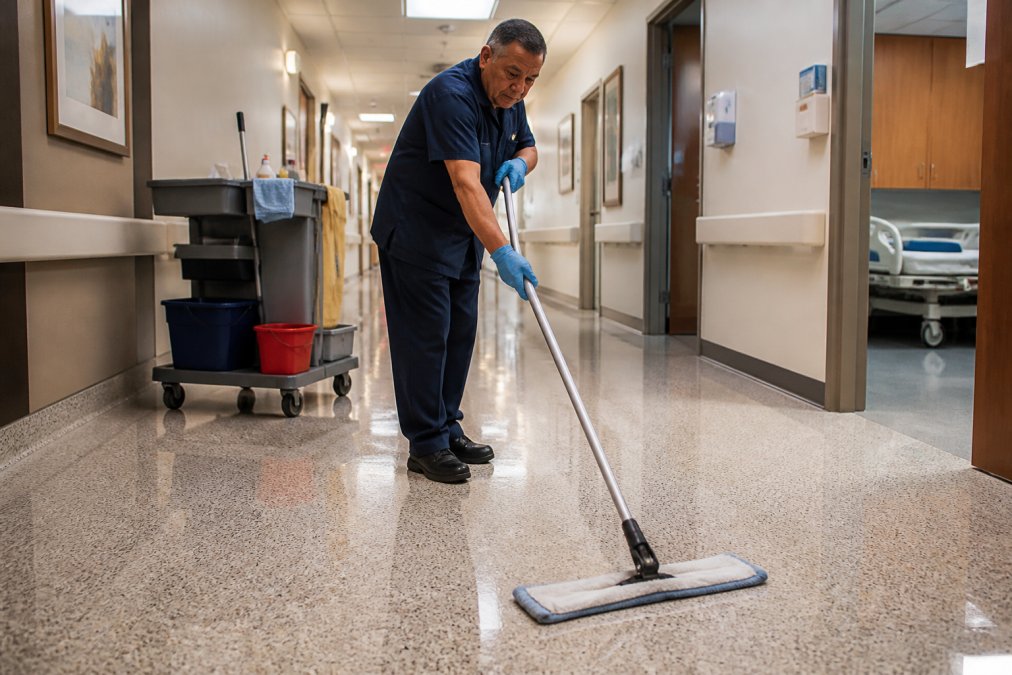
Daily maintenance involves damp mopping with neutral pH cleaner. Acidic or alkaline cleaners etch terrazzo surfaces, compromising the finish. Facility managers must educate cleaning staff on proper products and provide pre-approved cleaner lists to prevent inappropriate product use.
Weekly deep cleaning uses hospital-approved disinfectants. The nonporous surface allows disinfectants to work effectively without absorption. Contact time, allowing disinfectant to sit on the surface for the manufacturer's specified duration, is critical.
Annual resealing maintains the moisture barrier and enhances appearance. Neglecting resealing accelerates wear and creates conditions for mold growth beneath the surface. Spot cleaning addresses spills immediately. Blood, bodily fluids, and chemical spills should be cleaned promptly. The nonporous surface prevents absorption, making cleanup straightforward.
Damage assessment and repair protocols should be established before installation. Small chips or cracks can be filled and resealed. Major damage requires section removal and replacement.
Installation Downtime and Facility Logistics
Installation downtime is critical but often underestimated. Unlike vinyl installation requiring 2-3 days, terrazzo requires 7-10 days of traffic restriction during curing. This extended timeline demands careful planning around hospital operations.
Phased installation spreads disruption across multiple periods. Rather than closing an entire wing, facilities can schedule installation by zone. This approach extends project timeline but minimizes impact on patient care.
Emergency department and surgical suite areas require special planning. Installation often occurs during night hours or scheduled shutdowns. Substrate preparation often takes longer than terrazzo installation itself. If existing subfloor has moisture issues or structural problems, remediation can add weeks. Pre-installation assessment by experienced contractors prevents costly surprises.
Staff training on traffic restrictions and maintenance protocols should occur before installation. Signage and communication prevent staff from inadvertently damaging freshly installed terrazzo.
Life-Cycle Cost Analysis: Terrazzo vs Other Options
Initial cost comparison favors vinyl or basic tile. But comparing only installation costs misses the true financial picture. Life-cycle cost analysis reveals terrazzo's long-term value.
Consider a 10,000 square foot hospital floor over 30 years:
Terrazzo scenario: Higher initial installation cost, but the floor lasts 50+ years. Within 30 years, one installation cycle completes. Maintenance costs are moderate with annual resealing and damp mopping.
Vinyl scenario: Lower initial cost, but replacement occurs every 10-15 years. Within 30 years, 2-3 replacement cycles occur. Each replacement requires installation labor, removal of old material, and facility disruption. Maintenance involves stripping and rewaxing every 1-2 years. Total material and labor costs exceed terrazzo significantly.
Tile scenario: Moderate initial cost. Grout-line maintenance and occasional tile replacement add labor costs. While tile lasts longer than vinyl, it typically requires replacement within 20-25 years.
Factoring in facility disruption costs, rerouting traffic, and operational impacts, terrazzo's advantage becomes clearer. Each replacement cycle disrupts patient care. Terrazzo eliminates most replacement cycles within a facility's typical 30-50 year planning horizon. The polished finish reflects light, reducing lighting requirements. Over 30 years, energy savings contribute meaningfully to total cost of ownership.
Choosing the Right Terrazzo for Your Hospital
Selection depends on facility priorities, budget constraints, and operational requirements.
For new construction with design flexibility: Epoxy terrazzo systems or precast terrazzo offer maximum customization and performance.
For renovation with timeline constraints: Resilient terrazzo tiles or troweled epoxy mortar systems offer faster installation while maintaining performance advantages.
For budget-conscious facilities: Terrazzo-look alternatives provide aesthetic appeal at lower cost, suitable for non-critical areas. Reserve true terrazzo for high-traffic clinical zones.
For sustainability-focused systems: DURAZZO Biopolymer delivers environmental benefits without performance compromise.
For facilities with existing moisture or structural issues: Precast terrazzo or troweled systems are more forgiving than poured epoxy.
The infection control advantage is universal across all true terrazzo systems. The seamless, nonporous surface eliminates bacterial harboring zones that vinyl and tile cannot match. For healthcare environments, this benefit alone justifies terrazzo selection for critical areas.
A1 Terrazzo's 35 years of healthcare facility experience means we understand the specific demands hospitals face. We've installed terrazzo in emergency departments, surgical suites, intensive care units, and patient care areas where performance is non-negotiable.
Hospital flooring is an infrastructure investment affecting patient safety, staff efficiency, and operational costs for decades. Terrazzo delivers the sanitation performance, durability, and design flexibility that clinical environments demand. The seamless, nonporous surface resists bacterial colonization better than any alternative. The longevity eliminates replacement cycles that disrupt operations and increase costs.
Contact A1 Terrazzo to discuss your hospital's specific requirements. Our team will assess your facility's needs, recommend the appropriate terrazzo system, and ensure installation meets rigorous healthcare standards. With proper installation and maintenance protocols, your terrazzo floor will serve your facility reliably for 50+ years.
Frequently Asked Questions
Is terrazzo flooring suitable for hospitals?
Yes. Terrazzo flooring is highly suitable for hospitals because it provides a seamless, nonporous surface that resists bacteria, mold, and mildew growth. Epoxy-based terrazzo systems meet ADA compliance for slip resistance and offer superior durability in high-traffic areas like emergency rooms and hallways. The nonporous properties and ease of cleaning make terrazzo an excellent choice for infection control in healthcare environments.
How does terrazzo flooring help with infection control?
Terrazzo flooring infection control depends on its seamless, nonporous construction. Unlike vinyl or tile with grout lines, terrazzo has no joints where bacteria and pathogens can accumulate. Epoxy terrazzo systems include anti-microbial properties that inhibit the growth of harmful bacteria, mold, and mildew. The smooth, polished finish allows for thorough cleaning with standard hospital protocols, reducing the risk of healthcare-associated infections (HAIs).
What is the difference between terrazzo and vinyl flooring for hospitals?
Terrazzo vs vinyl for hospitals shows distinct trade-offs. Terrazzo offers superior longevity (25+ years), seamless nonporous surfaces, and exceptional durability under heavy foot traffic. Vinyl is less expensive upfront and easier to install but requires more frequent replacement, has visible seams that trap bacteria, and shows wear faster in high-traffic areas. Terrazzo's life-cycle cost is lower despite higher initial installation expense, making it the preferred choice for long-term hospital facility planning.
What maintenance does terrazzo flooring require in hospitals?
Hospital flooring maintenance requirements for terrazzo are straightforward: daily damp mopping with neutral pH cleaners and periodic deep cleaning. Avoid acidic or alkaline cleaners that can damage the resin. Terrazzo requires professional sealing every 3-5 years to maintain the polished finish and protect against stains. Regular maintenance prevents buildup of contaminants and keeps the surface hygienic. Professional maintenance services ensure compliance with healthcare facility standards and extend floor longevity significantly.
This article was written using GrandRanker
Frequently Asked Questions
Is terrazzo flooring suitable for hospitals?
Yes. Terrazzo flooring is highly suitable for hospitals because it provides a seamless, nonporous surface that resists bacteria, mold, and mildew growth. Epoxy-based terrazzo systems meet ADA compliance for slip resistance and offer superior durability in high-traffic areas like emergency rooms and hallways. The nonporous properties and ease of cleaning make terrazzo an excellent choice for infection control in healthcare environments.
How does terrazzo flooring help with infection control?
Terrazzo flooring infection control depends on its seamless, nonporous construction. Unlike vinyl or tile with grout lines, terrazzo has no joints where bacteria and pathogens can accumulate. Epoxy terrazzo systems include anti-microbial properties that inhibit the growth of harmful bacteria, mold, and mildew. The smooth, polished finish allows for thorough cleaning with standard hospital protocols, reducing the risk of healthcare-associated infections (HAIs).
What is the difference between terrazzo and vinyl flooring for hospitals?
Terrazzo vs vinyl for hospitals shows distinct trade-offs. Terrazzo offers superior longevity (25+ years), seamless nonporous surfaces, and exceptional durability under heavy foot traffic. Vinyl is less expensive upfront and easier to install but requires more frequent replacement, has visible seams that trap bacteria, and shows wear faster in high-traffic areas. Terrazzo's life-cycle cost is lower despite higher initial installation expense, making it the preferred choice for long-term hospital facility planning.
What maintenance does terrazzo flooring require in hospitals?
Hospital flooring maintenance requirements for terrazzo are straightforward: daily damp mopping with neutral pH cleaners and periodic deep cleaning. Avoid acidic or alkaline cleaners that can damage the resin. Terrazzo requires professional sealing every 3-5 years to maintain the polished finish and protect against stains. Regular maintenance prevents buildup of contaminants and keeps the surface hygienic. Professional maintenance services ensure compliance with healthcare facility standards and extend floor longevity significantly.