 listicle
Durable Flooring Solutions for Hospitals: 7 Top Options
Last Updated: October 23, 2026
Quick Summary
Durable flooring for hospitals comes down to matching material to space: sheet vinyl with welded seams suits patient rooms and corridors, while seamless terrazzo and epoxy or poured resin belong in operating rooms, sterile processing, and high-traffic corridors. Terrazzo costs more upfront but has the lowest lifecycle cost and maintenance load, and resin offers excellent chemical resistance.
- Specify a minimum 2.0 mm wear layer for corridors and anywhere beds roll.
- Vinyl composition tile is the cheapest per square foot but needs regular stripping and waxing.
- Rubber flooring suits physical therapy and behavioral health but has a limited palette and higher cost.
- Skipping a moisture test before pouring terrazzo is the most expensive shortcut in the trade.
- Get the manufacturer's written chemical-resistance list and cross-check it against the disinfectants your team uses.
Table of Contents
- Hospital Flooring Options: A Comparison at a Glance
- Sheet Vinyl and Resilient Flooring Systems
- Luxury Vinyl Tile and Vinyl Composition Tile
- Rubber, Linoleum, and Polyolefin Tile
- Terrazzo Flooring for Hospitals: The Long-Term Investment
- Epoxy and Poured Resin Flooring for Clinical Spaces
- Hospital Flooring Durability: What Wear Resistance Actually Means
- Hospital Floor Cleaning and Maintenance That Protects Your Investment
- Frequently Asked Questions
Hospital Flooring Options: A Comparison at a Glance
Durable flooring solutions for hospitals must survive rolling beds, chemical disinfectants, and round-the-clock cleaning while helping control infection. At A1 Terrazzo, we have watched facility managers cycle through cheap floors that fail early. The right choice comes down to matching material to space.
Below, we break down seven durable flooring options, what each costs over its life, and where each one actually belongs.
How We Evaluated These Flooring Systems
We scored every option on five criteria: wear resistance under rolling loads, cleanability and seam integrity, chemical resistance to hospital disinfectants, lifecycle cost, and installation disruption. No single material wins across the board. Sheet vinyl leads on upfront cost and speed. Terrazzo leads on lifecycle cost and infection control. The right pick depends on which criteria your facility can least afford to lose.
| Flooring System | Best For | Seams | Lifecycle Cost | Maintenance Load |
|---|---|---|---|---|
| Sheet vinyl | Patient rooms, corridors | Welded seams | Low upfront, medium life | Medium |
| Luxury vinyl tile | Administrative areas | Many seams | Low upfront, shorter life | Medium |
| Vinyl composition tile | Back-of-house | Many seams | Lowest upfront | High |
| Rubber | Physical therapy, behavioral health | Sealed seams | Medium | Low |
| Linoleum | Low-traffic clinical areas | Welded seams | Medium | Medium |
| Terrazzo | Corridors, lobbies, OR suites | Seamless | High upfront, lowest life | Low |
| Epoxy resin | Operating rooms, sterile processing | Seamless | Medium upfront | Low |
Sheet Vinyl and Resilient Flooring Systems
Sheet vinyl is the workhorse of hospital flooring. Large rolls mean fewer seams, and heat-welded seams create a continuous surface that resists moisture intrusion where spills and bodily fluids are routine.
The tradeoff is heat and point loads. Heavy equipment left in one spot can dent the surface, and sharp impacts can gouge it. For facilities comparing resilient formats across departments, Sanitary Flooring for Healthcare: A Facility Manager's Guide covers the requirements in more depth.
Luxury Vinyl Tile and Vinyl Composition Tile
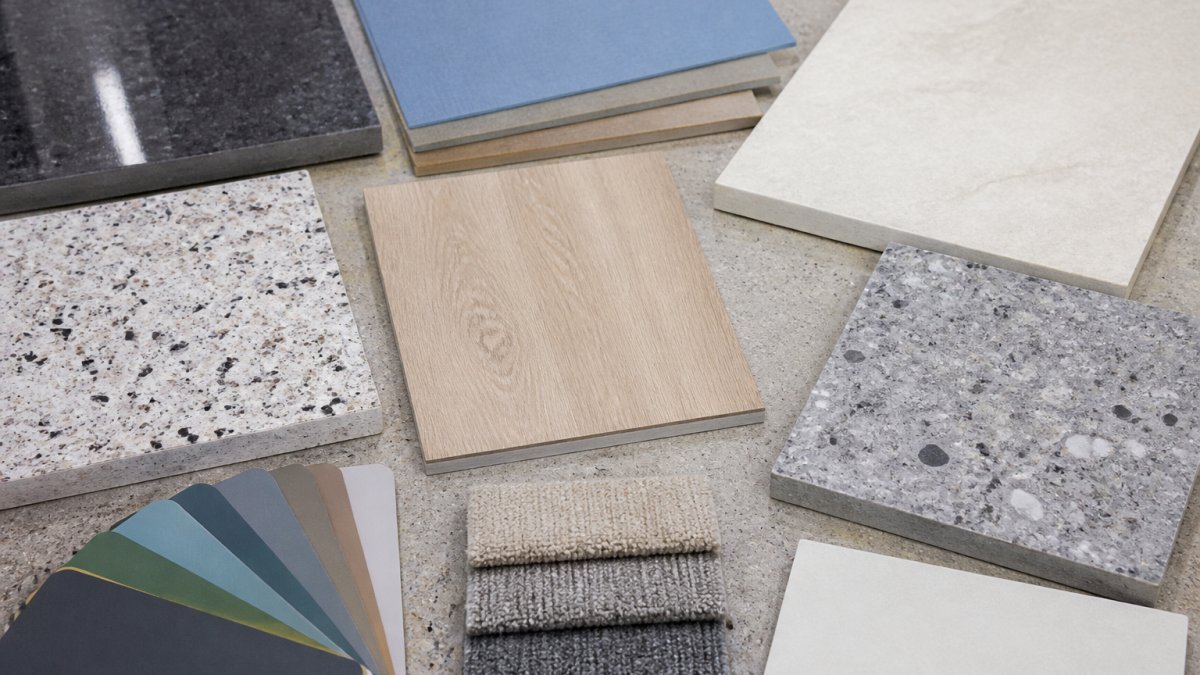
Luxury vinyl tile gives you design flexibility: wood and stone visuals that read warmer than sheet goods in waiting areas and administrative offices.
Vinyl composition tile is the cheapest option per square foot and the most labor-intensive to maintain, because it needs regular stripping and waxing to hold its finish.
Neither tile format belongs in an operating room or a patient bathroom. Too many seams, too many failure points.
Rubber, Linoleum, and Polyolefin Tile
Rubber flooring earns its place in physical therapy, behavioral health, and anywhere comfort underfoot and acoustics matter.
Linoleum is the sustainable pick. It is made from natural materials, holds up well to foot traffic, and welds into a seam-free surface.
Polyolefin tile is the specialist. It resists harsh chemicals and stains better than most resilient options, which makes it useful in soiled utility rooms and labs.
Terrazzo Flooring for Hospitals: The Long-Term Investment
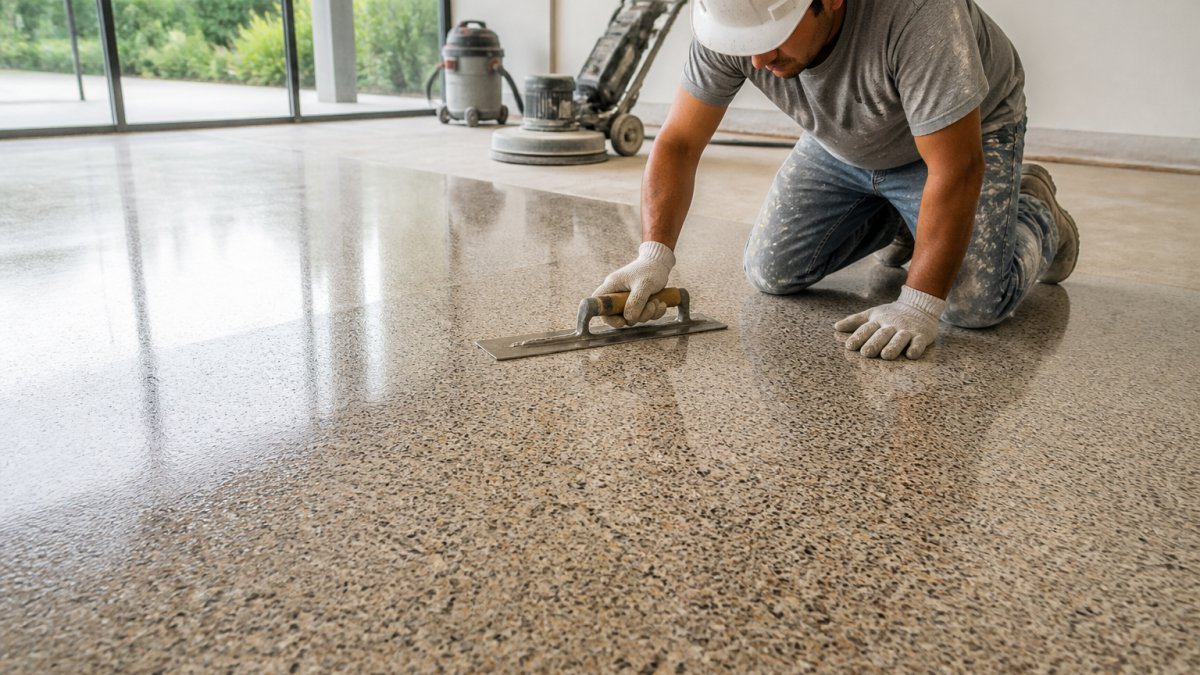
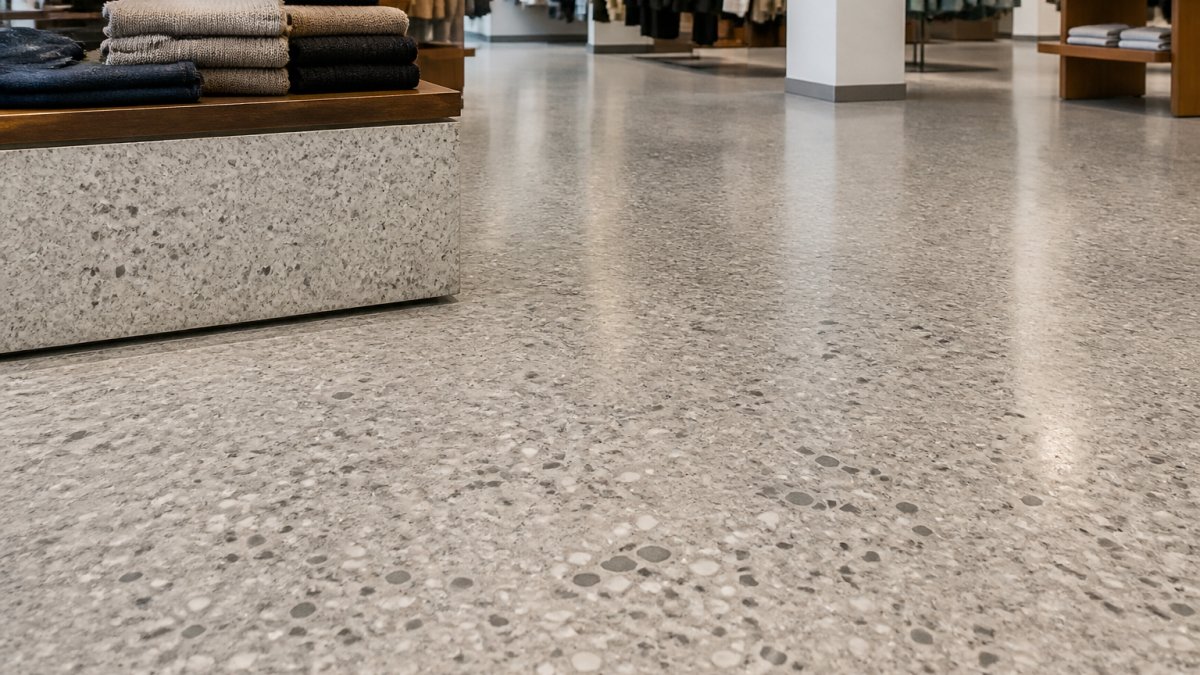
Terrazzo costs more upfront than any resilient option on this list, and it outlasts all of them. For a deeper look at the best terrazzo options for hospitals, see our best terrazzo flooring for hospitals guide.
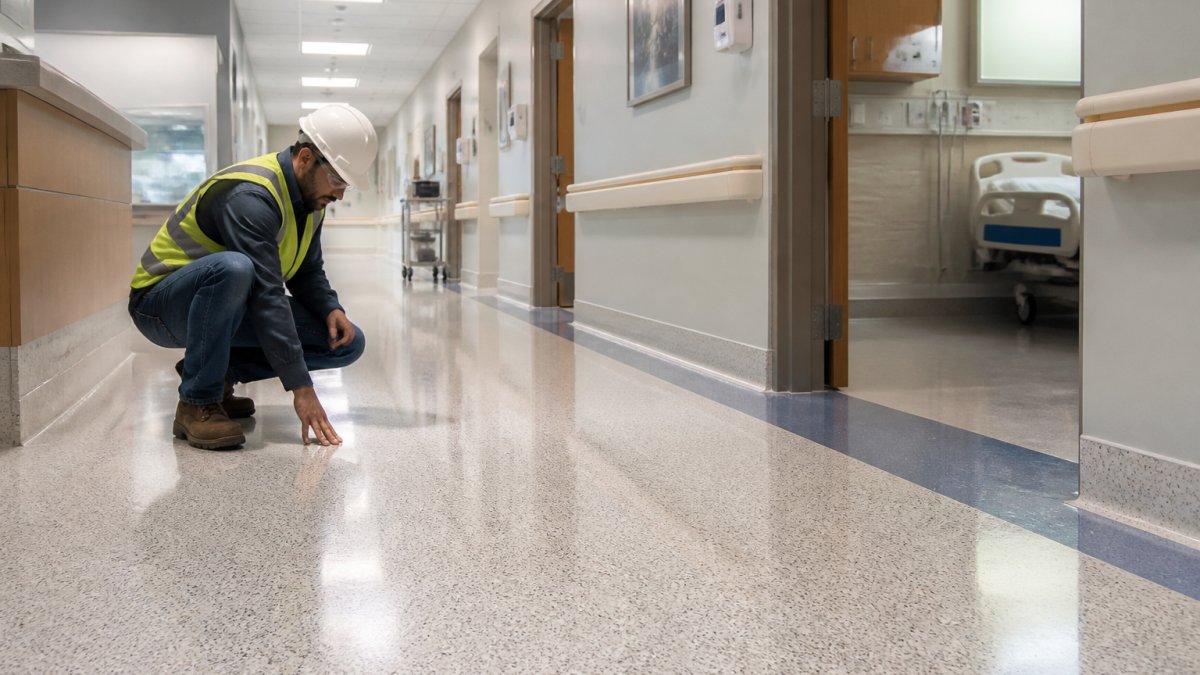
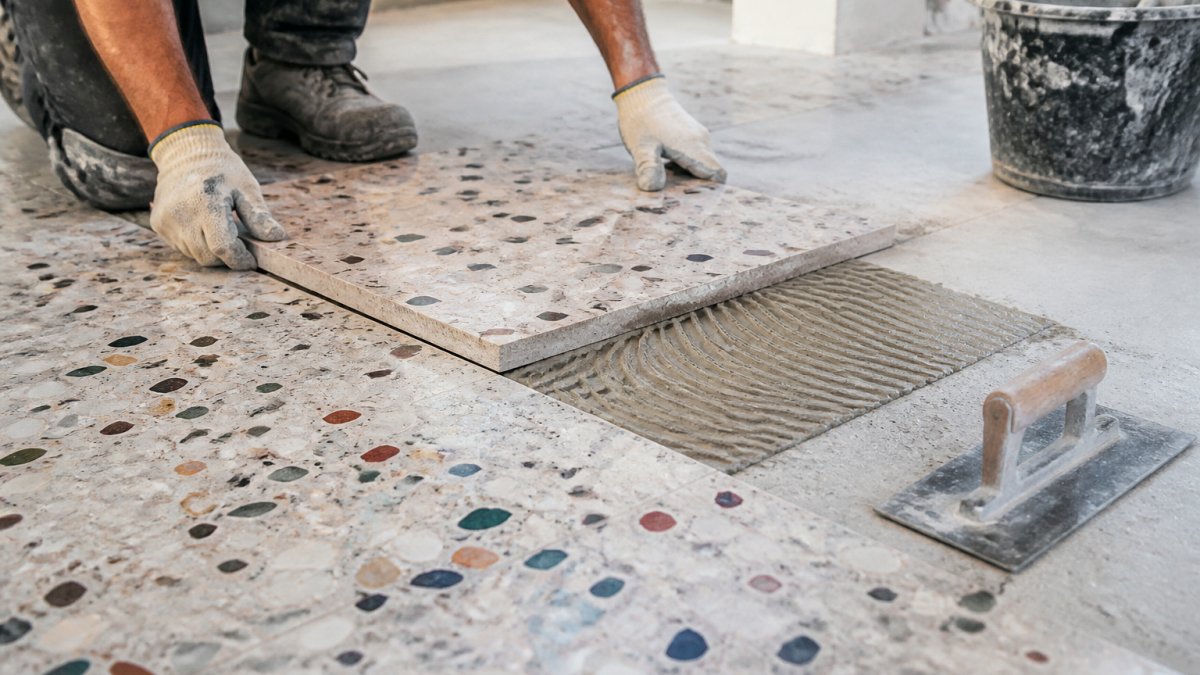
Substrate preparation decides whether terrazzo performs or cracks. Moisture issues traced back to poor prep are the most common failure we see in floors installed by other contractors.
Epoxy and Poured Resin Flooring for Clinical Spaces
Epoxy and poured resin systems give you a seamless, non-porous surface with excellent chemical resistance, making them the standard choice for operating rooms, sterile processing, and pharmacy clean rooms where the surface must withstand repeated disinfection without degrading.
The limitation is UV exposure and thermal shock. For a direct comparison of resin against stone-aggregate systems, read epoxy vs cement terrazzo flooring.
Hospital Flooring Durability: What Wear Resistance Actually Means
Durability in a hospital is four separate performance questions, and a floor can pass one and fail another.
- Abrasion resistance: how well the surface holds its finish under constant foot traffic
- Impact resistance: whether dropped equipment dents or chips the floor
- Rolling load capacity: whether beds and carts leave permanent tracks
Manufacturers publish test data for each, and comparing those ratings side by side is the only honest way to compare products. Our guide to commercial flooring durability ratings explains how to read them.
The Room-by-Room Selection Matrix
Most flooring failures are specification failures: the right material in the wrong room. The matrix below maps each hospital space to the flooring systems that meet its durability, hygiene, and safety demands. Use it as a starting point, then confirm against your own infection prevention and facilities requirements.
| Hospital Space | Primary Flooring Choices | Why It Fits | Watch Out For |
|---|---|---|---|
| Operating rooms and procedure suites | Epoxy or poured resin; seamless terrazzo | Seamless, non-porous, withstands repeated disinfection; no joints to harbor soil | Resin needs a fully cured, dry substrate and a shutdown window |
| Sterile processing and pharmacy clean rooms | Epoxy or poured resin | Chemical resistance to strong disinfectants; coved base integrates with walls | UV yellowing near windows; thermal shock from hot spills |
| Patient rooms and corridors | Sheet vinyl with welded seams; terrazzo in high-traffic corridors | Fewer seams, rolling-load capacity, cleanable surface | Thin wear layers dent under beds and heavy carts |
| Physical therapy and rehabilitation | Rubber; sheet vinyl | Comfort underfoot, acoustics, wet slip resistance | Rubber has a limited palette and higher cost |
| Behavioral health | Rubber; heavy-gauge sheet vinyl | Impact resistance, ligature-resistant detailing, quiet underfoot | Seams and edge details must be specified for the setting |
| Laboratories | Polyolefin tile; epoxy resin | Resistance to harsh chemicals and stains | Tile seams need a chemical-resistant grout or weld |
| Kitchens and dietary | Quarry tile with epoxy grout; poured resin | Grease, heat, and moisture resistance; cleanable | Slip resistance must be specified for wet and greasy conditions |
| Administrative and waiting areas | Luxury vinyl tile; terrazzo in lobbies | Design flexibility; durability in high-visibility zones | LVT seams in wet entries; specify entrance matting |
| Back-of-house corridors and storage | Vinyl composition tile; sheet vinyl | Lowest upfront cost where appearance matters less | VCT needs a stripping and waxing cycle |
Rolling Loads, Accessibility, and Mobility
Rolling load capacity is the criterion hospitals underestimate most. Beds, stretchers, supply carts, and imaging equipment concentrate weight on small wheels, and a floor that looks fine under foot traffic can develop permanent tracks within a year.
Accessibility and mobility belong in the same conversation. Rolling resistance affects how hard staff push a loaded bed and how easily a wheelchair moves through a corridor.
Hospital Floor Cleaning and Maintenance That Protects Your Investment
Maintenance is where flooring budgets quietly disappear. The wrong cleaning product can dull a terrazzo floor or break down a vinyl wear layer, and the damage usually shows up months later, after the warranty window has closed. Treat cleaning as a specification decision made at the same time as the floor itself.
Match the Method to the Material
Every flooring family has a cleaning protocol that protects it and a protocol that destroys it. The table below is the short version we hand to facility managers during handoff.
| Flooring System | Daily Method | Periodic Restoration | Products to Avoid |
|---|---|---|---|
| Sheet vinyl | Dust mop, damp mop with neutral pH cleaner | Burnish or scrub per wear-layer rating; recoat if specified | High-alkaline strippers on low-gauge wear layers; solvent spot cleaners |
| Luxury vinyl tile | Damp mop, auto-scrub with low-foam cleaner | Light scrub at grout lines; reseal only if the product requires it | Steam and excessive water at seams |
| Vinyl composition tile | Dust mop, damp mop | Strip and rewax on a scheduled cycle | Skipping the strip cycle, which lets finish build up and yellow |
| Rubber | Damp mop with neutral cleaner | Deep scrub; follow maker's guidance on dressings | Solvent-based products that leach plasticizers |
| Linoleum | Dust mop, damp mop | Recoat with manufacturer-approved finish | High-alkaline strippers and standing water at seams |
| Terrazzo | Dust mop, damp mop with neutral pH cleaner | Diamond polish or hone on a multi-year cycle; reseal if specified | Acidic cleaners, which etch the matrix; harsh strippers that dull the polish |
| Epoxy and poured resin | Damp mop with neutral or maker-approved disinfectant | Recoat or buff per manufacturer | Abrasive pads that scratch the gloss; solvents that soften the resin |
Cleaning Chemistry and Infection Control
Hospital disinfectants are aggressive by design.
The practical rule is to get the flooring manufacturer's written chemical-resistance list and cross-check it against the disinfectants your infection prevention team actually uses, not the ones on a generic sample list.
Seams deserve separate attention. Heat-welded seams in sheet vinyl and linoleum are designed to be liquid-tight, but a poorly executed or later damaged weld becomes a reservoir for soil and moisture.
Distinguish product claims from clinical evidence. Manufacturers can document cleanability and chemical compatibility, but claims that a specific floor reduces healthcare-associated infections should be treated as marketing until supported by independent clinical study. Specify on documented performance, and let infection prevention sign off on the cleaning protocol. ::: Rigorous adherence to these protocols ensures that the chosen material maintains its integrity, which remains the foundational objective of effective commercial floor care.
Build a Written Protocol and Train Against It
Post a one-page cleaning protocol per floor type in every janitorial closet, listing the approved product, dilution, dwell time, and equipment. Train new housekeeping staff against the written protocol, not against habit, and review it annually and whenever a disinfectant or flooring product changes.
For terrazzo specifically, a list of top commercial terrazzo floor cleaners covers products that protect the finish rather than strip it.
Budget the Maintenance Load, Not Just the Floor
Maintenance labor, not the purchase price, is usually the largest line in a flooring lifecycle cost. A floor that needs stripping and waxing four times a year carries a very different labor burden than a terrazzo or resin floor that needs only damp mopping and periodic polishing. Ask every vendor for the recommended maintenance schedule in writing, then price the labor hours against your own housekeeping rates before the budget committee sees the bid.
Frequently Asked Questions
What kind of flooring do hospitals usually have?
Most hospitals use resilient flooring: sheet vinyl, luxury vinyl tile, vinyl composition tile, or rubber. These materials handle heavy foot traffic, rolling loads from hospital beds and medical carts, and frequent disinfection without swelling at the seams. Operating rooms and procedure areas often use poured epoxy or resin systems for a seamless surface. Terrazzo appears in lobbies, corridors, and older institutional buildings because it lasts decades with basic maintenance. The right choice depends on the space, not a single facility-wide standard.
Is terrazzo a good flooring choice for hospitals?
Terrazzo is one of the most durable options for hospital corridors, lobbies, and high-traffic public areas. A poured terrazzo floor resists wear, holds up under rolling loads, and can last 40 years or more with routine cleaning and periodic polishing. Welded seams and grout lines are eliminated because the surface is poured in place, which helps with hygiene and cleanability. The trade-off is a higher initial installed cost and the need to protect the floor during renovation work nearby. For spaces where lifecycle cost matters more than first cost, terrazzo often wins.
Which flooring is best for hospital corridors?
Corridors take the heaviest combined traffic in a hospital: beds, wheelchairs, carts, staff, and visitors. Sheet vinyl with welded seams and a wear layer rated for high traffic is a common, cost-effective choice. Terrazzo and poured resin floors perform better over decades because there are no seams to lift or trap soil. Rubber is quieter underfoot and easier on staff who walk miles per shift. Whichever material you pick, specify a slip-resistant texture, confirm compatibility with your disinfectants, and plan a maintenance schedule before installation, not after.
How often should hospital floors be replaced?
Replacement timelines depend on material and traffic. Sheet vinyl and vinyl composition tile typically need replacement or significant repair within 10 to 20 years in busy areas. Rubber and luxury vinyl tile often last 15 to 25 years with proper maintenance. Terrazzo and poured epoxy can last 30 to 40 years or more, with epoxy needing recoating in high-abuse zones. Facilities that track lifecycle cost, including annual maintenance and replacement, usually find that the cheapest floor to install is rarely the cheapest to own.
What do hospitals use to sanitize floors?
Hospital floors are cleaned with EPA-registered disinfectants, often quaternary ammonium or chlorine-based products, following the manufacturer's dwell time. Not every flooring material tolerates every chemical. High-alkaline cleaners can dull terrazzo polish, and some disinfectants degrade vinyl wear layers over time. Before you commit to a flooring system, confirm chemical resistance with the manufacturer and standardize your cleaning products across departments. Mismatched cleaners are one of the most common causes of premature floor failure in healthcare facilities.