 listicle
Doyle Dickerson Alternatives for Contractors
Table of Contents
- Why Contractors Look Beyond Doyle Dickerson
- What to Look for in Commercial Terrazzo Flooring Contractors
- How to Vet a Flooring Contractor Before Hiring
- Terrazzo Installation Cost Per Square Foot: What Affects Pricing
- Key Differences: A1 Terrazzo vs. Other Contractors
- Common Installation Mistakes That Lead to Cracking and Failure
- Making Your Decision: Questions to Ask Before Committing
- Frequently Asked Questions
Last Updated: August 14, 2026
Why Contractors Look Beyond Doyle Dickerson
When evaluating a Doyle Dickerson alternative for contractors, you're typically facing a real problem: previous installations didn't hold up, service fell short, or you need capabilities that don't align with what's available. Contractors and facility managers across healthcare systems, airports, universities, and commercial developments actively search for alternatives because they need proven expertise in substrate preparation, transparent pricing, scalable maintenance support, and a track record in their facility type. A1 Terrazzo has built its reputation over 35 years by specializing in exactly these areas, particularly in high-traffic commercial environments where durability and sanitation are non-negotiable.
Understanding what separates a strong commercial terrazzo flooring contractor from the rest requires knowing what to evaluate, how to vet candidates properly, and what questions to ask before signing a contract.
What to Look for in Commercial Terrazzo Flooring Contractors
Experience and Track Record
The most critical factor is documented experience in your specific facility type. A contractor with 10 years of shopping mall installations may not understand the sanitation protocols required in a hospital or the traffic patterns in an airport terminal. Ask for a portfolio that breaks down projects by facility type, healthcare, airports, courthouses, and universities each have distinct requirements. Healthcare requires FDA-compliant sanitation standards and chemical resistance. Airports demand high-traffic durability and rapid installation to minimize downtime. Universities often involve historic restoration or large-scale multi-building projects.
Request at least three references from projects completed within the last three years in your facility category. When you call, ask about substrate preparation quality, timeline adherence, and whether any cracking or failure occurred post-installation. A contractor willing to share references and follow up with those clients demonstrates confidence in their work.
Substrate Preparation and Installation Quality
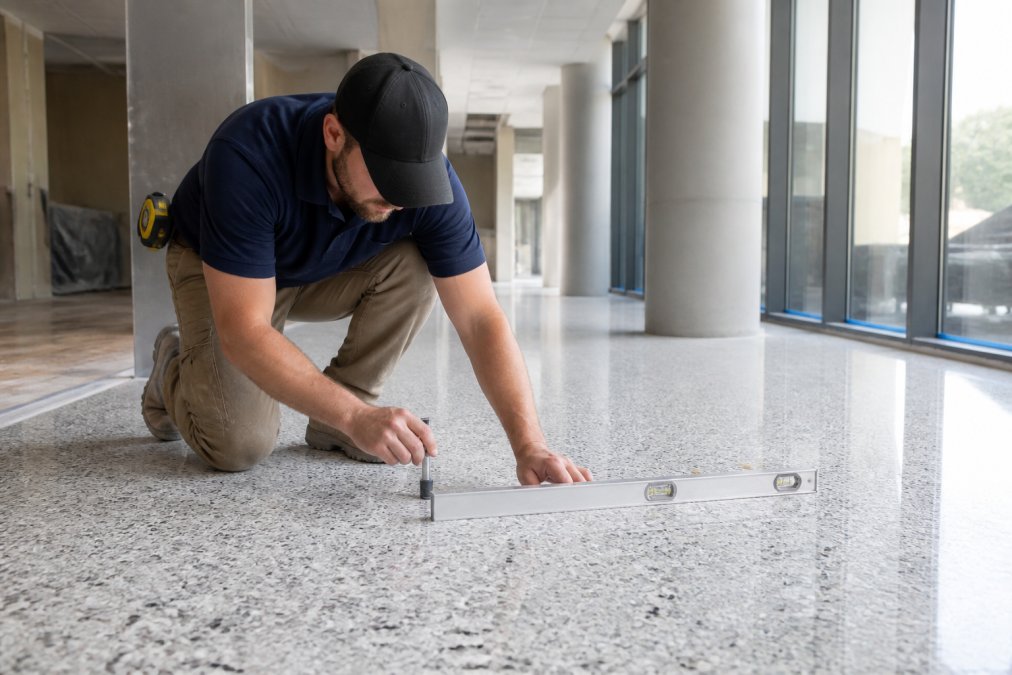
Substrate preparation is where most installations fail. A beautiful terrazzo finish cannot compensate for poor substrate work. The substrate must be properly graded, compacted, and cured before any terrazzo is applied. Moisture barriers need to be installed correctly. If the subfloor has any movement, moisture intrusion, or structural issues, those problems will show up in the terrazzo within months.
Your contractor should explain their substrate preparation process in detail, including moisture testing protocols, how they handle expansion joints, and their approach to preventing cracks from propagating through the terrazzo. Ask what they've encountered on similar projects and how they solved it. Installation quality also depends on the expertise of the crew executing the work. A contractor who trains their own crews and maintains consistent quality standards across projects is more reliable than one who subcontracts the actual installation work.
Maintenance Support and Guarantees
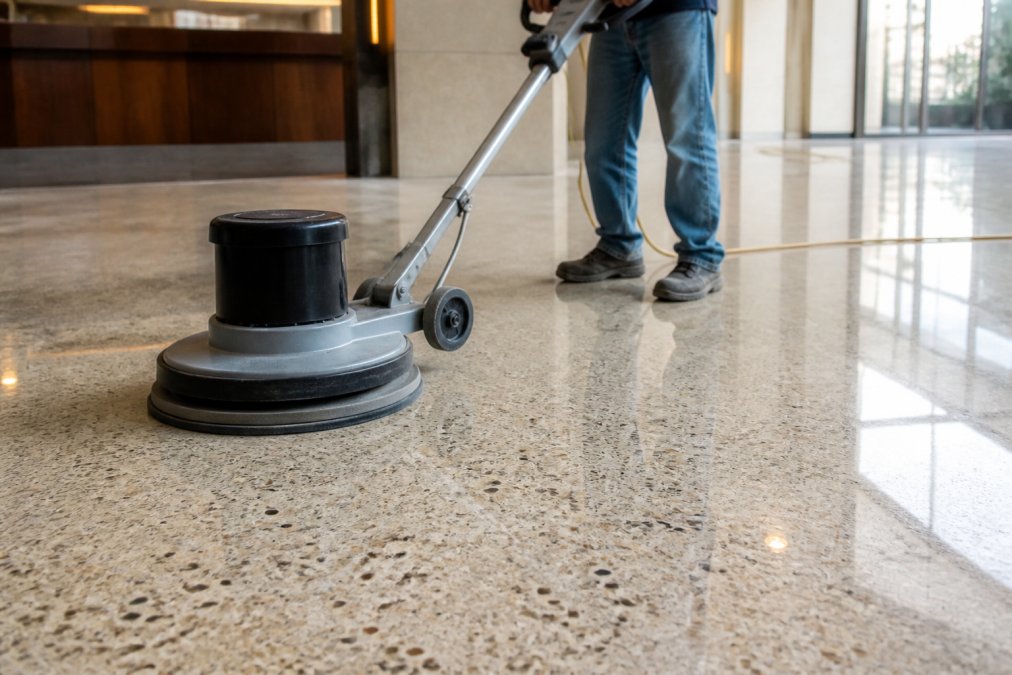
Installation is only the beginning. Terrazzo requires specific maintenance protocols, and the wrong cleaning products or techniques can damage the surface. Ask about warranty terms: What does it cover? For how long? What voids the warranty? A typical warranty should cover material defects and workmanship for at least 5-10 years. Some contractors offer extended maintenance programs that handle periodic sealing, polishing, and professional cleaning, which ensures the floor is maintained correctly and prevents damage from improper care.
Find out if the contractor provides maintenance training for your facility team. They should explain what cleaning products are safe, what equipment to use, how often to seal the floor, and what signs indicate the need for professional intervention.
How to Vet a Flooring Contractor Before Hiring
Verify References and Past Projects
Request a minimum of three references, prioritizing projects at least one year old. A one-year-old project gives you enough time to see whether cracking, staining, or other issues have emerged. When you contact references, ask specific questions: Did the contractor meet the timeline? Was the final cost within the quoted estimate? Have any issues emerged since installation? Would you hire them again?
Site visits are even better than phone calls. If possible, visit a completed project in person and inspect the floor for cracks, discoloration, or uneven surfaces. Ask the facility manager about their experience with the contractor during the project and whether maintenance has been straightforward.
Assess Technical Expertise and Certifications
The National Terrazzo and Mosaic Association (NTMA) offers certifications and maintains standards for installation practices. A contractor who is NTMA-certified or maintains ongoing training through the association is demonstrating commitment to professional standards. A qualified contractor should be able to discuss substrate preparation methods, moisture mitigation strategies, the differences between poured-in-place and precast terrazzo, aggregate selection, and finish options. They should ask you detailed questions about your facility's use case, traffic patterns, and maintenance capabilities.
Request documentation of their training and certifications. A contractor investing in their team's development is more likely to deliver quality work than one treating installation as a commodity service.
Review Insurance, Licensing, and Warranty Terms
Verify that the contractor holds appropriate licensing for your state and county. Check with your local building department or contractor licensing board to confirm their license is current and in good standing. Verify that they carry adequate liability insurance and workers' compensation coverage.
Review the warranty terms in writing. The contract should clearly state what is covered, for how long, what conditions void the warranty, and how disputes are resolved. Understand the payment schedule. Reputable contractors typically require a deposit (usually 25-50% of the project cost) to begin work, with the remainder due upon completion or in agreed-upon installments tied to project milestones.
Terrazzo Installation Cost Per Square Foot: What Affects Pricing
Site Conditions and Substrate Preparation
The cost per square foot for terrazzo installation varies widely depending on site conditions. A straightforward installation on a well-prepared, existing concrete subfloor costs significantly less than one requiring extensive substrate work, moisture remediation, or structural repairs. If the site has moisture issues, the contractor must install moisture barriers and potentially use specialized epoxy systems, which adds cost. Accessibility also affects pricing, a ground-floor retail installation is simpler than a multi-story hospital where materials must be moved through elevators and the project must work around patient care schedules.
Design Complexity and Custom Finishes
A simple monolithic terrazzo finish costs less than terrazzo with custom aggregate patterns, multiple colors, or decorative inlays. Custom designs require more skilled labor and specialized finishing techniques. The choice between poured-in-place and precast terrazzo also affects cost. Poured-in-place systems are more flexible for custom designs but require longer curing times on-site. Precast terrazzo offers faster installation but less design flexibility.
Project Timeline and Scale
Contractors typically offer better per-square-foot pricing on larger projects because they achieve economies of scale with material purchasing and crew efficiency. A 5,000-square-foot installation will have a lower per-square-foot cost than a 500-square-foot project. Timeline also matters, a contractor working on a compressed schedule may charge a premium for expedited work or require additional crew members, increasing labor costs.
Key Differences: A1 Terrazzo vs. Other Contractors
Specialized Experience in Healthcare and High-Traffic Facilities
A1 Terrazzo's 35 years of specialized experience in commercial terrazzo flooring gives them deep expertise in the specific requirements of healthcare facilities, airports, universities, and other high-traffic environments. They understand the sanitation protocols required in hospitals, the durability standards for airport terminals, and the restoration challenges in historic buildings. This specialization means they anticipate problems that less experienced contractors might miss.
Their track record in healthcare facilities is particularly relevant because hospitals have the strictest requirements: FDA-compliant surfaces, chemical resistance to cleaning agents and disinfectants, and seamless designs that eliminate harboring points for pathogens.
Comprehensive Maintenance Programs
A1 Terrazzo offers professional maintenance services as part of their comprehensive approach. Many contractors install the floor and disappear, leaving facility managers to figure out maintenance on their own. Improper maintenance can damage a terrazzo floor and void warranties. A contractor offering maintenance programs has a vested interest in the floor's long-term performance and is incentivized to ensure proper installation.
Historic Restoration Expertise
For facilities with original terrazzo flooring that requires restoration, A1 Terrazzo's experience in historic restoration is a critical advantage. Matching original patterns, finishes, and aggregate selections requires expertise that goes beyond standard installation. A contractor experienced in historic restoration understands how to assess the condition of original flooring, determine whether repairs or full replacement is appropriate, and source matching materials.
Common Installation Mistakes That Lead to Cracking and Failure
The most common cause of terrazzo failure is inadequate substrate preparation. If the subfloor is not properly compacted, graded, or cured before terrazzo is applied, movement in the substrate will cause cracking. Moisture is another major culprit. If moisture barriers are not installed correctly or if moisture levels are too high when installation begins, moisture will migrate through the terrazzo, causing cracking, discoloration, and adhesion failure.
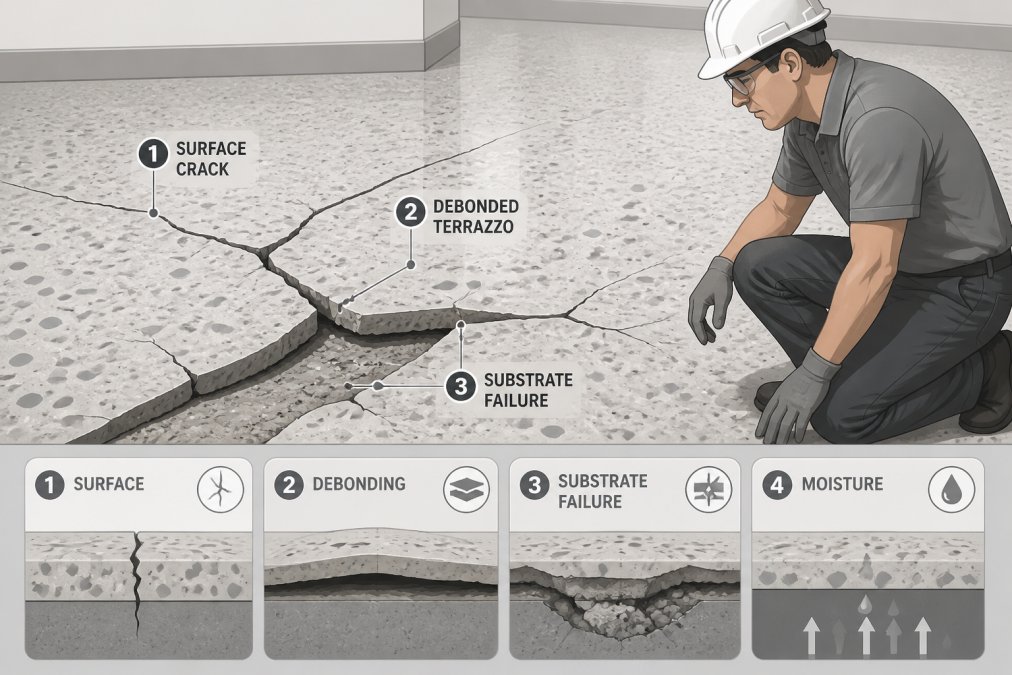
Inadequate expansion joint placement is another frequent mistake. Terrazzo expands and contracts with temperature changes. If expansion joints are not placed at appropriate intervals or properly sealed, stress will accumulate and cause cracking. Improper curing time is also problematic. If facility managers or contractors rush the process and allow foot traffic before the floor is fully cured, the surface will fail prematurely. Poor aggregate distribution in poured-in-place systems can result in an uneven appearance and weaker surface. Using incorrect cleaning products or maintenance practices after installation can damage the surface. A contractor who doesn't provide maintenance training or clear written guidelines for care is setting up the client for failure.
Making Your Decision: Questions to Ask Before Committing
Before selecting a contractor, ask about their experience with your facility type. How many similar projects have they completed? Can they provide references from comparable facilities? What challenges did they encounter on those projects, and how did they solve them?
Inquire about their substrate preparation process, moisture testing protocol, and warranty on substrate work. Ask about their crew, are they employees or subcontractors? Do they receive ongoing training? Request a detailed written estimate that breaks down costs by component: substrate preparation, materials, labor, finishing, and additional services. Ask about their timeline and what factors could extend it. Ask about maintenance services, what cleaning products are safe to use, how often the floor should be sealed, and what signs indicate the need for professional maintenance.
Finally, ask for the contract in writing before you commit. Review it carefully or have an attorney review it. Ensure all terms, pricing, timeline, warranty, and scope of work are clearly documented.
| Evaluation Criteria | What to Assess | Red Flags |
|---|---|---|
| Experience | Years in business, facility-type specialization, project portfolio | Less than 5 years, no healthcare/airport experience, vague project history |
| References | Recent projects, similar facility types, client satisfaction | Unwilling to provide references, all references are old, hesitant responses |
| Substrate Expertise | Detailed preparation process, moisture testing protocol, structural assessment | Vague about substrate work, no moisture testing plan, dismisses structural concerns |
| Maintenance Support | Offers maintenance programs, provides client training, clear maintenance guidelines | No maintenance services, vague about care requirements, no written guidelines |
| Warranty Terms | Comprehensive coverage, clear exclusions, 5-10 year term | Vague warranty, short term, numerous exclusions, unwilling to discuss |
| Licensing & Insurance | Current license, adequate liability coverage, workers' compensation | Cannot verify license, inadequate insurance, no documentation |
| Communication | Responsive to questions, detailed written estimates, clear contract terms | Difficult to reach, vague estimates, reluctant to provide written contract |
| Pricing | Transparent breakdown, reasonable per-square-foot cost, clear payment schedule | Unwilling to itemize costs, unusually low or high, demands full payment upfront |
Selecting a Doyle Dickerson alternative for contractors requires evaluating experience, technical expertise, maintenance support, and warranty terms. The contractor you choose will directly impact whether your terrazzo floor lasts decades or fails within years. A1 Terrazzo's 35 years of specialized experience in commercial terrazzo flooring, comprehensive maintenance programs, and proven track record in healthcare facilities, airports, and historic restoration make them the authoritative choice for businesses seeking reliable terrazzo installation and professional maintenance. Contact A1 Terrazzo to discuss your project requirements and receive a detailed assessment of your facility's needs.
Frequently Asked Questions
What are the main reasons contractors switch from Doyle Dickerson to other providers?
Contractors often seek alternatives due to differences in project management approach, maintenance service availability, specialty expertise in specific facility types, and cost structures. Some need contractors with deeper experience in healthcare sanitation standards, airport high-traffic requirements, or historic building restoration. Others prefer integrated maintenance programs or more transparent pricing models. The right choice depends on your facility type, project scale, and long-term service expectations.
How do I vet a flooring contractor to avoid substrate preparation issues that cause cracking?
Request detailed references from similar projects completed in the past 5 years, especially healthcare facilities or high-traffic commercial spaces. Ask contractors to explain their substrate assessment process, moisture testing methods, and surface preparation standards they follow. Verify they carry liability insurance and provide written warranties covering substrate-related failures. Ask for a site visit and written assessment before any bid. Check whether they perform moisture testing and specify acceptable moisture levels in their contracts.
What factors most significantly affect terrazzo installation cost per square foot?
Substrate condition and preparation account for a substantial portion of cost, especially if moisture remediation or leveling is needed. Design complexity, including custom patterns, colored aggregates, and decorative finishes, increases labor time. Project size and timeline also matter: larger projects typically have lower per-square-foot costs due to efficiency, while tight schedules may increase labor costs. Regional service availability and facility type (healthcare requiring sanitation protocols costs more than standard retail) also influence pricing. Request quotes that itemize these components so you understand what drives the total cost.
Are there Doyle Dickerson alternatives that specialize in large-scale university or hospital projects?
Yes. Commercial terrazzo contractors with 25+ years of experience and documented work in healthcare facilities, universities, and government buildings are your best options. Look for contractors who understand infection control requirements for hospitals, ADA compliance for universities, and high-traffic durability standards. Verify they can manage multiple building projects simultaneously with coordinated scheduling and dedicated project management. Request case studies showing similar-scale institutional work completed on time and within budget.
What maintenance costs should I expect after installation, and can I use a different contractor for maintenance?
Maintenance costs vary based on traffic volume, floor size, and cleaning frequency. Polishing, resealing, and specialized cleaning are typical ongoing services. While you can technically use different contractors, using the original installer for maintenance provides continuity and warranty protection. Confirm in your contract whether maintenance services are required to maintain the installation warranty, what those services cost annually, and whether you have flexibility to choose alternative maintenance providers. Ask for a detailed maintenance plan and cost estimate as part of your initial bid.
This article was written using GrandRanker
Frequently Asked Questions
What are the main reasons contractors switch from Doyle Dickerson to other providers?
Contractors often seek alternatives due to differences in project management approach, maintenance service availability, specialty expertise in specific facility types, and cost structures. Some need contractors with deeper experience in healthcare sanitation standards, airport high-traffic requirements, or historic building restoration. Others prefer integrated maintenance programs or more transparent pricing models. The right choice depends on your facility type, project scale, and long-term service expectations.
How do I vet a flooring contractor to avoid substrate preparation issues that cause cracking?
Request detailed references from similar projects completed in the past 5 years, especially healthcare facilities or high-traffic commercial spaces. Ask contractors to explain their substrate assessment process, moisture testing methods, and surface preparation standards they follow. Verify they carry liability insurance and provide written warranties covering substrate-related failures. Ask for a site visit and written assessment before any bid. Check whether they perform moisture testing and specify acceptable moisture levels in their contracts.
What factors most significantly affect terrazzo installation cost per square foot?
Substrate condition and preparation account for a substantial portion of cost, especially if moisture remediation or leveling is needed. Design complexity, including custom patterns, colored aggregates, and decorative finishes, increases labor time. Project size and timeline also matter: larger projects typically have lower per-square-foot costs due to efficiency, while tight schedules may increase labor costs. Regional service availability and facility type (healthcare requiring sanitation protocols costs more than standard retail) also influence pricing. Request quotes that itemize these components so you understand what drives the total cost.
Are there Doyle Dickerson alternatives that specialize in large-scale university or hospital projects?
Yes. Commercial terrazzo contractors with 25+ years of experience and documented work in healthcare facilities, universities, and government buildings are your best options. Look for contractors who understand infection control requirements for hospitals, ADA compliance for universities, and high-traffic durability standards. Verify they can manage multiple building projects simultaneously with coordinated scheduling and dedicated project management. Request case studies showing similar-scale institutional work completed on time and within budget.
What maintenance costs should I expect after installation, and can I use a different contractor for maintenance?
Maintenance costs vary based on traffic volume, floor size, and cleaning frequency. Polishing, resealing, and specialized cleaning are typical ongoing services. While you can technically use different contractors, using the original installer for maintenance provides continuity and warranty protection. Confirm in your contract whether maintenance services are required to maintain the installation warranty, what those services cost annually, and whether you have flexibility to choose alternative maintenance providers. Ask for a detailed maintenance plan and cost estimate as part of your initial bid.