 how-to
Prevent Terrazzo Floor Discoloration: A Step-by-Step Guide
Table of Contents
- Why Terrazzo Discoloration Happens
- Choosing the Right Terrazzo Floor Cleaner
- Daily and Weekly Maintenance Routines
- How to Remove Stains from Terrazzo
- Terrazzo Floor Sealing and Protection
- DIY Maintenance vs. Professional Care
- Frequently Asked Questions
Last Updated: September 28, 2026
Why Terrazzo Discoloration Happens
Terrazzo floors are beautiful and durable, but vulnerable to discoloration. Understanding what causes staining is the first step toward learning how to prevent terrazzo discoloration effectively.
Terrazzo's porous nature makes it vulnerable to stains. The stone absorbs liquids, minerals, and chemicals that seep into the surface and change the floor's appearance permanently unless removed promptly. Common culprits include acidic spills, mineral-rich water, rust, and certain cleaning products.
High-traffic areas experience accelerated wear and discoloration. Foot traffic breaks down protective sealers, exposing raw stone that absorbs dirt, dust, and moisture more readily than sealed terrazzo.
Environmental factors also contribute. Humidity causes efflorescence (white mineral deposits), alkaline cleaners leave dull residue, and acidic spills etch the stone permanently.
Most discoloration is preventable, knowing how to prevent terrazzo discoloration helps you avoid costly repairs. Knowing what damages terrazzo helps you avoid costly repairs.
Choosing the Right Terrazzo Floor Cleaner
The cleaner you choose determines whether your floor stays pristine or develops permanent stains. The key is understanding pH balance and reading product labels for damaging ingredients.
pH-Neutral Cleaners: The Safe Standard
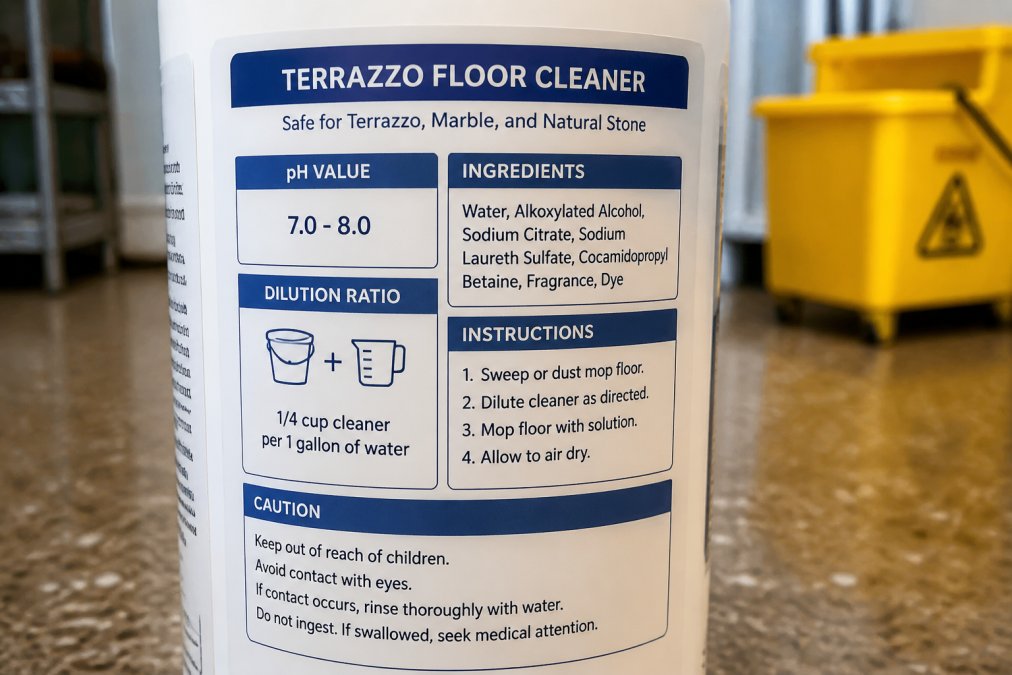
PH-neutral cleaners are your best defense against terrazzo discoloration. These products maintain a balanced pH level (typically 6.5-7.5), remove dirt and grime without etching the stone or stripping protective sealers, and prevent both etching and alkaline residue buildup.
When shopping, look for the pH value on the product label or safety data sheet (SDS). If a label says "pH-neutral" without listing the actual number, contact the manufacturer. Many general-purpose cleaners contain hidden acids (citric, phosphoric) or alkaline agents (sodium hydroxide, potassium hydroxide) that damage terrazzo.
Specific pH-Neutral Options Safe for Terrazzo:
- Commercial stone cleaners labeled for marble and terrazzo: These are formulated specifically for polished stone and typically range from pH 6.8 to 7.2. Check the label to confirm terrazzo compatibility.
- Mild dish soap diluted in water: A few drops of unscented liquid dish soap mixed with one gallon of distilled water creates a safe cleaning solution. Test the pH with inexpensive pH strips to verify it stays between 6.5 and 7.5.
- Distilled water with castile soap: Pure castile soap must be heavily diluted, no more than 1 teaspoon per gallon of distilled water, to remain safe. Undiluted castile soap becomes alkaline and leaves residue.
- Specialized terrazzo floor cleaners: Products engineered for terrazzo's specific composition typically cost $15-$40 per gallon but require smaller dilution ratios, making them economical for large facilities.
Test any new cleaner on a small, inconspicuous area first. Wait 24 hours and check for dullness, discoloration, or residue before applying to visible sections.
Chemicals to Avoid
Certain products cause irreversible damage to terrazzo. Avoid these entirely:
Acidic cleaners (pH below 6.5) damage terrazzo permanently. This category includes vinegar, lemon juice, toilet bowl cleaners, rust removers, and citrus-based cleaners. Even diluted versions cause chemical etching that shows as dull spots, streaks, or frosted appearance. Once etched, the damage cannot be reversed without professional diamond grinding.
Alkaline cleaners (pH above 8.0) strip sealers and leave residue. This category includes ammonia-based cleaners, bleach, strong degreasers, and heavy-duty all-purpose cleaners. These break down protective coatings and leave a cloudy, dull film requiring professional restoration.
Abrasive products (steel wool, scouring powders, pumice-based cleaners, powdered bleach) scratch the surface and create permanent pathways for dirt and moisture to enter the stone, leading to difficult-to-remove staining.
Solvent-based products (mineral spirits, lacquer thinner, orange oil cleaners, denatured alcohol) dissolve sealers and discolor stone. Never use on sealed terrazzo floors. These are appropriate only for specific stains on unsealed surfaces with professional guidance.
How to Read a Product Label for Safety
Before purchasing any cleaner, check the label or request the Safety Data Sheet (SDS). Look for: (1) pH value between 6.5 and 7.5; (2) ingredient list avoiding acids and strong alkalines; (3) explicit terrazzo or stone compatibility; (4) correct dilution ratio.
Daily and Weekly Maintenance Routines
Consistent maintenance prevents discoloration before it starts. Daily: sweep or vacuum, wipe spills immediately, use pH-neutral cleaner for spot cleaning, and dry the floor. Weekly: mop with pH-neutral cleaner and warm water, rinse thoroughly, and dry completely. High-traffic areas need more frequent attention. Regular cleaning prevents expensive restoration.
How to Remove Stains from Terrazzo
Fresh stains are much easier to remove than set-in stains. Speed matters when dealing with spills. The remediation method depends on stain type: organic stains (food, beverages, dirt) and chemical etching (acidic or alkaline damage) require different approaches.
Understanding Stain Types
Before treating a stain, identify what caused it. This determines whether the damage is removable or permanent.
Organic stains (coffee, wine, grease, mud) sit on or just below the surface and can often be lifted with the right technique. Chemical etching results from acidic or alkaline spills that chemically alter the stone. Acidic etching creates frosted or dull spots; alkaline etching discolors or softens the surface. Unlike organic stains, etching cannot be removed with cleaning alone, it requires mechanical restoration.
Immediate Response to Fresh Spills
Act within minutes of a spill. Blot immediately with a clean, dry cloth, don't wipe. Work from the edges toward the center to contain the spill.
For water-based organic spills (coffee, juice, wine): Blot immediately, rinse with distilled water, blot dry, and apply pH-neutral cleaner if residue remains.
For oily organic spills (cooking oil, grease): Blot immediately, sprinkle baking soda for 15 minutes, vacuum, then clean with pH-neutral cleaner and dry.
For acidic chemical spills (vinegar, lemon juice, soda, battery acid): Blot immediately, rinse thoroughly with distilled water, and dry completely. Do not apply additional cleaners. If etching is visible (dull or frosted spot), contact a professional, this cannot be reversed by cleaning.
For alkaline chemical spills (bleach, degreasers, ammonia): Blot immediately, rinse thoroughly with distilled water, and dry completely. Contact a professional if discoloration or surface softening is visible.
Treating Set-In Organic Stains
Set-in stains have penetrated below the surface but have not chemically altered the stone. These stains often respond to poultices or specialized cleaners.
Treating Set-In Chemical Etching
When to Call a Professional
Terrazzo Floor Sealing and Protection
Sealers create a barrier that prevents liquids from penetrating the stone. Penetrating sealers soak into the stone and last 3-5 years. Topical waxes sit on the surface and require reapplication every 6-12 months. For most commercial facilities, penetrating sealers offer better long-term value.
Professional Restoration and Resealing
DIY Maintenance vs. Professional Care
Daily and weekly cleaning are straightforward DIY tasks. Stain removal becomes professional territory when DIY methods fail. Mechanical restoration, honing, buffing, and polishing require professional expertise. Sealing and resealing require professional-grade products and application methods. A small office with light traffic may handle all maintenance in-house. A large hospital or airport facility benefits from professional partnerships.
| Maintenance Task | Frequency | DIY or Professional |
|---|---|---|
| Sweeping and vacuuming | Daily | DIY |
| pH-neutral mopping | Weekly | DIY |
| Spill cleanup | Immediate | DIY |
| Stain removal (DIY methods) | As needed | DIY |
| Stain removal (professional) | As needed | Professional |
| Deep cleaning | Monthly | DIY or Professional |
| Mechanical restoration | Every 3-5 years | Professional |
| Sealing and resealing | Every 2-5 years | Professional |
Frequently Asked Questions
What should I not use to clean terrazzo floors?
Avoid acidic cleaners (vinegar, lemon juice), alkaline solutions (ammonia, bleach), and abrasive scrubbing pads that can etch the surface. Never use lacquer thinner, mineral spirits, or denatured alcohol on unsealed terrazzo, as these penetrate the porous material and cause discoloration. Stay away from oil-based products and wax strippers. Always use pH-neutral cleaners specifically formulated for terrazzo to protect the surface integrity and prevent chemical etching.
How often should terrazzo be professionally sealed?
High-traffic commercial spaces typically require professional resealing every 1-2 years, depending on foot traffic volume and maintenance practices. Lower-traffic areas may only need sealing every 2-3 years. Penetrating sealers generally last longer than topical waxes. Have a professional assess your floor's porosity and stain resistance annually to determine the right resealing schedule. Proper preventative maintenance between professional services extends the time between resealing appointments.
Does sunlight cause terrazzo floor discoloration?
Yes, prolonged UV exposure can cause terrazzo to yellow or fade, particularly lighter-colored installations. UV rays can break down sealers and cause surface discoloration over time. Use UV-protective window treatments or apply UV-blocking coatings to vulnerable areas. This is especially important in healthcare facilities and schools with large windows. Professional-grade sealers often include UV protection, which is why regular resealing helps maintain the floor's natural shine and prevents sun-related discoloration.
What is the best way to clean terrazzo without damaging the finish?
Use pH-neutral cleaners diluted according to manufacturer instructions with soft-bristled brushes or microfiber mops. Avoid high-pressure water or steam cleaning, which forces moisture into the porous substrate and causes staining. Dry the floor immediately after cleaning to prevent moisture absorption. For daily maintenance, sweep first to remove grit, then mop with minimal water. Test any new cleaning product in an inconspicuous area first. Professional mechanical polishing and honing should only be performed by experienced contractors to maintain surface protection and prevent damage.