 How-to
Do Terrazzo Floors Meet Infection Control Standards?
Last Updated: November 21, 2026
Quick Summary
Terrazzo flooring can meet infection control standards because its nonporous, low-porosity surface and seamless construction leave few places for contamination to collect. It tolerates many hospital-grade disinfectants and can be cleaned thoroughly and repeatedly, though it is not inherently antimicrobial and chemical compatibility must be confirmed.
- No single federal rule mandates terrazzo; compliance layers FGI guidelines, ASTM methods, Joint Commission standards and CDC guidance.
- A poured terrazzo floor has only the joints the slab needs, unlike tile with hundreds of grout lines.
- Strong acids and some solvent-based products can dull or etch terrazzo, so confirm compatibility before use.
- Hospital disinfectant contact times commonly run from about one to ten minutes depending on the active ingredient.
- Reseal before wear reaches the aggregate and fix joint sealant as soon as it fails.
Table of Contents
- Healthcare Flooring Infection Control Requirements
- How Terrazzo Supports Infection Control in Clinical Environments
- Seamless Flooring for Healthcare Facilities: Joint Design and Hygiene
- Chemical Compatibility, Slip Resistance, and Durability Under Load
- Healthcare Floor Cleaning and Maintenance Protocols That Hold Up
- Terrazzo Floor Sealing Frequency and Long-Term Surface Integrity
- Specifying Terrazzo for Your Facility: What to Put in the Bid Documents
- Frequently Asked Questions
Healthcare Flooring Infection Control Requirements
Terrazzo flooring infection control standards start with one question: can a surface be cleaned completely, every time, without damage?
Terrazzo flooring is a hard, poured or precast surface made from marble or stone chips set in a cement or resin binder, then ground and polished smooth. Its density and joint-light construction are what make it relevant to infection control.
Hospitals do not choose flooring on looks alone. They choose it on cleanability, chemical tolerance, slip resistance and how it holds up under beds, carts and constant disinfection.
The Standards That Actually Apply
No single federal rule says "use terrazzo." Instead, compliance comes from several sources layered together:
- Facility Guidelines Institute (FGI) guidelines for hospital and outpatient design, which set floor finish requirements room by room
- ASTM International test methods for slip resistance, chemical resistance and surface wear
- The Joint Commission environment-of-care standards, which survey how surfaces are cleaned and maintained
- CDC and WHO guidance on environmental cleaning and disinfection in clinical settings
The FGI Guidelines for Design and Construction of Hospitals are the reference most design teams work from. Check with your state health department too, since licensing rules can add local requirements.
Why Surface Porosity Decides Compliance
Porosity is the whole ballgame. A nonporous surface resists liquid absorption, so spills, body fluids and cleaning solutions stay on top where they can be removed.
Porous floors trap moisture and soil in tiny openings. Once contamination gets in, routine cleaning cannot reliably reach it.
Terrazzo's low porosity comes from its composition. The binder and aggregate are tightly packed and ground flat, leaving few pathways for liquid.
How Terrazzo Supports Infection Control in Clinical Environments
Terrazzo can support infection control by offering fewer places for contamination to collect. Fewer seams, low absorption and a surface that tolerates hospital disinfectants can make thorough cleaning easier.
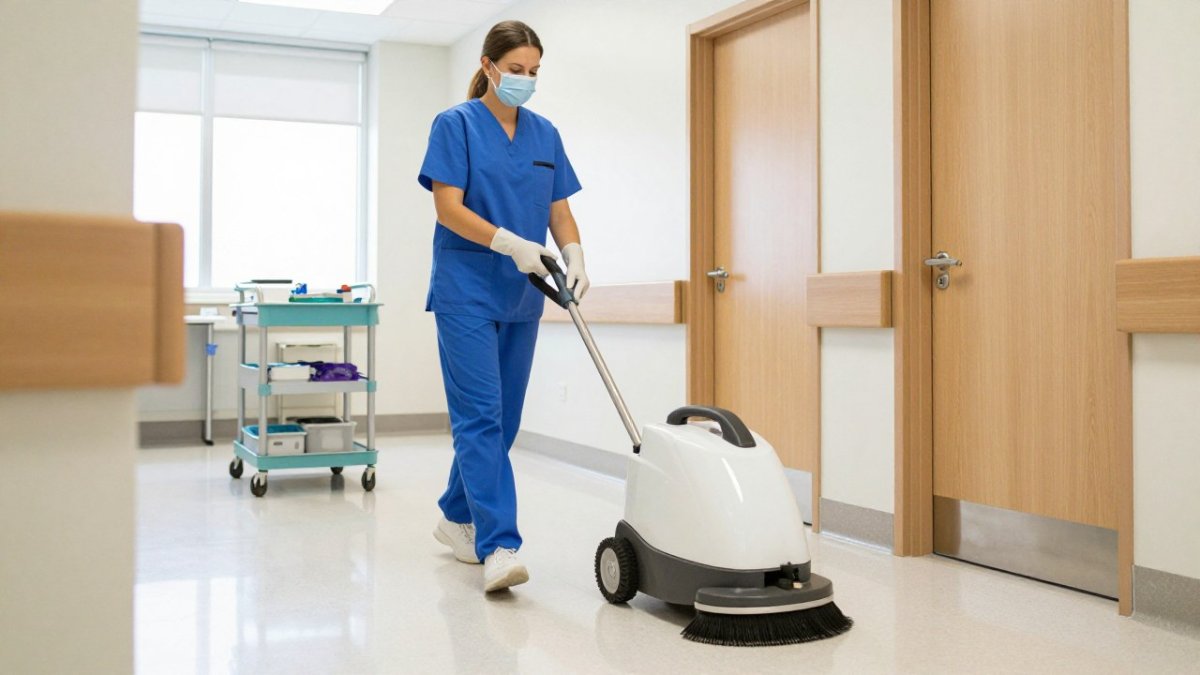
Here is how that plays out in practice:
- Nonporous surface: liquids bead rather than soak in, so spills can be wiped up completely.
- Low porosity: bacterial harboring is limited because there is no sponge-like layer to hold moisture.
- Chemical resistance: the surface stands up to repeated disinfection without etching or dulling.
- Seamless construction: fewer joints mean fewer crevices where soil and pathogens collect.
- Surface integrity: a properly sealed floor stays smooth, so cleaning equipment makes full contact.
For a closer look at how terrazzo fits among compliant options, see our guide to sanitary flooring for healthcare.
One honest caveat: terrazzo is not inherently antimicrobial. Because reliable cleaning depends on more than the floor itself, align terrazzo specifications with a validated disinfection workflow, as emphasized by doc-market ag.
Seamless Flooring for Healthcare Facilities: Joint Design and Hygiene
Seams are where hygienic flooring succeeds or fails. Every joint is a gap, and gaps collect soil.
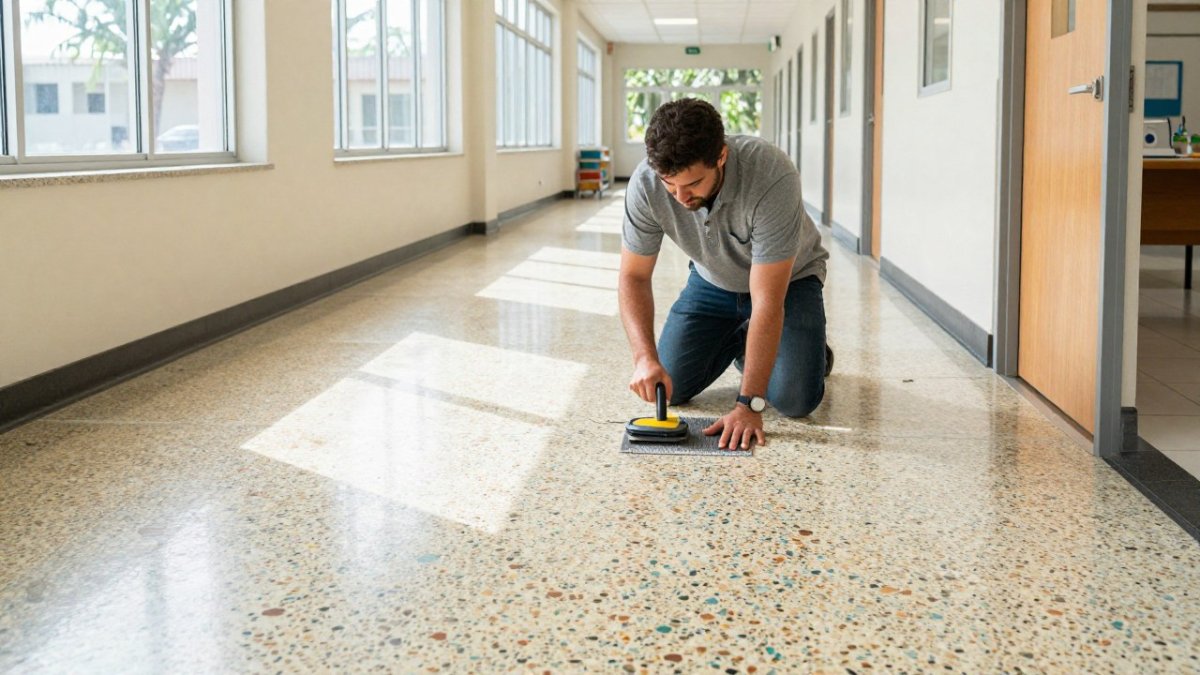
Terrazzo reduces joint count dramatically compared with tile. A tile floor in a long corridor may have hundreds of grout lines.
Joint design still matters. Movement joints, isolation joints and control joints must be detailed correctly and filled with a flexible sealant that tolerates cleaning chemicals.
Watch out: specifying a cheap sealant to save money is a common mistake.
If you are weighing jointless systems against other options, our breakdown of the pros and cons of seamless flooring covers where each approach earns its place.
Chemical Compatibility, Slip Resistance, and Durability Under Load
Chemical compatibility is the requirement most often missed. Healthcare floors face bleach, quaternary ammonium compounds, hydrogen peroxide and peracetic acid, sometimes several times a day.
Terrazzo is generally compatible with many hospital-grade disinfectants, but not all. Strong acids and some solvent-based products can dull or etch the surface.
Slip resistance is the other non-negotiable. Wet floors in patient areas are a fall risk, and falls drive patient safety incidents.
Durability ties it together. Our guide to meeting slip resistance standards for hospital corridors walks through the testing details.
Healthcare Floor Cleaning and Maintenance Protocols That Hold Up
A validated cleaning protocol is what turns a good floor into a compliant one. The floor only performs if the routine is written down, trained, and verified.
Routine cleaning (daily and as needed)
- Dry soil removal first. Dust mop or use a microfiber flat mop before any wet step. Dry soil that gets wet becomes a film that dulls the finish and traps soil in the surface.
- Neutral cleaner, correct dilution. Mix the manufacturer's recommended dilution, typically measured with a dispenser, not eyeballed, in the auto-scrubber or mop bucket. Over-concentration leaves residue that attracts soil and can haze the finish; under-concentration fails to lift soil.
- Mechanical action and dwell. Allow the cleaner the dwell time on the label (commonly a few minutes) before scrubbing. Auto-scrubbers with the correct pad pressure do the work; a mop alone is not a substitute in high-soil areas.
- Rinse and dry. Pick up dirty solution and follow with a clean-water rinse where the product label calls for it. Leave the floor dry before patient traffic; wet floors are both a slip hazard and a re-soiling magnet.
Spill and body-fluid response
- Contain and remove bulk soil with absorbent material before applying disinfectant.
- Apply the facility's approved disinfectant at the label dilution and contact (dwell) time. Contact time is product-specific, commonly cited ranges for hospital disinfectants run from about one to ten minutes depending on the active ingredient and the claim on the label. The floor is not disinfected until the dwell time is met.
- Rinse if the label requires it. Some quaternary ammonium and bleach products leave residue that dulls terrazzo or interferes with the next disinfectant; the label is the authority.
Terminal cleaning (patient room turnover, discharge, and outbreak response)
- Work top-down and dry-to-wet. Clean high surfaces and fixtures before floors so soil does not fall onto a cleaned floor.
- Use a fresh mop head or pad per room in terminal cleaning, or a validated microfiber system with color-coded cloths, to avoid transferring pathogens between rooms.
- Disinfect the floor with the approved product at label dilution and dwell time, then allow it to air dry before the room is released.
- Document the room, product, dilution, and time in the environmental services log; that record is what surveyors and infection prevention committees review.
Periodic and restorative work
- Scrub and recoat where a finish system is used, on a schedule driven by traffic and appearance, not a fixed calendar.
- Deep scrub and reseal when water stops beading or the surface dulls; reseal before wear reaches the aggregate.
- Strip only when necessary. Stripping is aggressive and should be a planned event, not a routine step.
Compatibility checks before any new chemical enters the building
- Get the manufacturer's written approval for each disinfectant, cleaner, and floor finish against the specific terrazzo system (cement or resin binder, sealer type).
- Run a small test patch in an inconspicuous area and observe for dulling, etching, or hazing after the label dwell time and a rinse.
- Check the safety data sheet and label for acid content, solvent content, and any restriction on use on polished stone or terrazzo.
Training and verification
- Train environmental services staff on the approved chemical list and post it in the cleaning closet; the wrong product is the fastest way to ruin a floor.
- Audit with visual inspection and, where the facility uses one, an ATP bioluminescence meter to confirm cleaning effectiveness on high-touch and high-soil surfaces. ATP is a cleaning verification tool, not a pathogen test, and results should be interpreted with that limit in mind.
The CDC's environmental cleaning and disinfection guidance is a solid reference for building the protocol. Pair it with the floor manufacturer's chemical list and the disinfectant labels, the label dwell time and dilution are the enforceable numbers.
Abrasive pads and acidic cleaners can strip sealer and dull the surface, which can reduce cleanability over time.
Here are the cleaning and maintenance routines the article says keep a terrazzo floor compliant.
| Task | What to do | Key detail |
|---|---|---|
| Routine cleaning | Dry soil removal first, then neutral cleaner at label dilution | Dwell a few minutes, then rinse and dry |
| Spill and body-fluid response | Remove bulk soil, then apply approved disinfectant | Contact time commonly about one to ten minutes |
| Terminal cleaning | Work top-down and dry-to-wet with fresh mop head per room | Document room, product, dilution and time |
| Periodic and restorative work | Scrub and recoat on a traffic-driven schedule | Deep scrub and reseal when water stops beading |
| New chemical checks | Get manufacturer's written approval and run a test patch | Check label for acid and solvent content |
| Training and verification | Train staff on approved chemical list and audit | ATP meter verifies cleaning, not pathogens |
Terrazzo Floor Sealing Frequency and Long-Term Surface Integrity
Sealing frequency depends on traffic and cleaning chemistry, not a fixed calendar. Busy clinical corridors may need resealing more often than quiet administrative areas.
Many terrazzo floors benefit from resealing when the surface starts to look dull or water stops beading.
Long-term surface integrity comes down to three habits:
- Reseal before wear reaches the aggregate
- Fix joint sealant as soon as it fails
- Keep abrasive and acidic products off the floor
Do this and a terrazzo floor can serve a healthcare facility for decades. Skip it and you will be planning repairs far sooner than the budget expects. Our team handles professional terrazzo maintenance and can build a resealing schedule around your building's traffic.
Specifying Terrazzo for Your Facility: What to Put in the Bid Documents
A specification is only as good as its details. Vague language invites substitutions and shortcuts that undermine hygiene.
Put these in the bid documents:
- Binder and aggregate type, with the specific system named
- Slip resistance test method and target for each space
- Chemical resistance requirements, referencing the disinfectants your facility uses
- Joint design and sealant specification, including chemical tolerance
- Sealer type and resealing interval
- Substrate preparation and moisture testing before installation
- Cleaning protocol and approved chemical list handed over at completion
Substrate prep deserves special attention. Moisture under a slab is one of the most common causes of terrazzo failure, and it is invisible until the floor cracks or delaminates.
For healthcare-specific scoping details, our terrazzo installation guide for healthcare facilities covers what belongs in the documents. And if you are still selecting a system, the best terrazzo options for hospitals lays out the choices.
Getting infection control right on a healthcare floor means getting the specification, installation and maintenance right from day one.
Frequently Asked Questions
How often do terrazzo floors need to be sealed in healthcare facilities?
Sealing frequency depends on traffic, cleaning chemical exposure, and the finish system used. Hospitals generally set sealing intervals from observed wear rather than a fixed calendar: check for dulling, water absorption at the surface, and visible scratches during routine inspections.
Do terrazzo floors have joints or seams where contaminants can collect?
Terrazzo is poured in place and finished as a continuous surface, so it has far fewer seams than tile or sheet vinyl. It still needs control joints to manage slab movement, and those joints must be filled with a flexible, non-porous sealant that is inspected and replaced as it wears. Seamless flooring for healthcare facilities can reduce harborage points, but joint detailing during installation is an important factor in how well it performs.
What are the flooring requirements for healthcare facilities regarding slip resistance?
Slip resistance is typically specified by a measured coefficient of friction or a slip-resistance test result written into the project documents, and the requirement often varies by area, with stricter values in operating rooms and wet zones. Ask your installer to confirm the finished surface meets the tested value after grinding and sealing, since the final finish, not the raw material, determines the result.
Can existing terrazzo floors be restored to meet infection control standards?
Existing terrazzo floors may be evaluated for restoration. Have the floor assessed for substrate movement and moisture before restoration, because those issues can cause cracking that undermines hygiene.