 listicle
Terrazzo Maintenance Costs for Schools: 2026 Guide
Table of Contents
- Terrazzo Maintenance Costs for Schools: What You'll Actually Pay
- Terrazzo Restoration vs Replacement Cost: Which Makes Sense
- Annual Maintenance Expenses and Budget Planning
- Terrazzo Floor Cleaning Best Practices for Schools
- Commercial Terrazzo Maintenance Schedule for High-Traffic Areas
- Durability, Lifespan, and Long-Term Cost Savings
- Terrazzo vs. Alternative Flooring: Cost and Performance Comparison
- Conclusion
- Frequently Asked Questions
Last Updated: August 26, 2026
Terrazzo Maintenance Costs for Schools: What You'll Actually Pay
Terrazzo flooring is one of the most durable surfaces you can install in a school, but many facility managers underestimate the true cost of keeping it pristine. Maintenance costs depend heavily on your approach: preventive care, addressing wear and tear, or planning full restoration. A well-maintained terrazzo floor lasts 30+ years with minimal capital expenditure; neglected floors require costly repairs or replacement within a decade.
At A1 Terrazzo, we've worked with schools across Florida managing everything from routine floor care to major restoration projects. This guide breaks down the real expenses you'll face: daily cleaning costs, periodic restoration, and the long-term financial impact of different maintenance strategies.
Terrazzo Restoration vs Replacement Cost: Which Makes Sense
The decision between restoring existing terrazzo and replacing it entirely comes down to condition, timeline, and budget. Restoration typically costs significantly less than full replacement, but only if the substrate is sound and the damage is surface-level.
Restoration involves diamond grinding, honing, and polishing to remove scratches, stains, and minor cracks. This process brings the floor back to like-new condition without demolition and new installation. For schools, restoration also means minimal disruption, most work can happen during summer breaks or after hours.
Replacement means removing the existing floor, preparing the substrate, and installing new terrazzo. This approach is necessary only when the base layer has failed, structural damage is severe, or the school wants a completely different aesthetic.
According to Rose Restoration International's school flooring analysis, restoration typically ranges from $3 to $8 per square foot depending on damage extent and local labor rates. For a 10,000 square foot corridor, that's $30,000 to $80,000. Full replacement easily exceeds $12 to $20 per square foot for commercial installations.
When to restore: The floor is cosmetically worn but structurally sound. Cracks are surface-level. Stains and scratches are the main issues.
When to replace: The substrate is compromised or actively failing. Water infiltration is present. The floor is beyond 25+ years old and showing systemic deterioration.
Annual Maintenance Expenses and Budget Planning
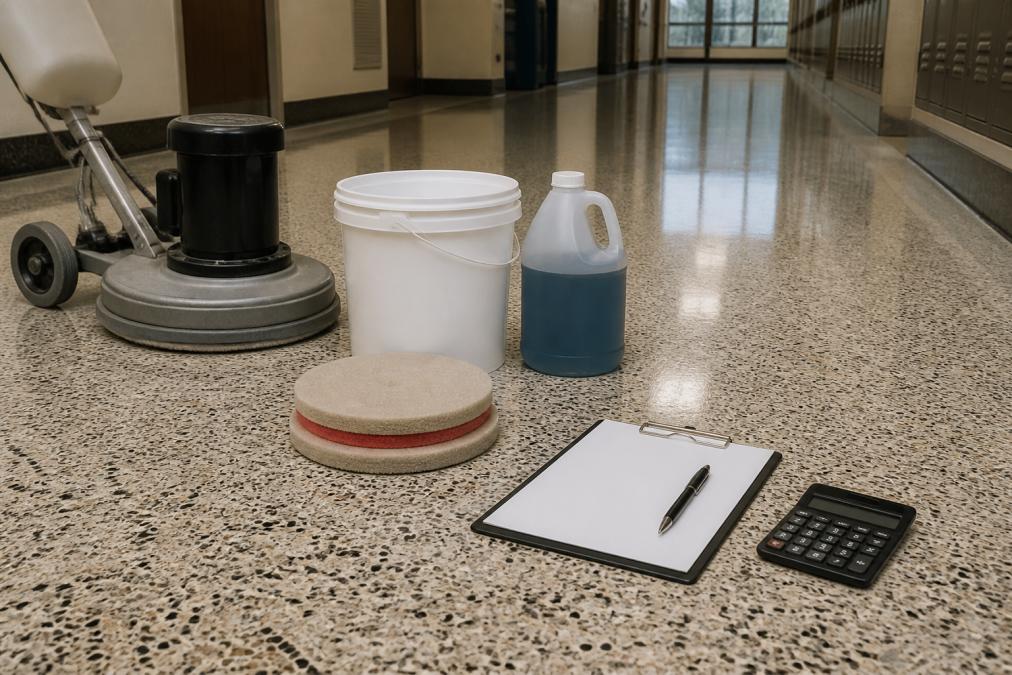
Daily and periodic maintenance costs are where most schools find budget surprises. A proper terrazzo maintenance schedule includes routine cleaning, periodic deep cleaning, and occasional repairs.
Routine daily cleaning, sweeping, dust mopping, and damp mopping with appropriate cleaner, requires consistent labor. For a school with 50,000 square feet of terrazzo, custodial staff should budget 8-12 hours per week for routine floor care. Use a pH-neutral cleaner like Fab Floors Terrazo-Pro Stone Floor Cleaner for commercial terrazzo maintenance to avoid damage from harsh alkaline products.
Deep cleaning typically happens quarterly or semi-annually, depending on foot traffic. This involves machine scrubbing with commercial floor scrubbers, which removes embedded soil and restores clarity. Schools with high-traffic corridors need deep cleaning more frequently than those with light-traffic spaces.
Sealing and protective finishes extend the time between restorations. A quality seal like Spartan Terra Glaze Terrazzo Floor Seal for durable terrazzo protection creates a barrier against stains and moisture. Resealing typically happens every 2-3 years depending on traffic and the specific product used.
Crack repair and void filling address minor damage before it spreads. MB Stone Professional Terrazzo Epoxy Kit for school floor repairs allows in-house repairs for minor damage, reducing the need for contractor visits.
A realistic annual budget for a 50,000 square foot school terrazzo installation should include:
- Routine cleaning supplies and labor: $8,000-$12,000
- Quarterly deep cleaning (4 sessions): $6,000-$10,000
- Annual sealing or protective finish: $3,000-$5,000
- Minor repairs and void filling: $2,000-$4,000
Total annual operational budget: $19,000-$31,000 annually, or roughly $0.38-$0.62 per square foot per year.
Terrazzo Floor Cleaning Best Practices for Schools
The cleaning products and methods you use directly impact how long your terrazzo floor lasts and how much you'll spend on restoration. Using the wrong cleaner is one of the fastest ways to damage terrazzo.
Acidic cleaners, alkaline degreasers, and wax-based products are terrazzo's enemies. They dull the surface, etch the aggregate, and create buildup that's expensive to remove. pH-neutral cleaners are the standard for terrazzo. Dilute properly, most commercial terrazzo cleaners require 1:10 or 1:20 dilution with water.
Daily mopping should use a damp, not wet, mop. Excess water penetrates seams and can cause substrate issues. Microfiber mops are ideal because they trap soil without scratching the surface.
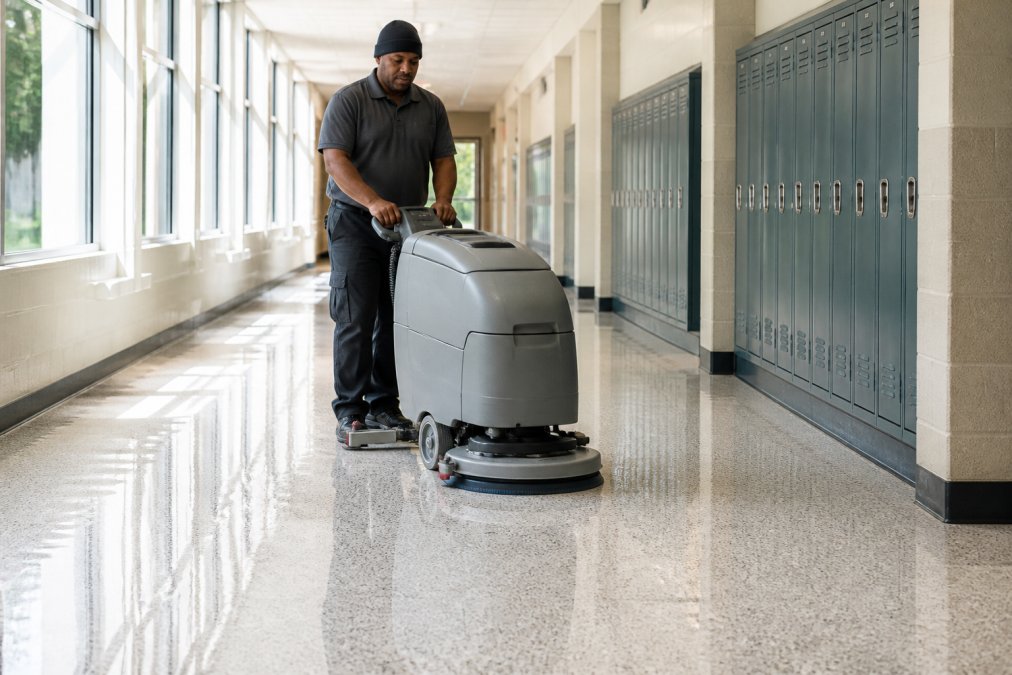
For high-traffic areas, commercial floor scrubbers with soft brushes are necessary. Hard brushes scratch the surface. Scrubbers should be set to low speed in areas with delicate finishes or decorative elements.
Spot cleaning requires care. Spills should be cleaned immediately to prevent staining. For organic stains, use a neutral pH cleaner. For ink or dye stains, a mild hydrogen peroxide solution works, but test it on an inconspicuous area first. Never use bleach. commercial flooring costs.
Entryway matting is essential. A 10-foot matted area at every entrance reduces the amount of dirt tracked onto the floor by 80%, extending the time between deep cleanings.
Commercial Terrazzo Maintenance Schedule for High-Traffic Areas
High-traffic corridors, entry areas, and cafeterias experience accelerated wear and need a more aggressive maintenance schedule than low-traffic spaces.
Daily maintenance (high-traffic zones):
- Morning dust mop to remove debris
- Spot cleaning of spills and marks
- Evening damp mop with pH-neutral cleaner
Weekly maintenance:
- One full machine scrub of high-traffic areas
- Detailed spot cleaning of problem areas
- Inspection for emerging cracks or damage
Monthly maintenance:
- Deep clean with commercial scrubber and appropriate cleaner
- Inspect seals for wear
- Address any repairs immediately
Quarterly maintenance:
- Full deep cleaning of entire high-traffic zone
- Seal reapplication if needed
- Assessment by facility manager or contractor
Annual maintenance:
- Professional inspection and condition assessment
- Full resealing if protective finish is wearing
- Any necessary crack repairs or void filling
Schools that follow this schedule consistently see terrazzo floors maintain their appearance and integrity for 25-30 years. A school managing a 5,000 square foot entry corridor should budget $12,000-$18,000 annually for specialized maintenance in that zone alone.
Durability, Lifespan, and Long-Term Cost Savings
Terrazzo's durability is its primary financial advantage. A properly maintained terrazzo floor outlasts vinyl composition tile by 15+ years and epoxy by 10+ years. This longevity translates directly to lower total cost of ownership.
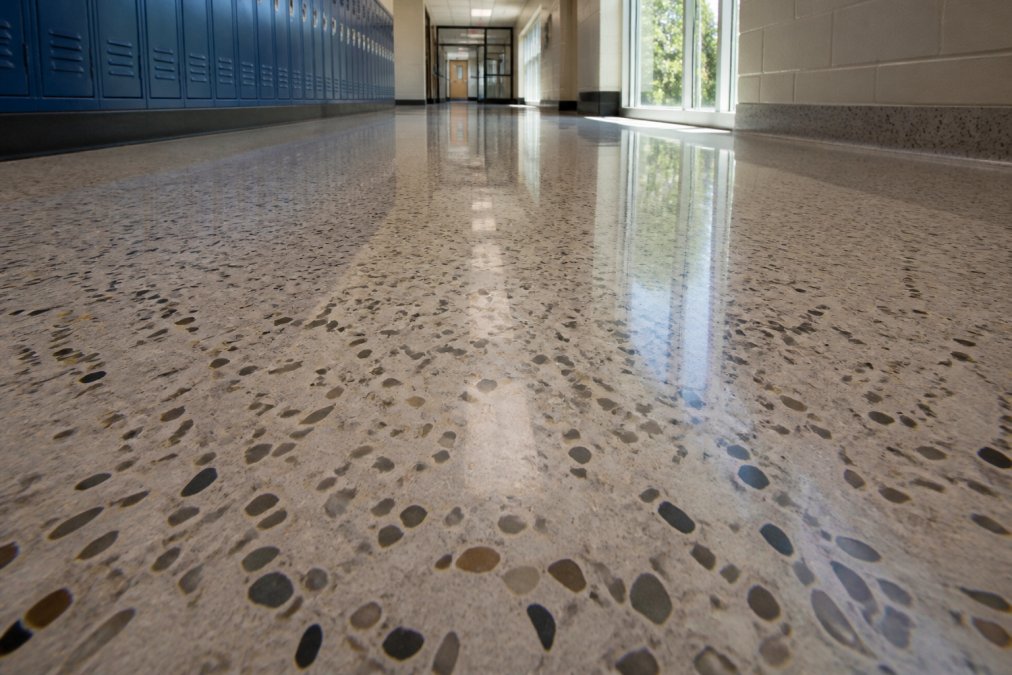
The aggregate in terrazzo, marble, granite, glass, or stone chips, is as hard as the surrounding cementitious matrix. Unlike softer flooring materials that compress and thin, terrazzo maintains its structural integrity for decades. High-traffic areas show cosmetic wear first, but restoration brings the floor back to original condition.
Lifecycle cost analysis shows terrazzo's advantage clearly. Over a 30-year period:
- Terrazzo: Initial installation ($15-$25/sq ft) + maintenance ($0.38-$0.62/sq ft annually) + one restoration ($3-$8/sq ft around year 20) = approximately $8-$12 per square foot over 30 years
- Vinyl composition tile: Initial installation ($3-$6/sq ft) + maintenance ($0.20-$0.40/sq ft annually) + replacement every 10 years ($3-$6/sq ft) = approximately $6-$10 per square foot over 30 years
- Epoxy: Initial installation ($8-$15/sq ft) + maintenance ($0.30-$0.50/sq ft annually) + recoating every 8-10 years ($4-$8/sq ft) = approximately $7-$11 per square foot over 30 years
Terrazzo's advantage becomes clear when you factor in non-financial benefits: durability in high-traffic areas, aesthetic appeal that doesn't degrade, and the ability to restore rather than replace.
Terrazzo vs. Alternative Flooring: Cost and Performance Comparison
Schools choosing flooring for new construction or major renovation face a fundamental decision: terrazzo, vinyl composition tile (VCT), or epoxy. Each has distinct cost and performance profiles.
| Flooring Type | Initial Installation | Annual Maintenance | Lifespan | Restoration/Replacement Cycle | Best For |
|---|---|---|---|---|---|
| Terrazzo | $15-$25/sq ft | $0.38-$0.62/sq ft | 30+ years | Restoration at year 20 | Long-term durability, high-traffic zones |
| Vinyl Composition Tile | $3-$6/sq ft | $0.20-$0.40/sq ft | 10-15 years | Full replacement every 10 years | Budget-conscious facilities, short-term use |
| Epoxy | $8-$15/sq ft | $0.30-$0.50/sq ft | 15-20 years | Recoating every 8-10 years | Moderate durability, chemical resistance |
Vinyl Composition Tile is the lowest initial cost option but wears faster in high-traffic areas. It requires stripping and rewaxing every 1-2 years, which is labor-intensive. Schools often replace VCT within 10 years, and cumulative replacement costs exceed terrazzo's initial investment.
Epoxy offers a middle ground. It's more durable than VCT and resists chemicals and moisture better. However, epoxy coatings require recoating every 8-10 years, which requires facility closure during application. Epoxy can also yellow over time if exposed to UV light.
Terrazzo costs more upfront but delivers superior durability and aesthetic value. It doesn't require stripping and rewaxing, resists stains and moisture better than VCT or epoxy, and can be restored rather than replaced. Terrazzo also offers design flexibility with custom colors, patterns, and finishes.
For schools in humid climates or those with basement areas prone to moisture, terrazzo's impermeability is a major advantage. A1 Terrazzo has worked with schools making this decision, and the pattern is consistent: schools that consider total cost of ownership choose terrazzo and realize savings over 20+ years.
Conclusion
Terrazzo maintenance costs for schools are manageable when you plan ahead and follow a preventive maintenance schedule. The real expense comes from deferred maintenance, using wrong cleaning products, and failing to address small issues before they become major restoration needs.
At A1 Terrazzo, we've helped schools across Florida establish maintenance programs that extend floor lifespan and control costs. Our 35 years of experience in commercial terrazzo installation and maintenance means we understand the specific challenges schools face.
If you're planning a terrazzo installation, restoration, or developing a maintenance strategy for existing floors, contact A1 Terrazzo for a consultation. We'll assess your current situation, recommend a maintenance schedule tailored to your facility, and provide transparent guidance on costs and timelines.
Frequently Asked Questions
How much does terrazzo maintenance cost per square foot for schools?
Annual maintenance costs typically range from $0.50 to $2.00 per square foot depending on traffic volume, cleaning frequency, and the condition of the floor. High-traffic corridors and entry areas require more frequent professional refinishing. Costs include routine cleaning supplies, labor, and periodic diamond honing or polishing. Schools with preventive maintenance programs often spend less over time than those addressing damage reactively. For a detailed estimate based on your facility's specific needs, contact A1 Terrazzo for a consultation.
Is it more cost-effective to restore or replace old school terrazzo?
Restoration is almost always more cost-effective than full replacement. Restoration through diamond grinding, honing, and polishing typically costs $3 to $8 per square foot, while complete replacement can exceed $15 to $25 per square foot. Restoration extends floor life by 10 to 20 years and restores the original finish without the disruption of removal and reinstallation. Even floors with cracks and voids can be repaired and refinished, making restoration the preferred approach for school budgets.
What are the daily cleaning requirements for school terrazzo floors?
Daily cleaning should include dust mopping to remove loose debris and damp mopping with a pH-neutral terrazzo cleaner. Avoid acidic cleaners, harsh chemicals, and excessive water, which damage the surface and cause dulling. Spills should be wiped immediately to prevent staining. Weekly or bi-weekly deep cleaning with a commercial auto-scrubber removes ground-in soil without stripping the finish. Proper daily care prevents buildup and extends the time between professional refinishing, reducing long-term costs significantly.
What is the typical lifespan of terrazzo flooring in high-traffic school hallways?
Well-maintained terrazzo floors in schools last 30 to 40 years or longer. High-traffic areas like hallways and entry corridors experience wear faster than classrooms, but with proper maintenance including regular sealing, honing, and protective coatings, these areas remain durable and attractive. The lifespan of terrazzo far exceeds vinyl composition tile (VCT) or carpet, making it a superior long-term investment despite higher initial installation costs.
How does terrazzo maintenance compare to VCT or carpet in schools?
Terrazzo requires more specialized care than VCT but offers superior durability and longevity. VCT is cheaper to maintain initially but must be stripped and rewaxed annually, adding labor costs over time. Carpet requires frequent replacement every 5 to 7 years and harbors allergens. Terrazzo's maintenance focuses on polishing, sealing, and professional refinishing every 3 to 5 years, which costs more per service but is needed less frequently. Over a 20-year period, terrazzo's total cost of ownership is typically lower than alternatives when calculated with labor, replacement, and sanitation factors combined.
This article was written using GrandRanker
Frequently Asked Questions
How much does terrazzo maintenance cost per square foot for schools?
Annual maintenance costs typically range from $0.50 to $2.00 per square foot depending on traffic volume, cleaning frequency, and the condition of the floor. High-traffic corridors and entry areas require more frequent professional refinishing. Costs include routine cleaning supplies, labor, and periodic diamond honing or polishing. Schools with preventive maintenance programs often spend less over time than those addressing damage reactively. For a detailed estimate based on your facility's specific needs, contact A1 Terrazzo for a consultation.
Is it more cost-effective to restore or replace old school terrazzo?
Restoration is almost always more cost-effective than full replacement. Restoration through diamond grinding, honing, and polishing typically costs $3 to $8 per square foot, while complete replacement can exceed $15 to $25 per square foot. Restoration extends floor life by 10 to 20 years and restores the original finish without the disruption of removal and reinstallation. Even floors with cracks and voids can be repaired and refinished, making restoration the preferred approach for school budgets.
What are the daily cleaning requirements for school terrazzo floors?
Daily cleaning should include dust mopping to remove loose debris and damp mopping with a pH-neutral terrazzo cleaner. Avoid acidic cleaners, harsh chemicals, and excessive water, which damage the surface and cause dulling. Spills should be wiped immediately to prevent staining. Weekly or bi-weekly deep cleaning with a commercial auto-scrubber removes ground-in soil without stripping the finish. Proper daily care prevents buildup and extends the time between professional refinishing, reducing long-term costs significantly.
What is the typical lifespan of terrazzo flooring in high-traffic school hallways?
Well-maintained terrazzo floors in schools last 30 to 40 years or longer. High-traffic areas like hallways and entry corridors experience wear faster than classrooms, but with proper maintenance including regular sealing, honing, and protective coatings, these areas remain durable and attractive. The lifespan of terrazzo far exceeds vinyl composition tile (VCT) or carpet, making it a superior long-term investment despite higher initial installation costs.
How does terrazzo maintenance compare to VCT or carpet in schools?
Terrazzo requires more specialized care than VCT but offers superior durability and longevity. VCT is cheaper to maintain initially but must be stripped and rewaxed annually, adding labor costs over time. Carpet requires frequent replacement every 5 to 7 years and harbors allergens. Terrazzo's maintenance focuses on polishing, sealing, and professional refinishing every 3 to 5 years, which costs more per service but is needed less frequently. Over a 20-year period, terrazzo's total cost of ownership is typically lower than alternatives when calculated with labor, replacement, and sanitation factors combined.