 blog
7 Flooring Options That Survive Heavy University Hallway Traffic
Quick Summary
Terrazzo is the most durable choice for heavy university hallways, because its dense, polished surface resists scratches and stains and can be re-ground and re-polished to restore it. Porcelain tile suits wet entry zones, luxury vinyl tile allows single-tile repairs, and polished concrete works well in large open corridors. Plan each zone by traffic level.
- Terrazzo resists scratches and stains well and can be restored by re-grinding and re-polishing.
- Porcelain tile handles moisture, making it a strong choice for wet entry vestibules.
- Luxury vinyl tile can be replaced one tile at a time, which helps with ongoing repairs.
- Compare flooring on lifecycle cost, including cleaning labor and replacement cycles, not material price alone.
- Walk the corridor in wet shoes before approval, since dry-feeling finishes can be slick after rain.
Table of Contents
- Why University Hallways Are Harder on Flooring Than Most Commercial Spaces
- Comparison Table: Best Flooring for High-Traffic Campus Corridors
- Terrazzo Flooring for Schools: Durability, Maintenance and Lifecycle Cost
- Commercial Flooring for Schools: Porcelain Tile, Luxury Vinyl and Polished Concrete Compared
- Terrazzo vs Polished Concrete: Which Holds Up Better in Busy Corridors?
- Slip Resistance, Acoustics and Accessibility in Campus Hallways
- Low-Maintenance Flooring for Educational Facilities: Cleaning Products and Upkeep Schedules
- Scheduling a Hallway Flooring Assessment for Your Campus
- Frequently Asked Questions
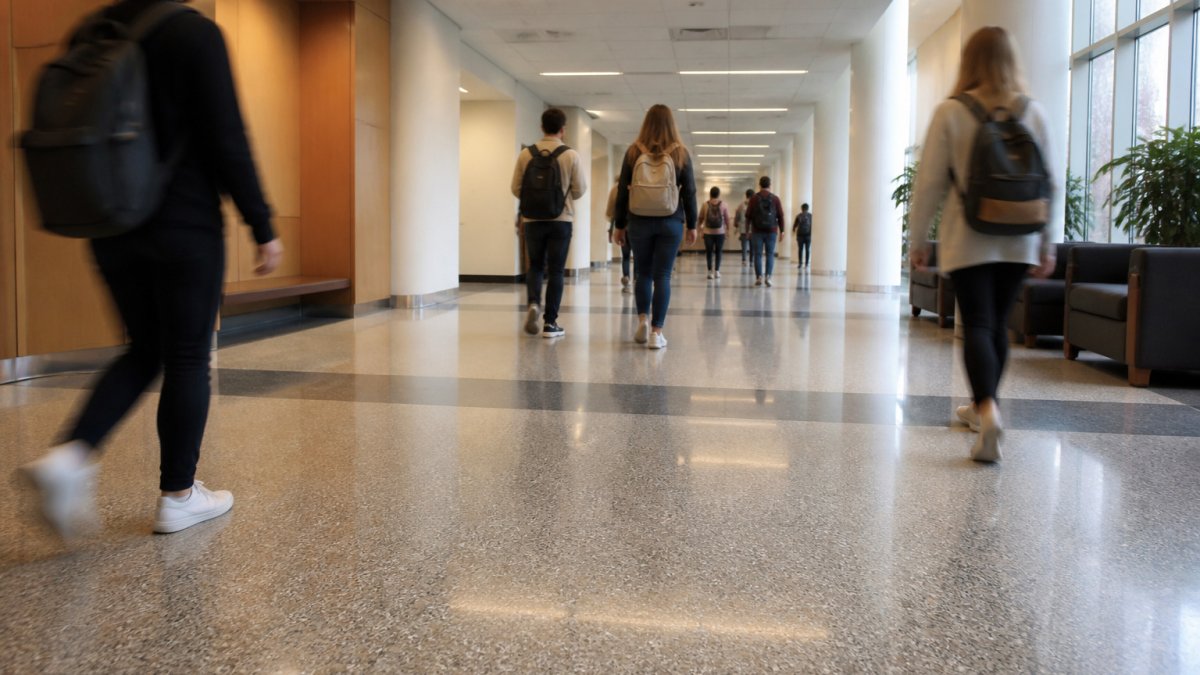
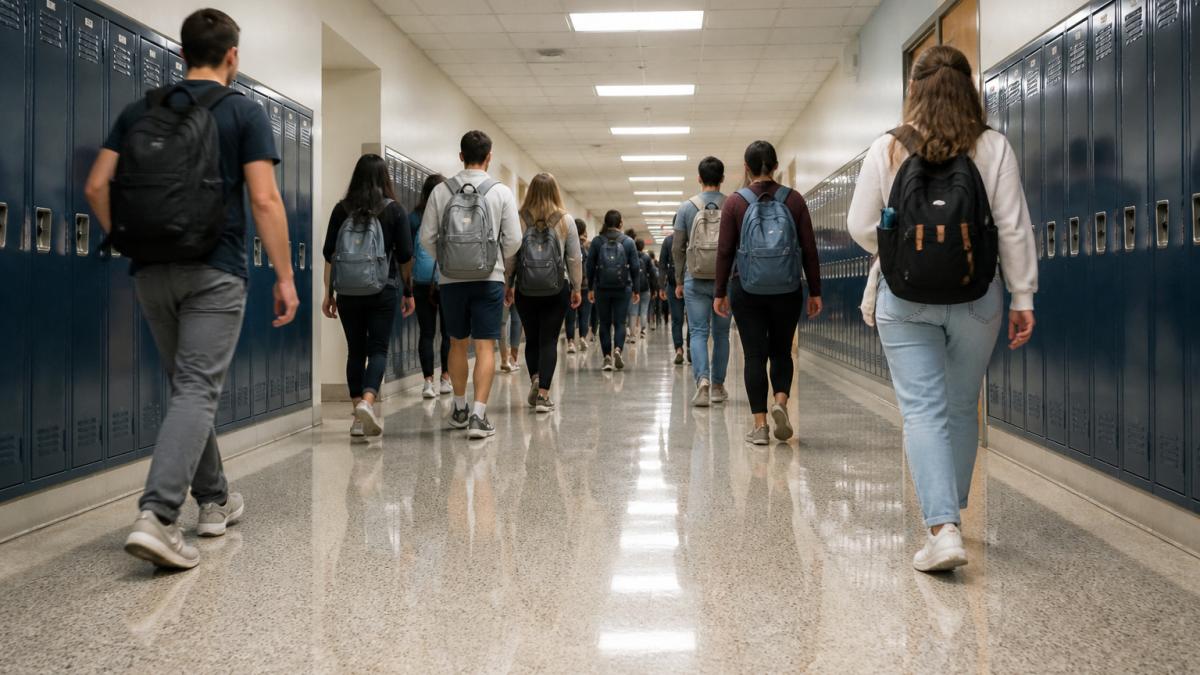
A busy university corridor between class periods can see thousands of footsteps in a single day, with backpacks, rolling carts, wet shoes and heavy doors all grinding against the floor. Choosing the right hallway flooring for that kind of traffic matters more than most campus budget committees expect. This guide walks through seven flooring options that hold up under heavy use, with the trade-offs for each.
Why University Hallways Are Harder on Flooring Than Most Commercial Spaces
University hallways combine several stresses at once. Foot traffic arrives in sharp waves between classes, grit is tracked in from outdoors, and rolling equipment is pushed across the same path every day. Many campus facility teams find that a floor which looks fine after installation shows visible wear within a few years if it lacks the right wear layer.
Most of the damage happens at entrances, intersections and stairwell landings, not evenly across the whole floor. Plan the material for those zones first. The rest of the corridor will rarely be the problem.
Comparison Table: Best Flooring for High-Traffic Campus Corridors
The table below summarizes the seven options covered in this guide. Ratings are qualitative, based on common performance patterns, not lab test results.
| Flooring Option | Wear Resistance | Maintenance | Repairability | Best For |
|---|---|---|---|---|
| Terrazzo | Very high | Low to moderate | Good, with patch work | Main corridors, lobbies |
| Porcelain tile | High | Low | Moderate | Wet entry zones |
| Luxury vinyl tile | Moderate to high | Low | Good, by replacing tiles | Classrooms, upper floors |
| Polished concrete | High | Low | Limited | Large open corridors |
| Engineered hardwood | Moderate | Moderate to high | Good | Lounges, low-traffic halls |
| Laminate | Moderate | Low | Poor | Light-use administrative areas |
| Natural stone | High | Moderate to high | Moderate | Historic or feature areas |
Pros and cons at a glance
- Terrazzo: Pro: long service life. Con: higher upfront installed cost.
- Porcelain tile: Pro: water resistant. Con: hard surface can be loud.
- Luxury vinyl tile: Pro: quick replacement of single tiles. Con: scratches can show over time.
- Polished concrete: Pro: durable and easy to clean. Con: hard and cold underfoot.
Terrazzo Flooring for Schools: Durability, Maintenance and Lifecycle Cost
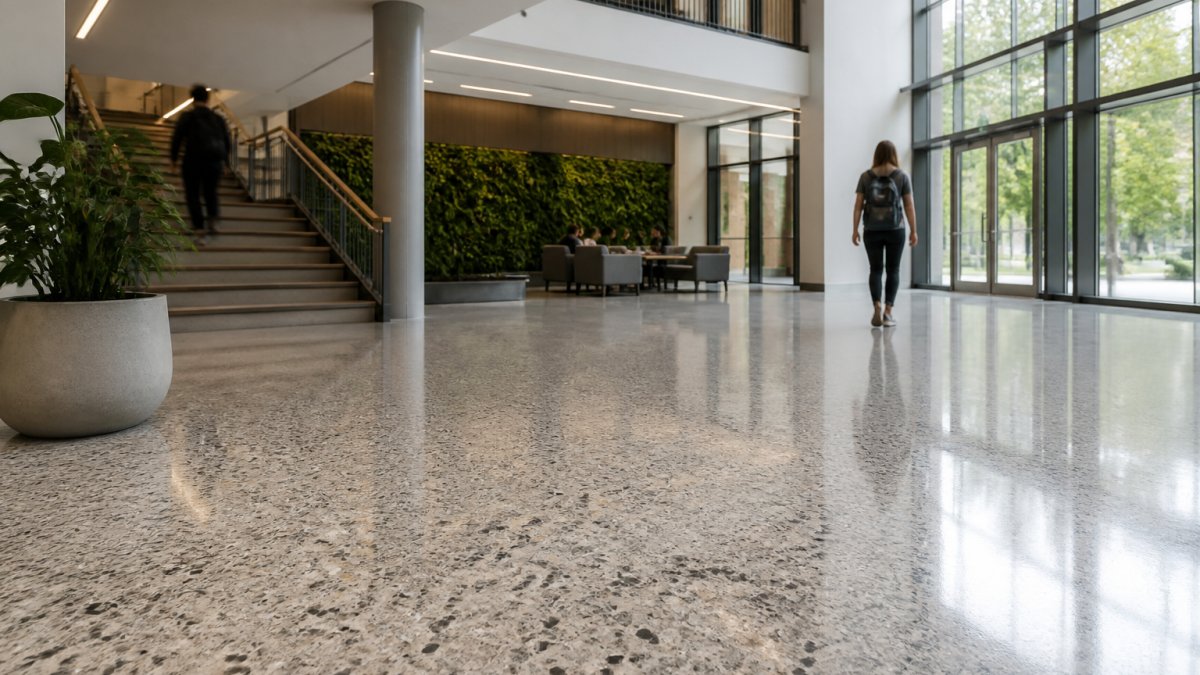
Terrazzo is a composite of marble, quartz or glass chips set in a cement or epoxy matrix, then ground and polished smooth. Its dense surface resists scratches and stains well, which is why it appears so often in older school buildings that are still in service.
Lifecycle cost is where terrazzo tends to justify itself. The initial investment is generally higher than resilient flooring, and terrazzo floors can last decades with routine cleaning. For facility managers, the question is less about the first invoice and more about how many replacement cycles the building will avoid.
Commercial Flooring for Schools: Porcelain Tile, Luxury Vinyl and Polished Concrete Compared
Porcelain tile is a strong choice for entry vestibules and wet zones because it shrugs off moisture. Luxury vinyl tile offers a quieter, softer walking surface and can be replaced one tile at a time, which helps with ongoing repairs. Polished concrete suits large open corridors and is easy to maintain, though it runs cold and hard underfoot.
Each option has a clear use case. Mixing materials by zone is a common approach on campuses where entrances, classrooms and corridors each face different demands.
Terrazzo vs Polished Concrete: Which Holds Up Better in Busy Corridors?
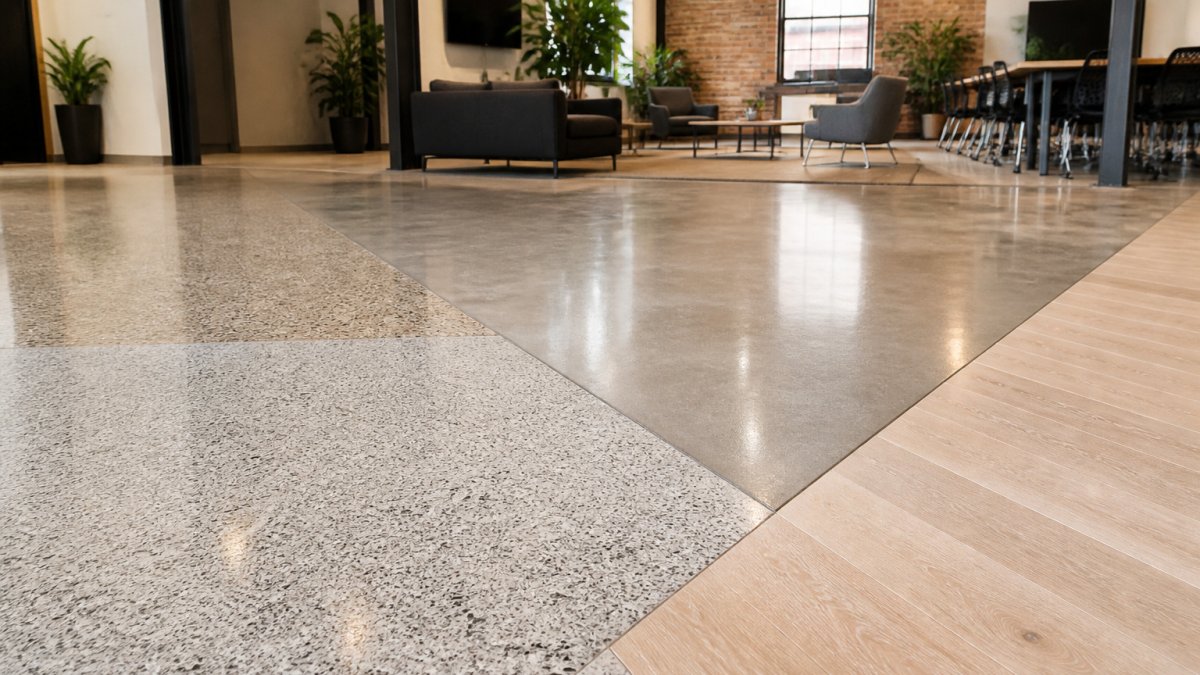
Both materials handle heavy traffic well, but they age differently. Terrazzo's aggregate chips are set into the matrix, so wear tends to be uniform and can be restored by re-grinding and re-polishing. Polished concrete can develop hairline cracks and surface dusting if the sealer wears thin, and repairs often show.
For busy corridors with frequent maintenance cycles, terrazzo usually offers the more forgiving long-term profile. Polished concrete remains a reasonable, lower-cost option for spaces where appearance is less critical.
Slip Resistance, Acoustics and Accessibility in Campus Hallways
Most flooring roundups stop at wear resistance. On a campus, three performance factors decide whether a hallway actually works between class changes: traction under wet shoes, noise transfer into adjacent rooms, and whether every student can move through the corridor safely.
Slip resistance. Wet-weather tracking is the main slip risk in academic hallways, especially at entries and stairwell landings. Look for a documented coefficient of friction (COF) or a slip-resistance classification from the manufacturer, and confirm the finish still meets that rating after the recommended cleaning routine. Polished terrazzo and polished concrete can become slick when wet unless the finish is specified with traction in mind. Tile should meet the manufacturer's recommended slip-resistance rating for wet areas, and grout lines should be narrow enough to keep carts and wheelchairs rolling smoothly but wide enough to provide texture.
Acoustics. Hard flooring reflects sound, so footfall and conversation carry down the corridor and into classrooms and study rooms. The practical levers are underlayment, resilient backing, and transition design. Luxury vinyl tile and engineered hardwood can be installed over acoustic underlayment to reduce impact noise; porcelain tile and terrazzo are harder surfaces and usually need acoustic treatment in the adjacent room rather than under the floor. Carpet tile in residence-hall corridors is a common trade-off: quieter underfoot, but harder to clean and less suited to wet entries. A common pattern is hard flooring in academic corridors with acoustic ceiling tiles and door seals to limit sound transfer.
Accessibility. Corridors need firm, stable surfaces with smooth transitions between materials. Changes in floor height, even a quarter inch, can trip wheelchair users and rolling carts, so specify transition strips or reducers at every material change. Door thresholds, elevator lobbies and stair landings deserve extra attention because they concentrate both traffic and level changes. Confirm slip-resistance and transition details against the applicable accessibility requirements with your local building authority before finalizing the specification.
Low-Maintenance Flooring for Educational Facilities: Cleaning Products and Upkeep Schedules
Maintenance is where the flooring budget actually lives. Material price is a one-time line item; cleaning labor, restoration and replacement recur for the life of the building. A floor that costs less upfront but needs more frequent stripping, sealing or patching can cost more over a decade than a higher-priced surface with a simpler upkeep routine.
Cleaning by material. Terrazzo and sealed concrete tolerate pH-neutral cleaners and routine damp mopping; harsh acids and high-alkaline strippers can etch polished surfaces, and abrasive pads dull the finish. The top commercial terrazzo floor cleaners are listed in a dedicated guide to help you choose safe products. Porcelain tile is forgiving but grout lines trap soil, so specify a grout that resists staining and plan periodic deep cleaning. Luxury vinyl tile cleans easily but can dull under abrasive cleaners, and beveled edges collect dirt. Engineered hardwood and laminate need moisture control, damp mops, not wet mops, and laminate seams can swell if water sits. Natural stone requires stone-specific cleaners and periodic resealing.
Labor and schedule. A common pattern in campus facilities is daily dust mopping, weekly damp cleaning, and periodic restoration (re-grinding and re-polishing for terrazzo, resealing for concrete and stone). Build a written schedule that names the product, frequency and responsible team for each zone. Entry zones and stair landings usually need more frequent attention than interior corridors, so zone the schedule rather than applying one routine everywhere.
Repairability and downtime. Terrazzo can be patched and re-polished, though color matching takes skill. Porcelain tile can be replaced tile by tile, but matching dye lots years later is difficult. Luxury vinyl tile is the easiest to repair, swap a single tile, which matters in high-abuse spots. Polished concrete repairs often show, and laminate is difficult to repair without replacing a run of planks. Factor downtime into the decision: a repair that closes a corridor during class changes has a cost beyond the material.
Installation logistics in occupied buildings. Most campus flooring work happens around classes, not during a break. Phased installation, one corridor or one wing at a time, keeps buildings open. Plan for acclimation time (especially for wood and resilient products), cure time for terrazzo and concrete, and odor and indoor-air considerations that can affect adjacent occupied spaces. Confirm product emissions and adhesive requirements before work begins, and schedule noisy grinding or demolition outside class hours.
Scheduling a Hallway Flooring Assessment for Your Campus
Every campus has different traffic patterns, substrate conditions and budget constraints, so the right material depends on the specific building. A site assessment is the fastest way to match each zone to the right option. Contact A1 Terrazzo to discuss your campus flooring needs.
Frequently Asked Questions
What is the most durable flooring for a university hallway?
Porcelain tile and terrazzo are generally the most durable options for university hallways because both resist abrasion, dents and moisture well and can last decades under heavy foot traffic. Terrazzo is poured or cast with a dense marble or glass aggregate, so wear is spread across the whole surface rather than concentrated in a thin top layer. Luxury vinyl performs well in quieter corridors and costs less to install, but its wear layer is thinner, so heavy rolling carts and grit can show damage sooner. Ask any contractor for documented wear ratings and sample wear tests before deciding.
Is terrazzo a good choice for high-traffic school hallways?
Yes. Terrazzo is one of the most widely specified floors for schools and campus hallways because it handles constant foot traffic, resists staining and can be ground and re-polished to restore its finish. Its main drawbacks are higher upfront installation cost and the need for skilled installers, and it can be noisier than carpet or resilient flooring unless acoustic measures are used. For buildings expected to stay in service for decades, the lifecycle cost often favors terrazzo over materials that need frequent replacement.
How does terrazzo compare with polished concrete for campus hallways?
Both are dense, low-maintenance surfaces, but they differ in how they handle wear and repairs. Terrazzo uses a cementitious or epoxy binder with stone chips, so it can be ground and re-polished in sections and patched with matching material. Polished concrete is typically a cured slab finished to a sheen, which can dust or scratch and generally needs densifiers and periodic re-polishing to stay consistent. Terrazzo usually costs more to install, while polished concrete can be less expensive when an existing slab is already suitable. Compare quotes on a like-for-like basis, including grinding and repair assumptions.
What commercial flooring is easiest to maintain in a busy corridor?
Dense, non-porous surfaces such as terrazzo, porcelain tile and sealed polished concrete are typically easiest to maintain because they need routine dust mopping and damp cleaning rather than frequent stripping and waxing. The cleaning product matters as much as the floor type: harsh or high-alkaline chemicals can etch terrazzo and dull finishes, so facility teams should use pH-neutral cleaners recommended by the flooring installer. A written cleaning schedule with daily dust control and periodic deep cleaning helps extend the life of any hallway surface.