 ultimate-guide
Choosing Terrazzo for University Campuses: A 2026 Guide
Table of Contents
- Why Choosing Terrazzo for University Campuses Makes Strategic Sense
- Life Cycle Cost Analysis: Terrazzo Flooring Cost Per Square Foot vs. Long-Term ROI
- Terrazzo Flooring Maintenance for Schools and University Buildings
- ADA Compliance for University Flooring: What Terrazzo Delivers
- Sustainability Certifications: LEED, WELL, and Eco-Friendly Materials
- Design Flexibility: Custom Aesthetics and University Branding
- Acoustic Performance and Seamless Installation on Campus
- Choosing Terrazzo for University Campuses: Pros, Cons, and Final Considerations
- Frequently Asked Questions
Last Updated: August 7, 2026
Why Choosing Terrazzo for University Campuses Makes Strategic Sense
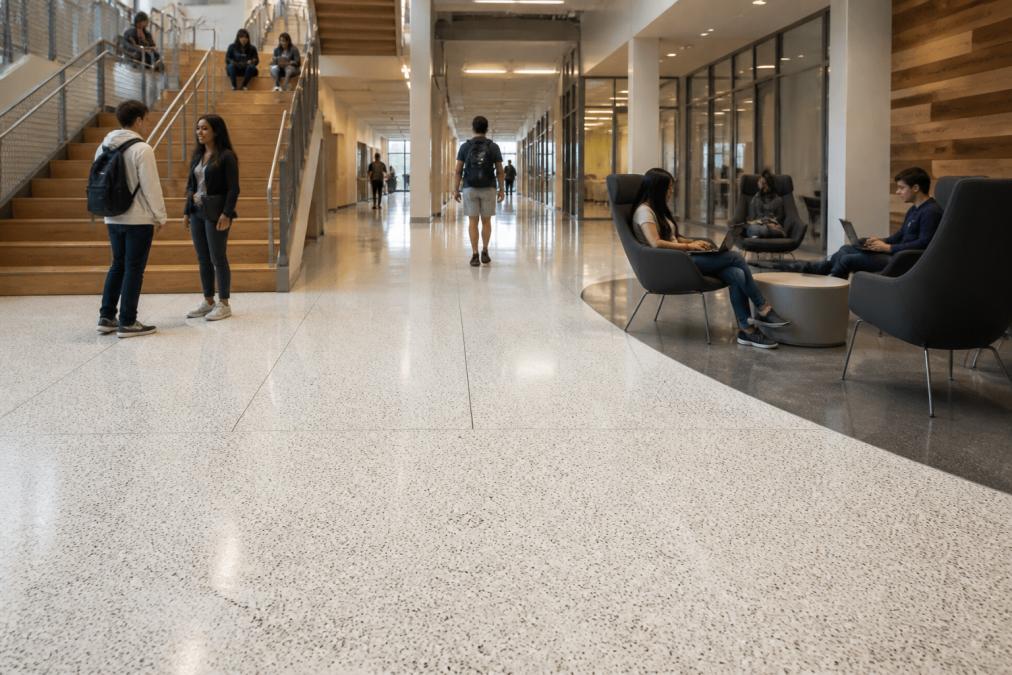
University buildings absorb punishment. A single high-traffic corridor can see thousands of foot-traffic cycles daily. Most flooring systems degrade visibly within five to seven years under those conditions. Terrazzo does not. At A1 Terrazzo, we've spent over 35 years installing and maintaining commercial terrazzo across Florida's most demanding institutional environments, and the pattern is consistent: campuses that invest in terrazzo early spend significantly less managing their floors over the following decades.
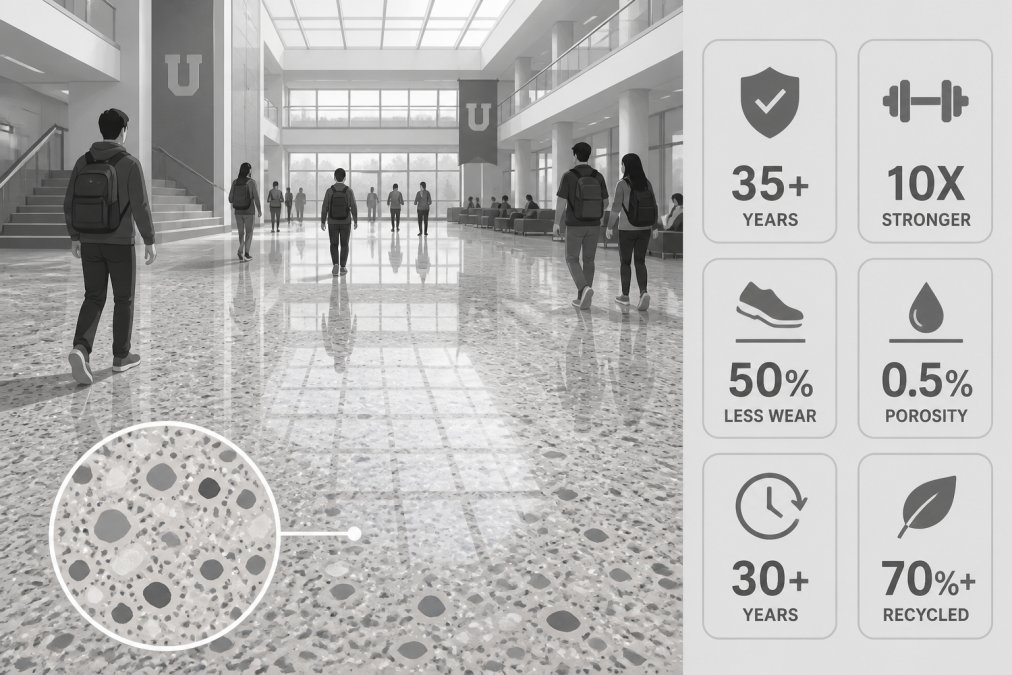
Terrazzo flooring is a composite material made from marble aggregate, quartz chips, glass aggregate, or other decorative chips set in a cementitious or epoxy binder, then ground and polished to a seamless, high-end finish. The result is a non-porous surface that is simultaneously decorative and industrial-grade.
Durability and Abrasion Resistance in High-Traffic Academic Spaces
The biggest mistake facility managers make is evaluating flooring cost at installation rather than across the full service life. Terrazzo's abrasion resistance is exceptional. The material does not dent, scratch, or delaminate under rolling loads from maintenance carts, furniture movement, or constant foot traffic. Properly installed epoxy terrazzo can remain structurally sound and visually consistent for 40 years or more, a performance threshold that vinyl composition tile, carpet, and most engineered hardwood cannot approach.
For university applications, this matters in lobbies, corridors, stairwells, cafeterias, and library reading rooms where flooring longevity is tested hardest. Substrate preparation is the single largest variable in terrazzo longevity. A floor installed over an inadequately prepared or moisture-compromised slab will crack within years regardless of material quality. This is where contractor experience separates good outcomes from expensive failures.
Hygiene, Indoor Air Quality, and Non-Porous Surface Benefits
The non-porous surface of terrazzo is both a durability and hygiene asset. Unlike carpet or grout-jointed tile, terrazzo provides no microscopic recesses where bacterial growth can establish itself. This is particularly relevant for campus health centers, dining facilities, and laboratory spaces where sanitation protocols are non-negotiable.
According to EPA guidance on indoor air quality in schools and commercial buildings, VOC emissions from flooring adhesives and finishes contribute to poor indoor air quality in occupied buildings. Epoxy terrazzo systems, when properly specified, can be installed with low-VOC formulations that support healthier indoor environments and contribute toward WELL Building Standard documentation. Terrazzo also does not harbor allergens the way carpet does and does not off-gas over time like some vinyl products can.
Life Cycle Cost Analysis: Terrazzo Flooring Cost Per Square Foot vs. Long-Term ROI
Most flooring decisions are made on initial cost. That is the wrong metric for institutional procurement. Life Cycle Cost Analysis (LCCA) is the correct framework for evaluating terrazzo flooring cost per square foot in a university context. LCCA accounts for installation cost, annual maintenance expenditure, restoration costs, and eventual replacement cost across a defined service period, typically 30 to 50 years.
The Federal Highway Administration's guidance on Life Cycle Cost Analysis in infrastructure procurement provides a useful framework: calculate total cost of ownership across the expected service life, not just upfront capital outlay. Terrazzo carries a higher initial installation cost than many alternatives, but across a 40-year service life, maintenance requirements are modest and replacement cost is near zero if the original installation was executed correctly. Competing flooring systems that cost less upfront often require full replacement every 10 to 15 years, which compounds dramatically over the same time horizon.
| Flooring Type | Typical Service Life | Major Maintenance Events | Full Replacement Needed? |
|---|---|---|---|
| Epoxy Terrazzo | 40+ years | Periodic polishing, resealing | Rarely, if substrate is sound |
| Vinyl Composition Tile | 10-15 years | Annual waxing, periodic stripping | Yes, every 10-15 years |
| Carpet | 7-10 years | Regular deep cleaning | Yes, every 7-10 years |
| Ceramic Tile | 20-25 years | Grout resealing, tile replacement | Partial, ongoing |
| Polished Concrete | 15-25 years | Resealing, crack repair | Partial, varies |
Terrazzo Flooring Maintenance for Schools and University Buildings
Terrazzo flooring maintenance for schools and university buildings is far simpler than most facility managers expect. When the protocol is followed, annual maintenance costs are low relative to other institutional flooring systems. The floor does not need stripping and waxing cycles or grout line scrubbing.
Cleaning Protocols That Protect Epoxy Terrazzo Finishes
The most common cause of premature terrazzo degradation is the wrong cleaning product. Acidic cleaners, bleach-based products, and high-pH industrial degreasers all etch the polished surface over time. The correct approach for daily terrazzo maintenance:
- Dry dust mop or auto-scrub with a neutral pH cleaner (pH 7 to 9)
- Avoid acidic cleaners, vinegar-based products, and anything with bleach
- Use soft-bristle pads on auto-scrubbers; avoid abrasive pads that micro-scratch the finish
- Rinse with clean water after wet mopping to prevent residue buildup
- Apply a penetrating sealer annually or as needed based on traffic volume
Restoration vs. Replacement: What Facility Managers Need to Know
A worn or dull terrazzo floor is not a failed floor. Terrazzo can be mechanically ground back to a fresh surface, repolished, and resealed without replacing the substrate or aggregate layer. For historic campus buildings with original terrazzo dating back decades, restoration preserves architectural character while meeting current performance standards.
Replacement becomes necessary only when the substrate has failed, when cracking is structural rather than cosmetic, or when the aggregate layer has been ground through entirely. These are relatively rare outcomes in well-maintained terrazzo.
ADA Compliance for University Flooring: What Terrazzo Delivers
ADA compliance for university flooring is a non-negotiable requirement under the Americans with Disabilities Act. The ADA Standards for Accessible Design, Section 302 on floor surfaces specifies that floor surfaces must be stable, firm, and slip resistant. Epoxy terrazzo, when finished with an appropriate surface treatment, meets all three criteria. The seamless installation eliminates the raised edges and grout lines that create trip hazards in tile systems, which is a meaningful compliance advantage in high-traffic corridors and transition zones.
Slip resistance is specified by a static coefficient of friction. Terrazzo can be finished to meet or exceed the recommended thresholds for both dry and wet conditions when the correct aggregate blend and surface treatment are specified at installation. For universities undergoing ADA remediation projects, terrazzo's seamless surface is often the most direct path to compliance.
Sustainability Certifications: LEED, WELL, and Eco-Friendly Materials
Sustainability is no longer a preference in university capital projects. Many institutions now have board-level commitments to carbon reduction and sustainable building standards that directly affect materials procurement decisions.
Terrazzo supports multiple sustainability certification pathways. For LEED v4 projects, terrazzo can contribute to credits through low-VOC epoxy systems, recycled content (glass aggregate and recycled marble chips), and regional materials if sourced within the required radius. The U.S. Green Building Council's LEED materials and resources credit documentation outlines specific documentation requirements.
For WELL Building Standard certification, terrazzo's low VOC emissions and non-porous surface support credits related to air quality and cleaning protocols. Terrazzo's long service life means the embodied carbon of installation is amortized over a much longer period than competing systems, improving the lifecycle carbon profile of the building.
Design Flexibility: Custom Aesthetics and University Branding
Modern terrazzo offers more design flexibility than almost any other commercial flooring system. Aggregate selection drives color and texture. Marble aggregate produces classic aesthetics. Glass aggregate introduces translucency and jewel-toned color options. Quartz chips add texture and depth. These materials can be combined in virtually unlimited ratios to produce custom colorways that match institutional Pantone specifications.
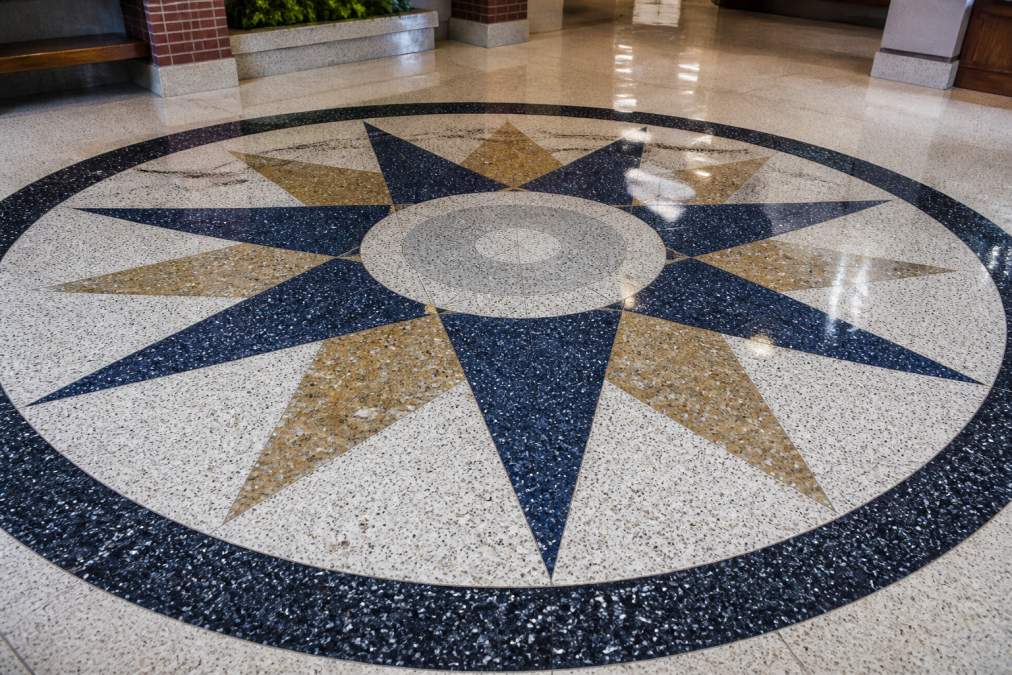
Divider strips define pattern boundaries and allow for complex geometric designs, school crests, campus maps, and custom medallions to be executed directly in the floor surface. These are integral to the floor material itself, not applied graphics that can peel or fade.
Acoustic Performance and Seamless Installation on Campus
Hard flooring surfaces, including terrazzo, reflect sound rather than absorbing it. In open spaces like lobbies or cafeterias, this can increase ambient noise levels. The solution is to account for acoustic performance in the overall building design, using ceiling treatments, soft furnishings, and wall panels to manage reverberation while retaining the flooring benefits terrazzo provides.
Seamless installation is another operational advantage. Terrazzo has no grout lines, no seams, and no joints except for structural expansion joints and divider strips. This eliminates the primary failure points of tile systems, where grout deteriorates and moisture infiltrates the substrate at seams. For campus buildings in Florida's humid climate, seamless flooring is a moisture management strategy.
Choosing Terrazzo for University Campuses: Pros, Cons, and Final Considerations
The case for choosing terrazzo for university campuses is strong, but it is not unconditional.
Pros:
- Exceptional flooring longevity, typically 40+ years with proper maintenance
- Non-porous surface resists bacterial growth and supports hygiene protocols
- Seamless installation eliminates grout lines and moisture infiltration points
- Design flexibility supports custom university branding and school colors
- Supports LEED and WELL certification pathways with appropriate material specification
- Low annual maintenance cost relative to replacement-cycle flooring systems
- ADA-compliant surface characteristics when correctly specified
- Restorable rather than replaceable, preserving historic campus aesthetics
Cons:
- Higher initial installation cost than many competing systems
- Requires specialized contractors; general flooring installers are not qualified
- Hard surface increases ambient noise in open spaces; requires acoustic planning
- Incorrect cleaning products can etch or dull the surface over time
- Substrate preparation is critical; poor prep leads to cracking regardless of material quality
- Not appropriate for spaces with severe moisture transmission from below-grade slabs without proper mitigation
Terrazzo is the right choice for most permanent university buildings where the institution expects to own and operate the facility for decades. For campuses evaluating large-scale flooring projects across multiple buildings, specification consistency, phased installation scheduling, and contractor capacity all become variables. These are manageable with a contractor possessing genuine institutional project experience.
University facility teams across Florida face the same core challenge: justify long-term capital investments to budget committees focused on short-term costs. Terrazzo's LCCA profile makes that case clearly, but only when the installation is executed correctly from substrate preparation through final polish. A1 Terrazzo brings over 35 years of specialized commercial terrazzo installation and maintenance experience to exactly these projects. Contact A1 Terrazzo to discuss your campus flooring project and get a consultation grounded in real project data.
Frequently Asked Questions
Is terrazzo flooring cost-effective for large university campuses?
Terrazzo carries a higher upfront cost than carpet or vinyl, but its flooring longevity, often 40 to 75 years with proper care, makes it one of the most cost-effective institutional flooring choices over time. A Life Cycle Cost Analysis typically shows that terrazzo's low maintenance budget and near-zero replacement costs outperform cheaper alternatives within 10 to 15 years. For multi-building campus projects, that gap widens considerably. Contact A1 Terrazzo for a project-specific cost estimate.
What are the primary maintenance requirements for terrazzo in high-traffic areas?
Terrazzo flooring maintenance for schools and universities centers on three tasks: daily dust mopping with a microfiber pad, periodic wet mopping with a pH-neutral cleaner, and scheduled professional resealing to protect the floor finish. Avoid acidic or alkaline cleaners, which etch the surface. Epoxy terrazzo is particularly forgiving because its non-porous surface resists bacterial growth and staining. A professional maintenance assessment every few years keeps the floor in competition-ready condition without major floor restoration costs.
How does terrazzo flooring contribute to LEED certification for university buildings?
Terrazzo can contribute to several LEED credit categories. Its use of recycled marble aggregate, quartz chips, and glass aggregate supports Materials and Resources credits. Low VOC emissions from modern epoxy terrazzo systems help earn Indoor Environmental Quality credits. Because it is a seamless flooring system with no grout lines or adhesives that off-gas, it also supports healthy indoor air quality goals aligned with WELL Building Standard requirements. Documenting these attributes during procurement strengthens a university's sustainability reporting.
Is terrazzo slip-resistant enough for student-heavy environments?
Yes, when properly specified and finished. Terrazzo's slip resistance is measured by its dynamic coefficient of friction, and a correctly ground and sealed epoxy terrazzo floor meets ADA compliance standards for university flooring, including ADA requirements for slip resistance in wet and dry conditions. Aggregates like quartz chips add texture that improves traction. Facility managers should specify the finish level during design, a higher-grit polish increases shine but can reduce slip resistance, so the right balance depends on the specific campus location.
This article was written using GrandRanker
Frequently Asked Questions
Is terrazzo flooring cost-effective for large university campuses?
Terrazzo carries a higher upfront cost than carpet or vinyl, but its flooring longevity — often 40 to 75 years with proper care — makes it one of the most cost-effective institutional flooring choices over time. A Life Cycle Cost Analysis typically shows that terrazzo's low maintenance budget and near-zero replacement costs outperform cheaper alternatives within 10 to 15 years. For multi-building campus projects, that gap widens considerably. Contact A1 Terrazzo for a project-specific cost estimate.
What are the primary maintenance requirements for terrazzo in high-traffic areas?
Terrazzo flooring maintenance for schools and universities centers on three tasks: daily dust mopping with a microfiber pad, periodic wet mopping with a pH-neutral cleaner, and scheduled professional resealing to protect the floor finish. Avoid acidic or alkaline cleaners, which etch the surface. Epoxy terrazzo is particularly forgiving because its non-porous surface resists bacterial growth and staining. A professional maintenance assessment every few years keeps the floor in competition-ready condition without major floor restoration costs.
How does terrazzo flooring contribute to LEED certification for university buildings?
Terrazzo can contribute to several LEED credit categories. Its use of recycled marble aggregate, quartz chips, and glass aggregate supports Materials and Resources credits. Low VOC emissions from modern epoxy terrazzo systems help earn Indoor Environmental Quality credits. Because it is a seamless flooring system with no grout lines or adhesives that off-gas, it also supports healthy indoor air quality goals aligned with WELL Building Standard requirements. Documenting these attributes during procurement strengthens a university's sustainability reporting.
Is terrazzo slip-resistant enough for student-heavy environments?
Yes, when properly specified and finished. Terrazzo's slip resistance is measured by its dynamic coefficient of friction, and a correctly ground and sealed epoxy terrazzo floor meets ADA compliance standards for university flooring, including ADA requirements for slip resistance in wet and dry conditions. Aggregates like quartz chips add texture that improves traction. Facility managers should specify the finish level during design — a higher-grit polish increases shine but can reduce slip resistance, so the right balance depends on the specific campus location.