 ultimate-guide
Slip Resistance Standards for University Flooring
Table of Contents
- Understanding Slip Resistance Standards for University Flooring
- Why Slip Resistance Matters for Campus Safety and Fall Prevention
- How Flooring Slip Resistance Is Tested and Measured
- ANSI A326.3 Tile Slip Resistance Standards for Campus Buildings
- DCOF Testing for Commercial Flooring in High-Traffic Areas
- Selecting Flooring for Wet Areas and Dining Facilities
- Campus Flooring Maintenance and Slip Resistance Inspection
- Compliance and Risk Management for University Facilities
- Frequently Asked Questions
Last Updated: October 18, 2026
Understanding Slip Resistance Standards for University Flooring
Slip resistance standards university flooring materials define the minimum friction requirements that prevent slips, trips, and falls on campus surfaces.
The core purpose of slip resistance standards is straightforward: reduce fall-related injuries on campus. Falls are a leading cause of unintentional injury, and wet areas, high-traffic corridors, and transitions between surfaces create conditions where inadequate friction leads to injuries.
Different campus spaces require different levels of slip resistance. A dry classroom hallway has different friction demands than a wet shower facility or a dining hall where spills are frequent.
Why Slip Resistance Matters for Campus Safety and Fall Prevention
Falls on campus cause injuries requiring medical attention, missed classes, and compromised mobility.
The relationship between slip resistance and fall prevention is direct. When a floor provides insufficient friction, measured as coefficient of friction or COF, a person's foot loses grip during normal walking.
Campus environments amplify fall risk by combining high foot traffic with diverse conditions.
Compliance also demonstrates institutional responsibility. Documenting that flooring meets recognized standards like ANSI A326.3 or ASTM F2913 shows decisions were based on established safety criteria, not guesswork.
How Flooring Slip Resistance Is Tested and Measured
Slip resistance cannot be determined by appearance or feel. A smooth, polished floor might look clean but be dangerously slippery when wet, while a textured surface might feel rough yet fail required friction standards. Testing provides objective measurement.
Standardized test methods measure slip resistance by simulating the conditions under which slips occur. A test device applies controlled force and measures friction between a shoe material and the flooring surface. Tests vary shoe materials, moisture conditions, and pressure levels because real-world slip risk varies, and friction physics changes when water is present.
ASTM F2913 and Laboratory Testing Methods
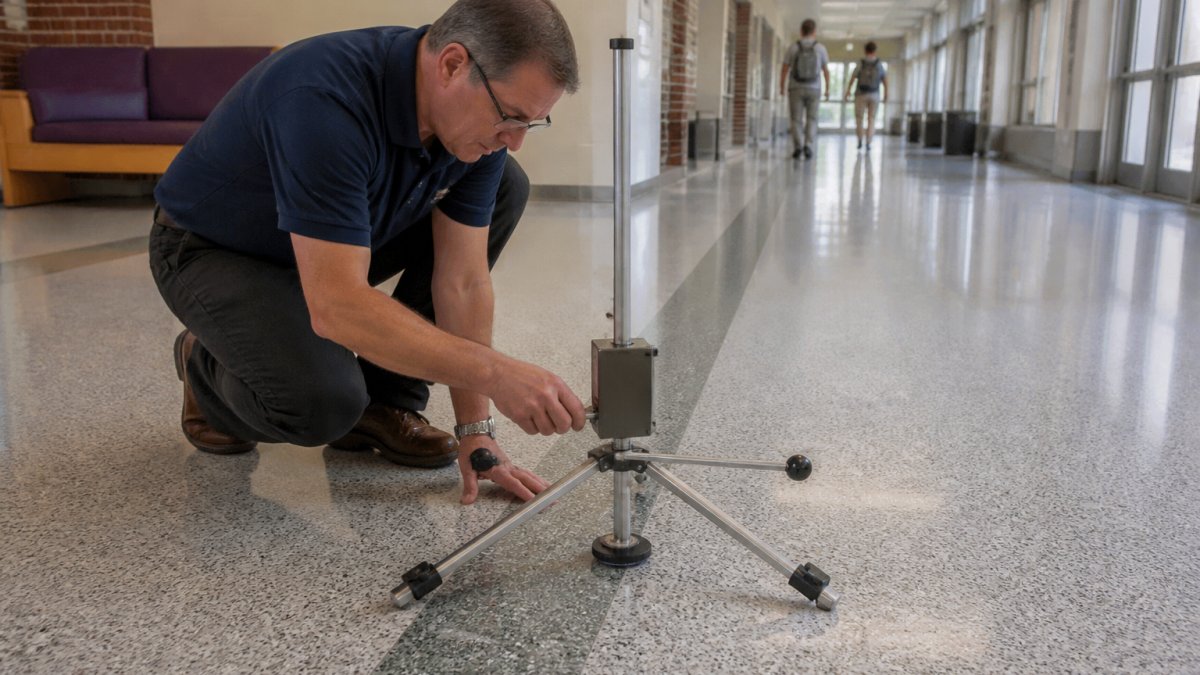
ASTM F2913 is the standard test method for measuring coefficient of friction on tile and stone surfaces using a portable tribometer.
The ASTM F2913 test uses a rubber slider, typically a standard shoe material, that moves across the flooring under controlled pressure and speed.
The test is portable, so it can be performed on-site after installation. This lets facility managers verify that newly installed flooring meets the slip resistance specifications in the contract, catching problems before injuries occur.
ASTM F2913 results are expressed as a numerical COF value. Industry guidance typically recommends a minimum DCOF of 0.42 for level surfaces and 0.50 for ramps.
Coefficient of Friction: Understanding COF and DCOF
Coefficient of friction (COF) is a dimensionless number representing resistance to sliding between two surfaces, here a shoe and flooring.
Dynamic coefficient of friction (DCOF) measures friction while surfaces move relative to each other, the condition during a slip.
This distinction matters when reviewing specifications. A manufacturer might report static COF without mentioning dynamic COF, or test only dry surfaces. For campus safety, wet DCOF is the relevant metric because it reflects the conditions most likely to cause slips.
ANSI A326.3 Tile Slip Resistance Standards for Campus Buildings
ANSI A326.3 is the American National Standard for Ceramic Tile Slip Resistance Evaluation, developed by the American National Standards Institute with the Tile Council of North America.
ANSI A326.3 classifies tiles by wet DCOF values measured using ASTM F2913, ranging from R9 through R13, with higher numbers indicating greater slip resistance.
For campus applications, selection depends on the area. General circulation areas, hallways and corridors where traffic is normal and surfaces are typically dry, might use R9 or R10 tiles.
The advantage of ANSI A326.3 is that it provides a common language.
DCOF Testing for Commercial Flooring in High-Traffic Areas
High-traffic areas on campus, dining halls, student centers, main hallways, experience continuous foot traffic and accumulate contaminants. Dirt, moisture, and residue from shoes reduce friction over time. Flooring in these areas must maintain adequate slip resistance even when soiled.
DCOF testing for commercial flooring accounts for this. The test often includes a soiling step where the surface is deliberately contaminated before measuring friction, simulating actual conditions.
Terrazzo flooring, when properly sealed and maintained, performs well in high-traffic commercial environments. Its dense, non-porous surface resists water penetration and contaminant buildup, so DCOF values remain stable over time even with continuous foot traffic.
Selecting Flooring for Wet Areas and Dining Facilities
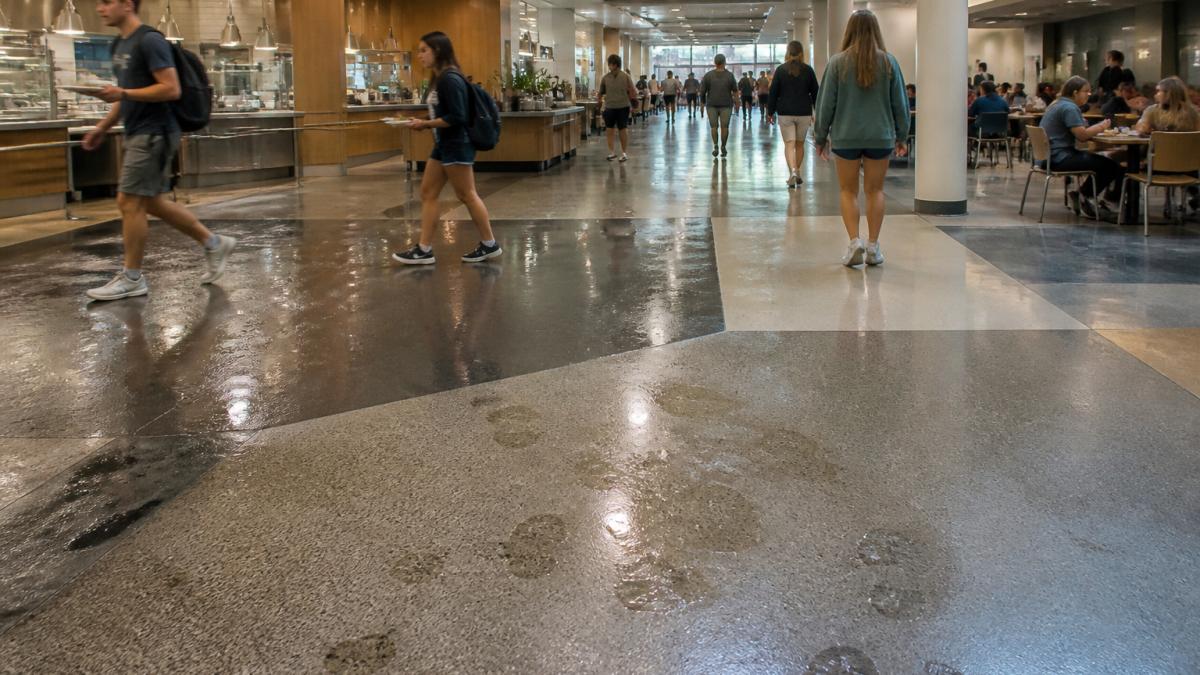
Wet areas and dining facilities present the most demanding slip resistance requirements on campus. These spaces combine moisture, foot traffic, and the likelihood of spills. Flooring must maintain friction when wet and under contamination.
Material Comparison: Tile, Vinyl, Carpet, and Terrazzo
Different flooring materials offer different slip resistance characteristics and maintenance demands.
Ceramic tile offers excellent slip resistance when properly selected.
Vinyl flooring is cost-effective and offers moderate slip resistance. Some products have textured surfaces to improve friction, and vinyl resists water penetration and is easy to clean.
Carpet is not appropriate for wet areas because it absorbs moisture, creating conditions for mold and bacterial growth, and becomes dangerously slippery when wet.
Terrazzo combines durability with excellent slip resistance. Its non-porous surface prevents water and contaminant absorption, and properly sealed terrazzo maintains consistent DCOF values over years of use.
Performance Under Real Campus Conditions
Laboratory testing measures slip resistance under controlled conditions, but campus environments are variable. Temperature fluctuations, different cleaning protocols, and varying foot traffic patterns all affect real-world performance.
Materials that perform well in the lab must also perform well under actual campus use. Flooring must maintain slip resistance through temperature cycles, under different types of contamination (dirt, food residue, cleaning product residue), and with the specific shoe types worn on campus.
Terrazzo performs consistently under these varied conditions. The material does not soften or degrade with temperature changes the way some polymeric flooring might.
Campus Flooring Maintenance and Slip Resistance Inspection
Slip resistance is not a one-time achievement at installation. It requires ongoing maintenance to preserve. Improper cleaning can actually reduce slip resistance, while proper maintenance preserves it.
Retesting Protocols and Durability Standards
After installation, flooring should be tested to confirm it meets the slip resistance standards university flooring specifications. This baseline measurement documents that the floor was correctly installed.
Retesting protocols use the same ASTM F2913 method as the original testing. Multiple measurements across the floor surface account for variation in wear patterns. High-traffic areas may show slightly lower DCOF values than less-trafficked areas, which is normal.
Durability standards recognize that some flooring materials retain slip resistance longer than others. Materials like terrazzo that resist wear and contamination absorption maintain slip resistance over decades.
Cleaning Products and Maintenance to Preserve Performance
The wrong cleaning products can damage flooring and reduce slip resistance. Some cleaners leave a slippery film on the surface. Others can degrade sealants or damage the flooring material itself.
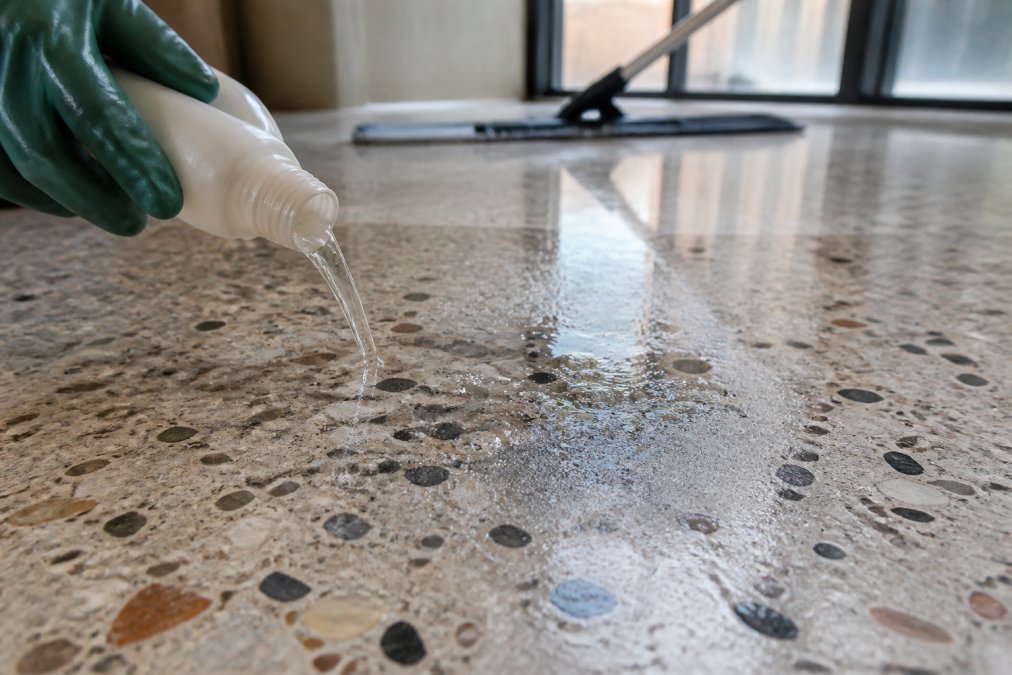
For terrazzo flooring, the maintenance protocol is straightforward: use pH-neutral cleaners specifically formulated for terrazzo, avoid acidic or alkaline products, and reseal periodically as recommended by the installer.
Facility managers should establish clear cleaning protocols and train staff accordingly. A cleaning schedule that maintains the floor without damaging it is an investment in safety. Regular maintenance costs far less than addressing injuries or replacing failed flooring.
Compliance and Risk Management for University Facilities
Universities face legal and regulatory obligations to maintain safe facilities.
Compliance with slip resistance standards demonstrates that the institution has taken reasonable precautions.
Risk management also includes understanding local and state regulations that may apply. Some states have specific requirements for public buildings or educational institutions.
A1 Terrazzo brings 35 years of experience in commercial flooring installation, including extensive work in educational facilities.
Selecting flooring for campus facilities requires balancing safety, durability, and budget. Slip resistance standards exist because they prevent injuries and reduce institutional liability.
Frequently Asked Questions
What slip-resistance standards apply to university flooring?
Universities must comply with ASTM F2913 for laboratory testing, ANSI A326.3 for tile slip resistance, and ADA Standards for accessibility. DCOF (dynamic coefficient of friction) ratings typically range from 0.42 to 0.75, with higher values indicating better slip resistance. Campus facilities should target DCOF values above 0.50 for wet areas like dining halls and above 0.42 for dry corridors. Specific compliance depends on the flooring material and intended use. Consult your facility manager or flooring specification team to determine which standards apply to your campus buildings.
How is the slip resistance of flooring measured?
Slip resistance is measured using standardized laboratory tests that calculate the coefficient of friction between a floor surface and a reference material. ASTM F2913 uses a tribometer device that measures dynamic coefficient of friction (DCOF) under wet and dry conditions. The test involves dragging a standardized rubber sensor across the floor at a controlled speed and angle. Results are expressed as a COF value; higher values mean greater slip resistance. Testing must be performed by qualified labs to ensure accuracy. Regular retesting after maintenance or surface changes helps verify that flooring maintains acceptable safety levels.
What does an R11 slip rating mean for tiles?
In the United States, ANSI A326.3 ratings are common and provide specific guidance for tile slip resistance. R11 tiles have a coefficient of friction between approximately 0.40 and 0.59, making them appropriate for corridors and classrooms but not ideal for wet environments like showers or kitchens. For university dining halls and wet areas, specify tiles with higher ratings (equivalent to DCOF above 0.50). Always verify that tile specifications meet both ANSI and ASTM standards for your campus climate and use case.
Which flooring materials are best for wet university areas?
Terrazzo, textured tile, and specialized vinyl composites perform well in wet campus areas when properly specified and maintained. Terrazzo offers excellent slip resistance, durability, and aesthetic appeal; its performance depends on surface finish and sealing. High-quality glazed or textured ceramic tile with DCOF ratings above 0.50 provides reliable slip resistance in wet conditions. Vinyl composite flooring with embedded aggregates or textured surfaces can meet slip-resistance standards but requires careful maintenance. Carpet and smooth stone are generally not recommended for wet areas. Consult material specifications and test results before specifying flooring for dining halls, bathrooms, or outdoor covered areas. Performance under real campus conditions, including cleaning products used and foot traffic patterns, should influence your final selection.
How often should campus floors be tested for slip resistance?
Universities should conduct initial slip-resistance testing before flooring is accepted after installation and then perform retesting every 12 to 24 months, depending on traffic volume and maintenance practices. High-traffic areas like dining halls and main corridors may require annual testing. Retesting should occur after major maintenance events, chemical treatments, or surface refinishing. If slip-and-fall incidents occur, immediate testing is warranted to identify whether the floor has degraded below acceptable standards. Maintenance practices significantly affect slip resistance; improper cleaning products or techniques can reduce COF values over time. Document all test results to demonstrate compliance and support risk management efforts. Work with your flooring contractor or a certified testing lab to establish a retesting schedule appropriate for your campus.
Can terrazzo flooring provide adequate slip resistance?
Yes, terrazzo can provide excellent slip resistance when properly specified and finished. Slip resistance depends on the surface finish: textured or aggregate-exposed finishes offer better grip than smooth polished surfaces. DCOF values for terrazzo typically range from 0.45 to 0.70 depending on finish, sealing, and maintenance. Terrazzo is durable, easy to clean with appropriate products, and maintains performance over decades with proper care. It is particularly well-suited for high-traffic campus areas, dining facilities, and wet environments when specified with slip-resistant finishes. Terrazzo's longevity and low maintenance requirements make it a cost-effective choice for universities seeking both safety and durability. Ensure your terrazzo specification includes ASTM testing results and maintenance protocols to preserve slip resistance throughout the floor's service life.
What should universities specify to avoid substrate and installation issues that cause cracking?
Proper substrate preparation is critical to prevent cracking and ensure long-term performance. Specify that contractors perform moisture testing before installation, install appropriate underlayment, and ensure proper curing times for adhesives and sealers. Require written documentation of substrate conditions, moisture levels, and curing procedures. Include performance guarantees and hold contractors accountable for workmanship defects. For terrazzo specifically, demand that installers follow ASTM standards for substrate preparation, use qualified installers with verifiable experience in commercial settings, and provide detailed maintenance documentation. Request references from similar institutional projects and inspect previous work. Clear specification language and contractor accountability reduce the risk of substrate-related failures that compromise both safety and durability.