 ultimate-guide
Durable Terrazzo for High Traffic: A 2026 Guide
Table of Contents
- Why Durable Terrazzo Outperforms Other High-Traffic Flooring
- Durability and Longevity: What Makes Terrazzo Built to Last
- Epoxy vs. Cementitious Terrazzo for High-Traffic Environments
- Commercial Terrazzo Maintenance Best Practices
- Terrazzo Flooring Installation Price 2026: Planning Your Investment
- Applications in Commercial Spaces: Healthcare, Airports, and Educational Facilities
- Repair and Restoration: Extending Terrazzo Life in High-Traffic Zones
- Frequently Asked Questions
Last Updated: August 21, 2026
Why Durable Terrazzo Outperforms Other High-Traffic Flooring
When you're managing a facility where thousands of people walk daily, your flooring choice isn't aesthetic, it's operational. Durable terrazzo for high traffic performs differently than standard alternatives because of how it's engineered at the substrate level. The monolithic surface created by epoxy or cementitious matrices means no grout lines to trap bacteria, no joints to fail under load, and no weak points where moisture penetrates.
This matters in hospitals where sanitation codes demand flawless surfaces. It matters in airports where foot traffic never stops. It matters in schools where maintenance budgets are tight but failure isn't an option. A1 Terrazzo has spent 35 years installing terrazzo in these exact environments, and the difference between a floor that lasts 20 years and one that fails in five comes down to substrate preparation and material selection, not just surface appeal.
The real advantage of durable terrazzo for high traffic is longevity paired with minimal maintenance complexity. Unlike tile or stone that requires sealing every 1-3 years, terrazzo's performance improves with proper sealing cycles. The aggregate particles, marble, granite, glass, or quartz, are locked into the matrix, creating a wear layer that actually resists abrasion better than the surface finish itself.
ASTM International standards for terrazzo specifications define the compressive strength requirements that separate commercial-grade terrazzo from decorative installations. Understanding these standards helps facility managers evaluate whether a contractor's proposal meets actual performance requirements or just aesthetic ones.
Durability and Longevity: What Makes Terrazzo Built to Last
Terrazzo's durability in high-traffic environments stems from its compressive strength and the way aggregate particles distribute load across the entire surface. A properly installed terrazzo floor can handle decades of foot traffic, equipment movement, and environmental stress that would crack or spall other materials.
The lifespan depends on three factors: the binder system (epoxy or cementitious), the aggregate selection, and maintenance protocol. Epoxy-based terrazzo typically performs better in wet environments and offers faster curing, while cementitious terrazzo provides superior compressive strength for heavy mechanical loads. Both, when installed correctly, exceed 30 years in service life.
Compressive Strength and Impact Resistance
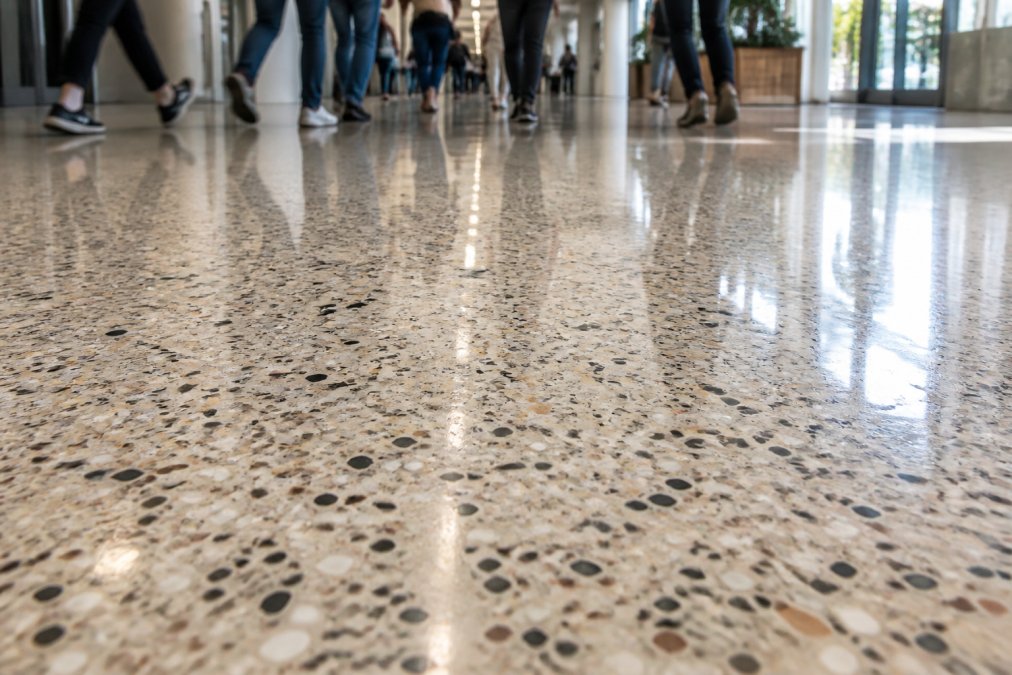
Compressive strength measures how much downward force a material can withstand before failing. Terrazzo achieves 4,000-5,000 PSI (pounds per square inch) depending on the binder and aggregate. This means a terrazzo floor can support concentrated loads from wheeled equipment, furniture legs, and the constant pressure of foot traffic without permanent deformation.
Impact resistance is different from compressive strength. It's the material's ability to absorb sudden shock without cracking. Terrazzo with a well-bonded aggregate matrix resists impact better than brittle alternatives like natural stone. A dropped instrument cart or heavy equipment wheel creates a localized stress that the matrix absorbs and distributes rather than concentrating at a single failure point.
The substrate preparation determines whether these properties are realized or wasted. If the subfloor has moisture issues, inadequate slope for drainage, or insufficient preparation, even premium terrazzo will fail. This is the most common reason facility managers see premature cracking, not because terrazzo itself is weak, but because the base wasn't ready.
Slip Resistance and Safety Features
Slip resistance is measured using the coefficient of friction (COF). The American Society for Testing and Materials (ASTM) D2047 standard defines COF values: 0.50 or higher is considered slip-resistant for level surfaces (astm.org). Terrazzo typically achieves 0.60-0.75 COF depending on the finish.
A polished terrazzo floor is slippery when wet. A honed finish (less glossy) provides better traction. A carborundum or aggregate-exposed finish offers maximum slip resistance. The choice depends on the space, hospitals often use honed finishes for safety while maintaining the aesthetic appeal of the material.
Slip resistance can be enhanced through sealing products that include anti-slip additives. These are applied during the sealing cycle and don't change the appearance significantly. For high-traffic healthcare facilities where both safety and sanitation matter, this is a standard specification.
Epoxy vs. Cementitious Terrazzo for High-Traffic Environments
The binder system determines how terrazzo performs in specific conditions. Epoxy terrazzo cures through chemical reaction rather than hydration, meaning it reaches full strength faster and resists moisture more effectively. Cementitious terrazzo uses Portland cement as the binder and cures through hydration, offering higher compressive strength but slower curing and greater moisture sensitivity.
For high-traffic environments, the choice depends on the specific conditions. Epoxy terrazzo excels in wet areas, kitchens, bathrooms, laboratory spaces where chemical spills are routine. Cementitious terrazzo performs better in dry, high-load environments where maximum compressive strength matters more than moisture resistance.
Epoxy terrazzo costs more upfront but requires less maintenance and fewer sealing cycles. Cementitious terrazzo costs less initially but demands more rigorous maintenance protocols. Neither is "better", the right choice depends on the facility's environmental conditions and maintenance capacity.
A1 Terrazzo evaluates these factors during the design phase, recommending the system that delivers the best lifecycle performance for your specific space rather than just the lowest installation cost.
Commercial Terrazzo Maintenance Best Practices
Maintenance determines whether durable terrazzo for high traffic actually lasts 30 years or fails in five. The protocol isn't complicated, but it must be consistent. Improper cleaning products, inadequate sealing cycles, or deferred maintenance will degrade even premium installations.
The maintenance cycle has three components: daily cleaning, periodic deep cleaning, and scheduled sealing. Each serves a specific purpose. Daily cleaning prevents dirt accumulation and protects the seal. Deep cleaning removes embedded soils that daily protocols miss. Sealing cycles restore the protective barrier that prevents staining and moisture penetration.
Daily and Weekly Cleaning Protocols
Daily cleaning should use pH-neutral cleaners specifically formulated for terrazzo. Acidic cleaners (vinegar, lemon juice) etch the surface. Alkaline cleaners (bleach, ammonia) can damage the seal. A microfiber mop with pH-neutral solution removes dust and light soils without leaving residue.
Weekly cleaning can include light scrubbing with a soft-bristle brush for areas with higher soil loads. The goal is to remove dirt before it becomes embedded in the seal. In healthcare facilities, this might mean daily disinfection with terrazzo-safe products followed by neutral pH rinse.
Never use abrasive pads or high-speed buffing on terrazzo. The aggregate particles can be scratched, and the seal can be damaged by mechanical action that's too aggressive. Facility managers should specify cleaning protocols in contracts with janitorial services to prevent inadvertent damage. finishes for high-traffic areas.
Sealing and Polishing Cycles
Sealing creates a protective barrier that prevents staining and moisture penetration. Terrazzo requires sealing every 12-24 months depending on traffic volume and environmental conditions. High-traffic commercial spaces might need annual sealing. Lower-traffic areas might extend to 24 months.
Polishing occurs between sealing cycles to restore the glossy finish and remove minor scuffs. Professional polishing uses diamond-impregnated pads that gradually wear away the top layer of the seal, revealing fresh material beneath. This is different from buffing, polishing actually removes material, while buffing just shines the existing surface.
The sealing product matters. Penetrating sealers protect from within. Film-forming sealers create a protective layer on top. For high-traffic areas, film-forming sealers are typically preferred because they're easier to reapply and provide more visible protection. The sealer type should match the terrazzo system (epoxy vs. cementitious) and the facility's environmental conditions.
Terrazzo Flooring Installation Price 2026: Planning Your Investment
Installation cost for durable terrazzo for high traffic depends on several variables: the binder system, aggregate selection, floor area, subfloor condition, and complexity of the design. A straightforward epoxy installation in a prepared space costs less than a cementitious installation with complex patterns in a space requiring extensive substrate work.
Rather than stating a generic price range, facility managers should request detailed quotes that break down substrate preparation, material costs, labor, and sealing. This transparency helps identify where costs are concentrated and where value can be optimized.
National Association of Terrazzo Professionals guidelines provides resources for evaluating contractor proposals and understanding industry standards for installation quality.
Lifecycle Cost Analysis for High-Traffic Areas
Lifecycle cost analysis (LCCA) compares the total cost of ownership over 20-30 years, not just the installation price. Terrazzo typically has higher upfront costs but lower ongoing maintenance expenses compared to alternatives like VCT (vinyl composition tile) or polished concrete.
A facility manager should calculate: installation cost + annual maintenance costs (labor and materials) + sealing cycles + repairs/restoration over the expected service life. Then compare this total to alternatives. Terrazzo often wins this analysis because the maintenance is less complex and less frequent than materials requiring more aggressive chemical treatments or more frequent replacement.
The real cost advantage appears after year 5-7 when alternative materials begin failing and requiring replacement or major restoration. Terrazzo, if maintained properly, continues performing without significant degradation.
Applications in Commercial Spaces: Healthcare, Airports, and Educational Facilities
Durable terrazzo for high traffic dominates specific commercial sectors because it solves problems that other materials can't address cost-effectively.
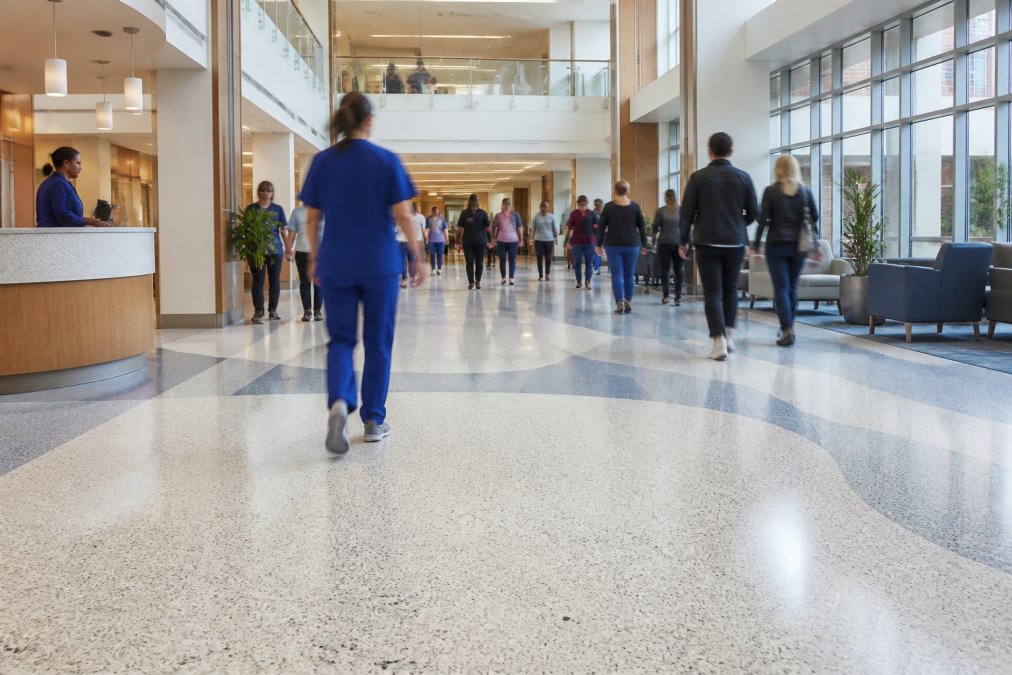
Healthcare facilities require flooring that can withstand constant foot traffic, wheeled equipment, chemical spills, and aggressive cleaning protocols without harboring bacteria or viruses. Terrazzo's monolithic surface and jointless design eliminate the hiding places that tile grout provides. The material is compatible with hospital-grade disinfectants and doesn't degrade under repeated chemical exposure.
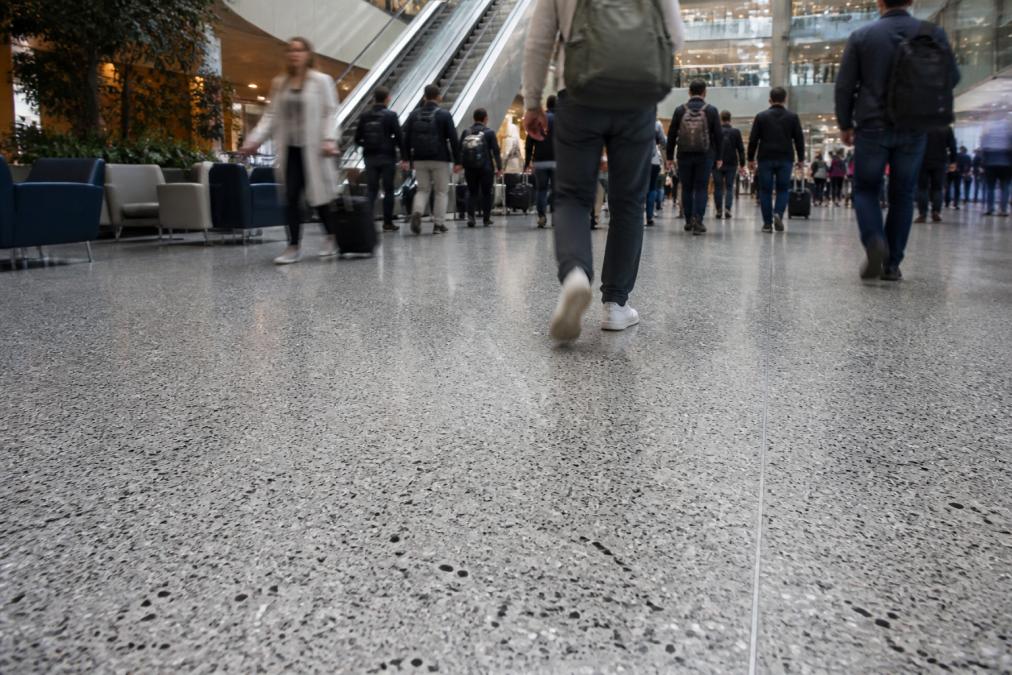
Airports and cruise terminals have the highest foot traffic of any commercial space. Thousands of people move through these facilities daily, along with luggage, carts, and equipment. Terrazzo's compressive strength and impact resistance make it ideal for this environment. The aesthetic appeal also matters, terrazzo in major terminals creates a professional impression that influences customer perception.
Educational facilities benefit from terrazzo's durability and low maintenance. Schools operate on tight budgets and can't afford frequent floor replacement. A terrazzo installation in a high-traffic hallway or cafeteria will outlast multiple generations of students while requiring only routine maintenance.
Government buildings, courthouses, and administrative facilities often feature original terrazzo that's decades old. Restoring these floors preserves architectural character while maintaining performance.
Repair and Restoration: Extending Terrazzo Life in High-Traffic Zones
Even properly maintained terrazzo eventually shows wear in high-traffic zones. Restoration protocols can extend the life significantly without requiring complete replacement.
Minor repairs, filling small cracks or chips, can be done with epoxy or polyester compounds that match the original material. The repair area is ground smooth and resealed to match the surrounding floor. These repairs are invisible if done properly and don't compromise performance.
Major restoration involves grinding the entire surface to remove the worn seal and expose fresh material beneath. This process removes shallow scratches, scuffs, and minor stains while restoring the original finish. The floor is then resealed and polished, effectively resetting the maintenance clock.
Restoration is far less expensive than replacement and can extend terrazzo life by 10-15 additional years. A facility manager facing a worn terrazzo floor should explore restoration before considering replacement.
A1 Terrazzo offers restoration services for original installations and for terrazzo installed by other contractors. The expertise required to match original patterns and finishes comes from experience, knowing how to assess what was done originally and replicate it accurately. This is particularly important for historic buildings where architectural integrity matters.
The choice to install durable terrazzo for high traffic is ultimately a choice about performance over decades, not just appearance today. It requires upfront investment in proper installation and commitment to maintenance protocols, but the payoff is a floor that outlasts the building's functional life in many cases. A1 Terrazzo brings 35 years of experience installing and maintaining commercial terrazzo across healthcare facilities, airports, universities, and government buildings. Contact A1 Terrazzo to discuss your facility's specific requirements and get a detailed assessment of how terrazzo can solve your high-traffic flooring challenges while delivering the durability and aesthetic appeal your space deserves.
Frequently Asked Questions
What makes terrazzo flooring exceptionally durable for high-traffic areas?
Terrazzo's durability comes from its composition: a matrix of cement or epoxy resin combined with stone aggregate and carborundum particles. This creates a monolithic surface with high compressive strength and abrasion resistance. The aggregate distribution ensures impact resistance across the entire floor, while proper sealing protects against porosity and staining. In high-traffic environments like hospitals and airports, terrazzo maintains its structural integrity for decades when installed correctly and maintained according to facility management protocols.
How does terrazzo compare to other high-traffic flooring materials in terms of lifecycle cost?
Terrazzo typically requires higher upfront installation costs than some alternatives, but lifecycle cost analysis reveals long-term savings. Unlike vinyl or standard tile that require replacement every 10-15 years, terrazzo floors last 30+ years with proper maintenance. Repair and restoration protocols allow worn areas to be refinished rather than replaced entirely. When you factor in reduced replacement frequency, lower maintenance labor over time, and minimal chemical resistance issues, terrazzo's total cost of ownership is competitive for commercial spaces managing high foot traffic volume.
What are the primary maintenance requirements for high-traffic terrazzo?
Daily cleaning uses pH-neutral cleaners to prevent porosity degradation and staining. Weekly protocols should include more thorough cleaning of high-traffic zones. Sealing cycles typically occur every 1-3 years depending on foot traffic volume and facility type. Polishing maintains the architectural finish and slip resistance. Avoid acidic cleaners and harsh chemicals that compromise the wear layer. Proper cleaning protocols prevent damage that would otherwise require costly repair and restoration work.
Can terrazzo be refinished to restore its durability after years of high-traffic use?
Yes. Terrazzo's monolithic surface allows for refinishing and restoration protocols that restore both durability and aesthetics. Professional restoration can address wear patterns, surface scratches, and staining without full replacement. This repair capability extends terrazzo's lifecycle significantly and makes it ideal for historic buildings and facilities seeking to maintain original flooring. Restoration protocols vary by damage type and terrazzo composition, so working with experienced contractors ensures the floor's performance is fully restored.
This article was written using GrandRanker
Frequently Asked Questions
What makes terrazzo flooring exceptionally durable for high-traffic areas?
Terrazzo's durability comes from its composition: a matrix of cement or epoxy resin combined with stone aggregate and carborundum particles. This creates a monolithic surface with high compressive strength and abrasion resistance. The aggregate distribution ensures impact resistance across the entire floor, while proper sealing protects against porosity and staining. In high-traffic environments like hospitals and airports, terrazzo maintains its structural integrity for decades when installed correctly and maintained according to facility management protocols.
How does terrazzo compare to other high-traffic flooring materials in terms of lifecycle cost?
Terrazzo typically requires higher upfront installation costs than some alternatives, but lifecycle cost analysis reveals long-term savings. Unlike vinyl or standard tile that require replacement every 10-15 years, terrazzo floors last 30+ years with proper maintenance. Repair and restoration protocols allow worn areas to be refinished rather than replaced entirely. When you factor in reduced replacement frequency, lower maintenance labor over time, and minimal chemical resistance issues, terrazzo's total cost of ownership is competitive for commercial spaces managing high foot traffic volume.
What are the primary maintenance requirements for high-traffic terrazzo?
Daily cleaning uses pH-neutral cleaners to prevent porosity degradation and staining. Weekly protocols should include more thorough cleaning of high-traffic zones. Sealing cycles typically occur every 1-3 years depending on foot traffic volume and facility type. Polishing maintains the architectural finish and slip resistance. Avoid acidic cleaners and harsh chemicals that compromise the wear layer. Proper cleaning protocols prevent damage that would otherwise require costly repair and restoration work.
Can terrazzo be refinished to restore its durability after years of high-traffic use?
Yes. Terrazzo's monolithic surface allows for refinishing and restoration protocols that restore both durability and aesthetics. Professional restoration can address wear patterns, surface scratches, and staining without full replacement. This repair capability extends terrazzo's lifecycle significantly and makes it ideal for historic buildings and facilities seeking to maintain original flooring. Restoration protocols vary by damage type and terrazzo composition, so working with experienced contractors ensures the floor's performance is fully restored.