 how-to
How to Choose Commercial Terrazzo Contractors in Florida
Table of Contents
- What to Confirm Before Hiring Terrazzo Contractors in Florida
- Why NTMA Certified Terrazzo Contractors Florida Projects Demand
- Terrazzo Installation Project Portfolio Examples That Prove Capability
- Commercial Terrazzo Flooring Cost per Square Foot in Florida
- Florida Climate Considerations for Terrazzo Installation
- How to Evaluate Commercial Terrazzo Contractors in Florida on Performance Criteria
- Step-by-Step: The Commercial Terrazzo Installation Process
- Frequently Asked Questions
Last Updated: August 10, 2026
Choosing the wrong terrazzo contractor on a commercial project doesn't just cost money, it costs years. Substrate failures, delamination, and premature cracking result almost always from poor vetting at the hiring stage. At A1 Terrazzo, we've spent over 35 years working on commercial floors across Florida, and the patterns are consistent: facility managers and general contractors who ask the right questions before signing a contract almost never end up with the same problems as those who chose on price alone.
This guide covers how to choose commercial terrazzo contractors in Florida, from licensing requirements and NTMA certification to climate-specific installation risks and contractual red flags that should end a conversation immediately.
What to Confirm Before Hiring Terrazzo Contractors in Florida
The biggest mistake commercial buyers make is treating the pre-hire phase as a formality. This is where you separate contractors who understand the full scope of a commercial terrazzo installation from those who've done residential work and scaled up their pitch.
Start with three non-negotiable verifications.
Licensing, Bonding, and Insurance Requirements in Florida
Florida requires terrazzo contractors to hold a state-issued license through the Florida Department of Business and Professional Regulation. For commercial work, the relevant category is typically a Specialty Contractor license under the Florida Building Code. Verify the license number directly on the DBPR website.
Beyond licensing, confirm:
- General liability insurance, minimum $1 million per occurrence for most commercial projects
- Workers' compensation coverage, required by Florida law for any contractor with employees; request the certificate directly from the carrier
- Surety bond, protects the project owner if the contractor fails to complete the work or meet specifications
Workman's compensation gaps are a common contractual exposure. If a subcontractor's employee is injured on your site and that subcontractor lacks coverage, liability can flow upward to the general contractor or facility owner. Verify this independently.
Subcontractor vs. General Contractor: Who Owns the Work?
Ask directly: "Will your company perform the terrazzo installation, or will you subcontract it?"
If the answer is subcontracting, request the subcontractor's name, license number, and insurance documentation separately. The GC's insurance does not automatically cover the sub's workmanship. Confirm that project specifications, aggregate selection, epoxy terrazzo vs. cementitious terrazzo, divider strip placement, moisture vapor transmission testing, are written into the subcontract, not just the primary contract.
Why NTMA Certified Terrazzo Contractors Florida Projects Demand
NTMA certification signals that a contractor has been trained to recognized standards. The National Terrazzo and Mosaic Association sets technical specifications for commercial terrazzo installation, including mix ratios, curing protocols, and finishing requirements. NTMA certified terrazzo contractors Florida-wide are not the majority of the market; many contractors offer terrazzo as one of several flooring services without deep specialization.
For a hospital corridor, an airport terminal, or a courthouse lobby, that generalist approach carries real risk. An NTMA-affiliated contractor understands project specifications well enough to flag design conflicts before installation begins.
Terrazzo Installation Project Portfolio Examples That Prove Capability
Request documented terrazzo installation project portfolio examples that match your project type. A contractor who has installed terrazzo in a K-12 school is not automatically qualified for a healthcare facility with infection control requirements.
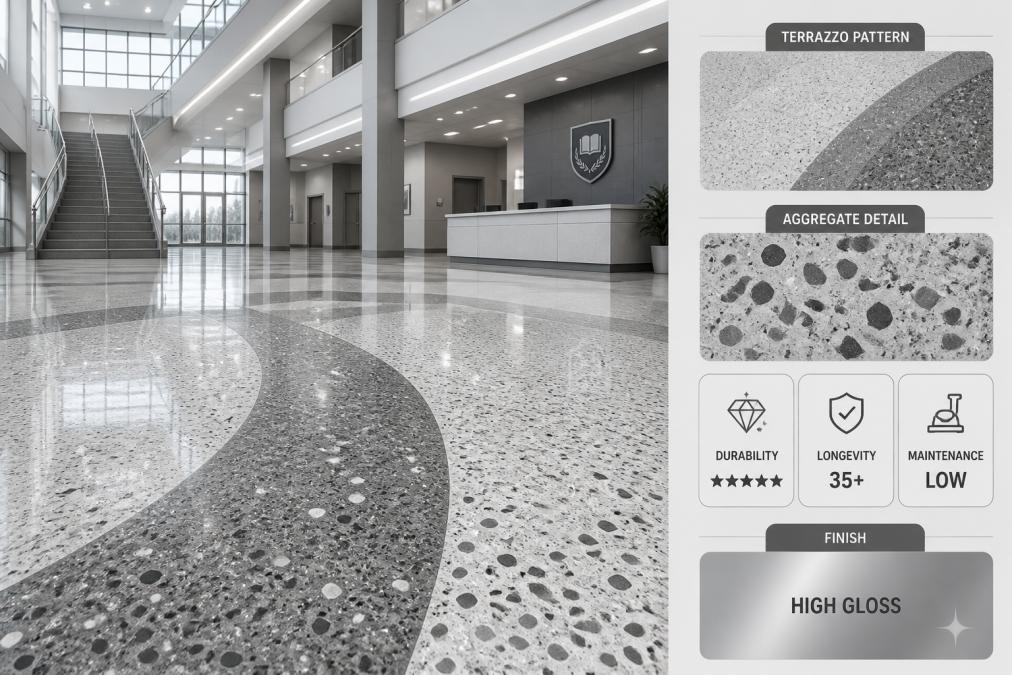
High-Traffic Institutional Buildings: Airports, Hospitals, and Schools
For high-traffic areas, ask the contractor to provide:
- The square footage of the largest comparable project completed
- The floor system specified (epoxy terrazzo vs. cementitious terrazzo, and why)
- How sub-floor preparation was handled, including any moisture vapor transmission testing
- The maintenance protocols recommended post-installation
- References from the facility manager
Epoxy terrazzo is generally preferred in healthcare settings because it is non-porous, highly resistant to chemical cleaners, and easier to maintain to sanitation standards.
Historic Restoration vs. New Commercial Build
Restoration work requires a fundamentally different skill set than new commercial build. If your project involves a historic building, ask specifically: "Have you matched existing terrazzo in a restoration project, and can I see photographs of the finished result?"
Commercial Terrazzo Flooring Cost per Square Foot in Florida
Pricing for commercial terrazzo flooring varies based on the floor system type, sub-floor condition, aggregate selection, project scale, and site access constraints. Many project managers make the mistake of comparing terrazzo bids as if they're comparing identical products. One bid may include moisture vapor transmission testing and a full sub-floor preparation protocol; another may assume the sub-floor is ready and exclude remediation.
Request an itemized breakdown from every contractor. For commercial terrazzo flooring cost per square foot in Florida, contact A1 Terrazzo directly for a project-specific estimate; pricing depends on scope, specifications, and site conditions.
Florida Climate Considerations for Terrazzo Installation
Florida's climate creates installation challenges that contractors in other states don't routinely encounter. High ambient humidity, temperature swings, and moisture-laden sub-floors all affect how terrazzo performs over time.
Moisture vapor transmission is the primary concern. When moisture migrates upward through a concrete sub-floor and becomes trapped beneath a terrazzo system, it causes delamination, discoloration, and cracking. A qualified contractor will conduct moisture vapor emission rate testing before installation begins and specify an appropriate moisture mitigation system if readings exceed acceptable thresholds. According to guidance from the Tile Council of North America on moisture testing standards, moisture testing should be conducted under conditions representative of actual service conditions.
Florida's hurricane season creates scheduling considerations for large exterior or semi-exterior terrazzo applications. Curing environments must be controlled, and installations requiring extended open-air curing should be scheduled to avoid peak storm season where possible.
How to Evaluate Commercial Terrazzo Contractors in Florida on Performance Criteria
Evaluating contractors on performance criteria means assessing how they manage a project within your construction network, timeline, and quality requirements.
Key performance criteria to assess:
- Installation timeline accuracy, Ask for references who can speak to whether the contractor met the project schedule
- Project management structure, Who is the on-site supervisor? What is the escalation path if specifications aren't being met?
- Communication protocols, How are RFIs and specification conflicts handled?
- Floor finishing standards, What polishing and sealing specifications does the contractor use as a default?
Contractual Red Flags to Watch For
- No defined performance criteria, If the contract doesn't specify finish level, gloss measurement, aggregate distribution, or acceptable tolerances, you have no recourse when the result doesn't meet expectations.
- Vague sub-floor preparation language, "Sub-floor to be prepared as needed" is not a specification. Require explicit language about moisture testing, leveling tolerances, and remediation protocols.
- Exclusion of moisture remediation, Any contract that excludes moisture vapor transmission testing or mitigation in a Florida climate should be renegotiated before signing.
- No warranty on workmanship, A contractor who won't provide a written workmanship warranty is telling you something important about their confidence in the finished product.
- Payment schedules front-loaded toward the contractor, Standard commercial practice ties payments to project milestones. Contracts requiring large upfront payments before work begins carry higher completion risk.
Sustainability and LEED Certification Considerations
Terrazzo is one of the most sustainable commercial flooring options available. It is made largely from recycled aggregate materials, has an exceptionally long service life, and requires no replacement for decades when properly maintained. For projects with sustainability requirements, confirm that the contractor can document the recycled content of aggregate materials and produce documentation suitable for LEED submission.
Step-by-Step: The Commercial Terrazzo Installation Process
Understanding the installation process gives you a framework for evaluating contractor competence and monitoring project progress.
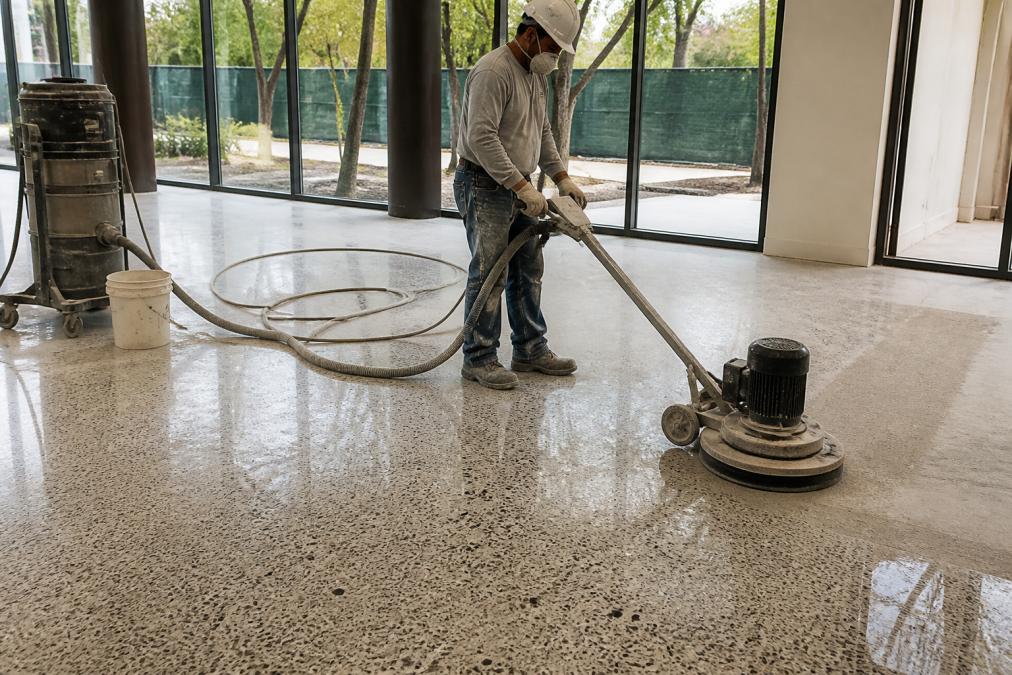
Step 1: Sub-floor assessment and preparation The installer evaluates the concrete substrate for flatness, structural integrity, and moisture vapor emission levels. Any remediation, crack repair, leveling, or moisture mitigation membrane installation happens here.
Step 2: Divider strip layout Metal or plastic divider strips are installed according to the architectural drawings, defining the pattern and providing control joints that manage expansion and contraction.
Step 3: Terrazzo mix installation The terrazzo matrix, epoxy or cementitious, combined with aggregate, is poured and spread within the divider strip sections.
Step 4: Initial grinding Once cured, the surface is ground with progressively finer abrasives to expose the aggregate and achieve a flat, uniform surface.
Step 5: Grouting and filling Surface voids are filled with matching matrix material and allowed to cure before further grinding.
Step 6: Polishing and sealing The floor is brought to the specified finish level through fine polishing, then sealed with an appropriate sealer for the use environment.
Step 7: Final inspection and handover A qualified inspector reviews the finished floor against the project specifications. Gloss level, aggregate distribution, divider strip alignment, and surface flatness should all be measured and documented before the floor is accepted.
| Phase | Key Risk | What to Verify |
|---|---|---|
| Sub-floor preparation | Moisture vapor transmission | Moisture test results and mitigation spec |
| Divider strip layout | Pattern deviation from drawings | Sign-off on layout before pour |
| Terrazzo installation | Mix inconsistency | Contractor's quality control process |
| Grinding | Aggregate exposure uniformity | Mid-process inspection |
| Polishing and sealing | Wrong sealer for use environment | Sealer specification in contract |
| Final handover | No documented acceptance | Written punch list and sign-off |
Commercial terrazzo projects fail most often not because of the material, but because of who installs it and what was agreed to in writing before they started. If you're managing a hospital, airport, school, or historic restoration in Florida, the vetting process outlined here is the difference between a floor that performs for 50 years and one that needs remediation within 18 months. A1 Terrazzo brings over 35 years of specialized commercial terrazzo experience across Florida, with deep expertise in institutional buildings, historic restoration, and the climate-specific installation protocols this state demands. Contact A1 Terrazzo for a site inspection and project-specific estimate.
Frequently Asked Questions
What certifications should a commercial terrazzo contractor in Florida hold?
At minimum, a Florida commercial terrazzo contractor should hold a valid Florida Certified Contractor license issued by the Florida Department of Business and Professional Regulation (DBPR), carry general liability insurance and workers' compensation coverage, and be bonded. NTMA membership and certification signals additional commitment to industry standards, proper installation methods, and ongoing training. For healthcare or government projects, ask specifically whether the contractor has experience meeting facility-specific safety and sanitation standards.
How do I verify the past performance of a Florida terrazzo installation company?
Request a project portfolio with verifiable references from comparable commercial builds, specifically hospitals, airports, schools, or institutional buildings similar to yours. Confirm the contractor's license status directly through the Florida DBPR online lookup tool. Ask for project specifications, installation timelines, and documented outcomes. Speaking directly with a facility manager or operations director from a completed project gives you the most reliable performance signal beyond what any contractor will volunteer.
What are the common pitfalls when hiring terrazzo contractors for commercial projects?
The most damaging pitfalls are inadequate sub-floor preparation, which causes cracking and delamination, and ignoring moisture vapor transmission rates in Florida's humid climate. Hiring a contractor without documented commercial terrazzo installation experience in high-traffic areas is another frequent mistake. Contractual red flags include vague scope-of-work language, no defined performance criteria, and no workman's compensation coverage. Always confirm whether you're hiring the installing contractor directly or a general contractor who will subcontract the terrazzo work.
Is terrazzo a good flooring choice for high-traffic commercial spaces in Florida?
Terrazzo is one of the most durable commercial flooring systems available, making it well-suited for airports, hospitals, courthouses, and schools where foot traffic is constant. Both epoxy terrazzo and cementitious terrazzo offer exceptional flooring longevity when properly installed and maintained. Florida's climate adds a consideration: the floor system must account for moisture vapor transmission from the slab. Properly installed terrazzo with correct sealing and maintenance protocols can last decades, reducing lifecycle costs significantly compared to alternative commercial flooring options.
This article was written using GrandRanker
Frequently Asked Questions
What certifications should a commercial terrazzo contractor in Florida hold?
At minimum, a Florida commercial terrazzo contractor should hold a valid Florida Certified Contractor license issued by the Florida Department of Business and Professional Regulation (DBPR), carry general liability insurance and workers' compensation coverage, and be bonded. NTMA membership and certification signals additional commitment to industry standards, proper installation methods, and ongoing training. For healthcare or government projects, ask specifically whether the contractor has experience meeting facility-specific safety and sanitation standards.
How do I verify the past performance of a Florida terrazzo installation company?
Request a project portfolio with verifiable references from comparable commercial builds, specifically hospitals, airports, schools, or institutional buildings similar to yours. Confirm the contractor's license status directly through the Florida DBPR online lookup tool. Ask for project specifications, installation timelines, and documented outcomes. Speaking directly with a facility manager or operations director from a completed project gives you the most reliable performance signal beyond what any contractor will volunteer.
What are the common pitfalls when hiring terrazzo contractors for commercial projects?
The most damaging pitfalls are inadequate sub-floor preparation, which causes cracking and delamination, and ignoring moisture vapor transmission rates in Florida's humid climate. Hiring a contractor without documented commercial terrazzo installation experience in high-traffic areas is another frequent mistake. Contractual red flags include vague scope-of-work language, no defined performance criteria, and no workman's compensation coverage. Always confirm whether you're hiring the installing contractor directly or a general contractor who will subcontract the terrazzo work.
Is terrazzo a good flooring choice for high-traffic commercial spaces in Florida?
Terrazzo is one of the most durable commercial flooring systems available, making it well-suited for airports, hospitals, courthouses, and schools where foot traffic is constant. Both epoxy terrazzo and cementitious terrazzo offer exceptional flooring longevity when properly installed and maintained. Florida's climate adds a consideration: the floor system must account for moisture vapor transmission from the slab. Properly installed terrazzo with correct sealing and maintenance protocols can last decades, reducing lifecycle costs significantly compared to alternative commercial flooring options.