 ultimate-guide
Professional Terrazzo Floor Polishing Services: 2026 Guide
Table of Contents
- What Professional Terrazzo Floor Polishing Services Actually Involve
- The Terrazzo Polishing Process: Step by Step
- DIY vs. Professional Terrazzo Polishing: An Honest Comparison
- Terrazzo Floor Restoration Cost: What Drives the Price
- Terrazzo Floor Maintenance Tips to Protect Your Investment
- Long-Term ROI: Why Professional Terrazzo Polishing Pays Off
- Frequently Asked Questions
Last Updated: August 8, 2026
What Professional Terrazzo Floor Polishing Services Actually Involve
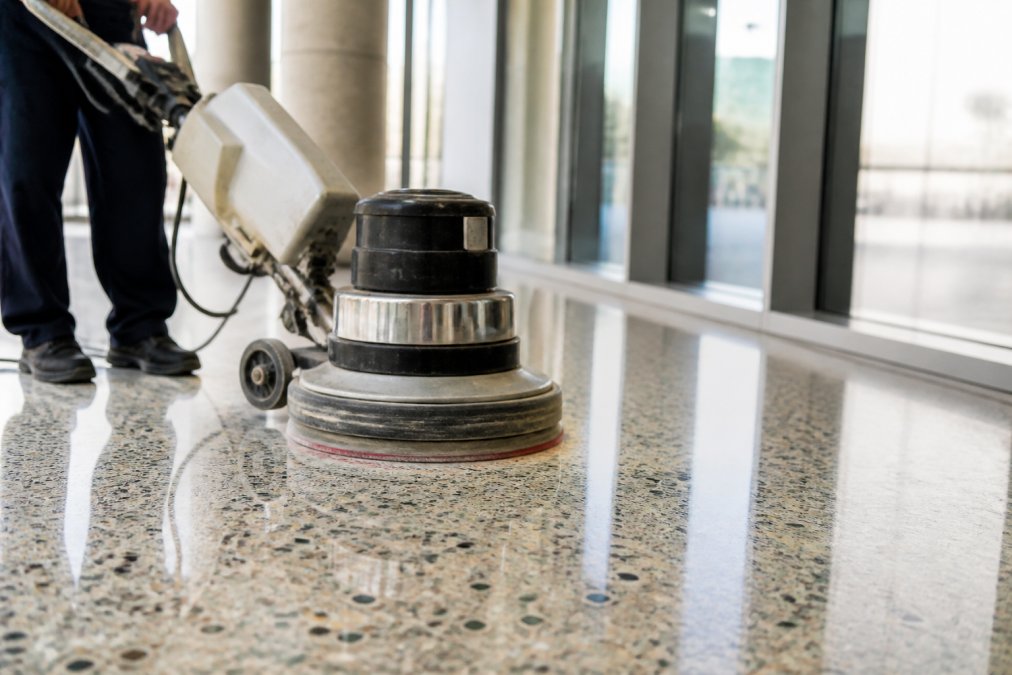
Terrazzo floor polishing is the multi-stage process of grinding, honing, repairing, and sealing a terrazzo surface to restore its original luster, eliminate surface damage, and extend its functional lifespan. Done correctly, it transforms a dull, scratched, or yellowing floor into a high-gloss or natural-finish surface that performs for decades.
At A1 Terrazzo, we've worked on floors in hospitals, airports, courthouses, and university campuses across Florida for over 35 years. The single most consistent finding: floors that look "too far gone" are almost never beyond restoration. What separates success from failure is understanding what type of terrazzo you're dealing with before equipment touches the surface.
Most people don't realize that terrazzo floors fall into two fundamentally different categories, and treating them the same way is a common industry mistake.
Cement-Based vs. Epoxy Terrazzo: Why the Difference Matters
Cement-based terrazzo is the traditional formulation, poured over a sand-bed or bonded directly to concrete. It contains marble chips, calcite aggregate, and a Portland cement binder. Because it is porous, it absorbs stains and reacts to acidic cleaners, requiring penetrating sealer applications for protection. Many historic Florida buildings have mid-20th century cement-based terrazzo that remains structurally sound but visually degraded from improper cleaning and wax cycles.
Epoxy terrazzo is the modern standard for high-traffic commercial installations. It uses an epoxy or polyester resin binder instead of cement, dramatically reducing porosity and allowing thinner pours. Epoxy terrazzo is preferred for healthcare facilities and airports because its low porosity resists staining, etching, and microbial penetration.
The restoration approach differs significantly. Cement-based floors require careful attention to sealer compatibility and are vulnerable to over-grinding. Epoxy terrazzo tolerates more aggressive diamond grinding but requires specific tooling to avoid heat buildup in the resin. Misidentifying the floor type leads to irreversible damage.
Signs Your Floor Needs Restoration Now
Surface dullness that doesn't respond to routine cleaning is the clearest signal. Watch also for visible scratches, yellowing from old wax buildup, hairline cracks, pitting or spalling, stains that deep cleaning cannot remove, and a gritty texture underfoot from surface erosion.
Waiting compounds these problems. A floor with minor scratches becomes one with deep etching and stain penetration into the calcite aggregate, requiring more aggressive grinding and material removal, which increases cost and shortens remaining lifespan.
The Terrazzo Polishing Process: Step by Step
Professional terrazzo floor polishing follows a defined sequence. Skipping steps or reordering them produces poor results, and cost-cutting shortcuts create expensive problems within a year or two.
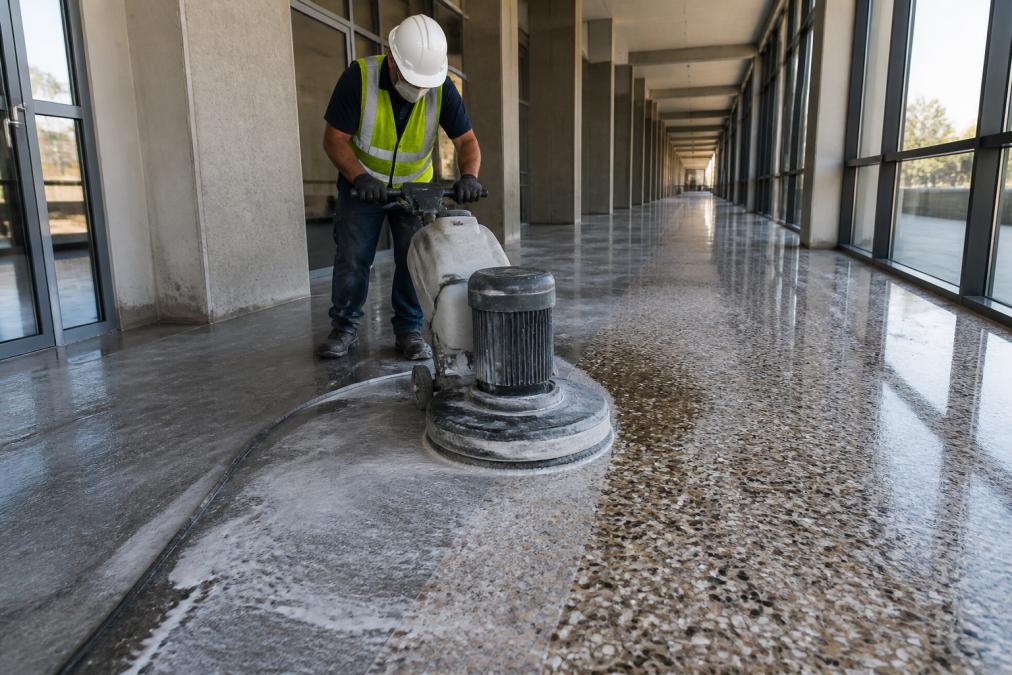
The full process runs as follows:
- Initial assessment and floor type identification, Visual inspection and, where needed, core sampling to confirm binder type, thickness, and substrate condition.
- Deep cleaning and stripping, Removal of old wax, coatings, and contaminants using pH-appropriate cleaners.
- Coarse diamond grinding, Heavy-grit diamond tooling removes deep scratches, stains, and uneven areas.
- Progressive honing, Sequential passes with finer grits (typically 30-grit through 200-grit) refine the surface and eliminate grinding marks.
- Crack and chip repair, Structural repairs are completed after initial grinding exposes the full damage picture.
- Fine polishing passes, Higher-grit diamond tooling (400-grit and above) brings the surface to the target finish level.
- Crystallization or densifier application, For cement-based floors, a chemical densifier hardens the surface matrix and increases abrasion resistance.
- Sealing, A penetrating sealer protects the polished surface from staining and moisture absorption.
- Final inspection and buffing, The finished floor is inspected under raking light to confirm uniformity.
Diamond Grinding and Honing
Diamond grinding is the technical foundation of terrazzo restoration. Professional equipment uses segmented diamond tooling bonded to rotating heads, with grit levels matched to floor condition. Coarser grits cut aggressively; finer grits refine progressively.
The critical variable is grit sequencing. Jumping from coarse to fine grit without intermediate steps leaves subsurface scratches that become visible once final polish is applied. Water management during grinding controls dust, keeps tooling cool, and produces slurry that helps technicians monitor even material removal.
Crack and Chip Repair Before Polishing
Crack repair must happen after initial grinding, not before. Grinding reveals the true extent of cracking; what looks like a hairline crack often branches or widens once the top layer is removed.
Professional crack repair uses color-matched epoxy or polyester resins, matched forensically to the surrounding matrix and aggregate. The repair material is applied, cured, ground flush with the surrounding surface, and polishing continues. According to the National Terrazzo and Mosaic Association's technical guidelines, proper substrate preparation and crack stabilization are prerequisites for any restoration work intended to last.
Sealing and Protective Coatings
Sealing is the step most often skipped or done poorly on budget restorations, and it determines how long the polished finish actually lasts.
A penetrating sealer migrates into the pore structure and bonds chemically with the substrate, rather than forming a film on top. This preserves the natural finish and high-gloss appearance while blocking liquid and oil-based stain penetration. Film-forming coatings are more susceptible to wear, scratching, and yellowing.
For cement-based terrazzo, sealer selection must account for porosity. A sealer that works on dense epoxy terrazzo may not protect a 50-year-old cement-based floor with high aggregate porosity. Professional applicators test sealer absorption rates before committing to a product across an entire floor. The Marble Institute of America provides technical guidance on stone and terrazzo sealer selection.
DIY vs. Professional Terrazzo Polishing: An Honest Comparison
DIY terrazzo polishing works only for very minor surface refreshing.
Consumer-grade polishing machines lack the weight, power, and diamond tooling quality of professional equipment. They cannot perform meaningful diamond grinding, cannot correct deep scratches, and cannot achieve the grit progression required for a durable high-gloss finish. On cement-based floors, an undertrained operator using wrong products can etch the calcite aggregate permanently.
In commercial environments, a botched DIY restoration costs far more in operational disruption than the professional service would have.
| Factor | DIY Approach | Professional Service |
|---|---|---|
| Equipment capability | Consumer-grade, limited grit range | Industrial diamond grinders, full grit progression |
| Crack and chip repair | Not feasible | Forensic color matching, structural repair |
| Sealer application | Topical coating only | Penetrating sealer, substrate-matched |
| Finish quality | Surface-level improvement | Full restoration to high-gloss or natural finish |
| Risk of damage | High on cement-based floors | Managed by trained technicians |
For routine maintenance between professional restorations, pH-neutral cleaning products applied correctly extend service intervals.
Terrazzo Floor Restoration Cost: What Drives the Price
Terrazzo floor restoration cost varies based on concrete variables. Any quote that doesn't account for them is unreliable.
The primary cost drivers are:
- Square footage, Larger floors benefit from economies of scale, but per-square-foot rates vary by project size.
- Floor condition, A floor requiring only honing and sealing costs less than one requiring aggressive diamond grinding.
- Crack and chip repair scope, Extensive structural repairs add unpredictable costs until initial grinding reveals full damage.
- Terrazzo type, Epoxy and cement-based terrazzo require different tooling and products.
- Finish specification, Natural matte finishes require fewer passes than high-gloss.
- Access and logistics, Occupied buildings and restricted access windows add coordination costs.
- Geographic market, Labor rates vary by region.
A1 Terrazzo provides project-specific quotes based on site assessment. Pricing is not a commodity service with a standard per-square-foot rate. Contact A1 Terrazzo directly for a quote tailored to your facility's conditions.
Terrazzo Floor Maintenance Tips to Protect Your Investment
A professionally restored terrazzo floor can last for generations. Most premature degradation comes from maintenance errors, not material failure.
The foundational rule: terrazzo maintenance requires pH-neutral cleaning products, consistently applied. Anything outside that range attacks either the calcite aggregate or the sealer.
Daily and weekly maintenance:
- Dry dust-mop or auto-scrub with clean water and pH-neutral cleaner
- Remove spills immediately; water left standing can penetrate a compromised sealer
- Avoid abrasive scrub pads; they scratch the polished surface
- Do not use vinegar, citrus-based cleaners, or general-purpose floor cleaners unless confirmed pH-neutral
Periodic maintenance:
- Inspect sealer condition annually; water should bead on the surface. If it absorbs, reapply sealer.
- Schedule professional honing and resealing based on traffic volume.
- Avoid stripping and waxing cycles entirely. Wax buildup causes yellowing and requires aggressive stripping.
The Marble Institute of America's care and maintenance guidelines provide reliable reference for facilities staff managing terrazzo floors between professional service intervals.
Protecting the floor from physical damage:
- Use non-marking furniture pads under all chair and table legs
- Place walk-off mats at building entrances to capture grit and moisture
- Address substrate movement or building settlement promptly
Long-Term ROI: Why Professional Terrazzo Polishing Pays Off
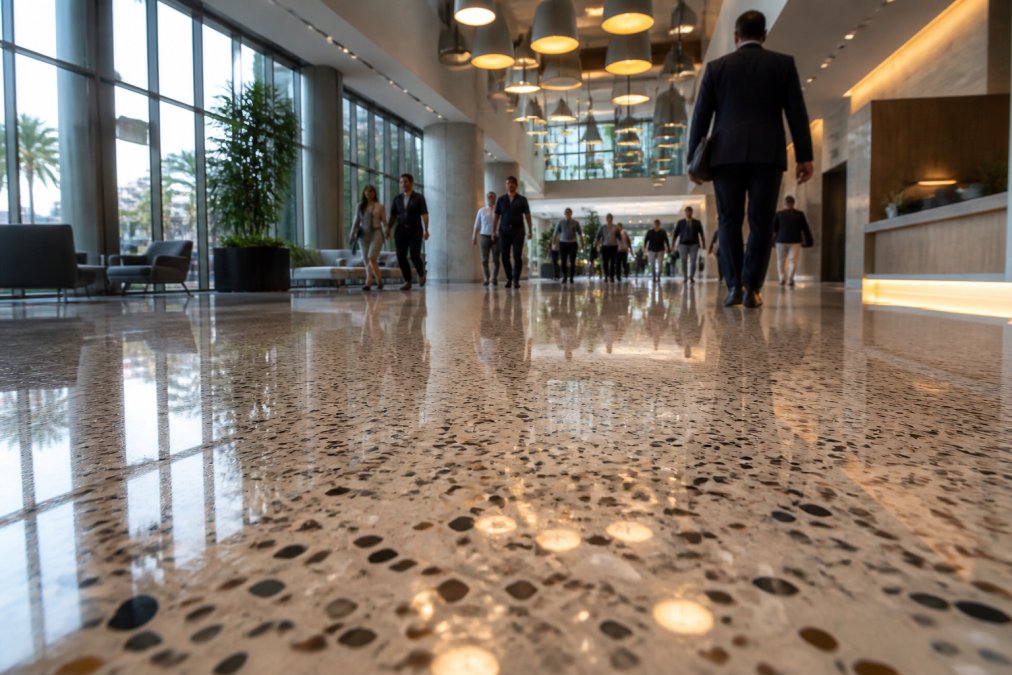
The return on investment for professional terrazzo polishing is most clearly understood by comparing it against floor replacement.
Terrazzo is one of the few flooring materials where restoration is genuinely competitive with replacement on a per-year cost basis. A properly installed terrazzo floor has a theoretical lifespan measured in decades. Replacement involves demolition, substrate preparation, material costs, installation, and extended facility downtime. For a hospital or airport, downtime costs alone can exceed restoration costs.
Professional polishing with proper sealing also reduces ongoing maintenance costs. A diamond-polished floor with penetrating sealer requires no wax, no stripping, and only routine cleaning between professional service intervals. Over ten years, elimination of strip-and-wax cycles represents meaningful operational savings.
For historic commercial buildings, original terrazzo floors are architectural assets. Restoration preserves that asset; replacement destroys it and typically reduces historical and aesthetic value.
The calculation for facility managers is straightforward: what does professional restoration cost per year of extended floor life, compared to replacement cost amortized over the same period? In most commercial scenarios, restoration wins decisively. According to the Whole Building Design Guide's flooring lifecycle cost analysis, hard surface flooring with low maintenance requirements consistently outperforms softer alternatives on total cost of ownership across 20-year building cycles.
Terrazzo floor polishing done correctly is a long-term investment decision, not a maintenance expense. The floors that last 50 years without replacement are the ones that received proper restoration and consistent care.
A1 Terrazzo has delivered professional terrazzo floor polishing services across Florida's most demanding commercial environments for over 35 years, from healthcare facilities where sanitation and surface integrity are non-negotiable to historic buildings where matching original patterns and finishes requires genuine expertise. Contact A1 Terrazzo for a site assessment and project-specific quote.
Frequently Asked Questions
Can a dull or damaged terrazzo floor be fully restored?
Yes, most dull, scratched, or stained terrazzo floors can be fully restored through professional terrazzo floor polishing. Technicians use diamond grinding to remove surface damage, honing to level the aggregate, and progressive polishing grits to rebuild clarity and shine. Even floors with moderate cracking or etching typically respond well to professional restoration. Severely neglected floors may require resurfacing or partial replacement, but complete loss is rare when a qualified contractor assesses the substrate first.
How often should professional terrazzo floor polishing be performed?
For high-traffic commercial spaces such as hospitals, airports, and schools, professional polishing is generally recommended every three to five years, with routine deep cleaning annually. Lower-traffic areas may go longer between full polishing cycles. The actual schedule depends on foot traffic volume, the finish type (high-gloss finishes show wear sooner than matte finishes), and how consistently day-to-day maintenance is performed. A professional assessment of your floor's condition is the most reliable way to set a schedule.
What is the difference between honing and polishing terrazzo?
Honing uses coarser diamond abrasive pads to flatten and smooth the terrazzo surface, removing scratches, stains, and surface irregularities. It produces a matte or satin finish. Polishing follows honing using progressively finer grits to refine the surface until the calcite and marble chip aggregate reflect light at a high-gloss level. Some facilities prefer a honed finish for slip resistance; others need the full high-gloss result. Professional terrazzo floor polishing services tailor the grit sequence to the desired finish and the floor's current condition.
Does sealing terrazzo floors really make a difference?
Sealing matters significantly for cement-based terrazzo, which is porous and absorbs liquids, oils, and cleaning chemicals without protection. A penetrating sealer bonds within the surface rather than sitting on top, repelling water and oil-based stains without altering the floor's appearance or slip rating. Epoxy terrazzo is less porous but still benefits from sealing at grout lines and repaired areas. In healthcare and food-service environments, sealing also reduces the porosity that harbors bacteria, making the floor easier to sanitize to required standards.
This article was written using GrandRanker
Frequently Asked Questions
Can a dull or damaged terrazzo floor be fully restored?
Yes, most dull, scratched, or stained terrazzo floors can be fully restored through professional terrazzo floor polishing. Technicians use diamond grinding to remove surface damage, honing to level the aggregate, and progressive polishing grits to rebuild clarity and shine. Even floors with moderate cracking or etching typically respond well to professional restoration. Severely neglected floors may require resurfacing or partial replacement, but complete loss is rare when a qualified contractor assesses the substrate first.
How often should professional terrazzo floor polishing be performed?
For high-traffic commercial spaces such as hospitals, airports, and schools, professional polishing is generally recommended every three to five years, with routine deep cleaning annually. Lower-traffic areas may go longer between full polishing cycles. The actual schedule depends on foot traffic volume, the finish type (high-gloss finishes show wear sooner than matte finishes), and how consistently day-to-day maintenance is performed. A professional assessment of your floor's condition is the most reliable way to set a schedule.
What is the difference between honing and polishing terrazzo?
Honing uses coarser diamond abrasive pads to flatten and smooth the terrazzo surface, removing scratches, stains, and surface irregularities. It produces a matte or satin finish. Polishing follows honing using progressively finer grits to refine the surface until the calcite and marble chip aggregate reflect light at a high-gloss level. Some facilities prefer a honed finish for slip resistance; others need the full high-gloss result. Professional terrazzo floor polishing services tailor the grit sequence to the desired finish and the floor's current condition.
Does sealing terrazzo floors really make a difference?
Sealing matters significantly for cement-based terrazzo, which is porous and absorbs liquids, oils, and cleaning chemicals without protection. A penetrating sealer bonds within the surface rather than sitting on top, repelling water and oil-based stains without altering the floor's appearance or slip rating. Epoxy terrazzo is less porous but still benefits from sealing at grout lines and repaired areas. In healthcare and food-service environments, sealing also reduces the porosity that harbors bacteria, making the floor easier to sanitize to required standards.