 ultimate-guide
Terrazzo Flooring for Healthcare: A 2026 Guide
Table of Contents
- Why Terrazzo Flooring Works in Healthcare Environments
- Infection Control Flooring Standards and Terrazzo Compliance
- Durability and Longevity in High-Traffic Medical Settings
- Seamless Flooring Advantages for Sterile Environments
- Terrazzo Maintenance for Hospitals and Clinical Spaces
- Cost-Benefit Analysis of Hospital Flooring: Terrazzo vs. Alternatives
- Design Flexibility and Aesthetic Versatility
- Installation Timeline and Minimizing Patient Disruption
- Frequently Asked Questions
Last Updated: August 31, 2026
Why Terrazzo Flooring Works in Healthcare Environments
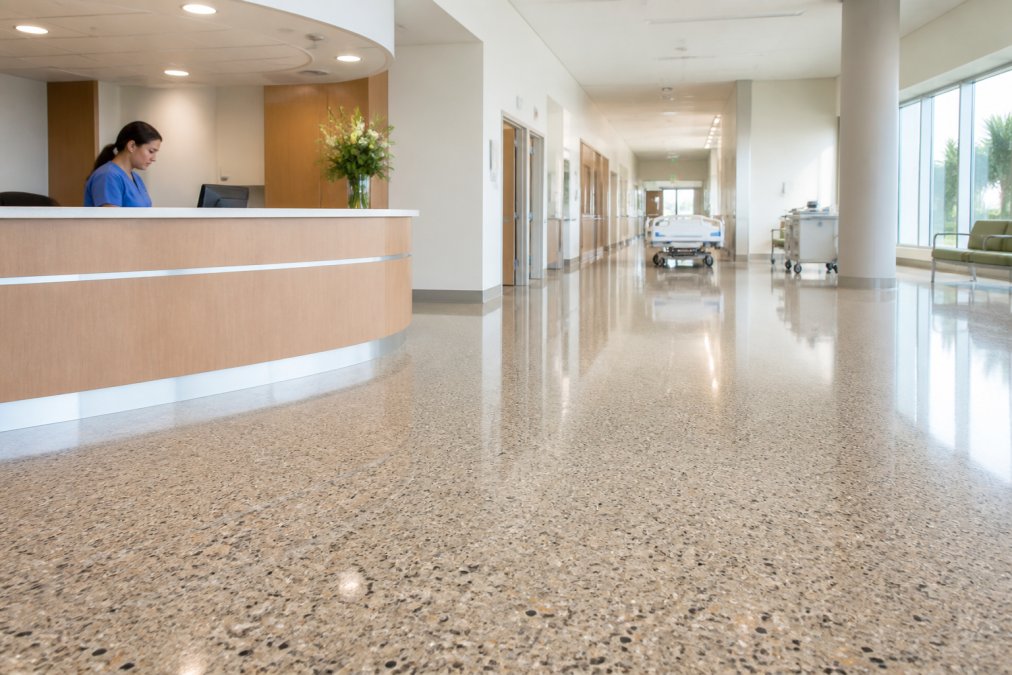
Terrazzo flooring for healthcare facilities represents a strategic investment in infection control, durability, and aesthetic consistency. At A1 Terrazzo, we've spent over 35 years working with hospitals, surgical centers, and clinical environments where flooring is a critical component of patient safety and operational efficiency.
Healthcare facilities face unique flooring demands that standard commercial flooring cannot meet. Constant foot traffic, equipment wheels, stretchers, and emergency response teams create intense wear. Simultaneous exposure to disinfectants, bodily fluids, and moisture requires surfaces that resist chemical degradation and microbial colonization. Traditional tile or vinyl fragments under these pressures, creating gaps where bacteria thrive. Terrazzo's seamless, non-porous construction eliminates these hidden contamination zones.
Infection Control Flooring Standards and Terrazzo Compliance
Healthcare flooring must meet stringent infection control standards established by federal regulators and industry bodies. The Centers for Disease Control and Prevention (CDC) emphasizes surfaces that can be easily cleaned and disinfected without harboring pathogens. CDC guidelines on healthcare environmental controls outline specific requirements for seamless, non-porous flooring in critical care areas.
Terrazzo achieves compliance through its inherently non-porous structure. Unlike tile with grout joints or vinyl with seams, seamless terrazzo presents a monolithic surface where disinfectants make complete contact with the substrate. The epoxy or polyester resin matrix bonds the aggregate permanently, preventing moisture infiltration that would allow microbial growth beneath the surface.
The Americans with Disabilities Act (ADA) requires flooring surfaces in healthcare facilities to meet specific slip resistance standards. ADA accessibility guidelines for flooring establish minimum coefficients of friction (DCOF) to prevent falls. Terrazzo can be finished with slip-resistant aggregates that achieve DCOF ratings exceeding 0.60, meeting these requirements without sacrificing aesthetic appeal.
Healthcare environments use quaternary ammonium compounds, bleach-based disinfectants, alcohol solutions, and enzymatic cleaners. Terrazzo's resin matrix resists these chemicals without degradation, maintaining surface integrity through thousands of cleaning cycles.
Key compliance checkpoints for terrazzo flooring healthcare:
- Non-porous surface eliminates bacterial harboring zones
- Seamless construction prevents moisture penetration
- Chemical resistance withstands standard hospital disinfectants
- Slip resistance meets ADA DCOF requirements
- Easy-to-clean surface supports infection control protocols
- Durability prevents replacement cycles that disrupt patient care
Antimicrobial additives can be incorporated into the resin during installation, creating surfaces that actively inhibit bacterial growth rather than simply preventing it.
Durability and Longevity in High-Traffic Medical Settings
High-traffic areas in healthcare facilities demand flooring that withstands constant mechanical stress without degradation. Terrazzo's aggregate particles are permanently bonded within the resin matrix, not simply pressed into a thin wear layer like vinyl or laminate.
Standard vinyl or linoleum flooring in healthcare settings typically requires replacement every 7-10 years (the CDC). Tile systems develop cracking in grout lines and experience moisture-related failures within 10-15 years. Properly installed terrazzo flooring routinely performs for 25-30 years or longer, with many installations from the 1980s and 1990s still in service today.
This longevity stems from terrazzo's monolithic construction. When a wheeled stretcher impacts the surface, the force distributes across the entire resin matrix rather than concentrating on a single tile. The aggregate particles absorb impact energy without fracturing because they're suspended uniformly throughout the binder.
Moisture resistance prevents the subfloor failures that plague other flooring types. Hospital cleaning protocols involve wet-mopping and frequent disinfection. Vinyl and tile systems allow moisture to penetrate beneath the surface, causing subfloor deterioration and mold growth. Seamless terrazzo sheds water completely, preventing subsurface moisture accumulation.
Durability factors that extend terrazzo flooring healthcare lifespan:
- Impact resistance from distributed force absorption
- Monolithic structure eliminates stress concentration points
- Moisture impermeability prevents subfloor degradation
- Chemical resistance maintains surface integrity through disinfection cycles
- Minimal wear progression even in 24/7 high-traffic areas
Over a 25-year horizon, the cost-per-year calculation becomes compelling. While initial installation costs exceed some alternatives, the extended service life and reduced maintenance requirements dramatically lower the annual cost burden.
Seamless Flooring Advantages for Sterile Environments
Seamless flooring is non-negotiable in operating rooms, sterile processing areas, and intensive care units where infection control determines patient outcomes. Terrazzo's monolithic pouring eliminates seams, grout lines, and transition joints that harbor bacteria and biofilm.
Unlike tile systems where grout joints create natural harboring zones, or vinyl planks where seams allow moisture infiltration, seamless terrazzo presents a continuous, impermeable surface. Biofilm, the protective matrix bacteria use to resist disinfectants, forms preferentially in crevices and seams. Seamless surfaces deny biofilm the protected microenvironments it requires, forcing bacteria into planktonic states where disinfectants eliminate them efficiently.
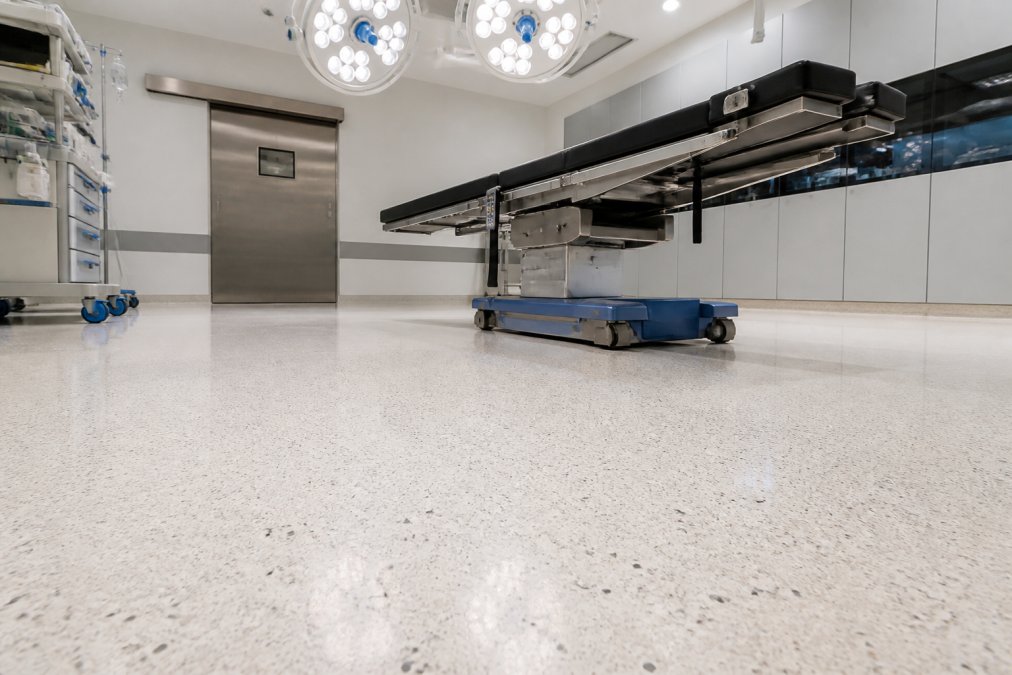
Coving, the curved transition between flooring and wall base, is standard in healthcare seamless flooring design. Terrazzo coving is poured as part of the monolithic installation, creating a true continuous surface from floor through the base rather than separate components joined with sealant.
Aesthetic consistency in seamless flooring supports both clinical and operational objectives. Hospitals can specify color patterns and aggregate selections that support wayfinding while maintaining professional appearance. Unlike tile systems where grout lines create visual discontinuity, terrazzo presents a unified, intentional aesthetic.
Terrazzo Maintenance for Hospitals and Clinical Spaces
Terrazzo maintenance for hospitals requires protocols that balance aggressive disinfection with surface preservation. The non-porous nature simplifies maintenance compared to porous alternatives.
Daily cleaning typically uses neutral pH cleaners with microfiber mop systems. The non-porous surface sheds water completely, allowing rapid drying that prevents slip hazards. Staff can execute thorough cleaning cycles quickly without the extended drying times vinyl or carpet require.
Disinfection protocols depend on facility-specific pathogen concerns. Quaternary ammonium compounds, phenolic disinfectants, and alcohol-based solutions are all compatible with properly sealed terrazzo surfaces. However, bleach-based disinfectants require caution; while terrazzo resists bleach, prolonged contact or high concentrations can affect the resin finish.
Terrazzo maintenance also includes periodic resealing. The surface finish, typically a polyurethane or epoxy topcoat, provides additional chemical resistance and aesthetic luster. Depending on traffic intensity, resealing occurs every 3-5 years in high-traffic areas, extending the protective barrier and maintaining appearance.
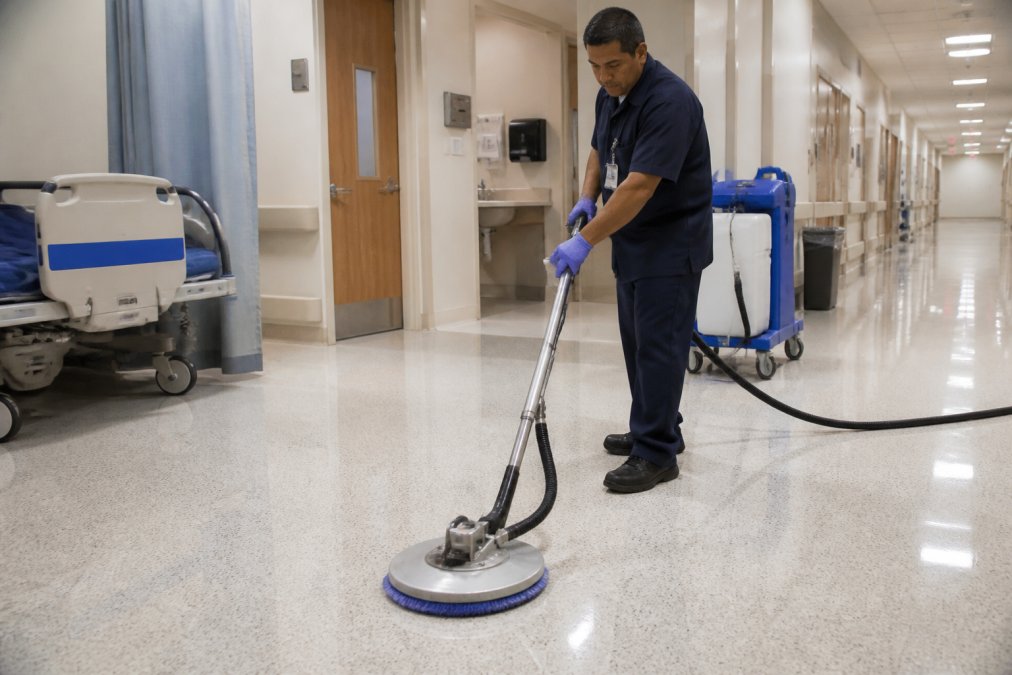
Minor chips or damage can be addressed through localized resin application without replacing entire sections, maintaining surface continuity and preventing new contamination zones.
Terrazzo maintenance for hospitals, standard protocols:
- Daily cleaning with neutral pH cleaner and microfiber mops
- Disinfection with approved hospital-grade solutions (quaternary ammonium, phenolic, alcohol-based)
- Avoidance of bleach or strict dilution/contact time control
- Periodic resealing every 3-5 years in high-traffic areas
- Spot repair for minor damage using compatible resin
- Professional deep cleaning annually or as needed
Cost-Benefit Analysis of Hospital Flooring: Terrazzo vs. Alternatives
The financial comparison between terrazzo flooring healthcare facilities and alternative systems requires analysis beyond initial installation cost. A comprehensive analysis includes material cost, labor, longevity, maintenance requirements, replacement cycles, and operational disruption.
Initial installation costs for terrazzo are typically higher than vinyl or standard tile. However, this upfront investment must be evaluated against extended service life and reduced maintenance burden.
Vinyl flooring typically costs less initially but requires replacement every 7-10 years. Over a 30-year horizon, this means 3-4 complete replacement cycles. Each replacement involves labor costs, material disposal, installation disruption, and patient care rescheduling. The cumulative cost of three vinyl replacements often exceeds the single terrazzo installation.
Tile flooring presents a middle-ground scenario. Initial costs are moderate, and durability extends to 10-15 years in healthcare environments. However, tile systems develop grout line failures and moisture infiltration that accelerate deterioration. Maintenance costs are higher than terrazzo because grout requires periodic resealing and cleaning.
The maintenance cost differential is substantial. Terrazzo eliminates the specialized grout cleaning, regrouting, and tile replacement that tile systems demand. Vinyl requires frequent stripping and waxing to maintain appearance and slip resistance, a labor-intensive process that terrazzo avoids.
Operational disruption costs are often overlooked but represent significant hidden expenses. Replacing flooring in an operating room or intensive care unit requires temporary closure and rescheduling of procedures. Terrazzo's extended lifespan means these disruptions occur once per 25-30 years rather than every 7-15 years.
| Cost Factor | Vinyl (7-10 yr cycle) | Tile (10-15 yr cycle) | Terrazzo (25-30 yr) |
|---|---|---|---|
| Initial Installation | Lower | Moderate | Higher |
| Replacement Cycles (30 yr) | 3-4 times | 2-3 times | 1 time |
| Annual Maintenance | Moderate-High | High | Low |
| Cumulative 30-Year Cost | High | High | Lower |
| Operational Disruptions | Multiple | Multiple | Single |
Terrazzo flooring healthcare facilities that maintain seamless, non-porous surfaces consistently achieve superior infection control audit results. Facilities with compromised flooring systems face audit findings, mandatory remediation, and potential reputational impact.
Design Flexibility and Aesthetic Versatility
Terrazzo flooring for healthcare facilities offers substantial aesthetic flexibility, allowing facilities to create environments that support patient psychology, staff morale, and operational wayfinding while maintaining infection control performance.
Aggregate selection determines terrazzo's visual character. Facilities can specify marble chips, granite fragments, glass particles, or metallic inclusions in virtually any color combination. This allows healthcare designers to create visual distinction between clinical zones and patient-facing areas without compromising durability and seamlessness.
Color psychology plays a documented role in healthcare environments. Cool tones (blues, greens) in patient recovery areas support relaxation. Warmer tones (earth tones, soft reds) in public spaces create welcoming atmospheres. Neutral tones in clinical areas maintain professional appearance. Terrazzo can use these principles through intentional color selection.
Wayfinding, helping patients and visitors navigate complex facilities, benefits from terrazzo's design flexibility. Facilities can incorporate color bands or pattern changes that guide movement through corridors without requiring signage.
The aesthetic consistency terrazzo provides, monolithic appearance without visible seams, creates a sense of intentional design that tile or vinyl systems cannot match.
Installation Timeline and Minimizing Patient Disruption
Installation timeline is critical in healthcare environments where flooring work disrupts patient care and operational revenue. Understanding the installation process is essential for successful terrazzo flooring healthcare projects.
Substrate preparation typically requires 3-5 days. This phase involves removing old flooring, assessing subfloor integrity, addressing moisture issues, and creating the level surface that terrazzo installation demands. In occupied healthcare facilities, this work often occurs during off-hours or in phased approaches.
The terrazzo installation itself, pouring, finishing, and initial curing, requires 7-14 days depending on space size and complexity. The resin must cure fully before the surface can support equipment or traffic. Full cure time before clinical use typically extends to 14-21 days from initial pouring.
Phased installation approaches are particularly valuable in healthcare facilities. Rather than closing an entire wing simultaneously, work can proceed in sections, allowing partial operational continuity. A1 Terrazzo has managed complex multi-phase installations in active hospitals, coordinating with facility operations to minimize patient care disruption.
Planning for terrazzo flooring healthcare installation should account for:
- Substrate preparation timeline (3-5 days)
- Terrazzo pouring and initial curing (7-14 days)
- Sealing and finishing (2-3 days)
- Full cure before clinical use (14-21 days total)
- Phased approach options for large facilities
- Coordination with patient care schedules
The long-term benefit, 25-30 years without replacement disruption, justifies the temporary inconvenience of initial installation.
Healthcare facility managers choosing terrazzo flooring face a clear decision: invest in a system that performs consistently across infection control, durability, and aesthetic requirements, or manage the recurring costs and operational disruptions that alternative flooring systems create. A1 Terrazzo's 35 years of healthcare installation experience means we understand the specific demands of clinical environments and deliver installations that meet those demands reliably. Contact A1 Terrazzo to discuss how seamless, durable terrazzo flooring can optimize your facility's performance, reduce long-term costs, and support your infection control objectives.
Frequently Asked Questions
What are the specific flooring requirements for healthcare facilities under CDC and OSHA guidelines?
Healthcare facilities must comply with CDC and OSHA standards requiring non-porous, easy-to-clean flooring that resists bacterial growth and chemical disinfectants. Terrazzo meets these requirements as a seamless, non-porous surface that prevents moisture and pathogen accumulation. The flooring must also resist stains from medical liquids and withstand frequent sanitization with hospital-grade cleaning agents. Terrazzo's chemical resistance and durability make it compliant with these stringent standards.
How does terrazzo flooring contribute to infection control in medical settings?
Terrazzo flooring supports infection control through its seamless, non-porous construction that eliminates grout lines where bacteria and viruses can hide. The surface does not harbor pathogens and resists the antimicrobial properties of cleaning protocols used in hospitals. Unlike traditional tile, terrazzo prevents moisture from penetrating the substrate, reducing the risk of mold and bacterial growth beneath the surface. This design directly supports sterile environment requirements in operating rooms, patient recovery areas, and clinical spaces.
Why is seamless terrazzo preferred over traditional tile in hospitals?
Seamless terrazzo eliminates grout lines that trap bacteria, moisture, and debris, critical vulnerabilities in infection control. Tile grout requires constant maintenance and can degrade under chemical disinfectants, creating gaps where contamination spreads. Terrazzo's continuous surface is easier to clean, resists puncture damage from medical equipment, and maintains structural integrity under high-traffic hospital corridors. The seamless design also reduces installation time and patient disruption compared to tile replacement cycles.
What is the expected lifespan of terrazzo flooring in high-traffic hospital corridors?
Properly installed and maintained terrazzo flooring in hospital corridors typically lasts 25-30 years or longer. Its impact resistance and puncture-resistant properties withstand constant foot traffic, equipment movement, and the physical demands of healthcare environments. Unlike tile or vinyl, terrazzo does not require replacement of individual sections, reducing long-term maintenance costs. Lifespan depends on subfloor preparation quality, installation technique, and adherence to maintenance protocols, factors that professional installers with healthcare experience control.
Is terrazzo flooring slip-resistant enough for emergency rooms and clinics?
Terrazzo can be finished with slip-resistant treatments that meet or exceed ADA compliance standards for DCOF (Dynamic Coefficient of Friction) ratings. Healthcare facilities require high slip resistance in emergency rooms, operating rooms, and patient care areas where spills and moisture are common. A proper terrazzo installation includes surface treatments and aggregate selection that provide adequate traction while maintaining the non-porous, easy-clean properties critical for infection control. Facility managers should specify slip-resistant finishes during the design phase.
How do you maintain and sanitize terrazzo floors in a sterile environment?
Terrazzo maintenance in hospitals involves daily cleaning with hospital-grade disinfectants and regular deep sanitization. The non-porous surface allows cleaning solutions to remain on the floor long enough to kill pathogens without being absorbed. Avoid acidic cleaners that can etch the surface; use pH-neutral or slightly alkaline solutions. Microfiber mop systems and professional-grade equipment remove bacteria effectively. Periodic resealing protects the surface from staining and maintains antimicrobial performance. Professional maintenance services ensure protocols align with infection control standards.
What makes terrazzo a better long-term investment than vinyl or tile for healthcare facilities?
Terrazzo offers superior life cycle cost value through durability (25-30+ years), minimal replacement needs, and lower maintenance frequency compared to vinyl (8-12 years) or tile (15-20 years with grout degradation). While initial installation costs are higher, the extended lifespan and reduced replacement cycles offset expenses. Terrazzo resists chemical damage from hospital disinfectants, preventing premature degradation. The seamless surface eliminates grout replacement and tile patching. For large healthcare facilities managing multiple buildings, terrazzo's long-term reliability reduces operational disruption and lifecycle costs significantly.
How does VOC emissions from terrazzo flooring affect indoor air quality in healthcare facilities?
Low-VOC terrazzo systems minimize volatile organic compound emissions, critical in healthcare where indoor air quality directly impacts patient recovery and staff health. Resin-based terrazzo with low-VOC binders meets or exceeds environmental standards for healthcare settings. Unlike some vinyl and epoxy alternatives, properly specified terrazzo does not off-gas harmful chemicals that compromise sterile environments. Healthcare facilities should verify VOC certifications (such as FloorScore or similar standards) during specification. Professional installers ensure proper ventilation during installation and curing to maintain air quality standards.
This article was written using GrandRanker
Frequently Asked Questions
What are the specific flooring requirements for healthcare facilities under CDC and OSHA guidelines?
Healthcare facilities must comply with CDC and OSHA standards requiring non-porous, easy-to-clean flooring that resists bacterial growth and chemical disinfectants. Terrazzo meets these requirements as a seamless, non-porous surface that prevents moisture and pathogen accumulation. The flooring must also resist stains from medical liquids and withstand frequent sanitization with hospital-grade cleaning agents. Terrazzo's chemical resistance and durability make it compliant with these stringent standards.
How does terrazzo flooring contribute to infection control in medical settings?
Terrazzo flooring supports infection control through its seamless, non-porous construction that eliminates grout lines where bacteria and viruses can hide. The surface does not harbor pathogens and resists the antimicrobial properties of cleaning protocols used in hospitals. Unlike traditional tile, terrazzo prevents moisture from penetrating the substrate, reducing the risk of mold and bacterial growth beneath the surface. This design directly supports sterile environment requirements in operating rooms, patient recovery areas, and clinical spaces.
Why is seamless terrazzo preferred over traditional tile in hospitals?
Seamless terrazzo eliminates grout lines that trap bacteria, moisture, and debris—critical vulnerabilities in infection control. Tile grout requires constant maintenance and can degrade under chemical disinfectants, creating gaps where contamination spreads. Terrazzo's continuous surface is easier to clean, resists puncture damage from medical equipment, and maintains structural integrity under high-traffic hospital corridors. The seamless design also reduces installation time and patient disruption compared to tile replacement cycles.
What is the expected lifespan of terrazzo flooring in high-traffic hospital corridors?
Properly installed and maintained terrazzo flooring in hospital corridors typically lasts 25-30 years or longer. Its impact resistance and puncture-resistant properties withstand constant foot traffic, equipment movement, and the physical demands of healthcare environments. Unlike tile or vinyl, terrazzo does not require replacement of individual sections, reducing long-term maintenance costs. Lifespan depends on subfloor preparation quality, installation technique, and adherence to maintenance protocols—factors that professional installers with healthcare experience control.
Is terrazzo flooring slip-resistant enough for emergency rooms and clinics?
Terrazzo can be finished with slip-resistant treatments that meet or exceed ADA compliance standards for DCOF (Dynamic Coefficient of Friction) ratings. Healthcare facilities require high slip resistance in emergency rooms, operating rooms, and patient care areas where spills and moisture are common. A proper terrazzo installation includes surface treatments and aggregate selection that provide adequate traction while maintaining the non-porous, easy-clean properties critical for infection control. Facility managers should specify slip-resistant finishes during the design phase.
How do you maintain and sanitize terrazzo floors in a sterile environment?
Terrazzo maintenance in hospitals involves daily cleaning with hospital-grade disinfectants and regular deep sanitization. The non-porous surface allows cleaning solutions to remain on the floor long enough to kill pathogens without being absorbed. Avoid acidic cleaners that can etch the surface; use pH-neutral or slightly alkaline solutions. Microfiber mop systems and professional-grade equipment remove bacteria effectively. Periodic resealing protects the surface from staining and maintains antimicrobial performance. Professional maintenance services ensure protocols align with infection control standards.
What makes terrazzo a better long-term investment than vinyl or tile for healthcare facilities?
Terrazzo offers superior life cycle cost value through durability (25-30+ years), minimal replacement needs, and lower maintenance frequency compared to vinyl (8-12 years) or tile (15-20 years with grout degradation). While initial installation costs are higher, the extended lifespan and reduced replacement cycles offset expenses. Terrazzo resists chemical damage from hospital disinfectants, preventing premature degradation. The seamless surface eliminates grout replacement and tile patching. For large healthcare facilities managing multiple buildings, terrazzo's long-term reliability reduces operational disruption and lifecycle costs significantly.
How does VOC emissions from terrazzo flooring affect indoor air quality in healthcare facilities?
Low-VOC terrazzo systems minimize volatile organic compound emissions, critical in healthcare where indoor air quality directly impacts patient recovery and staff health. Resin-based terrazzo with low-VOC binders meets or exceeds environmental standards for healthcare settings. Unlike some vinyl and epoxy alternatives, properly specified terrazzo does not off-gas harmful chemicals that compromise sterile environments. Healthcare facilities should verify VOC certifications (such as FloorScore or similar standards) during specification. Professional installers ensure proper ventilation during installation and curing to maintain air quality standards.