 ultimate-guide
Terrazzo Flooring Installation Price: 2026 Guide
Table of Contents
- What Drives Terrazzo Flooring Installation Price in 2026
- Epoxy vs Cementitious Terrazzo: Cost and Performance Compared
- Average Cost to Install 1000 Sq Ft Terrazzo: What to Expect
- Terrazzo Flooring Pros and Cons for Commercial Projects
- Terrazzo Floor Maintenance Costs and Long-Term Value
- DIY vs. Professional Terrazzo Flooring Installation: The Real Risk
- Sustainability, VOC Ratings, and Specification Compliance
- Frequently Asked Questions
Last Updated: August 9, 2026
What Drives Terrazzo Flooring Installation Price in 2026
Terrazzo flooring installation is one of the most labor-intensive flooring processes in commercial construction. At A1 Terrazzo, we've spent over 35 years working through the variables that cause quotes to swing dramatically from one project to the next. Understanding those variables is the first step toward building a realistic budget.
The core cost drivers fall into three categories: system type, labor intensity, and site conditions. A straightforward poured-in-place epoxy installation in a new-build with a level concrete slab costs significantly less than a custom cementitious pour with intricate divider strip patterns over a remediated subfloor. What most guides get wrong is treating terrazzo like a commodity floor covering. It's a site-fabricated product, literally manufactured on your premises, which changes everything about how pricing works.
Labor Intensity and Installation Complexity
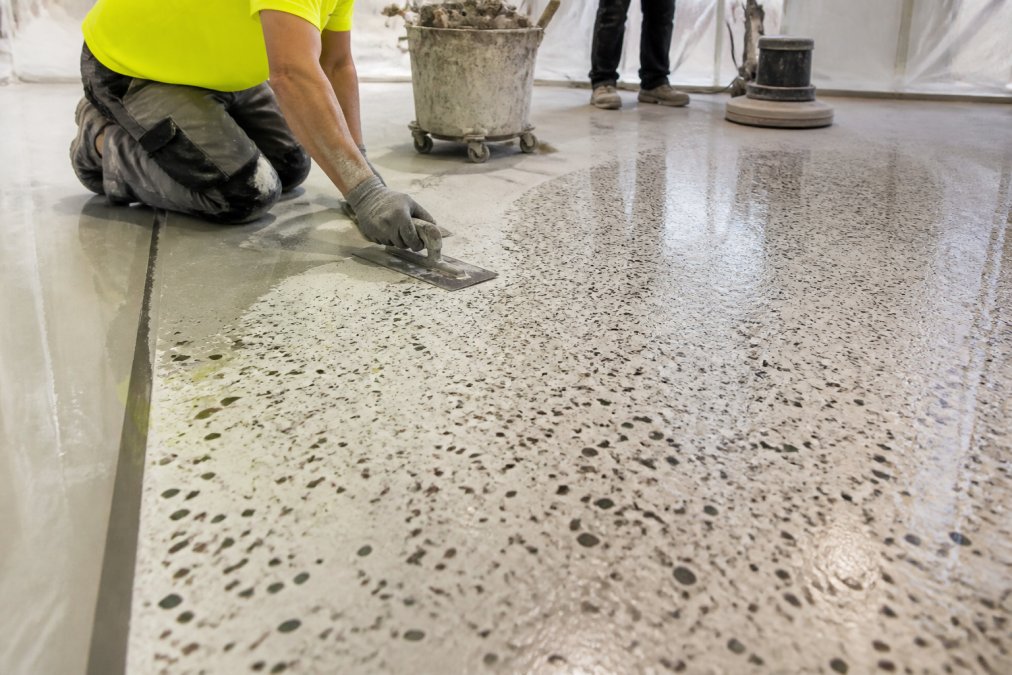
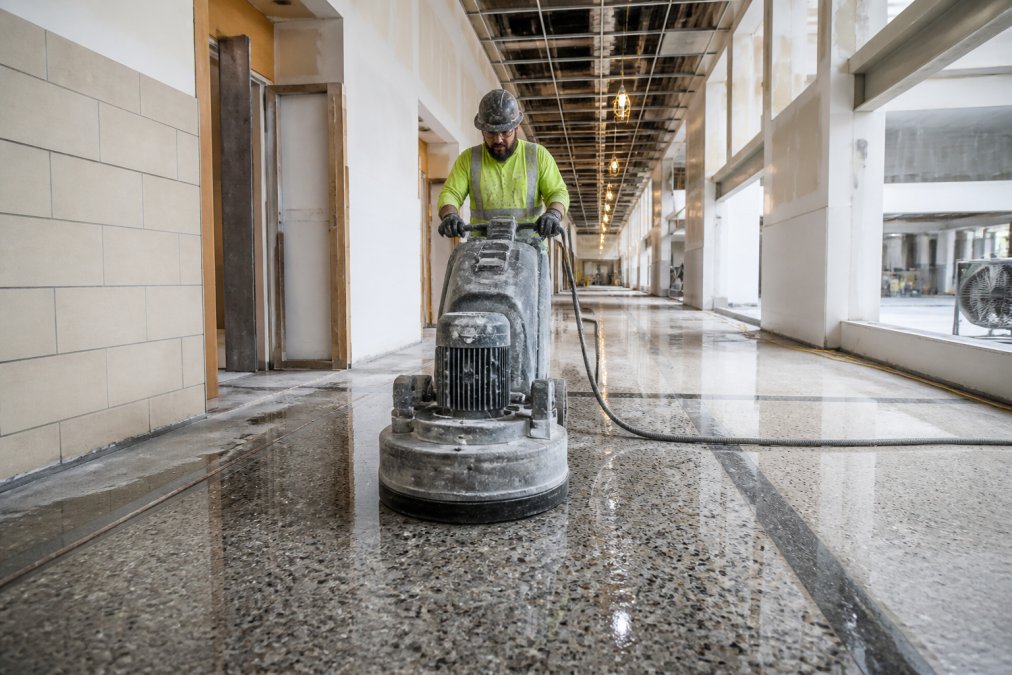
Labor typically represents the largest portion of any terrazzo flooring installation budget. The process involves multiple sequential trades: surface preparation, divider strip placement, aggregate pouring, initial grinding, honing, polishing, and sealing. Custom design work multiplies labor costs quickly. Intricate patterns with curved divider strips, multiple aggregate colors, or inlaid logos require precise layout work before pouring begins. A simple grid pattern across a school corridor is fundamentally different from a medallion installation at a hospital entrance.
Curing time also affects project scheduling and cost. Cementitious terrazzo requires a longer cure before grinding can begin, extending project duration. Epoxy resin systems cure faster, which is one reason they've become the preferred specification for fast-track commercial projects.
Hidden Costs: Subfloor Remediation and Moisture Barriers
Subfloor condition is the most common source of budget overruns on terrazzo projects. Terrazzo is rigid and does not flex. If the substrate moves, cracks, or transmits moisture, the finished floor will fail. This is the failure mode that produces cracking complaints from poorly executed projects.
Moisture barriers are non-negotiable on ground-level or below-grade installations. Moisture vapor transmission through a concrete slab without a proper bonding agent or moisture barrier will delaminate an epoxy system and effloresce a cementitious one. Remediation scope can include crack repair, floor leveling compounds, membrane installation, or full slab replacement in extreme cases.
According to the National Terrazzo and Mosaic Association's installation guidelines, proper substrate evaluation and preparation is a prerequisite for any warranted terrazzo installation. Skipping this step doesn't save money, it defers a larger expense.
Epoxy vs Cementitious Terrazzo: Cost and Performance Compared
The choice between epoxy resin and cementitious terrazzo is the single most consequential specification decision you'll make, affecting both installation price and long-term performance.
Epoxy terrazzo uses a two-part resin as the binder, typically poured at 3/8-inch thickness. It bonds directly to the substrate without a sand cushion layer, reducing floor thickness and making it suitable for renovation projects. Epoxy systems accept a wider range of aggregates including glass shards, producing vivid color options. The thinner pour and faster cure time generally mean lower labor costs per square foot compared to cementitious systems.
Cementitious terrazzo uses Portland cement as the binder with a sand cushion or bonded installation method. It's poured thicker, typically 1.75 to 2.5 inches for a sand cushion system. The additional material and longer curing time increase costs, but cementitious systems have a proven multi-decade track record and remain the specification of choice for restoration projects where matching original finishes is required.
| System | Typical Thickness | Cure Time | Best Application | Design Flexibility |
|---|---|---|---|---|
| Epoxy resin | 3/8 inch | 24-48 hours | Renovation, healthcare, airports | Very high, including glass aggregate |
| Cementitious (bonded) | 5/8 to 3/4 inch | 7+ days | New construction, heavy traffic | High, traditional aggregate |
| Cementitious (sand cushion) | 1.75 to 2.5 inches | 7-14 days | Historic restoration, isolation from slab | High, original-match capable |
Polyacrylate Systems: A Third Option
Polyacrylate terrazzo uses a water-based resin system offering lower VOC emissions than standard epoxy formulations, making it relevant for projects pursuing LEED certification or operating in environments with strict indoor air quality requirements. Installation costs for polyacrylate systems are generally comparable to epoxy. For healthcare facilities and schools where chemical sensitivity is a concern, polyacrylate systems deserve serious evaluation.
Average Cost to Install 1000 Sq Ft Terrazzo: What to Expect
Pricing for terrazzo flooring installation varies widely based on system type, design complexity, substrate condition, and regional labor rates. For a 1,000 square foot commercial installation, the variables that most affect your final number are:
- System type: Epoxy systems are typically less expensive per square foot than sand cushion cementitious systems
- Design complexity: A single-color field with a simple border costs a fraction of a multi-color custom pattern with curved divider strips
- Subfloor condition: A clean, level, moisture-free slab requires minimal preparation; a compromised slab adds remediation costs
- Project location: Labor rates vary across Florida markets
- Access and scheduling: Projects requiring off-hours work or phased installation carry premium labor costs
For a realistic budget number, the only reliable approach is a site visit from an experienced installer. Contact A1 Terrazzo for a project-specific estimate.
Poured-in-Place vs. Terrazzo Tiles: Price Difference
Poured-in-place terrazzo is fabricated on-site. Divider strips are set into the pour to control cracking and define design elements, then the entire surface is ground, honed, and polished as a continuous slab. The result is seamless with no grout joints, specified for hospitals, airports, and institutional buildings where hygiene and continuity are priorities.
Terrazzo tiles are pre-manufactured panels installed like conventional tile, with grout joints between them. They offer lower installation labor costs and suit smaller commercial projects or renovations where poured-in-place isn't feasible. The trade-off is the grout joint, which creates a maintenance surface and eliminates the seamless aesthetic.
For most commercial facility managers evaluating terrazzo flooring installation, poured-in-place is the correct specification for high-traffic, high-hygiene applications.
How Design Complexity Affects Your Installation Estimate
Design complexity is the most underestimated cost variable in terrazzo flooring installation. A simple two-color field with straight divider strips requires layout, pour, and grinding. A custom logo with radial patterns and five aggregate colors requires detailed pre-installation drawing, precise divider strip fabrication, multiple separate pours, and careful grinding sequencing.
Involve your terrazzo contractor in the design phase, not after the architect has finalized drawings. Changes to divider strip geometry after work begins are expensive.
Terrazzo Flooring Pros and Cons for Commercial Projects
Terrazzo flooring is the right specification for many commercial environments and the wrong one for others.
Pros:
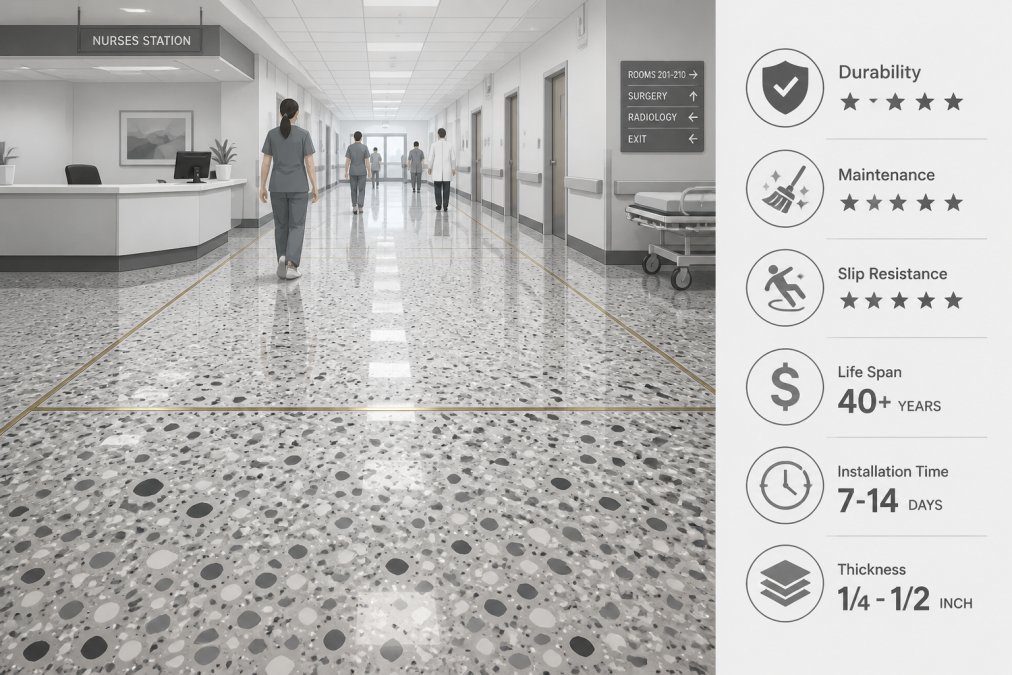
- Lifespan: Properly installed terrazzo regularly lasts 40 to 75 years with appropriate maintenance. Many historic buildings still have original terrazzo floors in serviceable condition after more than a century.
- Hygiene: The seamless surface eliminates grout joints where bacteria and moisture accumulate, which is why healthcare facilities and food service environments specify it.
- Durability: Terrazzo withstands the foot traffic that destroys softer materials. Airport terminals and courthouse lobbies are among the most demanding floor environments.
- Design range: From simple institutional floors to elaborate custom patterns, terrazzo accommodates nearly any aesthetic requirement.
- Sustainability: Terrazzo can incorporate recycled aggregate content, including post-consumer glass. Many epoxy formulations now meet low-VOC specifications relevant to green building certifications.
Cons:
- Upfront cost: Terrazzo flooring installation costs more upfront than most alternative commercial flooring materials, though long-term cost of ownership often reverses this equation.
- Installation time: The grinding, honing, and polishing sequence takes time. Projects cannot be rushed without compromising surface finish quality.
- Hardness underfoot: Terrazzo is unforgiving on joints for staff who stand for extended periods. Anti-fatigue matting is a common accommodation.
- Cold feel: In unconditioned spaces, terrazzo transmits ambient temperature, though this is rarely a concern in climate-controlled commercial buildings.
Terrazzo Floor Maintenance Costs and Long-Term Value
Terrazzo floor maintenance costs are modest relative to the floor's lifespan, but they are not zero. Routine maintenance involves daily dust mopping to remove abrasive particulates, periodic wet mopping with a pH-neutral cleaner, and scheduled resealing based on traffic volume. High-traffic areas may require resealing annually; lower-traffic areas can extend that interval.
The most expensive maintenance error is using the wrong cleaning products. Acidic cleaners, alkaline degreasers, and solvent-based products all damage terrazzo sealer and can etch the aggregate surface.
According to the Marble Institute of America's care and maintenance standards, pH-neutral cleaning solutions are the only appropriate daily-use products for polished stone and terrazzo surfaces. Facility managers should ensure their cleaning contractors work from product-approved lists.
The total cost of ownership argument for terrazzo is compelling when calculated honestly. A floor that costs more to install but requires no replacement for 50 years outperforms a less expensive floor replaced every 10 to 15 years when you factor in material, labor, and facility disruption costs across the full lifecycle.
DIY vs. Professional Terrazzo Flooring Installation: The Real Risk
DIY terrazzo flooring installation is technically possible, but the risk profile is not comparable to most home improvement projects. The grinding and polishing sequence requires industrial equipment: planetary grinders, progressively finer diamond tooling, and polishing compounds applied in a specific sequence. Skipping or rushing any stage produces a floor that looks wrong and cannot be corrected without starting over.
Subfloor assessment is the more serious risk. A professional installer evaluates substrate moisture, checks for existing cracks, and identifies problem areas before pouring begins. An inexperienced installer pours over a compromised substrate and discovers the problem six months later when the floor starts cracking.
For commercial projects, professional installation is the only viable path. The liability exposure, complexity of large-format poured-in-place work, and warranty requirements make it essential.
The Occupational Safety and Health Administration's silica dust standards apply to terrazzo grinding operations. Silica dust generated during grinding is a serious respiratory hazard. Professional installers use wet grinding methods and appropriate respiratory protection as standard practice.
Sustainability, VOC Ratings, and Specification Compliance
Sustainability is an increasingly common requirement in commercial terrazzo specifications, particularly for projects pursuing LEED v4 or LEED v4.1 certification.
Terrazzo flooring installation aligns well with green building goals. The aggregate component can incorporate significant recycled content, including post-consumer glass. Epoxy resin formulations have improved substantially, with many current products meeting low-VOC or zero-VOC thresholds relevant to LEED Indoor Environmental Quality credits.
The relevant VOC categories for terrazzo specification are:
- Flooring adhesives and bonding agents: Must meet South Coast Air Quality Management District Rule 1168 thresholds for most LEED-compliant specifications
- Sealers and coatings: Subject to VOC limits under LEED v4 EQ Credit requirements
- Aggregate sourcing: Recycled content documentation supports LEED Materials and Resources credits
Polyacrylate systems generally carry lower VOC profiles than conventional epoxy formulations. For healthcare facilities or schools subject to state indoor air quality regulations, polyacrylate or verified low-VOC epoxy systems are worth specifying explicitly.
For projects where sustainability documentation is required, request VOC certification data and recycled content percentages from your installer before specification is finalized.
Terrazzo flooring installation is a long-term capital decision. The difference between a floor that lasts 50 years and one that fails in five comes down to substrate preparation, system selection, and installer experience. A1 Terrazzo brings over 35 years of commercial terrazzo installation experience across Florida's most demanding environments, from healthcare facilities and airports to historic building restorations and large-scale campus projects. Contact A1 Terrazzo to discuss your project scope and get an installation estimate built on a thorough assessment of your actual site conditions.
Frequently Asked Questions
How much does it cost to install terrazzo flooring per square foot?
Terrazzo flooring installation price per square foot varies significantly based on system type, subfloor condition, design complexity, and project size. Epoxy resin systems typically cost more than cementitious systems due to material costs, while poured-in-place installations run higher than terrazzo tiles. Commercial projects in Florida should request itemized quotes that separate labor, materials, subfloor preparation, and finishing to compare bids accurately. Contact A1 Terrazzo for a project-specific estimate.
What factors influence the total cost of a terrazzo floor installation?
The biggest cost drivers are system type (epoxy vs. cementitious vs. polyacrylate), project square footage, subfloor condition, labor intensity, and design complexity. Custom patterns with intricate divider strips, multiple aggregate colors, or logos require more skilled labor and increase the installation estimate considerably. Hidden costs like moisture barrier installation, subfloor grinding, and crack repair can add substantially to the total. Getting a thorough site assessment before finalizing a budget is essential.
How much does it cost to floor 1,000 sq ft with terrazzo fully installed?
The total cost to install 1,000 sq ft of terrazzo depends on the system chosen, subfloor condition, and design specifications. Poured-in-place epoxy systems for commercial facilities generally cost more per square foot than cementitious or tile options. For a 1,000 sq ft project, subfloor remediation, moisture barriers, aggregate sourcing, grinding, polishing, and sealing all factor into the final number. A1 Terrazzo provides detailed project-specific quotes rather than generic per-square-foot estimates.
What are the primary downsides of choosing terrazzo flooring?
The main downsides are high upfront installation cost, long curing time (which can disrupt facility operations), and the need for professional subfloor preparation. Terrazzo is also hard underfoot, which can be a concern in facilities where staff stand for long periods. Using the wrong cleaning products can damage the surface finish, and repairs to cracked sections require skilled matching of aggregate and resin. These risks are largely mitigated by proper installation and a structured maintenance program.
Is terrazzo still a practical choice for commercial facilities in 2026?
Terrazzo remains one of the most durable and low-maintenance flooring options available for high-traffic commercial environments. Its seamless, non-porous surface makes it a strong fit for hospitals, airports, schools, and government buildings where sanitation and longevity matter. With a properly installed epoxy or cementitious system, a terrazzo floor can last 40 years or more with routine maintenance, making the total cost of ownership significantly lower than many alternative flooring materials over the same period.
Can terrazzo be installed over existing concrete floors?
Terrazzo can be installed over existing concrete, but only after thorough subfloor preparation. The concrete must be assessed for moisture levels, structural integrity, and surface flatness. Cracks, contamination, or high moisture readings require remediation before any bonding agent or terrazzo system is applied. Skipping this step is the most common cause of premature cracking and delamination. A qualified installer will conduct a full site assessment and specify the correct moisture barrier and floor thickness before installation begins.
How long does a professional terrazzo installation take?
A commercial terrazzo installation timeline depends on project scope, system type, and subfloor condition. Poured-in-place systems require curing time after each phase, including the base pour, aggregate setting, grinding, honing, and sealing. A mid-size commercial project of several thousand square feet can take anywhere from two to six weeks from subfloor prep through final polishing. Larger campus or multi-floor projects are typically phased to minimize operational disruption. A1 Terrazzo provides project-specific timelines during the scoping process.
This article was written using GrandRanker
Frequently Asked Questions
How much does it cost to install terrazzo flooring per square foot?
Terrazzo flooring installation price per square foot varies significantly based on system type, subfloor condition, design complexity, and project size. Epoxy resin systems typically cost more than cementitious systems due to material costs, while poured-in-place installations run higher than terrazzo tiles. Commercial projects in Florida should request itemized quotes that separate labor, materials, subfloor preparation, and finishing to compare bids accurately. Contact A1 Terrazzo for a project-specific estimate.
What factors influence the total cost of a terrazzo floor installation?
The biggest cost drivers are system type (epoxy vs. cementitious vs. polyacrylate), project square footage, subfloor condition, labor intensity, and design complexity. Custom patterns with intricate divider strips, multiple aggregate colors, or logos require more skilled labor and increase the installation estimate considerably. Hidden costs like moisture barrier installation, subfloor grinding, and crack repair can add substantially to the total. Getting a thorough site assessment before finalizing a budget is essential.
How much does it cost to floor 1,000 sq ft with terrazzo fully installed?
The total cost to install 1,000 sq ft of terrazzo depends on the system chosen, subfloor condition, and design specifications. Poured-in-place epoxy systems for commercial facilities generally cost more per square foot than cementitious or tile options. For a 1,000 sq ft project, subfloor remediation, moisture barriers, aggregate sourcing, grinding, polishing, and sealing all factor into the final number. A1 Terrazzo provides detailed project-specific quotes rather than generic per-square-foot estimates.
What are the primary downsides of choosing terrazzo flooring?
The main downsides are high upfront installation cost, long curing time (which can disrupt facility operations), and the need for professional subfloor preparation. Terrazzo is also hard underfoot, which can be a concern in facilities where staff stand for long periods. Using the wrong cleaning products can damage the surface finish, and repairs to cracked sections require skilled matching of aggregate and resin. These risks are largely mitigated by proper installation and a structured maintenance program.
Is terrazzo still a practical choice for commercial facilities in 2026?
Terrazzo remains one of the most durable and low-maintenance flooring options available for high-traffic commercial environments. Its seamless, non-porous surface makes it a strong fit for hospitals, airports, schools, and government buildings where sanitation and longevity matter. With a properly installed epoxy or cementitious system, a terrazzo floor can last 40 years or more with routine maintenance, making the total cost of ownership significantly lower than many alternative flooring materials over the same period.
Can terrazzo be installed over existing concrete floors?
Terrazzo can be installed over existing concrete, but only after thorough subfloor preparation. The concrete must be assessed for moisture levels, structural integrity, and surface flatness. Cracks, contamination, or high moisture readings require remediation before any bonding agent or terrazzo system is applied. Skipping this step is the most common cause of premature cracking and delamination. A qualified installer will conduct a full site assessment and specify the correct moisture barrier and floor thickness before installation begins.
How long does a professional terrazzo installation take?
A commercial terrazzo installation timeline depends on project scope, system type, and subfloor condition. Poured-in-place systems require curing time after each phase, including the base pour, aggregate setting, grinding, honing, and sealing. A mid-size commercial project of several thousand square feet can take anywhere from two to six weeks from subfloor prep through final polishing. Larger campus or multi-floor projects are typically phased to minimize operational disruption. A1 Terrazzo provides project-specific timelines during the scoping process.