 How-to
Terrazzo Subfloor Moisture: What to Do Next
Last Updated: November 5, 2026
Quick Summary
When terrazzo shows signs of subfloor moisture, first stop the water source and block off the affected area. Then test the subfloor with a moisture meter, dry it slowly, and fix the cause before repairing or refinishing the terrazzo.
- Stop the moisture source first, such as a leaking fixture or a nearby valve.
- Block off wet or soft floor areas and document the damage with dated photos.
- Test concrete with ASTM F1869 or F2170 methods, and wood with a pin-type meter.
- Dry the subfloor slowly, retesting every few days before starting any repairs.
- Confirm the subfloor is within the manufacturer's limits before repairing the terrazzo.
Table of Contents
- Recognizing Signs of Moisture Under Terrazzo Flooring
- Triage Steps for an Occupied Building
- Identifying Likely Moisture Sources
- Testing Subfloor Moisture Before Any Repair
- How to Dry a Wet Subfloor Safely
- Terrazzo Restoration After Water Damage
- When to Call a Terrazzo Professional and Book Your Assessment
- Frequently Asked Questions
Terrazzo Subfloor Moisture: What to Do Next
Recognizing Signs of Moisture Under Terrazzo Flooring
Spotting subfloor moisture early can save a terrazzo floor from serious damage. Terrazzo is durable, but water that moves up from below can still cause cracking, staining and loose sections over time. What makes terrazzo different from tile or carpet is that the floor is a composite: a cementitious or resin matrix holding aggregate, topped with a sealer and a polished finish.
Start by looking at the floor itself. Moisture rarely shows up as one clear sign. It usually appears as a group of small changes that build over weeks or months.
Watch for these signs:
- Discoloration or dark patches that do not clean away
- Efflorescence, the white, chalky residue left as water evaporates
- Hairline cracks that spread or reappear after repair
- A musty smell that worsens in certain rooms
- Soft spots, hollow sounds or sections that shift underfoot
- Blistering, bubbling or lifting at the sealer or finish layer
How the Terrazzo Matrix Changes the Symptoms
A cementitious terrazzo system behaves like a porous material. Water vapor moving up through the slab can pass into the cement matrix, carrying dissolved salts that later appear as efflorescence at the surface. Resin-based systems, such as epoxy or polyacrylate matrices, are far less permeable, so moisture tends to collect at the bond line between the terrazzo and the subfloor rather than passing through the topping.
The sealer and finish add another layer of interpretation. A solvent-based or water-based sealer that is intact can mask early moisture, holding symptoms back until the damage beneath is advanced. When the sealer breaks down, moisture escapes unevenly and you see patchy dullness or cloudiness rather than a uniform stain.
Visible Clues: Discoloration, Efflorescence and Hairline Cracks
Discoloration is often the first sign. A patch that looks darker than the rest of the floor may be holding water.
Efflorescence is another common clue. It forms when moisture carries mineral salts up through the slab and leaves them on the surface. On terrazzo, efflorescence often appears first at control joints, perimeter edges and cracks, because those are the paths of least resistance for vapor.
Hairline cracks deserve attention too. A single small crack may come from settling, but several cracks that grow after a rain or plumbing leak point to water moving underneath. Mark the edges of any crack with painter's tape and check it again after a week.
Odor, Softness and Hollow Sounds
A musty smell often means moisture has been trapped for some time. It is strongest near floor level and may be worse after humid weather. Mold or mildew can follow if the area stays damp. Because moisture can travel beyond the floor, checking nearby walls can help detect hidden moisture before dampness spreads further.
Press your foot on the floor and listen. Solid terrazzo sounds firm. A hollow or drummy sound, or a section that gives slightly, suggests the bond beneath has loosened.
A floor that looks dry at the surface but sounds hollow across a wide area can indicate that the bond has already failed, which typically requires professional assessment.
Triage Steps for an Occupied Building
When a building stays open, you need a clear plan. Work through these steps in order:
- Stop the source if you can. Turn off a leaking fixture or shut the valve on a nearby line.
- Block off the affected area. Use cones and signs to keep people off wet or soft floor.
- Check for safety hazards. Look for standing water, exposed wiring or raised edges that could trip someone.
- Document the damage. Take dated photos from several angles and note the location on a floor plan.
- Notify the right people. Tell facility management, and call a licensed plumber if you suspect a leak.
- Schedule an inspection. Book a terrazzo assessment before any repair work starts.
Keep the closed area as small as possible. Many businesses find that a clear barrier and a posted schedule keep operations running while the problem is checked.
Identifying Likely Moisture Sources
Finding the source matters. Patching the surface without fixing the cause almost always leads to repeat damage.
Common sources include:
- Plumbing leaks from supply lines, drains or fixtures below the slab
- Ground moisture rising through a concrete slab, especially at or below grade
- Sewer or drain line problems that saturate the soil under the floor
- Roof or exterior water that runs down walls and collects beneath flooring
- Condensation in rooms with poor ventilation or temperature swings
Ask a few direct questions. Did the problem start after heavy rain? Is it near a bathroom, kitchen or mechanical room? Are there new stains on nearby walls? Each answer narrows the list.
Testing Subfloor Moisture Before Any Repair
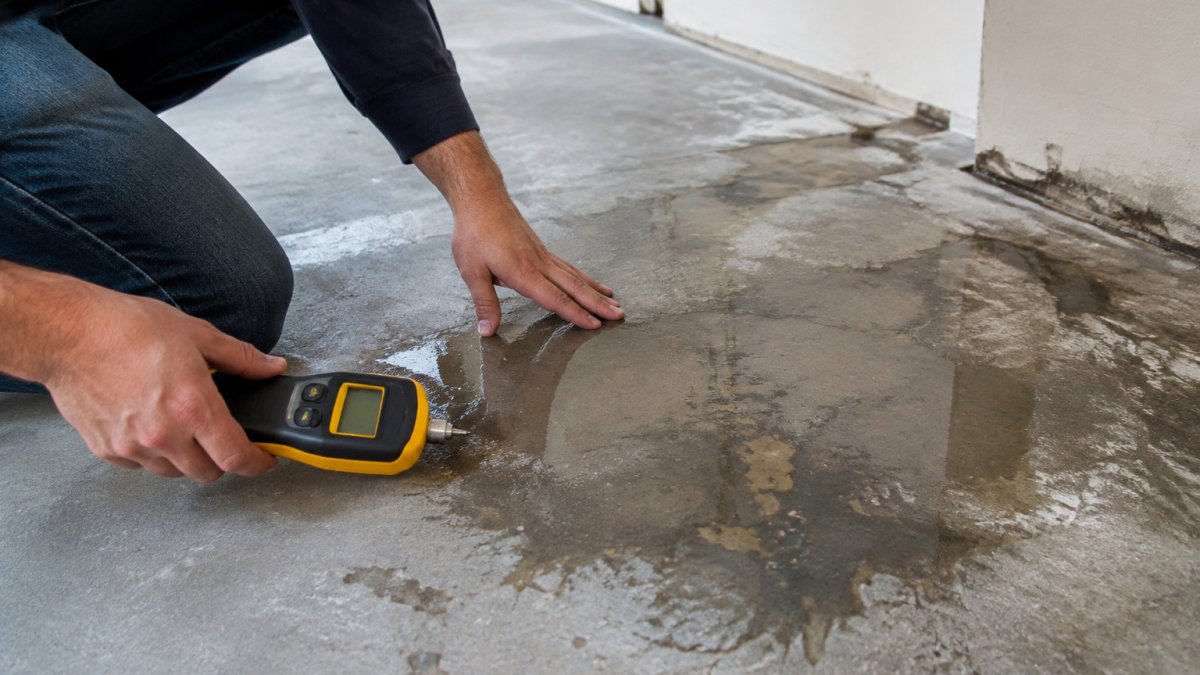
Never repair or refinish a floor before you know how wet the subfloor is. Surface drying can hide a problem that returns within weeks. Testing gives you a number to act on, and on terrazzo the number matters more than on most floors because the topping is bonded directly to the substrate and has little tolerance for vapor drive.
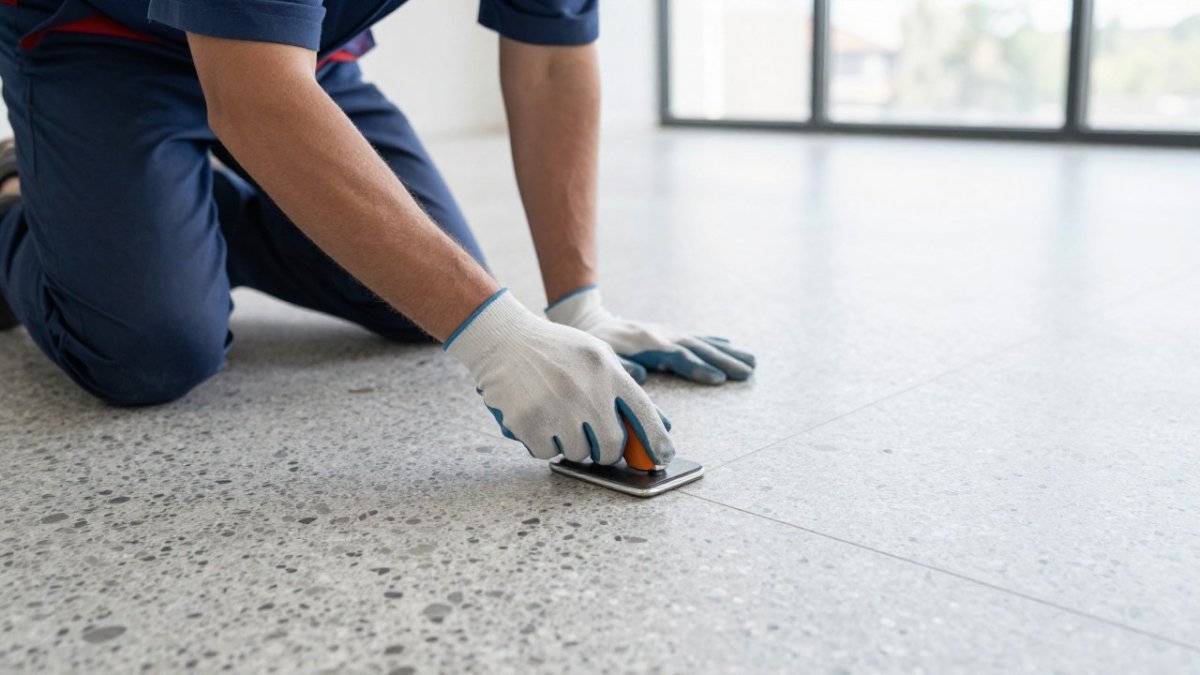
The right test depends on what is under the terrazzo, and each method has limits you need to understand before you trust a reading.
Testing Concrete Subfloors
For concrete, three approaches are commonly used, often in combination:
- Calcium chloride test (ASTM F1869). This measures the rate of moisture vapor emission from the slab over 60 to 72 hours and reports results in pounds per 1,000 square feet per 24 hours. It is a long-standing method for assessing vapor emission before floor coverings go down.
- In-situ relative humidity probe (ASTM F2170). This measures the relative humidity inside the slab at a specified depth, usually 40 percent of the slab thickness, after the hole has equilibrated. It reflects the moisture condition within the concrete rather than only at the surface.
- Electrical impedance or pin-type meters. These are fast and useful for mapping a grid of readings across a floor, but they give relative readings unless calibrated for the specific concrete mix and moisture condition. Use them to find wet zones and to track drying, not as the sole basis for a repair decision.
Take readings in a grid across the affected area and in a dry control spot away from the damage. Compare the damaged area with the control. A large gap points to a real moisture problem. Record each reading with its location so you can track whether conditions improve or worsen over time.
Testing Wood Subfloors
Wood subfloors are usually checked with a pin-type moisture meter, which measures the moisture content of the wood itself. Take readings at several depths and locations, because wood wicks moisture along the grain and the wettest point may not be where the stain appears. A common pattern is for the perimeter and areas near plumbing penetrations to read higher than the field of the floor. Wood also moves as it takes on moisture, so a subfloor that reads high is a subfloor that is likely to cup, crown or squeak after the terrazzo is restored.
Interpreting Readings and Their Limits
Meters give relative readings unless calibrated for the material. Interpret results with care, and confirm borderline numbers with a second method before you decide the floor is ready for installation or refinishing. The acceptable reading is not a single universal number. It depends on the flooring system and the product specifications: a resin terrazzo system, a cementitious terrazzo system and a moisture-sensitive adhesive each carry their own limits, and the manufacturer's written requirements govern.
A meter that reads dry at the surface can still sit over a slab with high vapor emission, because the surface dries faster than the slab interior, which is why a single pin reading is not enough to clear a floor for restoration.
The article's main test methods and what each one measures:
| Test | What it measures | Key note |
|---|---|---|
| Calcium chloride (ASTM F1869) | Vapor emission rate over 60-72 hours | Reported in pounds per 1,000 sq ft per 24 hours |
| In-situ RH probe (ASTM F2170) | Relative humidity inside the slab | Read at 40% of slab thickness |
| Electrical impedance or pin meter | Relative moisture across a grid | Use to map wet zones and track drying |
| Pin-type meter on wood | Moisture content of the wood | Check several depths; wood wicks moisture along grain |
How to Dry a Wet Subfloor Safely
Drying a subfloor is slower than most people expect. Rushing it can trap moisture and cause the same problem again.
- Remove standing water first. Use a wet vacuum to lift as much as possible.
- Improve airflow. Place air movers and dehumidifiers to move air across the floor.
- Control humidity. Keep relative humidity in a steady, moderate range while drying.
- Monitor progress. Retest with your meter every few days and log the results.
- Wait for the readings to drop. Do not start repairs until the subfloor is within acceptable limits.
Protect workers as well. Wear gloves and eye protection when handling wet materials, and use proper ventilation when running drying equipment or cleaning agents. Mold growth is a health concern, so limit exposure and call a qualified remediation service if the damage is widespread (the EPA).
Terrazzo Restoration After Water Damage
Once the subfloor is dry and the source is fixed, the terrazzo itself can often be restored. Restoration can involve cleaning, crack repair, and resealing, depending on the floor's condition.
Cracks and chips should be repaired with materials that match the existing floor. How long terrazzo crack repair takes helps you plan the work around an occupied building. Patching with the wrong product can show clearly under a polished finish.
Restoration works best when the root cause is already solved, since refinishing over an active leak can waste time and money. Once the floor is back in service, learn how to prevent terrazzo floor cracking going forward.
When to Call a Terrazzo Professional and Book Your Assessment
Call a professional if you see spreading cracks, loose sections, widespread discoloration or any sign of mold. Moisture problems tied to plumbing, drainage or structural issues also need experienced help. A1 Terrazzo can inspect the floor and explain your repair options.
Book an assessment before the damage grows, and request a quote for current pricing. Contact A1 Terrazzo today to schedule your inspection.
Frequently Asked Questions
What are the signs of moisture beneath a terrazzo floor?
Common signs include discoloration or darkened patches, white efflorescence (mineral deposits) at cracks or joints, hairline cracks that reappear, a musty odor, and areas that feel soft or sound hollow underfoot. Edges near walls, drains and exterior doors are the most likely places to see these symptoms first. Any of these signs justify a moisture test before you assume the surface is the problem.
Can moisture from the subfloor damage terrazzo flooring?
Yes. Water moving up through a concrete slab or a wood subfloor can loosen the bond between the terrazzo and its substrate, cause cracking, and encourage mold or mildew under the floor. Because the damage often starts out of sight, it can progress for months before it is noticed. Early testing and drying usually cost far less than replacing sections of terrazzo later.
How do you dry a subfloor beneath terrazzo flooring?
Drying starts with stopping the water source, then improving airflow with dehumidifiers and air movers, and confirming that the readings fall over several days. Drying can be slow under a dense terrazzo layer, so moisture readings are more reliable than judging by touch. If conditions do not improve, a professional should evaluate the slab.
Can terrazzo flooring be restored after moisture damage?
In many cases, yes, but only after the moisture source is fixed and the substrate has dried to acceptable levels. Restoration can involve repairing cracks and loose sections and resealing with an appropriate sealer. Cleaning products should be pH-neutral and approved for terrazzo, since harsh chemicals can etch the surface. Pricing depends on the size of the area and the extent of damage, so request a quote from A1 Terrazzo for current pricing.