 ultimate-guide
Terrazzo Substrate Preparation for Hospitals: A Complete Guide
Table of Contents
- Why Substrate Preparation Determines Hospital Terrazzo Success
- Concrete Moisture Testing for Flooring: The Critical First Step
- Assessing and Repairing Your Concrete Substrate
- Terrazzo Crack Isolation Membrane Requirements in Healthcare
- Hospital Flooring Infection Control Protocols During Prep
- NTMA Terrazzo Installation Standards and Substrate Compliance
- Moisture Vapor Barriers and Sealing the Prepared Substrate
- Renovation vs. New Construction: Different Prep Approaches
- Frequently Asked Questions
Last Updated: August 19, 2026
Why Substrate Preparation Determines Hospital Terrazzo Success
The difference between terrazzo flooring that lasts 20 years and flooring that fails within 12 months comes down to substrate preparation. Hospital environments demand flooring that withstands constant cleaning protocols, heavy foot traffic, and equipment movement while maintaining seamless, non-porous surfaces that resist microbial colonization. When preparation is rushed or incomplete, moisture migrates upward, cracks propagate, and the terrazzo becomes compromised.
At A1 Terrazzo, we've seen this pattern repeatedly. Facilities that invest in thorough substrate preparation experience dramatically fewer callbacks and premature failures. The stakes are higher in healthcare than standard commercial installations, a terrazzo floor failure is a sanitation liability, safety hazard, and operational disruption. This guide walks you through every step of proper terrazzo substrate preparation for healthcare facilities.
Concrete Moisture Testing for Flooring: The Critical First Step
Concrete moisture is the silent killer of terrazzo installations. Moisture vapor emission rates (MVER) must be tested according to ASTM standards before installation begins.
What you're measuring: MVER quantifies how much water vapor migrates upward through the concrete slab. Terrazzo systems have moisture tolerance limits, typically below 3-5 lbs/1,000 sq ft/24 hrs. Exceed those limits, and you risk bond failure, delamination, and potential mold growth beneath the surface.
A calcium chloride test measures moisture vapor emission over 24 hours in a sealed chamber. Concrete that fails the moisture test requires mitigation before terrazzo installation: applying moisture barriers, using moisture-tolerant primers, or allowing additional curing time. In renovation projects, older hospital buildings often have chronic moisture issues from original construction lacking vapor barriers.
The cost and time investment in proper moisture testing is minimal compared to the cost of removing and replacing failed terrazzo. A1 Terrazzo includes comprehensive moisture assessment as part of our substrate preparation protocol.
Assessing and Repairing Your Concrete Substrate
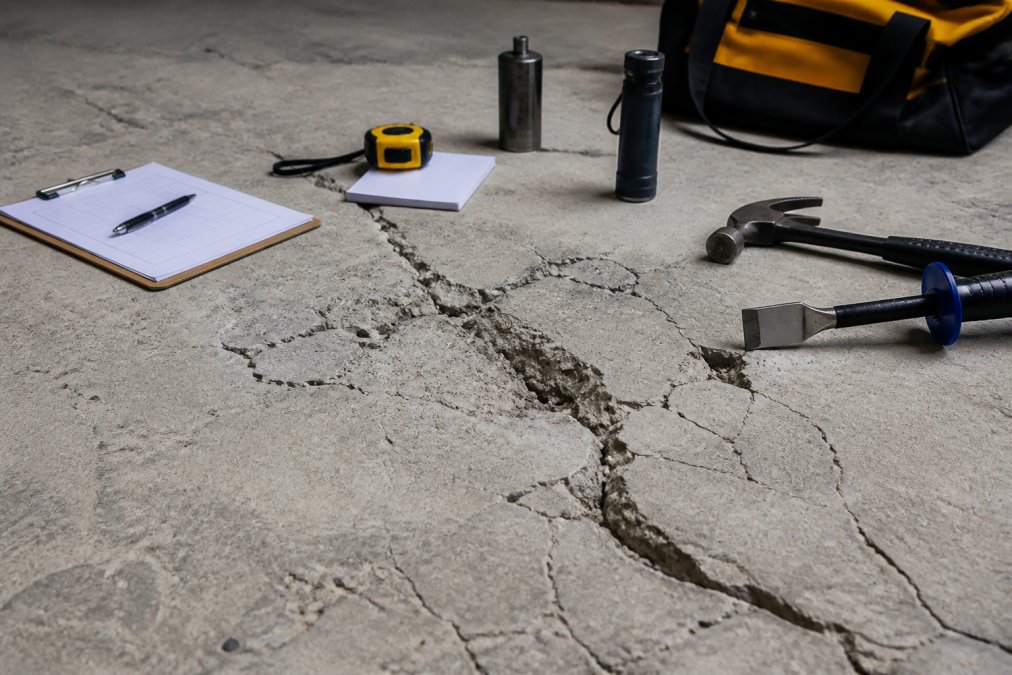
A thorough substrate assessment identifies every defect that will affect terrazzo performance: cracks, spalling, soft spots, surface irregularities, and contamination. Each issue requires specific repair before terrazzo substrate preparation can proceed.
Identifying Cracks and Surface Defects
Concrete cracks fall into different categories. Active cracks that are still moving will cause terrazzo above to crack as well. Static cracks that have stabilized can often be filled and sealed.
Inspect the entire substrate for:
- Hairline cracks (less than 1/16 inch): Often surface-level and stable; can be sealed with epoxy or polyurethane crack filler
- Structural cracks (wider than 1/8 inch): Indicate deeper movement; may require injection with epoxy or polyurethane resin
- Spalling: Concrete flaking away; requires removal of loose material and patching with concrete repair compound
- Soft spots: Areas where concrete has deteriorated; must be identified and removed before substrate preparation proceeds
Healthcare facilities often have concrete exposed to decades of wet cleaning protocols and chemical exposure. Moisture damage, efflorescence, and surface deterioration are common and must be addressed before terrazzo installation.
Mechanical Grinding and Surface Profile Preparation
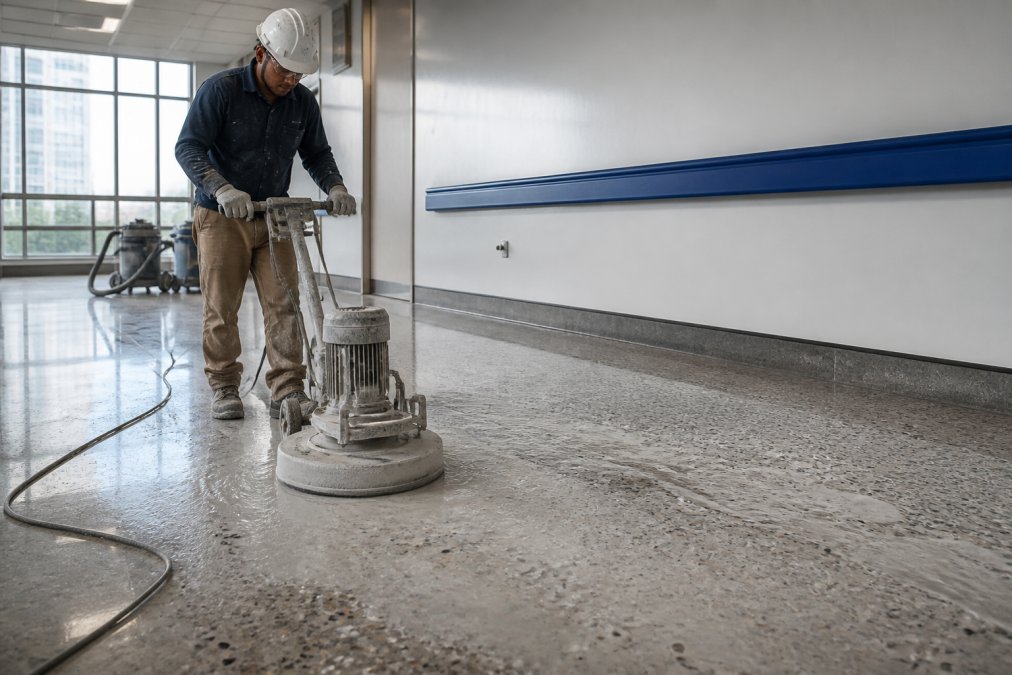
Mechanical grinding removes surface contaminants, creates a proper surface profile for bonding, and levels the concrete to required flatness tolerance.
The concrete surface profile (CSP) is critical for terrazzo adhesion. Most terrazzo installations require CSP-3 to CSP-5, which means the surface has been ground to expose aggregate and create a slightly textured finish.
Shot blasting is the preferred method for healthcare facilities because it removes contaminants, creates profile, and contains dust within a controlled system. The grinding process must achieve floor flatness within FF 25 or better (measured according to ASTM E1155), meaning no high or low spots exceeding 1/4 inch in 10 feet. Leveling compound can correct minor deviations.
Terrazzo Crack Isolation Membrane Requirements in Healthcare
Cracks in the concrete substrate will telegraph through the terrazzo if not isolated. A crack isolation membrane is a flexible layer that allows substrate movement without transferring stress to the terrazzo above.
Crack isolation membranes are especially important in healthcare facilities because hospitals experience significant structural movement from equipment loads and vibration. A membrane rated for expected movement (typically 1/8 inch or greater) must be installed over all cracks wider than 1/16 inch, extending at least 6 inches on either side.
Many contractors skip this step to save time and cost. In healthcare settings, this is a false economy. A single crack propagating through the terrazzo floor compromises the seamless, non-porous surface that infection control depends on.
Hospital Flooring Infection Control Protocols During Prep
Substrate preparation in healthcare facilities requires infection control measures that don't apply to standard commercial installations. The preparation process generates dust and debris that must be contained according to healthcare facility standards. testing concrete moisture.
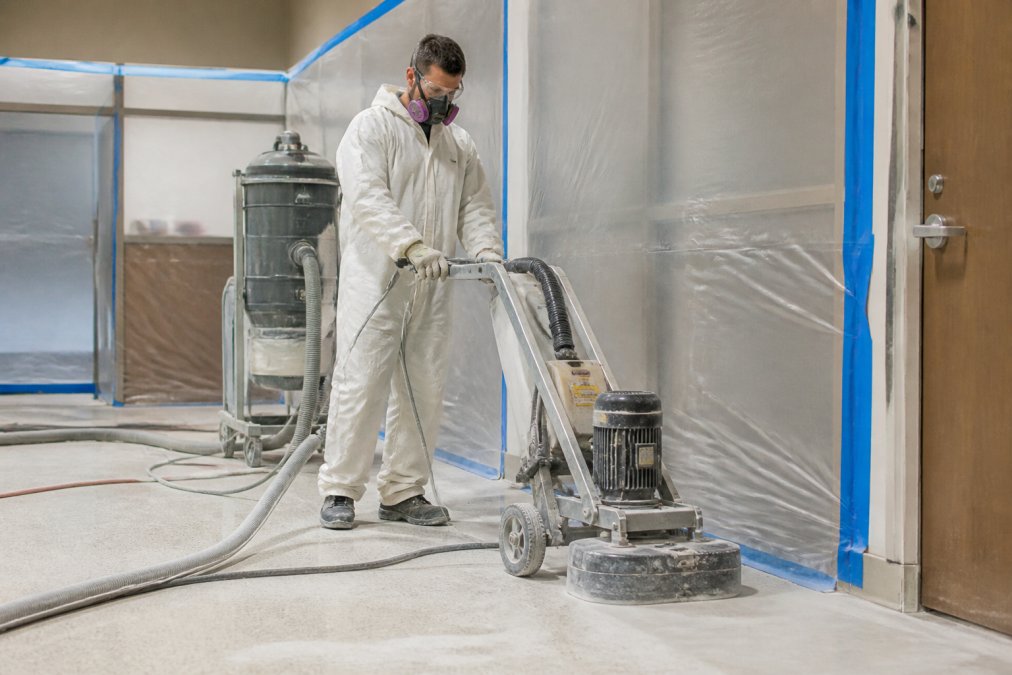
Dust containment during grinding or shot blasting is mandatory. Proper containment requires:
- Negative pressure containment barriers around the work area
- HEPA-filtered dust collection systems
- Sealed barriers between the work zone and adjacent spaces
- Air handling protocols to prevent dust migration
Surface contamination from the preparation process must be addressed before bonding agents or primers are applied. Cleaning protocols for substrate preparation in healthcare differ from standard practice, typically including decontamination steps that exceed standard dust removal. Some facilities require antimicrobial treatment of the prepared substrate before terrazzo installation begins.
NTMA Terrazzo Installation Standards and Substrate Compliance
The National Terrazzo and Mosaic Association (NTMA) publishes installation standards that define proper substrate preparation requirements. Healthcare facilities often reference these standards in specification documents.
NTMA standards specify concrete substrate requirements including:
- Minimum concrete strength (typically 3,500 psi compressive strength)
- Moisture limits (MVER testing requirements)
- Surface profile specifications (CSP ratings)
- Flatness tolerance (FF 25 or better)
- Cure time for new concrete (minimum 28 days)
- Bonding agent and primer requirements
Compliance with NTMA standards is often a contractual requirement. Healthcare facilities should verify that their terrazzo contractor is familiar with NTMA standards and commits to compliance as part of the installation agreement. A1 Terrazzo's work adheres to NTMA guidelines, ensuring that substrate preparation meets the standards that protect both the flooring investment and the facility's operational requirements.
Moisture Vapor Barriers and Sealing the Prepared Substrate
After the substrate has been assessed, repaired, and ground to proper profile, the next critical step is installing moisture protection. A moisture vapor barrier or moisture-tolerant primer system prevents residual moisture from compromising the terrazzo bond.
Moisture barriers come in different types: liquid coatings that cure to form a moisture-blocking layer, or sheet materials adhered to the concrete surface. Primers seal the concrete surface to prevent moisture migration while providing a base for adhesive bonding. Moisture-tolerant primers are specifically formulated for concrete with elevated MVER readings that present risk.
Application must follow manufacturer specifications exactly. Surface preparation, drying, temperature, and humidity conditions during application affect cure time and performance. Sealing also includes treatment of concrete joints with polyurethane or epoxy joint sealers applied after grinding but before terrazzo installation.
Renovation vs. New Construction: Different Prep Approaches
Substrate preparation for terrazzo differs significantly depending on whether you're installing on new concrete or renovating existing flooring.
New construction substrate preparation: New concrete must cure for a minimum of 28 days before terrazzo installation. Once cured, the concrete is ground to proper profile, tested for moisture, and any defects are repaired. The advantage is predictable concrete with controlled mix design and curing conditions.
Renovation and existing floor substrate preparation: Existing flooring must be removed before substrate preparation begins. This removal can reveal problems: moisture damage, failed previous repairs, structural cracks, and weaker concrete than expected. Removing existing flooring in healthcare facilities requires containment and decontamination protocols.
Once the old flooring is removed, the exposed concrete must be assessed. Moisture testing often reveals that older concrete has chronic moisture issues. Renovation projects in healthcare facilities face additional constraints, the facility must remain operational during renovation, so substrate preparation may occur in phases. Timeline for renovation is typically longer than new construction because of unknowns that emerge during removal.
Substrate preparation is where terrazzo installations succeed or fail. The concrete foundation must be properly assessed, repaired, protected from moisture, and prepared to the specifications that ensure long-term performance. In healthcare facilities, these requirements are non-negotiable, the flooring must be durable, seamless, and resistant to the cleaning protocols and environmental stresses that hospitals demand.
A1 Terrazzo brings 35 years of experience in substrate preparation for commercial and healthcare installations. We conduct thorough moisture testing, follow NTMA standards, and implement infection control protocols that healthcare facilities require. When you need terrazzo substrate preparation that meets the highest standards, contact A1 Terrazzo for a consultation and project assessment.
Frequently Asked Questions
Why is substrate preparation critical for hospital terrazzo flooring?
Hospital terrazzo flooring must withstand constant foot traffic, wheeled equipment, spills, and rigorous cleaning protocols. Improper substrate preparation leads to cracking, moisture infiltration, and bond failure within months. Hospitals require seamless, non-porous flooring that resists MRSA and other pathogens. A properly prepared substrate ensures the terrazzo bonds securely, maintains its surface profile, and provides the durability healthcare facilities demand. Skipping or rushing preparation is the primary cause of premature failure.
What are the NTMA standards for terrazzo subfloor moisture testing?
The National Terrazzo and Mosaic Association (NTMA) requires moisture vapor emission rate (MVER) testing before terrazzo installation. Concrete substrates must be tested using calcium chloride or in-situ moisture meters to verify MVER is below 3 pounds per 1,000 square feet per 24 hours. Testing must occur at multiple points across the floor, especially in healthcare facilities where moisture can compromise bond strength and encourage microbial growth. NTMA standards also require alkalinity testing to confirm pH levels are appropriate for primer and resin bonding.
How does concrete moisture affect hospital terrazzo installation?
Excess concrete moisture is the leading cause of terrazzo failure in hospitals. Moisture migrating through the substrate creates vapor pressure that weakens the bond between terrazzo and concrete, causing delamination and cracking. In healthcare environments, moisture also promotes mold and bacterial growth beneath the flooring surface, creating hygiene and durability problems. Proper moisture vapor barriers and leveling compounds prevent this, but only if the substrate moisture is tested and controlled before installation begins.
What role do crack isolation membranes play in healthcare terrazzo?
Crack isolation membranes prevent existing concrete cracks from reflecting through the finished terrazzo surface. In hospitals, this is critical because reflective cracks create seams that trap bacteria, cleaning solutions, and moisture. These membranes are flexible, allowing substrate movement without transferring stress to the terrazzo. They also provide secondary moisture protection. NTMA standards recommend crack isolation membranes in all healthcare installations, particularly over control joints and areas with high structural movement.
How do infection control protocols affect substrate preparation in hospitals?
Hospital infection control requires dust containment and decontamination during all substrate prep work. Grinding, shot blasting, and crack repair generate dust that can spread pathogens and contaminate adjacent clinical areas. Proper protocols include negative air containment, HEPA filtration, and thorough cleaning before primer application. Healthcare facilities often require documentation of infection control measures and may restrict prep work to off-hours or specific zones. Coordination with facility management and infection prevention teams is essential before beginning any substrate work.
Should substrate preparation differ between new construction and renovation projects?
Yes, significantly. New construction allows for controlled moisture curing and optimal substrate conditions from the start. Renovation projects must address existing moisture, old adhesives, sealers, and potential contamination. Existing terrazzo or flooring must be removed completely, and the substrate tested for hidden moisture or structural damage. Renovation work in operating hospitals requires additional infection control measures and scheduling around patient care. Both approaches require full substrate assessment, but renovation projects typically take longer and demand more intensive preparation.
What moisture testing methods are most reliable for hospital substrates?
Calcium chloride testing and in-situ moisture meters are the primary methods. Calcium chloride tests measure MVER directly and are referenced in NTMA standards. In-situ meters provide real-time readings but require proper calibration. For hospitals, dual testing methods are recommended to ensure accuracy. Testing should occur at multiple locations across the floor, in corners, near plumbing, and under any previous flooring. Results must be documented and reviewed before proceeding with primer and terrazzo installation.
This article was written using GrandRanker
Frequently Asked Questions
Why is substrate preparation critical for hospital terrazzo flooring?
Hospital terrazzo flooring must withstand constant foot traffic, wheeled equipment, spills, and rigorous cleaning protocols. Improper substrate preparation leads to cracking, moisture infiltration, and bond failure within months. Hospitals require seamless, non-porous flooring that resists MRSA and other pathogens. A properly prepared substrate ensures the terrazzo bonds securely, maintains its surface profile, and provides the durability healthcare facilities demand. Skipping or rushing preparation is the primary cause of premature failure.
What are the NTMA standards for terrazzo subfloor moisture testing?
The National Terrazzo and Mosaic Association (NTMA) requires moisture vapor emission rate (MVER) testing before terrazzo installation. Concrete substrates must be tested using calcium chloride or in-situ moisture meters to verify MVER is below 3 pounds per 1,000 square feet per 24 hours. Testing must occur at multiple points across the floor, especially in healthcare facilities where moisture can compromise bond strength and encourage microbial growth. NTMA standards also require alkalinity testing to confirm pH levels are appropriate for primer and resin bonding.
How does concrete moisture affect hospital terrazzo installation?
Excess concrete moisture is the leading cause of terrazzo failure in hospitals. Moisture migrating through the substrate creates vapor pressure that weakens the bond between terrazzo and concrete, causing delamination and cracking. In healthcare environments, moisture also promotes mold and bacterial growth beneath the flooring surface, creating hygiene and durability problems. Proper moisture vapor barriers and leveling compounds prevent this, but only if the substrate moisture is tested and controlled before installation begins.
What role do crack isolation membranes play in healthcare terrazzo?
Crack isolation membranes prevent existing concrete cracks from reflecting through the finished terrazzo surface. In hospitals, this is critical because reflective cracks create seams that trap bacteria, cleaning solutions, and moisture. These membranes are flexible, allowing substrate movement without transferring stress to the terrazzo. They also provide secondary moisture protection. NTMA standards recommend crack isolation membranes in all healthcare installations, particularly over control joints and areas with high structural movement.
How do infection control protocols affect substrate preparation in hospitals?
Hospital infection control requires dust containment and decontamination during all substrate prep work. Grinding, shot blasting, and crack repair generate dust that can spread pathogens and contaminate adjacent clinical areas. Proper protocols include negative air containment, HEPA filtration, and thorough cleaning before primer application. Healthcare facilities often require documentation of infection control measures and may restrict prep work to off-hours or specific zones. Coordination with facility management and infection prevention teams is essential before beginning any substrate work.
Should substrate preparation differ between new construction and renovation projects?
Yes, significantly. New construction allows for controlled moisture curing and optimal substrate conditions from the start. Renovation projects must address existing moisture, old adhesives, sealers, and potential contamination. Existing terrazzo or flooring must be removed completely, and the substrate tested for hidden moisture or structural damage. Renovation work in operating hospitals requires additional infection control measures and scheduling around patient care. Both approaches require full substrate assessment, but renovation projects typically take longer and demand more intensive preparation.
What moisture testing methods are most reliable for hospital substrates?
Calcium chloride testing and in-situ moisture meters are the primary methods. Calcium chloride tests measure MVER directly and are referenced in NTMA standards. In-situ meters provide real-time readings but require proper calibration. For hospitals, dual testing methods are recommended to ensure accuracy. Testing should occur at multiple locations across the floor, in corners, near plumbing, and under any previous flooring. Results must be documented and reviewed before proceeding with primer and terrazzo installation.