 blog
Epoxy vs Cement Terrazzo Flooring: Which Wins?
Table of Contents
- Epoxy vs Cement Terrazzo Flooring: A Head-to-Head Comparison
- Epoxy Terrazzo Advantages and Disadvantages
- Terrazzo Flooring Cost: Epoxy vs Cement
- Terrazzo Floor Installation: Methods and Timelines
- Terrazzo Floor Maintenance: Keeping Your Floor in Top Shape
- Making the Right Choice for Your Facility
- Frequently Asked Questions
Last Updated: October 15, 2026
Epoxy vs Cement Terrazzo Flooring: A Head-to-Head Comparison
Choosing between epoxy and cement terrazzo flooring comes down to one question: how much does substrate moisture control matter for your building? Epoxy terrazzo is a thin-set system that bonds to a prepared concrete slab with an epoxy resin binder. Cement terrazzo is a thicker, poured-in-place floor that uses a cement binder. This guide from A1 Terrazzo breaks down cost, installation, and upkeep so you can pick the right system the first time.
Cracking within a year is a common complaint from facility managers. The cause is almost always poor floor preparation, not the terrazzo itself. Get the substrate right and either system can last for decades.
What Sets Epoxy Terrazzo Apart
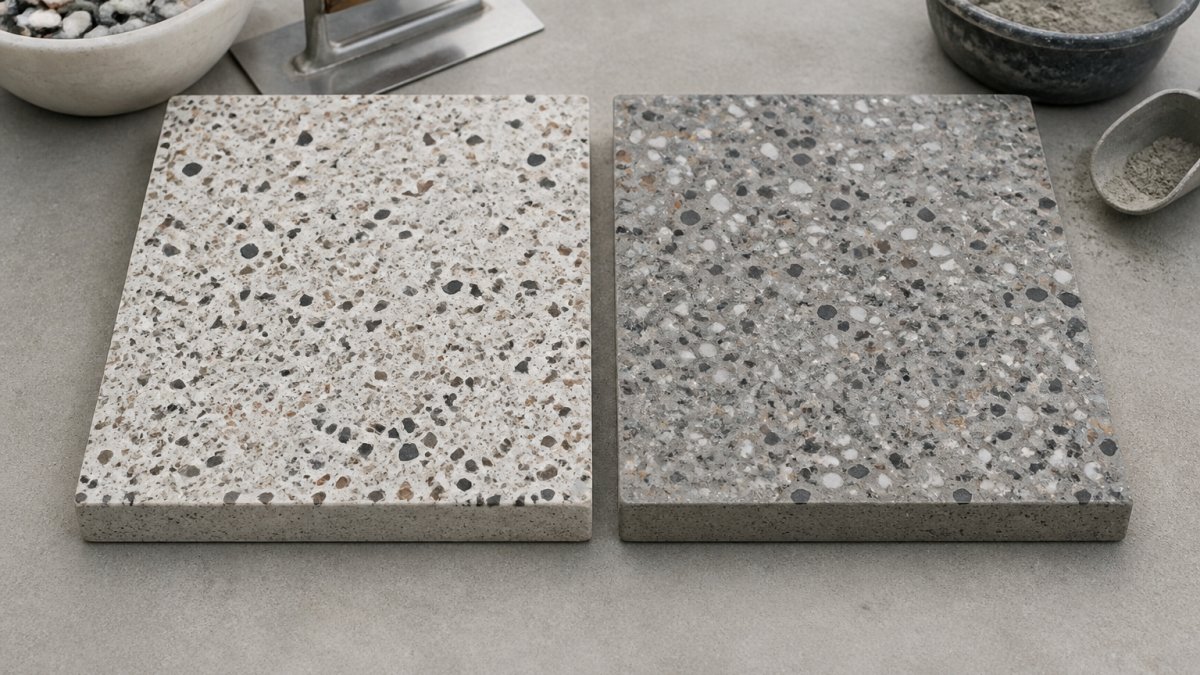
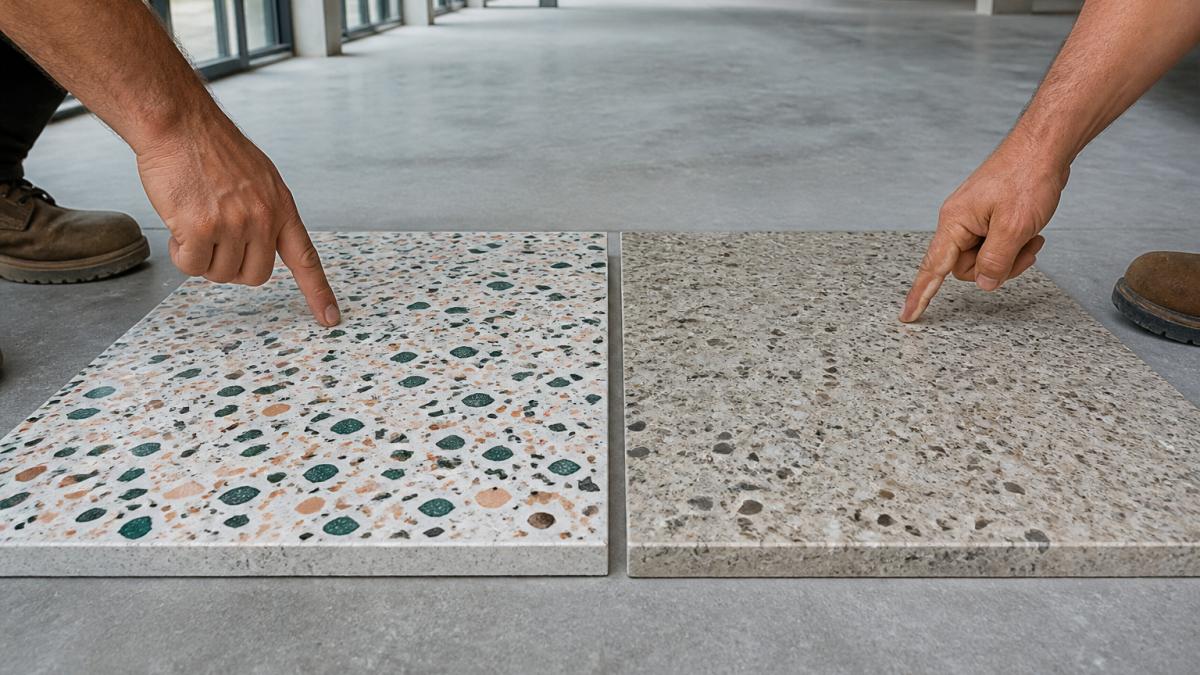
Epoxy terrazzo is a poured-in-place flooring system that mixes marble chips, glass aggregate, or recycled materials into an epoxy resin binder. The resin cures fast and bonds tightly to a concrete slab. That thin profile, often under 1/2 inch, keeps floor loading low. It also allows a wider color palette, from pastel colors to bold custom design.
What Defines Cement Terrazzo
Cement-based terrazzo uses a cement binder instead of resin. Contractors install it at roughly 1/2 to 1 inch thick, which adds weight and floor loading. The trade-off is durability: cement terrazzo handles heavy wear and resists moisture vapor better in some slabs. Earth tones and traditional aggregate mixes are common, though the color range is narrower.
Epoxy Terrazzo Advantages and Disadvantages
The main advantage of epoxy terrazzo is design freedom. Pigments mix directly into the resin, so you get bright, consistent color and fine detail. It cures faster, which shortens downtime. It also forms a seamless floor with no tile joints to trap soil.
The disadvantages matter too. Epoxy resin needs a dry, well-prepared substrate. Moisture vapor moving through a concrete slab can delaminate the floor, so contractors must test the slab first. Epoxy also costs more per square foot in materials.
Cement terrazzo pros and cons run the other way:
- Pros: lower material cost, strong wear resistance, good tolerance for moisture
- Cons: heavier floor loading, slower curing, fewer vivid color options
Terrazzo Flooring Cost: Epoxy vs Cement
Terrazzo flooring cost depends on square footage, substrate condition, aggregate choice, and design complexity. There is no single price, and any contractor who quotes one without a site visit is guessing. What we can do is break the cost into the four numbers that actually drive the decision: installed cost, maintenance cost, repair cost, and replacement cost over the life of the floor.
Installed Cost
Epoxy terrazzo carries a higher material cost because the resin binder is more expensive per pound than cement. Cement terrazzo carries a higher material volume because it is poured at roughly 1/2 to 1 inch thick versus under 1/2 inch for epoxy. The two forces partly offset, but epoxy terrazzo generally lands at a higher installed cost per square foot, especially on projects with complex logos, multi-color panels, or tight deadlines. Cement terrazzo tends to be the lower installed-cost option when the design is simple and the schedule is flexible.
Maintenance Cost
Both systems are maintained the same way: dust mopping, damp mopping with a pH-neutral cleaner, and periodic repolishing. The difference is frequency. Epoxy terrazzo's resin binder is more susceptible to scratching and dulling under abrasive traffic, so high-traffic commercial spaces often repolish sooner. Cement terrazzo holds a polish longer in heavy-wear zones but is more vulnerable to acidic cleaners, which etch the cement matrix and require patching rather than a simple repolish.
Repair Cost
Repairs are where the two systems diverge most. Epoxy terrazzo repairs are localized: the damaged area is cut out, re-poured with matching resin and aggregate, ground flush, and polished. The challenge is color matching, because epoxy resin cures fast and pigments can shift slightly batch to batch. Cement terrazzo repairs are more forgiving on color match because the cement matrix is more uniform, but the repair zone is larger and the cure time is longer, so the floor is out of service longer.
Replacement Cost
A properly installed terrazzo floor can last the life of the building with basic maintenance. That is the real cost story: the upfront price is spread across decades, while cheaper flooring that fails in five years often costs more over time once removal, disposal, and reinstallation are counted. When you compare bids, ask each contractor for a 20-year view that includes maintenance, one mid-life repolish, and a realistic repair allowance. That number, not the square-foot price, is what your facility will actually pay.
| Cost Factor | Epoxy Terrazzo | Cement Terrazzo |
|---|---|---|
| Material cost | Higher per pound | Lower per pound, higher volume |
| Floor thickness | Thin, under 1/2 inch | 1/2 to 1 inch |
| Floor loading | Lower | Higher |
| Labor intensity | High, needs dry slab | High, slower cure |
| Curing time | Fast | Slow |
| Repair cost | Moderate, color-match risk | Moderate, larger repair zone |
| Repolish frequency | More frequent in high traffic | Less frequent |
| Lifecycle cost | Higher upfront, lower over decades | Lower upfront, comparable over decades |
For a real number, request a site-specific quote. Pricing depends on your slab, square footage, and design, so we quote each project after a walkthrough. Whole Building Design Guide on floor finishes
Terrazzo Floor Installation: Methods and Timelines
Terrazzo floor installation follows a set sequence, and the timeline depends on curing and grinding. Here is the standard process with realistic stage durations for a commercial project.
- Substrate preparation and crack repair, 1 to 3 days depending on slab condition. Existing coatings, adhesives, and weak concrete must be removed before anything else.
- Moisture vapor and flatness testing, 1 day. This is non-negotiable for epoxy terrazzo and strongly recommended for cement terrazzo.
- Divider strip layout and installation, 1 to 2 days. Strips define panel size, control joints, and decorative patterns.
- Pouring the terrazzo mix, 1 to 2 days for epoxy, 1 to 3 days for cement, depending on square footage and crew size.
- Curing, Epoxy systems cure in roughly 12 to 24 hours before grinding can begin. Cement terrazzo needs several days of moist curing before it is hard enough to grind without pulling aggregate.
- Grinding to expose aggregate, 2 to 4 days. This is the dustiest, loudest phase and the one that most disrupts occupied buildings.
- Polishing to final finish, 1 to 3 days, depending on the sheen specified.
- Sealing and cleaning, 1 day, plus a short cure before the floor is returned to service.
What This Means for Your Schedule
A typical commercial epoxy terrazzo project runs two to three weeks from mobilization to walkable floor. Cement terrazzo runs three to five weeks because of the longer cure. Add time for substrate repair if the slab is in poor condition.
Occupancy and Disruption
Grinding and polishing generate dust, noise, and slurry, so occupied spaces usually need to be vacated or isolated during those phases. Epoxy terrazzo's faster cure means less total disruption, which matters for hospitals, schools, and retail spaces that cannot afford long closures. Cement terrazzo's longer cure is easier to absorb in new construction or phased renovations where the floor is not needed immediately.
Climate, Moisture, and Substrate Suitability
Epoxy terrazzo requires a dry, well-prepared slab. Moisture vapor moving through concrete can delaminate the floor, so contractors must test the slab first. Cement terrazzo tolerates higher moisture vapor and temperature variation better, which makes it the safer choice for slabs on grade, older buildings, and climates with wide seasonal swings. If your slab has a history of movement or cracking, both systems need properly spaced divider strips and, in severe cases, a crack-isolation membrane before the terrazzo goes down.
Terrazzo Floor Maintenance: Keeping Your Floor in Top Shape
Terrazzo floor maintenance is simpler than most people expect, but the wrong products will ruin it. Regular cleaning means dust mopping and damp mopping with a pH-neutral cleaner. That is it for daily care.
What damages terrazzo:
- Acidic cleaners that etch the surface
- Abrasive pads that dull the polish
- Skipping resealing, which lets stains set in
A repolish every few years restores the shine. For high-traffic spaces like airports, hospitals, and schools, a scheduled maintenance plan keeps the floor looking new. We offer professional maintenance services so your floor stays in top shape without guesswork.
EPA guidance on indoor air quality in commercial buildings
Making the Right Choice for Your Facility
Pick epoxy terrazzo when you want bold color, a thin profile, and faster installation on a dry, well-prepped slab. Pick cement terrazzo when you need maximum durability, lower material cost, and better moisture tolerance.
Match the system to your building, not the other way around. Hospitals, airports, and schools all have different traffic and sanitation needs. A healthcare floor has different demands than a retail entryway.
For most commercial projects, the deciding factors are substrate condition and design goals. Get those right and either system performs.
Frequently Asked Questions
What is the difference between epoxy and cement terrazzo flooring?
Epoxy terrazzo uses a two-part resin binder that cures hard and allows thin-set installation (about 0.25 to 0.375 inches). Cement terrazzo uses a Portland cement binder and is poured thicker (0.5 to 1 inch). Epoxy offers a wider color palette and faster cure, while cement terrazzo handles moisture and temperature swings better. Both are seamless terrazzo flooring systems, but the binder dictates performance, cost, and installation method.
Which lasts longer, epoxy terrazzo or cement terrazzo?
The lifespan of both epoxy and cement terrazzo depends heavily on the substrate condition and maintenance routine. Both systems are durable, and epoxy terrazzo can be refinished and repaired, extending its life.
Is epoxy terrazzo less expensive than cement terrazzo?
The initial cost of epoxy versus cement terrazzo can vary based on factors like cure time, installation thickness, labor, and material volume. For a true comparison, factor in lifecycle costs including maintenance, repairs, and downtime. Request a detailed quote from a terrazzo contractor to see which fits your budget.
Can epoxy terrazzo be installed over concrete?
Yes, epoxy terrazzo can be installed over concrete, but the slab must be properly prepared. Moisture testing is critical because epoxy is sensitive to moisture vapor. If the concrete slab has high moisture levels, a moisture mitigation system may be needed. Surface profile, cracks, and contaminants also affect adhesion. A qualified terrazzo floor installation contractor will assess the substrate and recommend the right preparation to prevent failures.
Choosing the wrong terrazzo system, or the right one installed poorly, leads to cracks, delamination, and costly repairs. A1 Terrazzo brings 35 years of commercial terrazzo experience to every project, from healthcare facilities to airports and campuses. We handle high-quality installation and professional maintenance services tailored to your building. Contact A1 Terrazzo and get a floor built to last.