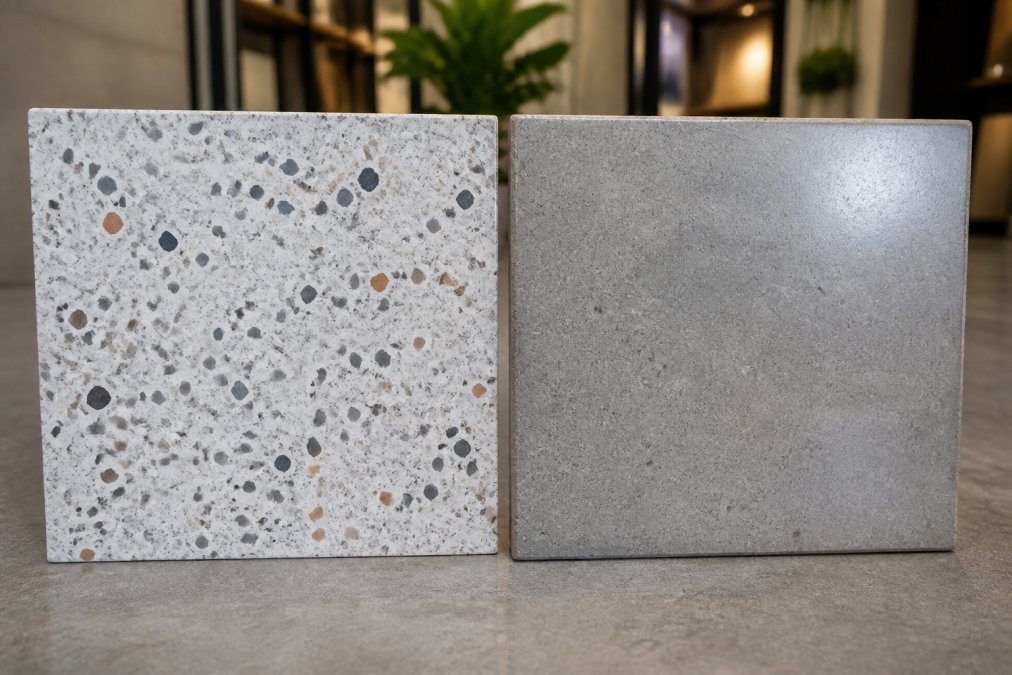
 comparison
Terrazzo vs Polished Concrete for Commercial Buildings
Table of Contents
- Terrazzo vs Polished Concrete: Quick Comparison
- Material Composition: Epoxy Resin vs Cementitious Matrix
- Epoxy Terrazzo Flooring Installation: Process and Timeline
- Durability, Traffic Load, and Terrazzo Flooring Lifespan
- Commercial Flooring Maintenance Costs and Maintenance Cycle
- Design Flexibility, Slip Resistance, and Radiant Heating Integration
- Best Use Cases for Healthcare, Airports, Schools, and Historic Buildings
- Conclusion
- Frequently Asked Questions
Last Updated: September 15, 2026
Terrazzo vs Polished Concrete: Quick Comparison
Choosing between terrazzo vs polished concrete for commercial buildings comes down to how much design control and longevity you need, and what you'll pay for it. Terrazzo is a poured or precast composite of marble, glass, or granite chips set in a cementitious or epoxy matrix, then ground and polished to a monolithic surface. Polished concrete is an existing slab, mechanically ground and chemically densified to harden the top layer. At A1 Terrazzo, we've installed commercial floors for more than 35 years, and the split is predictable: terrazzo wins on design flexibility and lifespan, concrete wins on upfront budget.
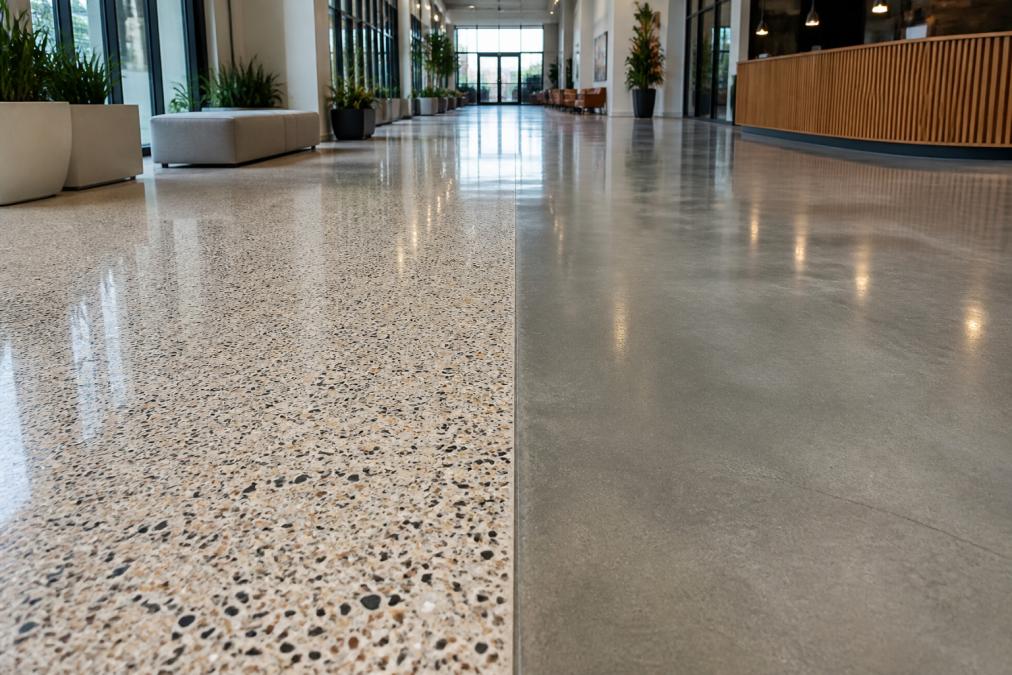
Side-by-Side Comparison Table
| Factor | Terrazzo | Polished Concrete |
|---|---|---|
| Composition | Aggregate in epoxy or cementitious matrix | Existing slab, densified and ground |
| Design control | Custom colors, patterns, logos | Limited to slab tone and aggregate exposure |
| Slip resistance | Tunable by finish and grit | Tunable by gloss level |
| Repair | Localized patching possible | Patching often visible |
| Radiant heating | Compatible | Compatible |
| Best for | Healthcare, airports, schools, historic | Warehouses, retail, industrial |
Material Composition: Epoxy Resin vs Cementitious Matrix
Terrazzo's performance starts with its binder. An epoxy resin matrix cures fast, resists chemicals, and holds high aggregate density without cracking, which is why most healthcare and food-service projects specify it. A cementitious matrix costs less and suits exterior or high-moisture areas, but needs longer curing and more control joints. Polished concrete has no added matrix; its hardness comes from the slab's compressive strength plus a chemical densifier that fills surface porosity.
Aggregate Density, Porosity, and Surface Hardness
Aggregate density drives both looks and wear. Terrazzo systems typically run 70% chip density, which is why the surface reads as stone rather than gray slab (About Concrete). Polished concrete exposes whatever aggregate the original pour contains, so its appearance is only as good as the batch that was placed. A properly densified concrete floor resists staining well, but terrazzo's resin matrix closes the surface more completely.
Epoxy Terrazzo Flooring Installation: Process and Timeline
Epoxy terrazzo flooring installation is a multi-stage process, not a coating. Crews prep the substrate, place divider strips to control cracking and define pattern, pour the matrix, cure, then grind through progressively finer diamond grits before honing and polishing. Polished concrete skips the pour entirely: grind, densify, polish. That shorter sequence is the biggest reason concrete costs less.
Substrate Preparation and Curing Time
Substrate preparation decides whether either floor lasts. Moisture vapor transmission from an unprepared slab is the most common cause of delamination and cracking, and rushing the pour before moisture testing clears is a common mistake (astm.org). Epoxy terrazzo cures within days; cementitious terrazzo needs longer before grinding. Polished concrete still requires moisture assessment, since a wet slab will cloud and stain no matter how well it's ground.
Durability, Traffic Load, and Terrazzo Flooring Lifespan
Terrazzo flooring lifespan is measured in decades, not years, for mechanical reasons. Because the aggregate runs through the full thickness of the pour, wear exposes fresh chip rather than a worn substrate. Polished concrete is durable too, but its finish lives in the top few millimeters of densified surface, so aggressive cleaning or heavy traffic dulls it faster and eventually requires re-grinding rather than simple re-polishing.
How Traffic Load Actually Wears Each Surface
Wear on a commercial floor comes from three sources, and the materials respond differently:
- Abrasion from grit and foot traffic. Grit tracked in from outside acts like sandpaper. Terrazzo's chip density means the abrasive must wear through stone, not just a surface layer. Polished concrete's densified layer is harder than the slab beneath it, but once breached, the softer concrete underneath wears faster.
- Point loads from carts, gurneys, and luggage. Rolling loads concentrate stress at wheel contact points. Terrazzo's monolithic pour distributes that stress across the matrix. Concrete slabs handle point loads well too, but control joints and existing cracks can propagate under repeated rolling loads.
- Chemical exposure. Healthcare and food-service floors see disinfectants, spills, and cleaning agents. Epoxy terrazzo matrix resists chemicals well; cementitious terrazzo and polished concrete are more vulnerable to acidic attack, so cleaning chemistry matters for both.
For airports and hospitals where traffic never stops, that difference compounds. A concourse floor seeing tens of thousands of passengers a day will show wear patterns on polished concrete long before terrazzo shows comparable wear.
Repairability and Patching in High-Traffic Zones
This is the biggest long-term concern for facility maintenance teams. A terrazzo floor can be patched in a localized area: crews chip out the damaged section, match the aggregate and matrix, re-pour, and grind it flush so the repair disappears. The key is aggregate matching, a skilled installer keeps a record of the original mix so future patches blend in.
Polished concrete patching is harder to hide because the surrounding slab has aged and its tone has shifted, so a fresh patch reads as a lighter or darker rectangle. In high-traffic zones like terminal concourses or hospital corridors, invisible repairs matter for appearance and safety, since a visible patch can become a trip hazard if the edges aren't feathered correctly.
What Determines Service Life in Practice
Service life is not a fixed number, it's a function of traffic load, cleaning regimen, and substrate condition. Practical rules of thumb:
Commercial Flooring Maintenance Costs and Maintenance Cycle
What Drives the Maintenance Cycle for Each Surface
A 20-Year Life Cycle Cost Analysis Framework
Acoustic Performance: The Angle Most Specifiers Miss
The Maintenance Cost Comparison in Practice
| Cost Stream | Terrazzo | Polished Concrete |
|---|---|---|
| Daily cleaning | Dust mop / microfiber | Dust mop / microfiber |
| Periodic restoration | Burnish / re-polish (exposes fresh chip) | Burnish, then re-grind once densified layer wears |
| Repair visibility | Localized patch blends in | Patch often visible against aged slab |
| Replacement horizon | Decades | Shorter in high-traffic zones |
| Operational disruption | Low if patched in place | Higher if re-grind or replacement needed |
Design Flexibility, Slip Resistance, and Radiant Heating Integration
Best Use Cases for Healthcare, Airports, Schools, and Historic Buildings
| Facility Type | Recommended Floor | Why |
|---|---|---|
| Hospital / clinic | Terrazzo | Sanitary, seamless, color-coded wayfinding |
| Airport / terminal | Terrazzo | Handles traffic load, invisible repairs |
| School / university | Terrazzo | Decades of service, campus branding |
| Historic building | Terrazzo | Pattern and finish matching |
| Warehouse / retail | Polished concrete | Lower cost, fast install |
Conclusion
Frequently Asked Questions
What are the primary maintenance differences between terrazzo and polished concrete?
Terrazzo requires a regular maintenance cycle of diamond grinding and honing every 3-5 years to maintain its gloss, plus daily dust mopping and periodic polishing with a densifier or sealer. Polished concrete needs similar daily cleaning but typically requires re-polishing every 5-7 years. Both benefit from a neutral pH cleaner; harsh chemicals can damage either surface. Facility managers should budget for professional maintenance to protect the investment.
How does the lifespan of terrazzo compare to polished concrete in high-traffic zones?
Terrazzo flooring lifespan often exceeds 40 years with proper care, while polished concrete typically lasts 20-30 years in high-traffic areas. The cementitious or epoxy matrix in terrazzo resists wear better than concrete's surface layer, which can degrade with heavy traffic load. Repairability is also a factor: terrazzo can be patched with matching aggregate, whereas polished concrete repairs may be more visible.
Is terrazzo more cost-effective than polished concrete for large commercial areas?
Upfront, polished concrete usually costs less per square foot, but terrazzo can be more cost-effective over its life cycle. A life cycle cost analysis (LCCA) that includes installation downtime, commercial flooring maintenance costs, and replacement frequency often favors terrazzo for facilities with long-term ownership. For large areas, terrazzo's durability reduces the need for costly repairs and early replacement.
Which flooring option offers better design versatility for modern commercial interiors?
Terrazzo offers superior design flexibility with decorative aggregate, custom color matching, and the ability to create logos, patterns, and monolithic surfaces. Polished concrete provides a more limited palette, typically in gray tones with varying gloss levels. For branding or architectural finishes, terrazzo is the clear choice. However, polished concrete can be a good fit for industrial or minimalist aesthetics.
Are there specific ADA compliance considerations for terrazzo versus polished concrete?
Yes, both surfaces must meet ADA slip resistance standards, typically a coefficient of friction of 0.60 or higher for level surfaces. Terrazzo can be finished with a honed or matte texture to improve slip resistance, while polished concrete may require a densifier or sealer to achieve the same. Facility managers should verify that the installed finish meets ADA guidelines, especially in healthcare and public spaces.
Considering terrazzo for your next commercial project? A1 Terrazzo has spent 35 years installing and maintaining terrazzo floors for hospitals, airports, schools, and historic buildings. Get started with A1 Terrazzo and get a floor built to outlast the building's next renovation.