 listicle
Eco-Friendly Terrazzo Flooring for Businesses
Table of Contents
- Why Eco-Friendly Terrazzo Flooring Matters for Commercial Spaces
- Quick Comparison: Top Eco-Friendly Terrazzo Options
- TERRAZZCO Brand Epoxy Terrazzo: Zero-VOC Performance
- Daltile and Crossville Porcelain: Recycled-Content Alternatives
- Low-VOC Terrazzo Sealers and Finishes for Indoor Air Quality
- LEED Certification Requirements for Commercial Flooring
- Sustainable Flooring Maintenance Best Practices
- Frequently Asked Questions
Last Updated: September 21, 2026
Why Eco-Friendly Terrazzo Flooring Matters for Commercial Spaces
Businesses across healthcare, hospitality, and education sectors are shifting toward sustainable building materials that deliver both durability and environmental responsibility. Eco-friendly terrazzo flooring has emerged as a practical solution for facilities managers seeking to reduce their carbon footprint while maintaining high-performance surfaces that withstand heavy foot traffic and rigorous cleaning protocols.
Sustainable flooring is both environmental and operational: worn flooring increases maintenance costs, safety liabilities, and aesthetic decline. The right flooring choice impacts facility budgets, employee satisfaction, and building certifications.
This guide covers eco-friendly terrazzo options, from epoxy systems to recycled-content porcelain, and how they meet LEED standards, reduce indoor air quality risks, and deliver long-term cost savings.
Quick Comparison: Top Eco-Friendly Terrazzo Options
| Option | Material Type | Best For | Key Advantage | Installation Weight |
|---|---|---|---|---|
| TERRAZZCO Epoxy Terrazzo | Poured epoxy with recycled aggregate | Large commercial projects, LEED certification | Zero-VOC, fully customizable, seamless | High |
| Daltile Terrazzo Porcelain | Porcelain tile, recycled-content available | Budget-conscious facilities, retrofit projects | Lower weight, no sealing required, easy maintenance | Low |
| Crossville Porcelain Tile | High-recycled-content porcelain | Healthcare and retail, high-traffic areas | Certified sustainable production, slip-resistant | Low |
| Interface Terrazzo-Look LVT | Luxury vinyl tile, carbon-neutral | Offices and retail, quick installation needs | Modular repair, carbon-neutral manufacturing | Very Low |
| Fiandre Architectural Surfaces | Large-format porcelain slabs | Luxury commercial lobbies, high-end retail | Minimal grout lines, sophisticated appearance | Medium |
TERRAZZCO Brand Epoxy Terrazzo: Zero-VOC Performance
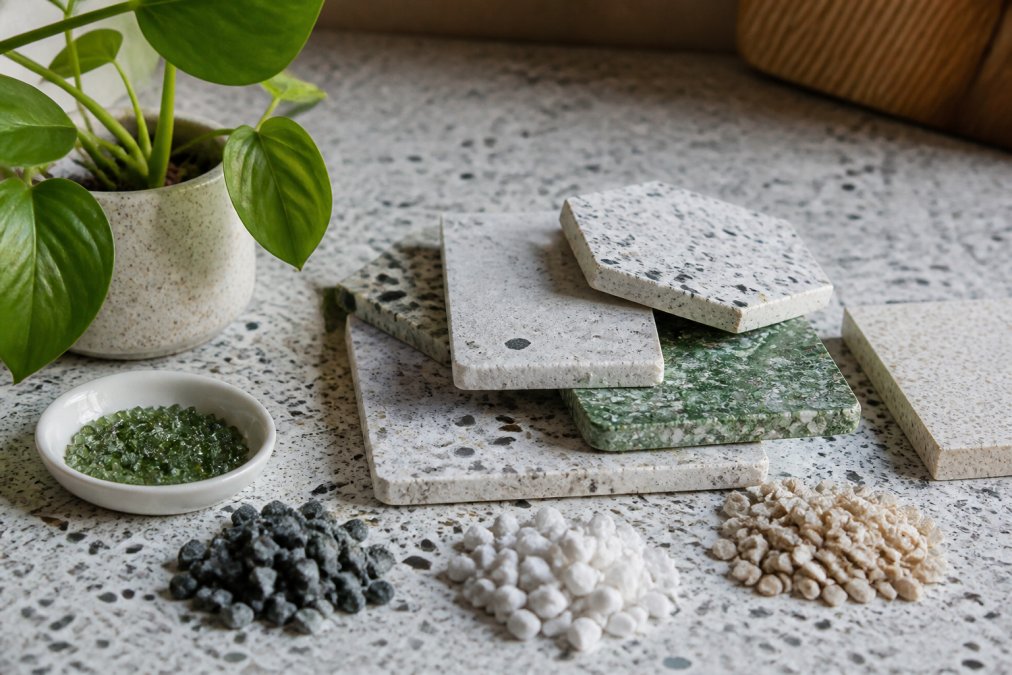
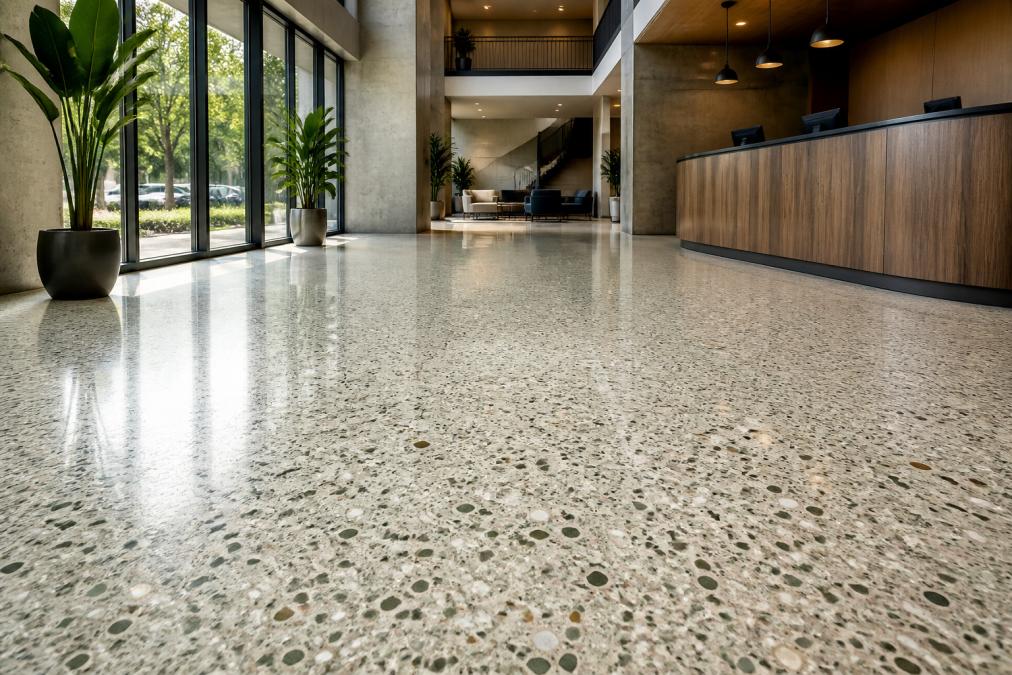
TERRAZZCO's epoxy terrazzo system uses zero-VOC epoxy resins combined with recycled glass, marble chips, and granite aggregate, eliminating harmful volatile organic compounds that degrade indoor air quality.
The zero-VOC formulation eliminates off-gassing that occurs with traditional epoxy systems over 6-12 months, providing immediate air quality benefits for healthcare, schools, and offices.
Recycled aggregate content ranges from 40-60%, reducing demand for virgin stone and diverting waste glass from landfills. The material is fully customizable for colors, particle sizes, and finishes.
TERRAZZCO epoxy delivers 20-30+ year lifespan with routine sweeping and damp mopping. The seamless surface eliminates grout lines where bacteria accumulate, making it ideal for healthcare and food-service environments.
Installation typically requires 2-4 weeks including substrate prep, application, and curing.
Daltile and Crossville Porcelain: Recycled-Content Alternatives
Porcelain tile offers a lighter-weight alternative for retrofit projects and facilities with structural load limitations. Both Daltile and Crossville manufacture terrazzo-look porcelain with recycled content.
Daltile Terrazzo Porcelain replicates traditional terrazzo using high-fired porcelain with visible aggregate patterns and recycled content. It costs significantly less than poured epoxy while delivering comparable durability.
The key trade-off is visible grout lines every 12-24 inches, which trap dust and bacteria. This is a minor limitation for office, retail, or hospitality spaces but problematic for healthcare or food-service environments.
Crossville Porcelain Tile specializes in certified sustainable manufacturing using energy-efficient kilns and recycled materials. Collections achieve third-party environmental certifications and contribute to LEED points. Slip-resistant finishes suit high-traffic areas with wide color variety.
Installation costs can be lower than epoxy systems due to faster application and lighter equipment requirements.
Low-VOC Terrazzo Sealers and Finishes for Indoor Air Quality
The sealer and finish applied to terrazzo flooring significantly impact indoor air quality. Traditional sealers release volatile organic compounds (VOCs) during application and curing, affecting occupant health for months.
Low-VOC sealers reduce or eliminate formaldehyde, benzene, and other harmful compounds. For healthcare, schools, and offices, they protect occupants from respiratory irritation and support indoor air quality compliance.
Traditional high-VOC sealers cause odor complaints, headaches, and air quality issues for 6-12 months. Low-VOC sealers eliminate this while delivering equivalent protection and durability.
Types of low-VOC finishes:
- Water-based polyurethane: Lower VOC content, fast-drying, suitable for most commercial applications. Slightly less durable than solvent-based systems but adequate for typical traffic patterns.
- Epoxy-based low-VOC: Offers enhanced durability for high-traffic areas. Cures faster than traditional epoxy, reducing facility downtime.
- Acrylic-based finishes: Cost-effective low-VOC option, though requires more frequent reapplication (every 2-3 years vs. 5+ years for polyurethane).
Require documentation that sealers meet GreenGuard Gold or similar third-party certifications to ensure genuine low-VOC performance.
LEED Certification Requirements for Commercial Flooring
LEED certification requires flooring materials to meet specific environmental and health criteria. The most strategic advantage lies in embodied carbon analysis, a metric increasingly weighted in LEED v4.1 and often overlooked in material selection.
Relevant LEED credits for flooring:
- MRc2 (Building Product Disclosure and Optimization): Requires Environmental Product Declarations (EPDs). Terrazzo with recycled content and low-VOC formulations qualify.
- EQc2 (Low-Emitting Materials): Low-VOC epoxy and water-based sealers satisfy VOC limits; traditional high-VOC systems do not.
- MRc3 (Sourcing of Raw Materials): Terrazzo using 40%+ recycled glass or marble chips earns points.
- MRc4 (Material Reuse): Restoration of existing terrazzo in historic buildings qualifies for points.
Embodied carbon analysis: The overlooked competitive advantage
LEED v4.1 introduced embodied carbon limits under MRc1 (Building Life-Cycle Impact Reduction), shifting focus from material sourcing alone to total lifecycle emissions.
Practical LEED strategy for facility managers:
-
For new construction: Poured epoxy with 40%+ recycled content and zero-VOC formulations earn more LEED points. Higher upfront embodied carbon is offset by durability and reduced replacement cycles.
-
For retrofit projects: Porcelain tile may offer faster payback if structural load is a constraint. Specify manufacturers with renewable energy certifications to minimize embodied carbon.
-
For healthcare and education: Prioritize low-VOC formulations and seamless surfaces (poured epoxy) to maximize EQc2 points and support infection control.
Sustainable Flooring Maintenance Best Practices
Proper maintenance extends floor lifespan and prevents costly repairs. Maintenance strategy directly impacts lifecycle carbon and total cost of ownership that justify the initial investment in sustainable flooring.
Sealer reapplication strategy and cost optimization:
Maintenance documentation and lifecycle tracking:
| Maintenance Task | Frequency | Cost Impact | Lifecycle Carbon Impact | DIY or Professional |
|---|---|---|---|---|
| Daily sweeping | Daily | Minimal | Prevents scratching; extends lifespan | DIY |
| Weekly damp mopping with approved cleaners | Weekly | Minimal | Maintains sealer integrity | DIY |
| Quarterly deep cleaning | Quarterly | Low | Removes buildup that accelerates wear | Professional recommended |
| Annual sealer inspection | Annually | Low | Identifies early degradation | Professional |
| Sealer reapplication (polyurethane low-VOC) | Every 5-7 years | Moderate | Extends lifespan by 10+ years vs. poor maintenance | Professional required |
| Sealer reapplication (water-based low-VOC) | Every 2-3 years | Low per application | More frequent but lower cost per application | Professional required |
| Grout repair or replacement (porcelain tile only) | As needed | Moderate to high | Prevents moisture infiltration and substrate damage | Professional required |
End-of-life planning and circular economy considerations:
Frequently Asked Questions
What makes terrazzo flooring considered eco-friendly?
Eco-friendly terrazzo uses recycled glass, marble chips, and metal aggregates as primary materials, reducing waste sent to landfills. Systems formulated with zero-VOC or low-VOC epoxy resins improve indoor air quality and reduce harmful chemical emissions. The long lifespan of properly installed and maintained terrazzo, often 20+ years without replacement, means fewer resources consumed over the building's lifecycle compared to materials requiring frequent replacement.
Can terrazzo flooring contribute to LEED certification for businesses?
Yes. Terrazzo products with high recycled content earn points under LEED Material and Resources credits. Zero-VOC and low-VOC formulations support Indoor Environmental Quality credits by reducing volatile organic compounds that affect air quality. Terrazzo's durability extends the lifecycle of the building material, supporting the long-term performance requirements of LEED v4. Specify products certified by third parties to maximize credit eligibility for your project.
What are the maintenance requirements for sustainable terrazzo floors?
Sustainable terrazzo requires regular sweeping and damp mopping with pH-neutral cleaners, never acidic or abrasive products that damage the sealant. Annual or biennial resealing with low-VOC products maintains the protective barrier and extends floor life. For high-traffic commercial areas like hospitals or airports, professional maintenance every 12-24 months prevents wear and preserves the aesthetic. Proper maintenance reduces the need for costly repairs and extends the floor's lifecycle, reinforcing its environmental value.
How does recycled glass terrazzo compare to traditional aggregate?
Recycled glass aggregate offers the same durability and aesthetic appeal as traditional marble or granite chips while diverting waste from landfills. Glass terrazzo creates distinctive visual effects with color variation and light reflection. Both systems achieve comparable hardness and slip resistance when properly formulated. The key difference is environmental impact: recycled glass reduces demand for virgin quarried materials and embodied carbon, making it the preferred choice for sustainability-focused projects.
What are the downsides of terrazzo flooring for commercial use?
Proper installation is critical, substrate preparation issues can lead to cracking within months if not done correctly. Terrazzo requires professional application and cannot be installed over certain existing floors without remediation. Sealing and maintenance must use specified products; wrong cleaners damage the finish. Initial material and installation costs are higher than some alternatives, though lifecycle cost often favors terrazzo due to longevity. Repairs to damaged sections may require professional help, though modern epoxy systems allow targeted patching.