 ultimate-guide
Terrazzo Flooring for Commercial Buildings: 2026 Guide
Table of Contents
- Why Terrazzo Flooring Belongs in Commercial Buildings
- Epoxy Terrazzo vs Cement Terrazzo: Choosing Your System
- Terrazzo Flooring Cost per Square Foot: What Shapes the Price
- Substrate Preparation: The Non-Negotiable First Step
- Installation Timeline and the Curing Process
- Commercial Flooring Maintenance Best Practices
- Repair and Restoration: Protecting Your Investment
- Conclusion: Making the Decision for Your Facility
- Frequently Asked Questions
Last Updated: September 5, 2026
Why Terrazzo Flooring Belongs in Commercial Buildings
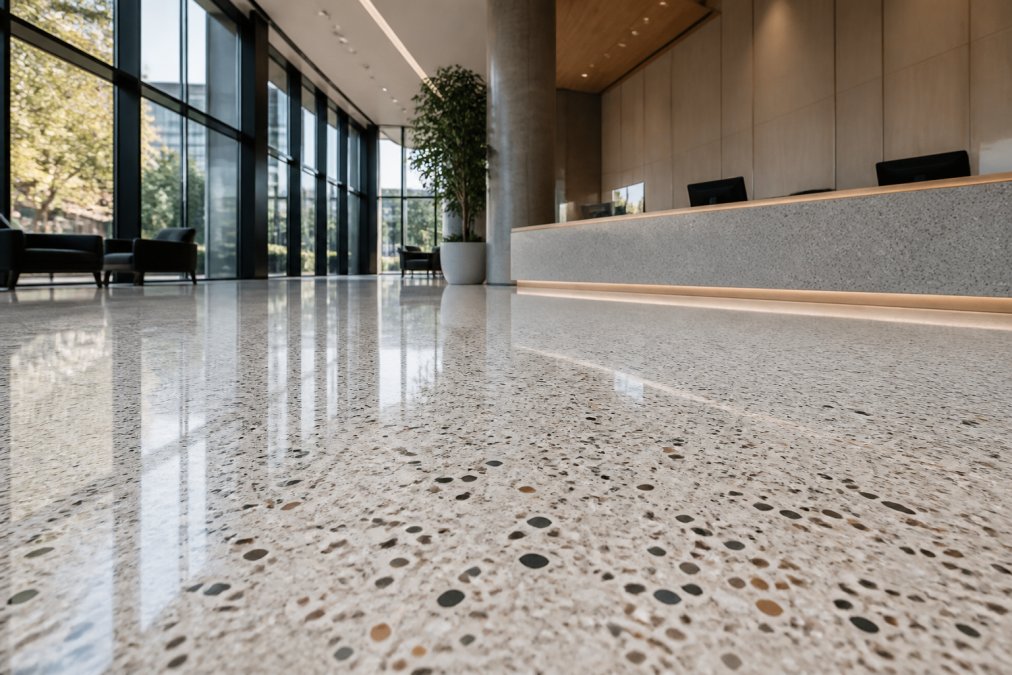
Terrazzo flooring for commercial buildings is a composite material system poured in place or installed as precast tiles, combining marble, quartz, granite, or glass chips within a cementitious or epoxy binder. Once cured, the surface is ground and polished to reveal a smooth, seamless finish. At A1 Terrazzo, we have spent 35 years installing and maintaining these systems across Florida, and our project history consistently validates what architects have known for over a century: no other flooring category matches terrazzo's combination of longevity, hygiene, and design flexibility.
The case for terrazzo starts with its service life. While carpet tiles typically require replacement every 7 to 10 years and VCT every 5 to 8 years, a properly installed terrazzo system routinely lasts 40 years or more. That longevity transforms the financial picture for a commercial facility, because the initial investment is amortized across decades rather than years. The National Terrazzo and Mosaic Association's technical specifications outline the performance standards that make these lifespans achievable.
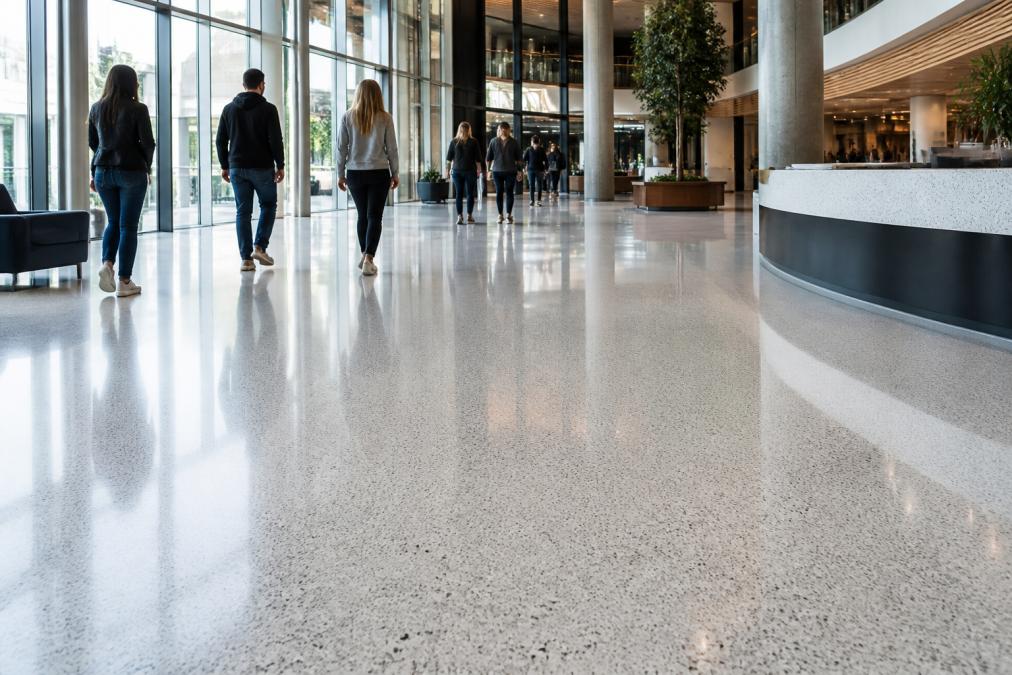
Terrazzo flooring is also non-porous when properly sealed, so it does not harbor bacteria, mold, or allergens the way grout lines and textile fibers do. For hospitals, schools, and food-service environments, that hygienic surface eliminates an entire category of maintenance concern. The seamless nature of poured-in-place systems removes the joints where pathogens accumulate, and the surface cleans with neutral pH products rather than harsh chemicals.
Epoxy Terrazzo vs Cement Terrazzo: Choosing Your System
The two primary binder systems for terrazzo flooring serve different building conditions, and the choice between them should be driven by the substrate and the project timeline rather than aesthetics. Epoxy terrazzo uses a resin-based binder that cures in 24 to 72 hours, bonds aggressively to prepared concrete, and installs at a minimum thickness of about 6 mm. Cement terrazzo relies on a Portland cement binder, requires a minimum thickness of roughly 13 mm, and needs a 7 to 14 day curing period before grinding can begin.
| Characteristic | Epoxy Terrazzo | Cement Terrazzo |
|---|---|---|
| Minimum thickness | ~6 mm | ~13 mm |
| Cure time | 24-72 hours | 7-14 days |
| Tensile strength | Higher, flexible | Lower, rigid |
| Chemical resistance | Superior | Good |
| Best substrate | Concrete, no moisture vapor issues | Concrete slab, vapor barrier recommended |
| Typical use | Healthcare, labs, airports | Schools, lobbies, historic restoration |
Epoxy systems dominate in healthcare and laboratory settings because their chemical resistance and lack of permeability suit environments that see daily sanitizing agents. Cement terrazzo remains preferred for historic restoration and projects calling for traditional aggregate exposure with larger chip sizes. Selecting the wrong binder for the substrate conditions is the most common cause of premature failure.
Terrazzo Flooring Cost per Square Foot: What Shapes the Price
Terrazzo flooring cost per square foot varies more than almost any other flooring category, and quoting a single number without project context misleads budget committees. The price drivers fall into four buckets: the binder system, aggregate selection, design complexity, and substrate condition. A straightforward epoxy system with standard marble chips in a single color runs at the lower end of the range, while custom color blending, intricate logos, or divider strip patterns push costs upward substantially.
Substrate condition is the cost variable most facility managers underestimate. A slab that requires moisture mitigation, crack repair, or significant leveling adds both material and labor before the terrazzo installation even begins. The American Concrete Institute guidance on slab preparation describes the surface tolerances and moisture vapor emission limits that terrazzo systems demand, and those requirements directly affect the final square foot price.
The Lifecycle Cost Analysis Facility Managers Actually Need
Most marketing content stops at the per-square-foot installation price, but that number alone cannot support a capital budget decision. The metric that matters is the total cost of ownership over the building's life. A lifecycle cost analysis (LCCA) compares initial installation, maintenance, cleaning labor, replacement frequency, and disposal costs across the service life of each flooring option.
Consider a 20-year LCCA horizon for a 50,000-square-foot commercial corridor. Terrazzo runs $15 to $30 per square foot installed; carpet tile runs $4 to $8; VCT runs $3 to $6. The initial price gap is obvious. But carpet tile in a high-traffic corridor needs replacement every 7 to 10 years (two full replacements within 20 years), and VCT every 5 to 8 years (three replacements). Each replacement carries material and labor costs plus the soft costs of moving furniture, disrupting operations, and disposing of old flooring.
Maintenance labor compounds the difference. Terrazzo requires daily dust mopping or auto-scrubbing with water and periodic neutral pH cleaning; carpet requires daily vacuuming, periodic hot water extraction, and spot treatment; VCT requires daily sweeping, periodic scrubbing, and annual stripping and re-waxing. Annual maintenance labor for terrazzo typically runs $0.15 to $0.30 per square foot, while carpet runs $0.40 to $0.70 and VCT runs $0.50 to $0.90 when stripping and waxing cycles are included.
The maintenance cost difference alone covers a significant portion of terrazzo's higher initial price within the first decade. When replacement costs are added, the 20-year total cost of ownership for terrazzo frequently lands below carpet or VCT despite the higher upfront number. The exact crossover point depends on local labor rates, traffic levels, and maintenance quality, but the direction is consistent across most commercial applications.
Presenting the Financial Case to Your Budget Committee
When presenting terrazzo to a budget committee, lead with the LCCA rather than the per-square-foot price. Show the 20-year curve with cumulative costs and replacement spikes for carpet and VCT. The conversation shifts from "why is terrazzo so expensive?" to "how do we fund the higher initial outlay to capture long-term savings?"
Because substrate and design variables swing the number so widely, the responsible approach is to budget for a site assessment rather than a per-square-foot estimate. A1 Terrazzo provides detailed proposals after evaluating actual slab conditions, protecting you from the change orders that plague projects quoted from photos or floor plans alone.
Substrate Preparation: The Non-Negotiable First Step
Every terrazzo installation stands or falls on the concrete slab beneath it, and substrate preparation is where experienced contractors separate themselves from low-bid competitors. The concrete must be cured for a minimum of 28 days, pass moisture vapor emission testing, and be free of curing compounds, laitance, and contaminants that would compromise the bond. Skipping any of these steps produces delamination, cracking, or unsightly blush within the first year.
Moisture is the primary enemy. Epoxy binders will not cure properly over a slab with high moisture vapor emission rates, and the resulting adhesive failure is not repairable by surface treatments. The standard mitigation approach involves testing the slab according to ASTM F2170, then applying a moisture barrier system if readings exceed the manufacturer's thresholds. A1 Terrazzo has encountered Florida slabs requiring extensive moisture mitigation, and addressing those conditions upfront is why our installations do not develop the cracking facility managers often blame on the terrazzo itself.
Surface profile matters equally. The slab must be mechanically profiled, typically by shot blasting, to create a CSP-3 to CSP-5 texture that gives the binder something to grip. A trowel-smooth slab will fail regardless of terrazzo quality, because the bond is purely mechanical.
Installation Timeline and the Curing Process
A realistic timeline for a commercial terrazzo project runs 4 to 8 weeks from slab approval to final sealing, depending on square footage and design complexity. The sequence follows a predictable pattern: substrate preparation, installation of divider strips and embedded designs, placement of the terrazzo mix, curing, coarse grinding, fine grinding, and final sealing and polishing.
The curing process is where project schedules often slip. Epoxy terrazzo cures fast enough that grinding can begin within days, but cement terrazzo demands patience. Rushing the cure produces a surface that never achieves its designed hardness and may exhibit efflorescence or surface dusting. For large-scale commercial work, sequencing installation in phases allows occupied areas to remain operational while work proceeds in others.
Grinding and polishing typically consume a third of the total schedule. The process moves through progressively finer diamond abrasives, starting around 40 grit and finishing at 3000 grit for a high-sheen polish. Each pass removes a thin layer of binder to expose fresh aggregate, and the number of passes determines the final gloss level.
Commercial Flooring Maintenance Best Practices
Commercial flooring maintenance best practices for terrazzo are simpler than most facility managers expect, but they require consistency. The daily routine is dry dust mopping or auto-scrubbing with water, followed by periodic cleaning with a neutral pH cleaner specifically formulated for terrazzo. The pH matters enormously: alkaline or acidic cleaners etch the polished surface, dulling the gloss and eventually exposing aggregate. commercial building fit-out.
The ASTM standard test methods for floor cleaning materials provide the framework for evaluating which maintenance products are safe for polished stone surfaces. A common mistake is using a general-purpose degreaser or a product with citrus or vinegar bases, both of which will dull terrazzo within months.
Reapplying a penetrating sealer every 1 to 3 years, depending on traffic levels, maintains stain resistance without altering surface appearance. High-traffic areas such as airport terminals and hospital corridors may need annual sealing, while lower-traffic lobbies can extend the cycle.
Repair and Restoration: Protecting Your Investment
Even the most durable flooring system will eventually show wear, and understanding repair and restoration protocols separates terrazzo owners who protect their asset from those who let minor issues compound. The repair approach depends entirely on the type and extent of damage, and commercial facility managers need a decision framework rather than a generic promise that "terrazzo is repairable."
Damage Assessment: What You Are Actually Looking At
The first step in any repair is classifying the damage. Surface dulling and light scratching affect only the polished finish layer and respond to re-polishing. Deeper scratches that expose aggregate require grinding below the damage depth. Chips at edges or corners involve loss of material and require patching. Cracks indicate either structural movement in the slab or a failed bond between the terrazzo and its substrate, and the repair protocol differs depending on which failure mode is present.
A crack that follows a divider strip or expansion joint is typically a movement crack and should be addressed with a flexible sealant rather than a rigid patch. A crack running through the middle of a field with no relation to joints suggests substrate failure, and patching the surface without addressing the underlying movement will simply produce a new crack nearby. A crack isolation membrane or additional expansion joints are necessary when substrate movement is the root cause.
Patching Protocols for Chips and Cracks
For a chip or localized crack, the repair sequence follows a specific order. First, cut out the damaged area with a diamond saw to create clean, square edges, extending at least 6 mm below the surface to give the patch material adequate thickness. Remove all loose material and vacuum the cavity thoroughly. Apply a bonding agent to the exposed substrate, then fill the cavity with a matching terrazzo mix. The mix must replicate the original aggregate type, chip size, and color ratio, which is why retaining the original specifications or a sample of the original mix is invaluable.
The patch must cure fully before grinding begins. Epoxy patches cure in 24 to 72 hours, while cementitious patches require 7 to 14 days. Grinding the patch flush with the surrounding surface requires progressively finer diamond abrasives, starting around 40 grit and working up to match the surrounding finish. A well-executed patch becomes nearly invisible, but quality depends on the aggregate match and the patience of the grinder.
Re-polishing and Refinishing Protocols
Surface dulling from years of foot traffic or improper cleaning responds to re-polishing. The process involves running diamond abrasives over the affected area in progressively finer grits, typically starting at 200 grit and finishing at 1500 to 3000 grit depending on the desired gloss. Re-polishing removes a microscopic layer of the surface to expose fresh binder and aggregate, restoring the original appearance.
For large areas with uniform dulling, a full refinishing pass is more efficient than spot treatment. The floor is cleaned, any stains are addressed, and the entire surface is re-polished with a floor machine equipped with diamond pads. After refinishing, a fresh application of penetrating sealer restores stain resistance. The coefficient of friction on polished terrazzo deserves attention during restoration. Polishing to a high gloss can reduce slip resistance, and commercial facilities must maintain compliance with ADA accessibility guidelines for floor surfaces. Adding a non-slip aggregate to the final seal coat or specifying a matte finish in wet areas balances aesthetic appeal with safety compliance.
Slip Resistance and Safety Compliance After Restoration
The coefficient of friction (COF) is the technical measure of slip resistance, and it changes with the finish level. A high-gloss polish on a dry floor typically measures 0.5 to 0.6 COF, which meets most commercial safety standards. In wet areas such as entryways, restrooms, or food service zones, the same polished surface can drop below 0.3 COF when wet, creating a liability concern. The Americans with Disabilities Act requires accessible routes to have a stable, firm, slip-resistant surface, and while it does not specify a numeric COF, most risk managers target a wet COF of 0.6 or higher in areas prone to moisture.
Restoration work in wet areas should specify a matte or satin finish rather than a high-gloss polish, or incorporate a non-slip additive into the final seal coat. Testing the surface with a tribometer after restoration provides documentation that the floor meets safety thresholds, protecting the facility from liability claims.
Historic Restoration: Matching the Original
Historic restoration projects require particular care. Matching the original aggregate blend, chip size, and color palette demands access to the original specifications or a careful analysis of the existing floor. A1 Terrazzo's restoration work on historic commercial buildings in Florida has involved sourcing aggregates to match 50-year-old installations, preserving architectural integrity rather than approximating it.
Conclusion: Making the Decision for Your Facility
Selecting terrazzo flooring for commercial buildings is a decision about lifecycle cost, not initial price. The material demands a higher upfront investment than most alternatives, but that investment returns decades of service with minimal maintenance. The key variables are the binder system, substrate conditions, and the quality of the installation crew, and each deserves scrutiny before you commit.
A1 Terrazzo brings 35 years of commercial installation experience to projects across Florida, from hospitals and airports to universities and government buildings. Our team handles substrate preparation, installation, and ongoing maintenance, meaning accountability for the floor stays with one contractor from slab to sealant. If you are evaluating terrazzo for a renovation or new construction, contact A1 Terrazzo for a site assessment and a proposal grounded in your actual building conditions.
Frequently Asked Questions
What are the downsides of terrazzo flooring?
The primary downsides are the upfront cost and the installation timeline. Terrazzo costs more per square foot than many alternatives like vinyl or tile, and the installation process involves multiple steps including substrate preparation, pouring, and grinding. The curing process alone can take days. However, because terrazzo can last for decades with minimal maintenance, the total cost of ownership often beats cheaper flooring that needs replacement every 10 to 15 years.
Is terrazzo suitable for high-traffic commercial environments?
Yes. Terrazzo is one of the most durable flooring systems for high-traffic areas like airports, hospitals, and schools. Its non-porous surface resists staining and bacterial growth, while the material's inherent abrasion resistance prevents wear from constant foot traffic. Unlike carpet or tile, terrazzo has no seams where debris can collect, and it will not chip or crack under normal commercial use. Many facilities choose terrazzo specifically because it maintains its appearance for decades with only routine cleaning.
How does epoxy terrazzo differ from traditional cement-based terrazzo?
Epoxy terrazzo uses a resin binder instead of cement. This makes the flooring system thinner, lighter, and faster to install. Epoxy terrazzo also offers more color options and a wider range of design possibilities. Cement terrazzo has a more traditional look, is better suited for outdoor applications, and can be more cost-effective for very large areas. The choice depends on your project's specific requirements, including the existing substrate, timeline, and design goals.
What factors influence the total cost of a commercial terrazzo installation?
The cost per square foot varies based on several key factors: the type of system (epoxy versus cement), the size and color of the aggregates used, the complexity of the design, and the condition of the existing substrate. Projects requiring extensive concrete repair or moisture mitigation will cost more. The total square footage also matters, as larger projects benefit from economies of scale. For an accurate estimate, schedule a consultation to assess your specific conditions.
What are the primary maintenance requirements for commercial terrazzo?
Daily maintenance is simple: dust mop and clean with a pH-neutral cleaner. The key is avoiding harsh chemicals, especially acidic cleaners, which can etch the surface and dull the finish. Periodic burnishing or polishing with a floor machine maintains the gloss. Most facilities establish a routine maintenance cycle that includes daily cleaning and periodic machine polishing. With this approach, terrazzo requires no waxing or sealing, which reduces long-term labor costs compared to other flooring types.
How does the lifespan of terrazzo compare to other commercial flooring options?
Terrazzo is one of the longest-lasting flooring materials available. A properly installed and maintained terrazzo floor can last for the life of the building, often 50 years or more. In comparison, vinyl tile typically lasts 10 to 20 years, and carpet needs replacement every 7 to 15 years. While the initial terrazzo flooring cost per square foot is higher, the lack of replacement cycles makes it a cost-effective choice over a building's lifetime.
This article was written using GrandRanker
Frequently Asked Questions
What are the downsides of terrazzo flooring?
The primary downsides are the upfront cost and the installation timeline. Terrazzo costs more per square foot than many alternatives like vinyl or tile, and the installation process involves multiple steps including substrate preparation, pouring, and grinding. The curing process alone can take days. However, because terrazzo can last for decades with minimal maintenance, the total cost of ownership often beats cheaper flooring that needs replacement every 10 to 15 years.
Is terrazzo suitable for high-traffic commercial environments?
Yes. Terrazzo is one of the most durable flooring systems for high-traffic areas like airports, hospitals, and schools. Its non-porous surface resists staining and bacterial growth, while the material's inherent abrasion resistance prevents wear from constant foot traffic. Unlike carpet or tile, terrazzo has no seams where debris can collect, and it will not chip or crack under normal commercial use. Many facilities choose terrazzo specifically because it maintains its appearance for decades with only routine cleaning.
How does epoxy terrazzo differ from traditional cement-based terrazzo?
Epoxy terrazzo uses a resin binder instead of cement. This makes the flooring system thinner, lighter, and faster to install. Epoxy terrazzo also offers more color options and a wider range of design possibilities. Cement terrazzo has a more traditional look, is better suited for outdoor applications, and can be more cost-effective for very large areas. The choice depends on your project's specific requirements, including the existing substrate, timeline, and design goals.
What factors influence the total cost of a commercial terrazzo installation?
The cost per square foot varies based on several key factors: the type of system (epoxy versus cement), the size and color of the aggregates used, the complexity of the design, and the condition of the existing substrate. Projects requiring extensive concrete repair or moisture mitigation will cost more. The total square footage also matters, as larger projects benefit from economies of scale. For an accurate estimate, schedule a consultation to assess your specific conditions.
What are the primary maintenance requirements for commercial terrazzo?
Daily maintenance is simple: dust mop and clean with a pH-neutral cleaner. The key is avoiding harsh chemicals, especially acidic cleaners, which can etch the surface and dull the finish. Periodic burnishing or polishing with a floor machine maintains the gloss. Most facilities establish a routine maintenance cycle that includes daily cleaning and periodic machine polishing. With this approach, terrazzo requires no waxing or sealing, which reduces long-term labor costs compared to other flooring types.
How does the lifespan of terrazzo compare to other commercial flooring options?
Terrazzo is one of the longest-lasting flooring materials available. A properly installed and maintained terrazzo floor can last for the life of the building, often 50 years or more. In comparison, vinyl tile typically lasts 10 to 20 years, and carpet needs replacement every 7 to 15 years. While the initial terrazzo flooring cost per square foot is higher, the lack of replacement cycles makes it a cost-effective choice over a building's lifetime.