 Comparison
Best Commercial Flooring vs Terrazzo for Florida Healthcare
Last Updated: November 10, 2026
Quick Summary
The best commercial flooring for Florida healthcare facilities depends on the room, but seamless or welded options like terrazzo, sheet vinyl and resinous systems suit clinical areas best. Florida's humidity and slab moisture make a moisture vapor test a key part of choosing healthcare flooring.
- Healthcare floors must resist wet cleaning, chemical disinfectants, heavy carts and high foot traffic.
- Welded sheet vinyl and seamless resinous surfaces reduce joints where contamination can build up.
- Terrazzo is seamless, very cleanable and well suited to high-traffic lobbies and corridors.
- Request a moisture vapor emission test before installation to protect against slab-driven adhesive failure.
- Compare total cost of ownership over 15 to 20 years, not just the installed price.
Table of Contents
- Why Florida Healthcare Facilities Need a Different Flooring Standard
- Healthcare Flooring Requirements: What Florida Facilities Must Meet
- Side-by-Side Comparison of Healthcare Flooring Materials
- Best Flooring for Medical Office and Clinic Areas
- Terrazzo Flooring Maintenance for Healthcare: Cleaning and Disinfection Without Damage
- Lifecycle Cost and Total Cost of Ownership for Florida Facilities
- Choosing Your Healthcare Flooring: Next Steps for Your Facility
- Frequently Asked Questions
Why Florida Healthcare Facilities Need a Different Flooring Standard
Choosing the best commercial flooring for Florida healthcare facilities is a decision that affects infection control, patient safety and your budget for years. A floor that works in an office or a retail store can fail quickly in a clinic. Healthcare floors face constant wet cleaning, chemical disinfectants, heavy carts and high foot traffic, often in buildings that stay humid for most of the year.
Florida adds its own pressures. High humidity and heavy seasonal rain raise the risk of moisture moving up through concrete slabs, and that moisture can lift adhesives and damage flooring from underneath. Facility managers therefore need to judge a floor on how it performs in a Florida building, not only on how it looks at installation.
This guide compares the main healthcare flooring materials, explains the requirements a facility must meet, and shows where terrazzo fits. We also cover maintenance and lifecycle cost, so you can make a choice that holds up over time.
Healthcare Flooring Requirements: What Florida Facilities Must Meet
Healthcare flooring must satisfy several overlapping requirements at once: infection control, slip resistance, chemical resistance, load handling, and moisture tolerance. The specific requirements depend on the room type and on the codes and accreditation standards that govern the facility, so the flooring decision should begin with a review of those documents rather than with a product brochure.
At the federal level, the Facility Guidelines Institute publishes the Guidelines for Design and Construction of Hospitals and Guidelines for Design and Construction of Outpatient Facilities, which many state and accreditation requirements reference. Florida's Agency for Health Care Administration regulates licensed facilities, and the Florida Building Code governs fire-rated assemblies and interior finish classifications that can limit which floor systems are permitted. Confirm current requirements with the relevant authority. Accessibility requirements affect slip resistance and transition heights. Your architect and the facility's infection control committee should confirm which of these apply to each space before any material is selected.
For performance, a practical screen covers five properties:
- Cleanability and disinfection: Nonporous surface with minimal joints, compatible with the disinfectants used in your protocol.
- Slip resistance: Measured under wet conditions, not only when dry, since wet mopping is standard in clinical areas.
- Chemical resistance: Tolerance to the specific cleaners and disinfectants your staff uses daily, including oxidizing agents.
- Load handling: Ability to withstand rolling carts, beds and equipment without indentation or cracking.
- Moisture tolerance: Performance over the slab conditions present in Florida, including humidity-driven moisture vapor transmission.
Florida's climate makes the last item especially important. Humidity and seasonal rain can drive moisture through concrete slabs, and that moisture can lift adhesives, cause bubbling in vinyl, or discolor resinous systems from below. Many installation failures attributed to the flooring material actually trace back to an untested or unmitigated slab. Requesting a moisture vapor emission test and confirming the manufacturer's allowable limits before installation is one of the most effective protections available.
Watch out: a floor that is compliant on paper can still fail if the installer does not match the seam and transition details to the room's use, so ask each contractor to show how seams, base details and transitions will be finished in clinical spaces.
Side-by-Side Comparison of Healthcare Flooring Materials
Each healthcare flooring option has clear strengths and limits. The best choice depends on the room, the traffic level and the cleaning routine.
| Material | Seams | Cleanability | Best Suited For |
|---|---|---|---|
| Sheet vinyl | Welded seams possible | High | Patient rooms, corridors |
| Luxury vinyl tile (LVT) | Visible joints | Moderate | Waiting and admin areas |
| Rubber | Low | High | Nurse stations, therapy areas |
| Resinous (epoxy, urethane) | Seamless | High | Labs, procedure rooms |
| Terrazzo | Seamless or minimal joints | Very high | High-traffic lobbies, corridors |
Sheet Vinyl and Homogeneous Vinyl
Sheet vinyl is a common choice in clinical settings because it can be welded at the seams. Welded seams reduce the number of joints where contamination can build up. Homogeneous sheet vinyl has the same color and pattern throughout its thickness, so scratches and wear show less over time.
Sheet vinyl is generally quieter and softer underfoot than hard surfaces, which helps staff on long shifts. Its main limit is that it can be damaged by sharp objects and heavy point loads if the subfloor is poorly prepared.
Luxury Vinyl Tile (LVT), Rubber, and Resinous Options
LVT offers many looks and installs quickly. Its joints, however, collect more dirt than a welded or seamless surface, so it suits waiting rooms and administrative areas better than procedure spaces.
Rubber flooring provides good slip resistance and cushioning, which makes it useful at nurse stations and therapy areas. Resinous systems, including epoxy and urethane, create a seamless, chemical-resistant surface. They are often used in labs and procedure rooms, but they require careful surface preparation and skilled application.
Terrazzo: Seamless, Durable, and Cleanable
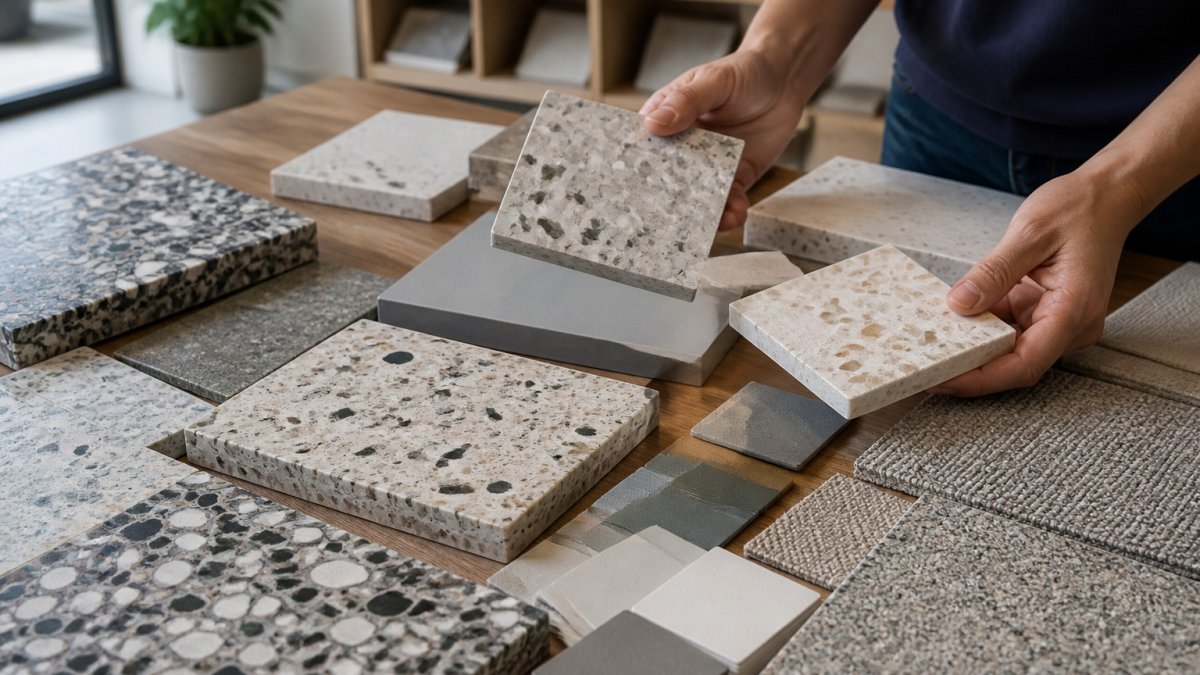
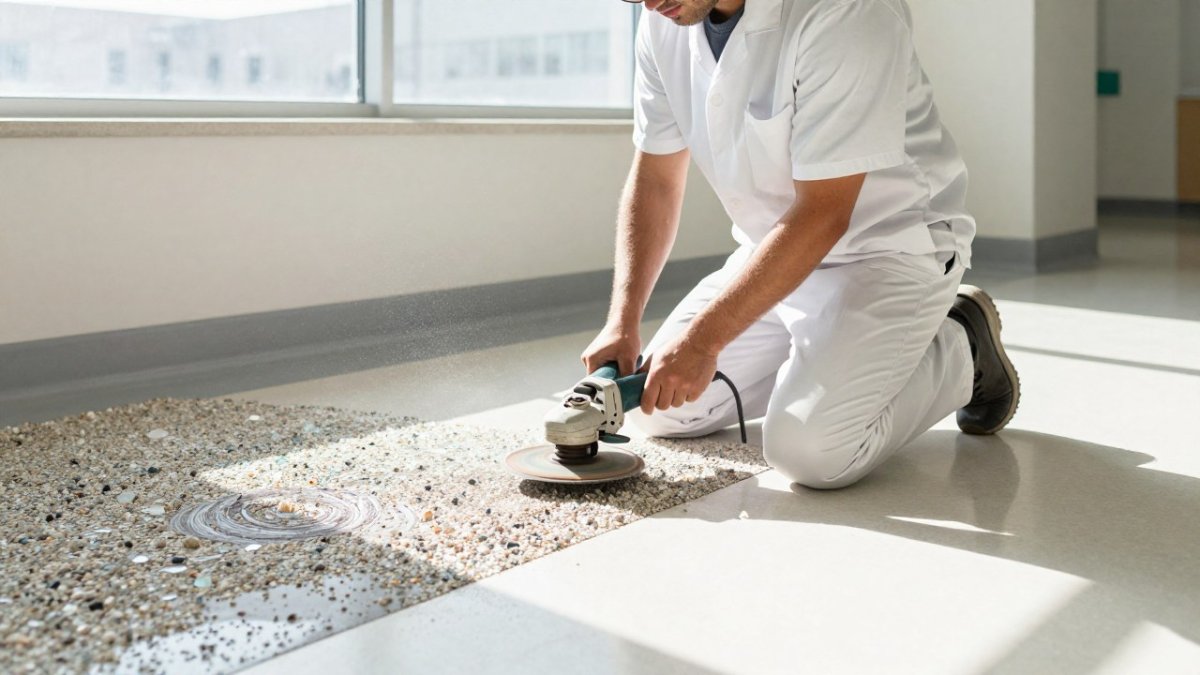
Terrazzo is a cast composite of marble or other aggregates set in a binder and polished to a smooth finish. Because it is installed with minimal joints and polished to a non-porous surface, it is easy to clean and holds up well under heavy foot traffic. It is a strong option for lobbies, main corridors and public areas where appearance and durability both matter.
Terrazzo is heavier and more labor-intensive to install than vinyl, so it is typically planned early in a project. It also needs proper substrate preparation to avoid cracking.
Best Flooring for Medical Office and Clinic Areas
Medical offices and clinics have different needs from hospital wings. Patient-facing areas often prioritize comfort, acoustics and a welcoming look, while exam rooms and clinical corridors prioritize cleanability and chemical resistance. For many clinics, a mix works best: terrazzo or LVT in lobbies, and welded sheet vinyl or resinous flooring in exam and procedure rooms.
The floor should be matched to the room, since a lobby and a single exam room have different demands. If you are planning a clinic renovation, our guide to terrazzo flooring for healthcare facilities covers how terrazzo fits into those plans.
Terrazzo Flooring Maintenance for Healthcare: Cleaning and Disinfection Without Damage
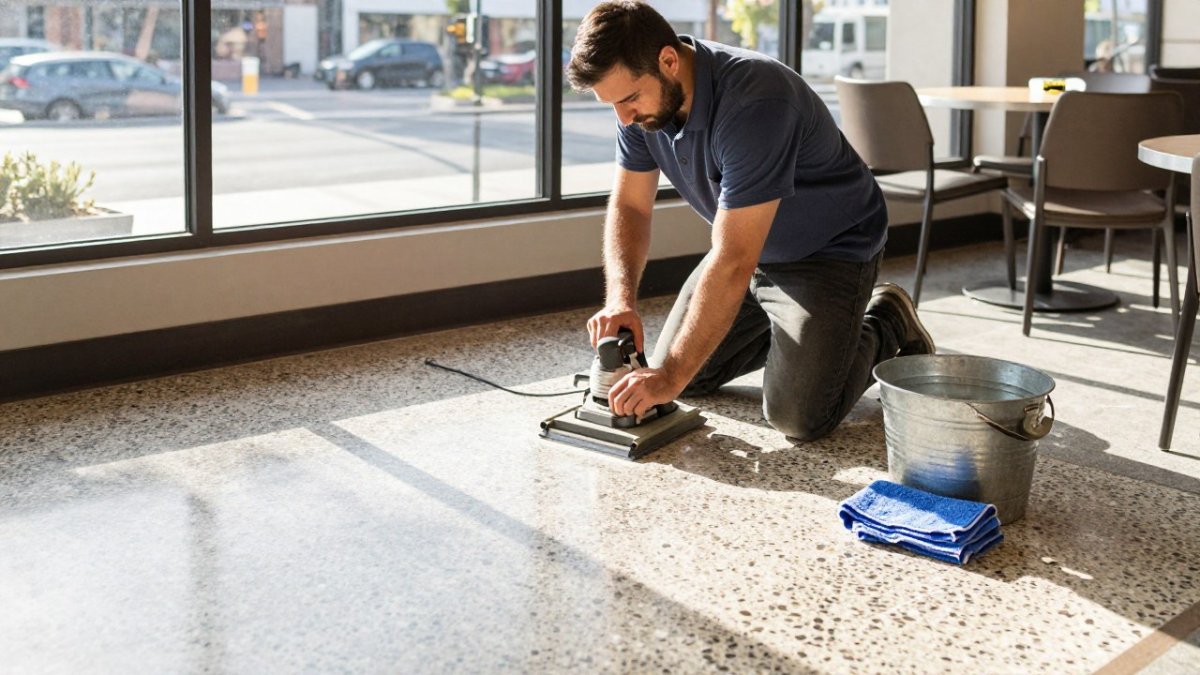
Terrazzo can last for decades when it is maintained correctly. The most common cause of damage is the wrong cleaning product. Strong acids and harsh alkaline cleaners can etch the polished surface and dull the finish. Use pH-neutral cleaners that your flooring contractor approves, and follow the manufacturer's dilution rules.
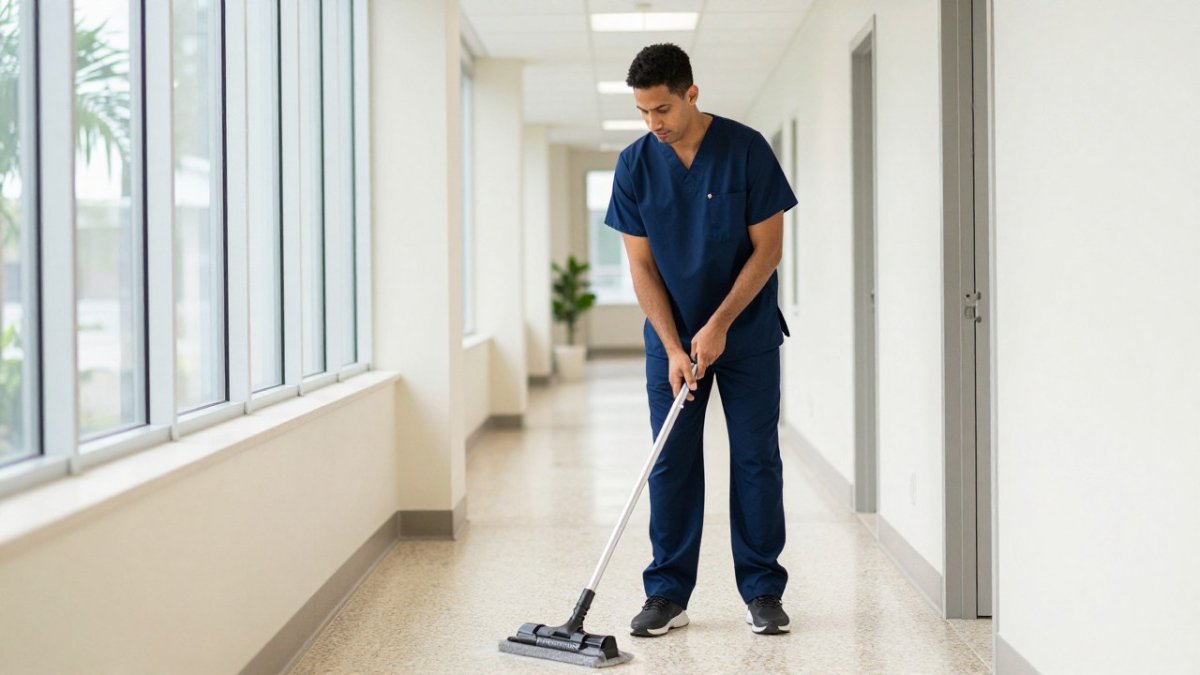
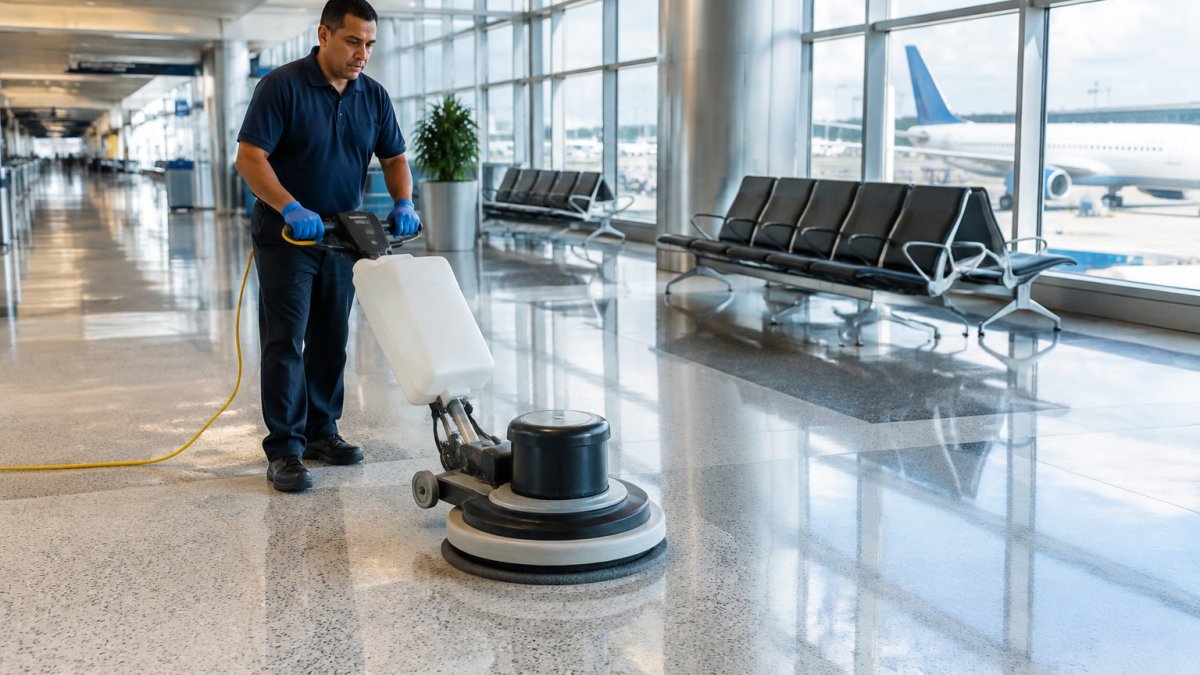
Daily dust mopping and routine wet cleaning remove the soil that causes wear. Disinfection should follow the facility's infection control protocol, using products compatible with terrazzo. Ask your maintenance provider to test any new cleaner on a small area first.
Before you begin any cleaning or disinfection program, check for moisture in the slab. Persistent moisture can cause surface problems that cleaning will not fix. If you suspect moisture, have it evaluated before you apply any new treatment.
Lifecycle Cost and Total Cost of Ownership for Florida Facilities
The lowest installed price rarely produces the lowest cost over the life of a healthcare floor. Facility teams should evaluate total cost of ownership (TCO), which combines installation, routine cleaning labor, periodic refinishing, repair, downtime and eventual replacement. In a clinical setting, downtime is often the largest hidden cost, because a floor that takes a patient corridor or procedure room out of service for days carries a revenue and scheduling penalty that never appears on the flooring invoice. Proactive maintenance strategies implemented by Phaze 2 Janitorial & Labor Services mitigate these operational disruptions by extending the functional lifespan of high-traffic surfaces.
A practical TCO comparison uses the same time horizon for every option, usually 15 to 20 years for a healthcare floor, and breaks costs into five buckets:
- Installation: Material, substrate preparation, labor, and any moisture mitigation. Terrazzo and resinous systems typically carry higher upfront labor than sheet vinyl or LVT because of multi-step preparation and curing.
- Routine cleaning labor: Daily and weekly cleaning and disinfection hours. Seamless surfaces and welded sheet vinyl generally reduce the time spent detailing joints.
- Maintenance and refinishing: Terrazzo can be ground and repolished, extending service life, while vinyl is usually replaced in sections and resinous systems may require recoating.
- Repair: Ease of patching. Sheet vinyl and LVT can often be repaired with localized replacement, while monolithic systems usually require skilled blending to avoid visible patches.
- Downtime: Days or weeks a room is unusable during installation or repair, including cure and off-gassing time before reoccupancy.
Florida conditions shift these numbers. Humidity and slab moisture can lengthen cure times, extend moisture testing, and force schedule changes during the wet season, all of which increase labor and downtime. Coastal facilities may also face more frequent repairs where salt air and moisture accelerate adhesive or substrate failure. A TCO model that ignores these factors will understate the true cost of a floor installed in a Florida building.
When you request quotes, ask each contractor to itemize the five cost buckets above and to state the assumed cure time, moisture testing protocol and refinishing interval. Quotes that cannot break out these items make it difficult to compare options on a like-for-like basis. Watch out: a low bid that excludes moisture mitigation or substrate repair often becomes the most expensive option once those costs are added after installation.
Pricing varies with project size, site access, phasing and the condition of the existing substrate, so treat any published figure as a starting point rather than a budget. The most reliable comparison comes from a site-specific estimate prepared after a moisture test and a review of your room-by-room plan.
Choosing Your Healthcare Flooring: Next Steps for Your Facility
Start by mapping your facility room by room, noting traffic levels, cleaning chemicals, moisture exposure and infection control requirements. Then shortlist the materials that fit each area, and ask each contractor how seams, substrate preparation and maintenance will be handled. Contact A1 Terrazzo to discuss your plans and project requirements.
Frequently Asked Questions
What type of flooring is best for healthcare facilities?
No single material suits every room. Healthcare facilities usually combine materials by zone: seamless or heat-welded sheet vinyl and rubber in patient rooms and clinical areas, LVT in offices and waiting areas, and terrazzo in high-traffic corridors, lobbies and entrances where wear resistance matters most. Resinous systems suit wet or chemically aggressive areas such as labs and sterile processing. Match each material to its cleaning protocol, traffic load and infection-control zone before choosing a single product for the whole facility.
Why is terrazzo a preferred choice for high-traffic medical corridors?
Terrazzo is a cement or epoxy matrix with marble or glass aggregate, ground and polished in place. It is nonporous when sealed, resists heavy carts and foot traffic for decades, and can be installed with minimal seams. These qualities make it practical for medical corridors that see constant movement and frequent cleaning. Facility managers should confirm slip-resistance ratings for wet areas and ask the installer to document the sealer and maintenance schedule.
What are the infection control requirements for hospital flooring?
Infection control depends on the space and the governing guidance, which in Florida includes state licensure rules and the Facility Guidelines Institute (FGI) Guidelines for Design and Construction of Hospitals and Outpatient Facilities. Flooring should be nonporous, seamless or tightly sealed, easy to disinfect with hospital-grade products, and resistant to the chemicals used in daily cleaning. Ask your architect and infection prevention team to confirm requirements for each room type before specifying materials.
How does humidity impact commercial flooring selection in Florida?
Florida's high humidity and frequent rain drive moisture through slabs, which can lift adhesives, cup vinyl and cause terrazzo cracks if the substrate is not properly prepared. Moisture testing of the slab, a vapor barrier where needed, and a moisture-tolerant adhesive or cementitious bed are essential. Ask any installer how they test slab moisture and what their substrate preparation process includes before committing to a product.