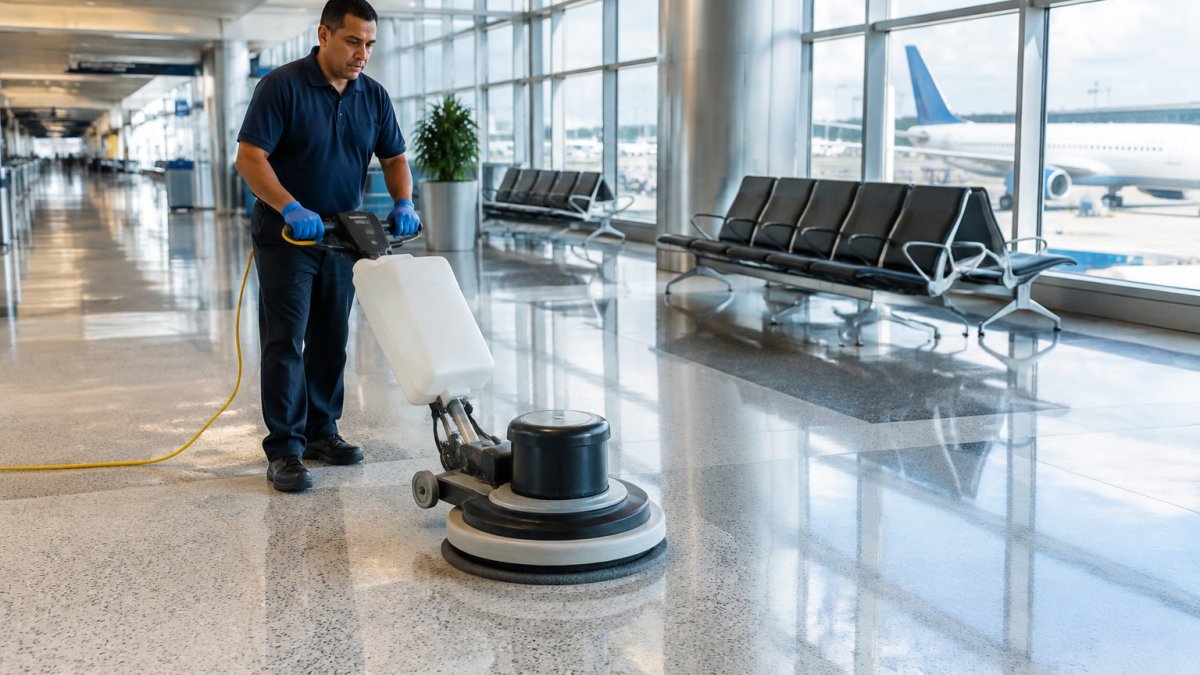
 Comparison
Professional Maintenance Services for Airport Terminals Compared
Last Updated: November 5, 2026
Quick Summary
Professional maintenance services for airport terminals cover far more than nightly cleaning, including floors, restrooms, disinfection of high-touch surfaces, and mechanical systems like HVAC that must run without interruption. A strong program defines scope by area with set frequencies, and buyers should compare providers using a weighted, scored evaluation matrix.
- Write cleaning scope area by area, with a defined frequency for each zone.
- Restock restrooms by the hour during peak travel, not once per shift.
- Use a weighted evaluation matrix locked before proposals arrive.
- Confirm badging timelines, since badging can take weeks and delay start dates.
- Require every bidder to submit the same line-item structure for comparison.
Table of Contents
- What Airport Terminal Maintenance Covers Today
- Airport Terminal Cleaning Services: Scope and Frequency
- Airport Facility Maintenance: HVAC, Mechanical and Preventive Work
- Comparing Providers: Side-by-Side Selection Criteria
- What Drives Cost and How to Read a Quote
- Structuring an Airport Terminal Maintenance Contract with SLAs and KPIs
- Keeping Terrazzo Floors Performing Between Contracted Service Visits
- Frequently Asked Questions
What Airport Terminal Maintenance Covers Today
Professional maintenance services for airport terminals cover far more than a nightly sweep of the concourse. A terminal runs around the clock, moves thousands of passengers a day, and depends on floors, restrooms, air handling and mechanical systems that must stay in service without interruption. Airport work is often split between janitorial crews, facility maintenance teams and specialty flooring contractors, and the scope of each contract shapes how well the terminal performs.
A terminal floor is only as good as the program that keeps it. Airport facilities differ in size, passenger volume and security level, so no two maintenance programs look identical. Because terminal size, passenger volume and security needs shape the scope of each program, comparing national maintenance providers on consistent service requirements helps keep the evaluation fair.
Airport Terminal Cleaning Services: Scope and Frequency
Terminal cleaning is the most visible part of airport maintenance, and it is where many contracts go wrong. Scope should be written by area, with a defined frequency for each: gate holdrooms, security lanes, baggage claim, restrooms and food court seating all carry different traffic loads and different cleaning demands. Contracts that list only "daily cleaning" leave gaps that surface as complaints within weeks.
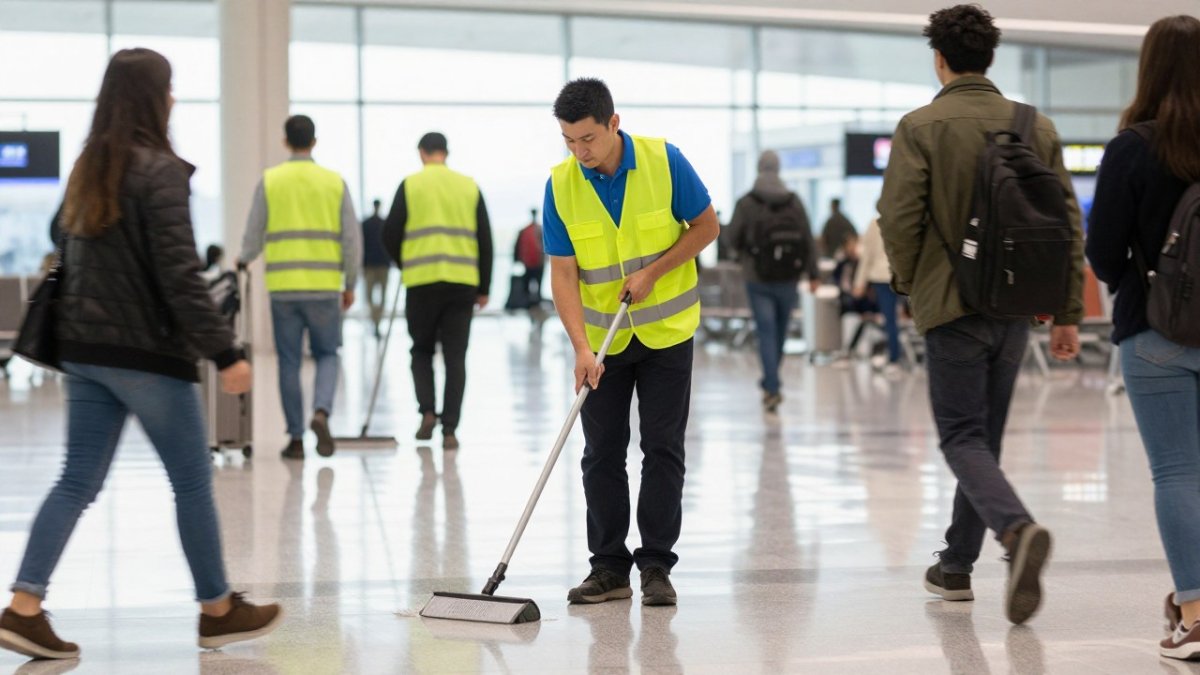
High-Traffic Floor Care and Restroom Restocking
Floors in high-traffic zones need the most frequent attention. Daily dust mopping, scheduled scrubbing and periodic deep cleaning keep grit from grinding into surfaces. Restroom restocking belongs in the same schedule, because empty dispensers and unchecked fixtures are the first things passengers notice. Set restocking checks by the hour during peak travel, not once per shift.
High-Touchpoint Disinfection in Passenger Areas
Handrails, check-in kiosks, elevator buttons and seating armrests need disinfection on a shorter cycle than floors. Specify the touchpoints by name, the cycle for each, and the approved products. Ask any provider to confirm which disinfectants they use on stone and terrazzo surfaces, since some common cleaners etch or dull polished finishes over time.
Airport Facility Maintenance: HVAC, Mechanical and Preventive Work
Facility maintenance covers the systems behind the cleaning: HVAC, electrical distribution, plumbing, lighting and building envelope work. Preventive maintenance, such as filter changes, equipment inspections and lubrication schedules, prevents the failures that close gates. Corrective repairs handle what preventive work misses. A strong contract defines both, with inspection frequency and a response time for each category of repair.
Floor work is part of this picture too. Terrazzo and tile sit under heavy wheeled traffic and sudden moisture, so cracks and loose sections need prompt repair before they become trip hazards. Our recommendation is to include flooring inspections in the preventive schedule rather than waiting for visible damage.
Comparing Providers: Side-by-Side Selection Criteria
Airport buyers often receive several proposals that look similar on the surface. The differences hide in scope language, staffing math, security procedures, and what happens during the first ninety days. Score every bidder against the same written criteria so the comparison is defensible to procurement and to airport operations.
Build a Scored Evaluation Matrix
Use a weighted matrix rather than a narrative comparison. Adjust the weights to your terminal's priorities, but lock them before proposals arrive so the scoring cannot be reverse-engineered to a preferred vendor.
| Criterion | What to Verify | Red Flag |
|---|---|---|
| Service scope | Written area-by-area task list with frequencies | Scope described only as 'daily cleaning' |
| Airport experience | Named references at terminals with similar passenger volume | References from office or retail only |
| Security and badging | Badging process, background check standard, escort rules for unbadged workers | No written badging timeline |
| Staffing model | Crew size per shift, supervisor-to-worker ratio, relief coverage | Headcount that does not reconcile to task hours |
| Equipment and supplies | Owned vs. subcontracted equipment, supply sourcing | Supplies billed as pass-through with no cap |
| SLAs and KPIs | Named measures, measurement method, remedies | 'Best efforts' language with no remedy |
| Reporting | Work-order system, inspection logs, monthly dashboard | Paper logs only |
| Transition plan | Mobilization timeline, training, continuity of incumbent staff | No written 30/60/90-day plan |
Airport-Specific Compliance and Security Checks
Terminal work sits inside a controlled environment. Ask each bidder to describe, in writing, how they handle access control, badging lead times, airside work rules, safety procedures, and coordination with airport operations during irregular operations. Badging can take weeks, so a provider that has not planned for it may miss the start date. Confirm the provider carries general liability, workers' compensation, and auto coverage at limits your risk office requires, and ask for the certificate before award, not after.
Watch out: a bidder that quotes airside work without describing how unbadged crew will be escorted is either planning to subcontract the work or has not read the solicitation.
Reference and Past-Performance Diligence
Ask each provider for three references at comparable facilities and call all three. Ask what went wrong on the last contract, how fast the provider responded, and whether the provider would be rehired. A reference that cannot describe a single problem is usually not a useful reference. For public-sector solicitations, past-performance records and any debarment history are often available through the contracting office and should be checked before scoring.
RFP and Transition Planning
A practical RFP checklist covers references, staffing plans with task-hour math, training curriculum, equipment lists, reporting samples, insurance certificates, and a mobilization plan. The transition plan matters as much as the price: ask how the provider will retain incumbent staff, transfer keys and badges, learn the terminal's zones, and maintain service continuity during the first thirty days. Contracts that hand over mid-shift without a written continuity plan tend to produce visible failures in restrooms and gate areas within the first two weeks.
What Drives Cost and How to Read a Quote
Airport terminal maintenance bids vary widely because the inputs vary widely. Two terminals of the same square footage can produce quotes that differ widely once operating hours, security requirements, and service mix are priced in. The goal is not to find the lowest number but to compare proposals on the same line-item structure so the differences are visible.
The Cost Drivers That Move a Bid
- Terminal size and zone count. Square footage matters, but so does the number of distinct zones, gate holdrooms, security lanes, baggage claim, restrooms, food courts, and back-of-house corridors each carry different task frequencies. A terminal with many small zones costs more per square foot than one large open concourse.
- Operating hours. Twenty-four-hour coverage requires multiple shifts, relief coverage, and night differential pay. A terminal that closes overnight can concentrate work in one shift and reduce labor cost.
- Security requirements. Badging, background checks, escort ratios, and airside access rules add administrative and supervisory labor. Providers that already hold badges and have established badging workflows price this lower than providers starting from zero.
- Service mix. Janitorial-only contracts price differently from integrated janitorial plus facility maintenance. Mechanical work adds licensed trades, parts inventory, and after-hours callout rates.
- Labor market. Wages, benefits, and turnover in the local market drive the largest share of most janitorial bids. Ask each provider to show the wage rate and burden rate separately so you can compare labor assumptions.
- Equipment and supplies. Owned equipment amortized into the contract prices differently from rented equipment. Supplies billed as pass-through should carry a cap or a documented markup.
How to Read a Quote Line by Line
Ask every bidder to submit the same line-item structure: labor by shift and classification, supervision, supplies, equipment, subcontractors, and overhead and profit. Then compare each line across bidders. A quote that looks low on the total often hides a thin supervision line or a supplies line that will be replenished through change orders.
Watch out: a fixed monthly price with no stated wage rate or shift schedule is not comparable to a bid that shows its labor math, even if the totals look similar.
Pricing Frameworks, Not Universal Rates
There is no universal rate for terminal maintenance, and any provider that quotes one without a site walk is guessing. A defensible framework prices each service line against measured task hours: estimate the hours required per zone per frequency, multiply by the loaded labor rate, add supervision, supplies, equipment, and overhead, and present the result as a monthly price with a stated scope. Ask bidders to show this math, and be cautious of bidders who cannot explain how their price maps to task hours.
Change Orders and Escalation
Define in the contract what triggers a change order, how it is priced, and who approves it. Common triggers include added square footage, new service lines, extended hours, and emergency response. Ask whether the price escalates annually and against what index. A contract with no escalation clause and no change-order procedure tends to produce disputes in year two, when labor costs rise and the provider looks for ways to recover margin.
Structuring an Airport Terminal Maintenance Contract with SLAs and KPIs
A service-level agreement turns expectations into measurable terms. Good SLAs name the standard, the measurement method and the remedy when it is missed. Key performance indicators may include restroom inspection pass rates, work-order completion within the agreed window, and passenger complaint counts.
Set a review schedule, usually monthly, where the operator and provider compare KPI results against the contract. Contracts that include credits or cure periods for missed targets tend to hold providers to their commitments.
Keeping Terrazzo Floors Performing Between Contracted Service Visits
Between scheduled service visits, terrazzo floors in a terminal need routine care that the crew can perform without specialty equipment. Dust mop daily, damp mop with a pH-neutral cleaner, and avoid acidic products that can etch the surface. Schedule periodic professional maintenance to check for chips or cracks.
If your floors need repair or a maintenance plan, contact A1 Terrazzo to discuss the condition of your surfaces. For ongoing upkeep between visits, our step-by-step repair guide and maintenance guide explain what to do, and polishing versus sealing options help you choose the right protection for high-traffic areas. Facilities comparing cleaning approaches can also review the cleaners we recommend.
Frequently Asked Questions
What does an airport terminal maintenance company provide?
Airport terminal maintenance providers typically combine janitorial work with facility upkeep. Janitorial scopes often include high-frequency cleaning of passenger areas, restroom care and restocking, floor care for tile and carpet, and high-touchpoint disinfection. Facility scopes often add HVAC and mechanical systems maintenance, preventive maintenance, and corrective repairs. Buyers should confirm which of these tasks the provider performs directly and which it subcontracts, since that affects accountability when a service is missed.
How do airports choose a facility maintenance provider?
Most airports compare providers on documented experience with terminals or similar high-traffic facilities, staffing depth, security clearance procedures, response time, and how clearly the proposal defines scope and reporting. Reviewing references and sample inspection reports helps. Buyers should also ask how the provider transitions staff and operations if it takes over an existing contract, because continuity matters in operating facilities.
How often should airport terminals be cleaned and maintained?
Frequency depends on passenger volume, the zone, and the task. High-traffic passenger areas, restrooms, and high-touchpoint surfaces generally need the most frequent attention, often several times a day, while floors and HVAC components follow longer inspection and maintenance cycles. A sound contract sets these frequencies per zone and ties them to inspection checkpoints and measurable response times rather than a single general standard.
What should an airport terminal maintenance contract include?
A strong contract defines the scope by zone and task, specifies inspection frequency, sets response times and work-order completion targets, and lists the KPIs used to measure performance. It should also address staffing and training, security and access procedures, reporting, escalation paths, and how pricing changes when scope or passenger volume changes. Service-level agreements give both parties a common, measurable standard.
Professional maintenance services for airport terminals work best when the scope, the metrics and the floor care plan are defined together. Start with an audit of your current contract, then compare providers on the criteria above. A1 Terrazzo can help you assess terrazzo and tile floors as part of that plan, so reach out to schedule an assessment.