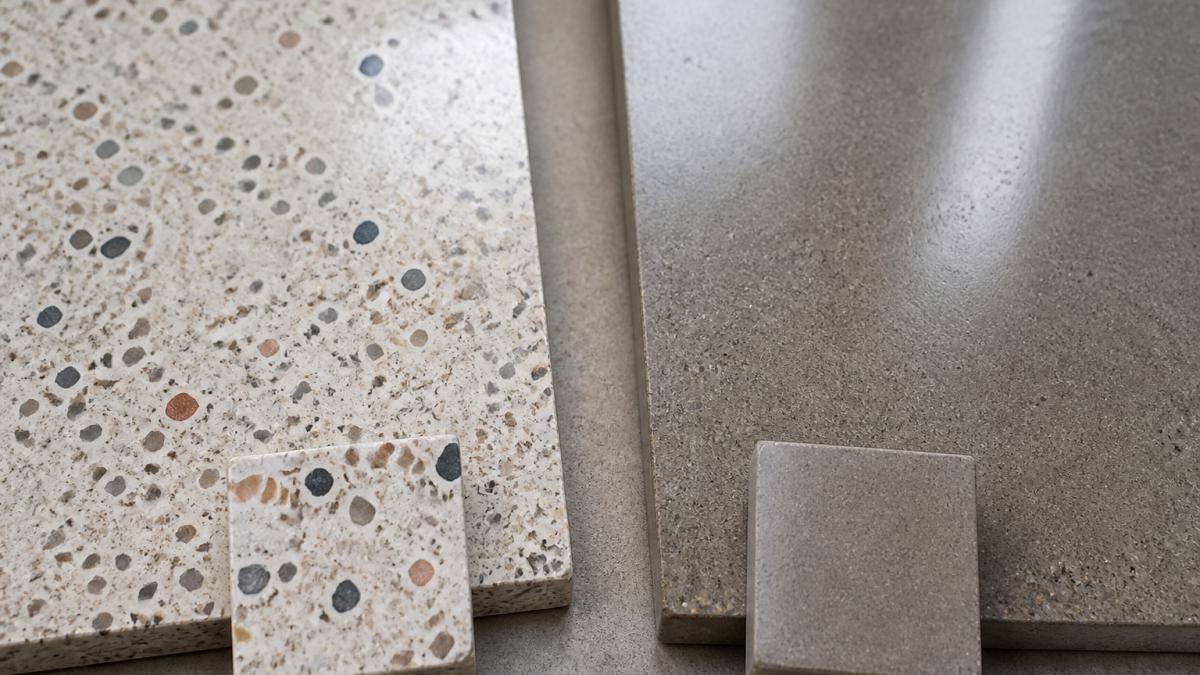
 comparison
Terrazzo vs. Polished Concrete for Campus Flooring
Table of Contents
- Terrazzo vs. Polished Concrete: Head-to-Head Comparison
- Durability and Wear Resistance in High-Traffic Campus Areas
- Polished Concrete Durability in High-Traffic Areas: Performance Reality
- Slip Resistance Standards for Campus Flooring
- Terrazzo Flooring Maintenance Costs vs. Operational Demands
- Installation Complexity and Substrate Preparation
- Environmental Impact and Lifecycle Carbon Footprint
- Design Flexibility, Aesthetics, and Institutional Branding
- Frequently Asked Questions
Last Updated: October 2, 2026
Terrazzo vs. Polished Concrete: Head-to-Head Comparison
When campus facility managers evaluate terrazzo vs polished concrete, the decision hinges on priorities: long-term lifecycle value and design control versus immediate affordability and simplicity. Terrazzo offers superior durability, aesthetic flexibility, and 30+ year performance; polished concrete provides lower upfront costs and minimal maintenance.
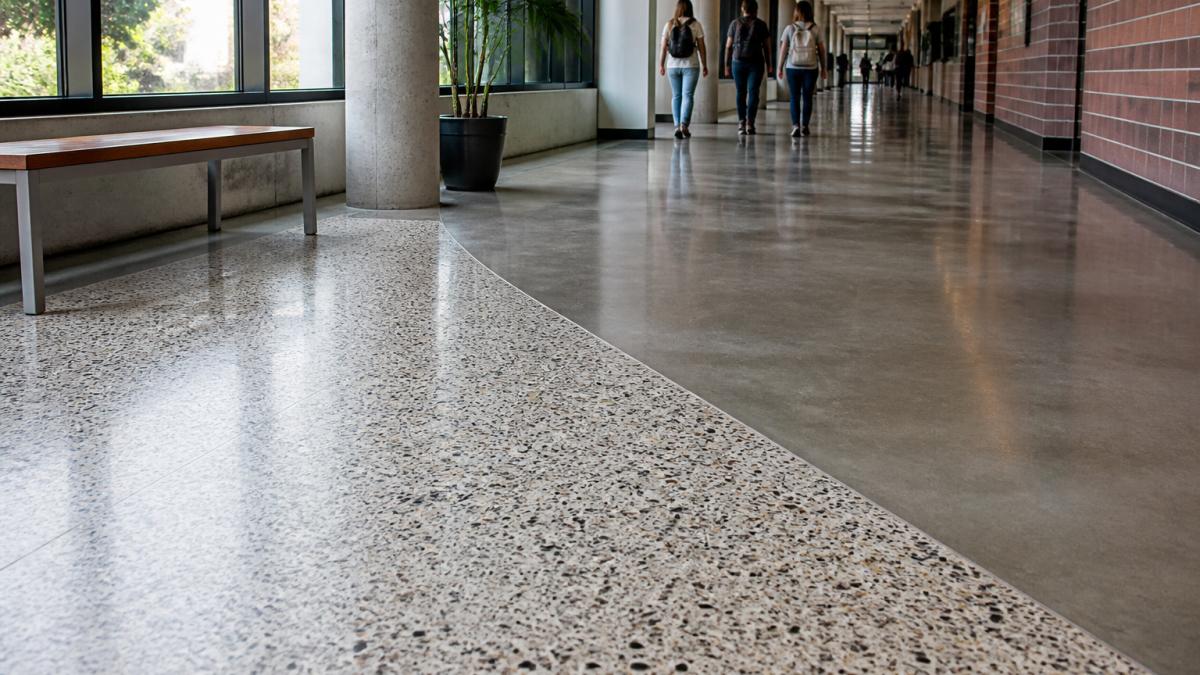
This comparison addresses what facility managers need to know: installation complexity, slip resistance, maintenance reality, and performance in high-traffic institutional environments.
Quick Comparison Table
| Criteria | Terrazzo | Polished Concrete | Winner for Campus Use |
|---|---|---|---|
| Upfront Installation Cost | Higher initial investment | Lower per-square-foot cost | Polished concrete |
| Design Flexibility | Unlimited aggregate colors and patterns | Limited to concrete color variations | Terrazzo |
| Durability in High Traffic | 30+ years with proper maintenance | 15-20 years, substrate-dependent | Terrazzo |
| Slip Resistance | High-gloss finishes require coating for safety | Natural texture offers inherent grip | Polished concrete |
| Maintenance Frequency | Regular sealing and professional cleaning | Minimal; occasional repolishing | Polished concrete |
| Substrate Preparation | Requires careful moisture mitigation | Works with existing slabs | Polished concrete |
| Aesthetic Customization | Full color and pattern control for branding | Monochromatic, industrial appearance | Terrazzo |
| Environmental Impact | Marble/granite aggregate, lower VOC | Utilizes existing concrete; minimal material waste | Polished concrete |
Durability and Wear Resistance in High-Traffic Campus Areas
In the comparison of terrazzo vs polished concrete, terrazzo outperforms in high-traffic spaces when properly installed. Its integrated aggregate creates a monolithic surface that resists wear, impact, and traffic patterns that show on concrete.
Polished concrete durability depends entirely on slab quality. A well-poured base performs reliably for 15-20 years; substrate defects, cracks, or poor compaction accelerate deterioration. Repair options are limited once spalling occurs.
In institutional settings with concentrated foot traffic, terrazzo's density distributes stress evenly, while polished concrete shows directional wear patterns and duller paths.
Installation quality determines durability. Proper substrate preparation, moisture mitigation, base layers, and professional finishing determine whether either material lasts 20 or 40 years.
Polished Concrete Durability in High-Traffic Areas: Performance Reality
Polished concrete performs well in interior corridors with minimal moisture exposure, but fails in bathrooms, entryways, and areas near exterior doors.
Grinding and polishing densifies the surface, creating wear resistance for heavy traffic. However, delamination, when the polished surface separates from weak concrete, is common in poorly prepared substrates.
For campus facilities, the critical question is substrate condition. Good slabs offer cost-effective durability; cracked or spalling concrete will deteriorate within 5-10 years despite polishing.
Slip Resistance Standards for Campus Flooring
Campus facilities must meet specific slip resistance standards to comply with accessibility requirements and reduce liability. The relevant standard is ASTM D2047, which measures coefficient of friction (COF) (D2047 Standard Test Method for Static Coefficient of Friction of Polish-Coated Flooring...). A COF of 0.5 or higher is generally considered safe for level surfaces; 0.6+ is recommended for ramps and stairs.
High-gloss terrazzo presents a slip hazard (0.4-0.5 COF). Institutional installations use anti-slip coatings or honed finishes to maintain 0.6+ COF while preserving aesthetics.
Polished concrete naturally achieves 0.6-0.8 COF, meeting safety standards without additional coatings, an advantage for slip-and-fall liability concerns.
Terrazzo requires periodic recoating to maintain slip resistance and protection; polished concrete maintains safe slip resistance indefinitely without additional treatments.
Terrazzo Flooring Maintenance Costs vs. Operational Demands
Polished concrete requires minimal maintenance until repolishing becomes necessary every 5-10 years.
Lifecycle Cost Analysis for Campus Facilities
For a 10,000-square-foot institutional corridor, typical costs break down as follows:
The math reveals that terrazzo's higher annual maintenance cost is offset by its extended lifespan. If polished concrete requires replacement or major restoration every 15-20 years, a campus operating for 60 years would install polished concrete three times versus terrazzo once, multiplying labor disruption and material costs.
Acidic cleaners and abrasive scrubbing damage terrazzo; skipping sealing causes staining and deterioration. Proper staff training and specialized maintenance providers ensure professional-grade care.
Frame terrazzo as a 30-year capital investment. Higher upfront costs are recovered through avoided replacement cycles, reduced operational disruption, and institutional branding value.
Request a detailed lifecycle cost analysis that includes installation, annual maintenance, and projected repolishing or replacement costs for polished concrete over the same 30-year period. Present this comparison to your finance and facilities teams to demonstrate long-term value.
Installation Complexity and Substrate Preparation
Substrate preparation determines success. Terrazzo installation requires moisture testing, proper base layers, precision formwork, grinding and polishing, and densification, a 4-8 week process. Any deviation in moisture control or base preparation compromises the final product.
Polished concrete installation is simpler (2-4 weeks): assess slab condition, repair damage, grind and polish, apply densifier and sealer. The trade-off: lower cost but limited by existing slab quality.
Environmental Impact and Lifecycle Carbon Footprint
Terrazzo and polished concrete present distinct environmental profiles regarding VOC emissions, indoor air quality, and lifecycle carbon, factors increasingly important for campus facilities.
VOC Emissions and Indoor Air Quality
Terrazzo has low VOC emissions.
Polished concrete, by contrast, depends heavily on the densifier and sealer applied during finishing.
For campus facilities like libraries, lecture halls, and dormitories where students and faculty spend extended periods, terrazzo's inherently low-VOC profile provides a health advantage.
Embodied Carbon and Material Sourcing
Terrazzo's environmental profile depends on aggregate sourcing.
Polished concrete utilizes existing concrete slabs, eliminating the material waste of new flooring installation.
Lifecycle Carbon Analysis: 60-Year Campus Building Operation
For a comprehensive environmental assessment, consider a 60-year building lifecycle:
Terrazzo scenario: One installation at year 0, minor repairs and recoating at years 15 and 30, no replacement required. Embodied carbon from initial installation amortized across 60 years.
Over 60 years, polished concrete generates 2-3 replacement cycles, multiplying embodied carbon from material manufacturing, transportation, and installation labor.
Sustainability Certifications and Campus Commitments
Both materials can qualify for LEED and other sustainability frameworks, but with different strategies:
- Terrazzo with recycled aggregate and low-VOC sealers qualifies for LEED Material and Resources credits (recycled content), Indoor Environmental Quality credits (low VOCs), and Durability credits (30+ year lifespan reduces replacement cycles).
- Polished concrete qualifies for Material and Resources credits (material efficiency, reduced waste) and Indoor Environmental Quality credits (if zero-VOC sealers are specified).
For institutions with aggressive carbon reduction targets or net-zero commitments, terrazzo's extended lifespan and lower lifecycle replacement cycles provide a measurable advantage.
Specifying for Environmental Performance
To maximize environmental benefits:
- For terrazzo: Specify recycled glass or reclaimed marble aggregate, low-VOC or zero-VOC sealers, and request a lifecycle carbon assessment from your installer. Request documentation of aggregate sourcing and recycled content percentages.
- For polished concrete: Specify zero-VOC densifiers and sealers (even at higher cost), ensure the existing concrete slab is structurally sound to avoid premature replacement, and request a lifecycle assessment that includes potential replacement scenarios.
Design Flexibility, Aesthetics, and Institutional Branding
This is where terrazzo separates itself decisively. Institutional buildings, universities, hospitals, government centers, use flooring as a branding and wayfinding tool.
A university can specify school colors in terrazzo aggregate, creating distinctive corridors that reinforce campus identity. A hospital can use color-coded terrazzo patterns for wayfinding, reducing patient confusion.
Polished concrete offers a single aesthetic: industrial, monochromatic, and uniform. Some institutions embrace this look intentionally. For most, the lack of design control feels like a limitation.
Terrazzo's design flexibility extends to finish options, high-gloss for dramatic effect, honed for a matte appearance, or textured for slip resistance.
For campus facilities seeking flooring that reinforces institutional identity and supports wayfinding, terrazzo is the only material that delivers this capability at scale.
Choosing between terrazzo and polished concrete for campus facilities requires balancing upfront investment against 20-30 year operational costs, maintenance tolerance, and institutional priorities.
Frequently Asked Questions
What are the key differences between terrazzo and polished concrete for campus facilities?
Terrazzo is a composite material made from marble, granite, and other aggregates bound in a binder, offering unlimited color customization and seamless surfaces ideal for branding. Polished concrete involves grinding and densifying existing concrete slabs to a high-gloss or matte finish. Terrazzo excels in design flexibility and longevity (30+ years in high-traffic areas), while polished concrete costs less upfront and requires minimal maintenance. For campus environments, terrazzo provides superior aesthetic control and durability, while polished concrete suits budget-conscious renovations where existing slabs are available.
How does polished concrete durability hold up in high-traffic campus areas?
Polished concrete performs well in moderate-to-high traffic when the underlying slab is properly prepared and densified. It resists wear from foot traffic and wheeled equipment, though performance depends heavily on slab quality. However, it can develop micro-cracks from heavy impact or thermal stress, and the surface is susceptible to staining from chemicals.
What slip resistance standards apply to campus flooring, and which material meets them better?
Terrazzo can achieve slip-resistant ratings through aggregate selection and surface finishes (honed finishes provide better grip than high-gloss). Polished concrete typically requires a slip-resistant coating or aggregate to meet institutional standards, adding cost and maintenance complexity.
What does terrazzo flooring maintenance actually cost per year for a large campus?
Terrazzo maintenance costs depend on facility size, foot traffic, and cleaning frequency.
Is terrazzo outdated for modern campus design?
No. Terrazzo has experienced a resurgence in institutional design. Modern terrazzo offers unlimited color palettes, custom aggregate patterns, and seamless installation that align with contemporary aesthetics while maintaining durability. Universities and healthcare facilities choose terrazzo specifically for its design flexibility, sustainability (many formulations use recycled aggregates), and institutional branding capabilities. Polished concrete appeals to industrial-modern aesthetics, but terrazzo remains the premium choice for facilities prioritizing longevity, hygiene, and visual distinction.