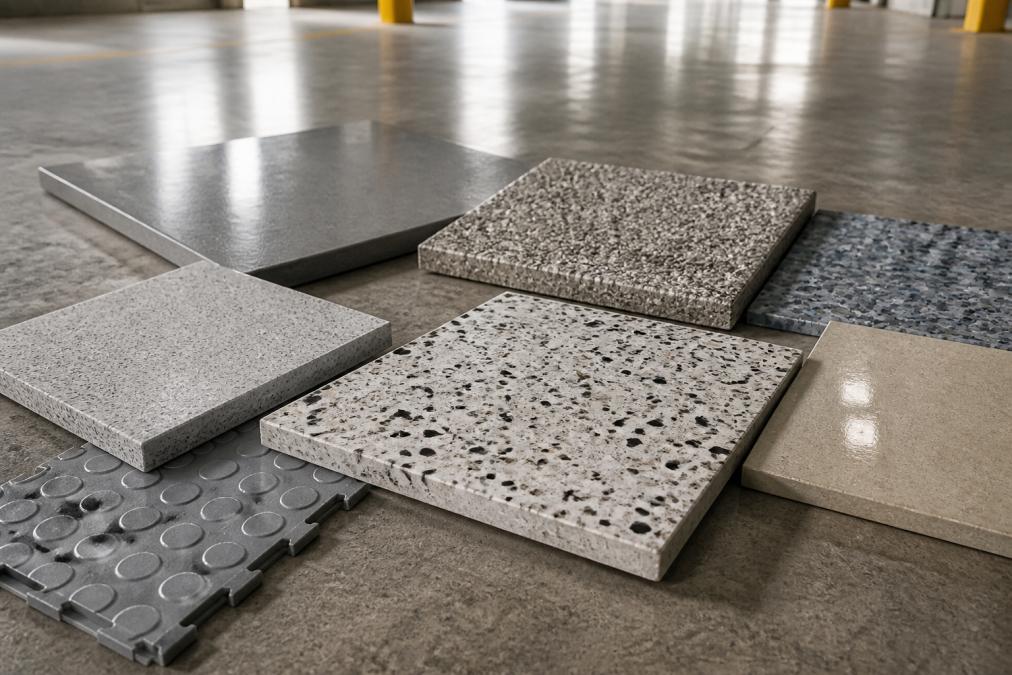
 listicle
7 Industrial Flooring Solutions That Cut Downtime
Table of Contents
- Quick Comparison: 7 Industrial Flooring Solutions
- 1. Epoxy Terrazzo Flooring: Seamless and Sanitary
- 2. Stonhard Resinous Flooring Systems: Heavy-Duty Performance
- 3. Sherwin-Williams Resin Flooring: Chemical and Thermal Shock Resistance
- 4. Ecotile Industrial Flooring: Modular Interlocking Tiles
- 5. Everlast Epoxy Flooring: Fast-Cure for Food Processing
- 6. Solidscreed HT and Polyaspartic Coatings: High-Impact and Rapid Return
- 7. Polished Concrete and Quarry Tile: Low-Maintenance Alternatives
- Frequently Asked Questions
Last Updated: September 11, 2026
Quick Comparison: 7 Industrial Flooring Solutions
Choosing industrial flooring solutions starts with one hard question: how much downtime can your facility absorb? Facility managers sometimes lose weeks to floors that cure too slowly, crack under forklift traffic, or fail chemical exposure tests within a year. The seven systems below solve different versions of that problem, from seamless epoxy terrazzo to rapid-cure polyaspartic coatings.
| Flooring Solution | Best For | Downtime Profile | Key Strength |
|---|---|---|---|
| Epoxy Terrazzo | Healthcare, institutional | Moderate | Seamless, sanitary |
| Stonhard Resinous Systems | Heavy manufacturing | Moderate | Impact resistance |
| Sherwin-Williams Resin Flooring | Chemical/thermal exposure | Moderate | Thermal shock resistance |
| Ecotile Modular Tiles | Warehouses | Minimal | No adhesive needed |
| Everlast Epoxy | Food processing | Fast | Antimicrobial finish |
| Solidscreed HT & Polyaspartic | High-impact zones | Minimal to fast | Rapid return to service |
| Polished Concrete & Quarry Tile | Low-maintenance facilities | Moderate | Minimal upkeep |
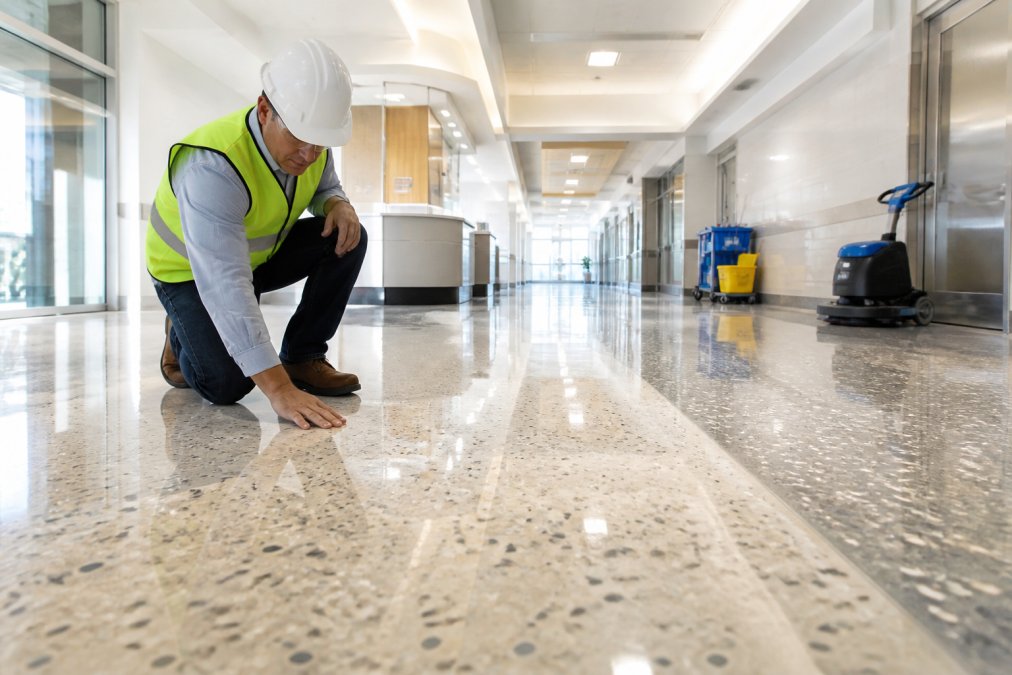
1. Epoxy Terrazzo Flooring: Seamless and Sanitary
Epoxy terrazzo flooring is a seamless resinous system that bonds marble, glass, or granite chips into an epoxy matrix, then grinds and polishes the surface to a uniform finish. Because it cures without joints or grout lines, there's nowhere for bacteria, soil, or moisture to collect.
That seamless surface is why healthcare and institutional facilities specify it. Standard cleaning protocols work without special equipment, and the floor holds up under repeated disinfection. A common mistake is skipping moisture testing before installation. Epoxy terrazzo fails when moisture vapor transmission from the slab isn't addressed first, and the cracks show up within a year. Proper substrate preparation, including diamond grinding and moisture testing, prevents that entirely.
Pros and Cons for Healthcare and Institutional Facilities
Pros:
- Seamless, non-porous surface supports strict sanitation standards
- Design flexibility for wayfinding, logos, and color zoning
- Service life measured in decades with proper maintenance
Cons:
- Higher upfront investment than standard coatings
- Requires skilled installation; curing takes longer than polyaspartic systems
For hospitals, schools, and government buildings, the lifecycle math usually favors epoxy terrazzo despite the higher initial cost. A1 Terrazzo has installed and maintained commercial terrazzo across Florida for over 35 years, specializing in environments where sanitation and durability are critical.
2. Stonhard Resinous Flooring Systems: Heavy-Duty Performance
Stonhard resinous flooring systems are seamless epoxy, urethane, and bio-based floors engineered for heavy-duty industrial use. Their non-porous surface resists impact, chemical spills, and constant forklift traffic without seams that catch debris.
Manufacturing plants choose these systems when they need a floor that outlasts standard coatings by years. The tradeoff is real: the initial investment runs higher than basic epoxy, and installation requires careful surface preparation to bond properly.
3. Sherwin-Williams Resin Flooring: Chemical and Thermal Shock Resistance
Sherwin-Williams resin flooring covers a family of heavy-duty systems, epoxy, epoxy novolac, polyurethane, and vinyl ester, formulated for manufacturing environments where the floor faces specific chemical or thermal exposure rather than general wear. The distinction matters because "chemical resistant" is not a single property. A floor that shrugs off lactic acid in a dairy plant may fail under concentrated sulfuric acid in a metal finishing line, and a coating that survives a 180°F washdown may crack when a 350°F process spill hits it.
How Thermal Shock Actually Fails a Floor
Thermal shock resistance is the ability of a coating to absorb a rapid temperature change without cracking, delaminating, or debonding from the substrate. The mechanism is differential expansion: the resin surface expands or contracts faster than the concrete beneath it, and the bond line takes the stress. Repeated cycles, hot washdown water, steam cleaning, molten product spills, fatigue that bond until it releases. Systems built for thermal shock resistance use flexible resin chemistry and higher film thickness to distribute that stress instead of concentrating it at the interface.
A common pattern in plants that experience thermal shock failures is a floor specified for chemical resistance alone, without anyone asking how hot the spills get or how fast the temperature swings. The fix is to document the actual exposure profile before selecting a system.
Building a Chemical Exposure Profile Before You Specify
Before choosing any resin system, most experienced specifiers build a written exposure profile that captures:
- Chemical identity and concentration, not just "acids" but the specific reagent and its strength
- Contact duration, incidental splash versus continuous immersion or pooled spillage
- Temperature at contact, ambient, hot, or molten
- Frequency, one-time event, daily washdown, or continuous exposure
- Mechanical load at the same location, forklift traffic, pallet drops, or scraping
Manufacturers publish chemical resistance charts that grade a given resin against specific reagents at specific concentrations and temperatures. Those charts are the correct starting point, but they assume proper surface preparation and full cure. A chart rating means nothing if the slab wasn't profiled correctly or moisture vapor transmission wasn't addressed.
The Selection Tradeoff
The product range is extensive, which cuts both ways. You get a formulation matched to nearly any exposure condition, but selecting the wrong one wastes money and can fail within a single production cycle. Vinyl ester systems generally outperform standard epoxy against strong acids and solvents but cost more and are less forgiving to install. Polyurethane and polyaspartic topcoats add flexibility and UV stability where epoxy would yellow or embrittle. Professional consultation is worth the cost here, the specification decision is where most of the project risk lives.
National Institute for Occupational Safety and Health guidance on workplace safety
4. Ecotile Industrial Flooring: Modular Interlocking Tiles
Ecotile industrial flooring uses modular interlocking tiles that install without adhesive, which means near-zero downtime and easy replacement of damaged sections.
Warehouses and distribution centers favor this approach when they can't shut down operations for a full coating cure. The limitation: it's not a seamless surface, so it doesn't meet the sanitation standards required in food processing or healthcare cleanrooms.
5. Everlast Epoxy Flooring: Fast-Cure for Food Processing
Everlast epoxy flooring is a fast-curing resin system with integrated antimicrobial properties, built for food processing plants that need sanitary, non-slip surfaces back in service quickly.
Fast cure doesn't mean skipping prep. Professional surface preparation is mandatory, and shortcuts here are the most common cause of premature coating failure in food facilities.
6. Solidscreed HT and Polyaspartic Coatings: High-Impact and Rapid Return
Solidscreed HT is a heavy-duty screed engineered for extreme industrial conditions and high-impact zones, while polyaspartic coatings cure fast enough for same-day return to service.
Pair them when you need both: Solidscreed HT in forklift traffic lanes, polyaspartic as a rapid topcoat. Polyaspartic requires precise application because of its fast cure rate, so this isn't a DIY job.
U.S. Department of Energy resources on industrial facility efficiency
7. Polished Concrete and Quarry Tile: Low-Maintenance Alternatives
Polished concrete and quarry tile sit at opposite ends of the industrial flooring spectrum, but they share one trait that matters to facility managers: both push cost out of the maintenance budget and into the installation or the cleaning protocol. Understanding where each one actually saves money, and where it doesn't, is the difference between a floor that pays for itself and one that becomes a recurring line item.
Polished Concrete: How It Works and What It Costs Over Time
Polished concrete transforms an existing slab through mechanical grinding and progressive diamond polishing, producing a dust-proof, low-maintenance floor with no topical coating to peel, flake, or recoat. Because there's no film on the surface, there's nothing to delaminate, the floor is the slab.
The lifecycle math is where polished concrete earns its reputation. A topical coating typically needs recoat or replacement on a multi-year cycle depending on traffic and chemical exposure. Polished concrete, by contrast, is maintained with routine auto-scrubbing and periodic re-polishing rather than full replacement. Over a long service horizon, that shifts spend from scheduled capital projects to routine operating expense, a pattern most facility managers find easier to budget.
The tradeoffs are real, though. Polished concrete offers limited chemical resistance compared to resinous systems, so it's a poor fit for plants with frequent solvent or acid exposure. It also depends on the quality of the existing slab: a slab with inadequate strength, excessive moisture, or poor flatness will not polish to a durable finish, and remediation can erase the cost advantage.
Quarry Tile: Density, Slip Resistance, and the Grout Problem
Quarry tile is an unglazed or minimally glazed clay tile fired at high temperature, producing a dense, abrasion-resistant surface with natural slip resistance, which is why it shows up in commercial kitchens, breweries, and wet processing areas. It handles thermal shock from hot water and steam better than most coatings and stands up to aggressive cleaning chemicals.
The catch is the grout. Grout lines are porous, trap soil and organic matter, and create a sanitation liability in food environments if they aren't sealed and maintained (the FDA). In kitchens, specify darker grout to hide staining and seal it on a defined schedule, or the floor becomes a compliance problem rather than a solution.
A Lifecycle Cost Framework You Can Apply
Most flooring comparisons stop at installed cost per square foot. That number is misleading. A more useful framework weighs four cost streams over the expected service life:
- Installation cost, material, labor, surface preparation, and downtime
- Downtime cost, lost production during cure or installation, which often exceeds the flooring invoice itself
- Routine maintenance cost, cleaning labor, consumables, and equipment
- Replacement and repair cost, recoats, patching, re-polishing, or full replacement, and when each occurs
A floor with a higher installation cost but a longer interval between replacements can win on total cost of ownership. A floor with a low installation cost but frequent recoats can lose. The only way to know is to model the four streams against your actual traffic, chemical exposure, and cleaning protocol, not against a generic average.
Before approving any industrial flooring project, ask for a written lifecycle cost breakdown covering installation, downtime, routine maintenance, and replacement intervals over at least a 10-year horizon. If a supplier can't provide one, build it yourself from the four cost streams above.
For warehouses prioritizing lifecycle cost over chemical exposure, polished concrete is often the strongest value play. For wet, hot, or chemically aggressive environments, quarry tile or a resinous system will outperform it, but only if the grout or the coating is maintained on schedule.
Frequently Asked Questions
What is the best type of flooring for industrial use?
The best industrial flooring depends on your facility's specific demands. For heavy manufacturing with chemical exposure, resinous systems like Stonhard or Sherwin-Williams offer seamless, non-porous surfaces with high compressive strength. For healthcare and institutional settings, epoxy terrazzo flooring provides a sanitary, seamless finish that withstands frequent cleaning. Warehouses needing quick installation often choose modular tiles like Ecotile. Evaluate chemical resistance, abrasion resistance, load-bearing capacity, and maintenance requirements against your operations before deciding.
How much does it cost to epoxy 1000 sq ft?
Industrial floor coating cost varies widely based on substrate condition, surface preparation needs, coating system selected, and local labor rates. For a 1,000 sq ft area, pricing depends on whether diamond grinding or shot blasting is required, the number of coats, and the specific resin chemistry. Request a site assessment and detailed quote from a qualified contractor to get accurate numbers for your project.
What is the downside of epoxy flooring?
Epoxy flooring has several limitations. Standard epoxy can yellow under UV exposure, making it less suitable for sunlit areas unless a UV-stable topcoat is applied. It requires professional surface preparation, including diamond grinding or shot blasting, to ensure adhesion and prevent moisture vapor transmission issues. Curing time can extend facility downtime, though fast-cure options like polyaspartic coatings reduce this. Epoxy also becomes slippery when wet unless slip-resistant aggregates are added to meet coefficient of friction standards.
How do you maintain industrial flooring for longevity?
Best practices for industrial floor maintenance include daily sweeping or dust mopping to remove abrasive particles, prompt spill cleanup to prevent chemical damage, and weekly damp mopping with pH-neutral cleaners. Avoid harsh acids or solvents that degrade resinous surfaces. For terrazzo, periodic polishing maintains gloss and slip resistance. Schedule annual inspections for cracks, delamination, or joint sealant failure, and address small repairs before they escalate. Proper maintenance protocols extend service life and protect your investment.
What are the cheapest commercial flooring options?
Quarry tile and polished concrete often have the lowest initial material costs. Polished concrete uses your existing slab, eliminating new material expenses, and offers extremely low maintenance costs over time. Quarry tile provides durable, water-resistant performance at a low material price, though grout lines require regular cleaning. For industrial floor coating cost, certain epoxy systems can be cost-effective for light-to-moderate duty. However, lifecycle cost analysis matters more than upfront price: cheaper options may need more frequent repairs or replacement.
Facility downtime, sanitation compliance, and long-term maintenance costs all trace back to one decision: which flooring system fits your building's actual demands. A1 Terrazzo brings over 35 years of specialized commercial terrazzo experience, from installation to professional maintenance, with service coverage across Florida for hospitals, airports, schools, and historic restorations. Get started with A1 Terrazzo and install a floor built to outlast the next renovation cycle.