 How-to
How Do You Choose Durable Commercial Flooring?
Quick Summary
Choose commercial flooring by first measuring how the space will be used, including foot traffic, rolling and point loads, cleaning methods and subfloor moisture. Then screen candidate products against measurable specifications such as wear layer thickness, indentation resistance, wet slip resistance and fire class rather than relying on a "commercial grade" label.
- Count daily foot traffic and note any carts, pallets or equipment loads before comparing products.
- Corridors with hundreds of daily crossings need a stronger wear layer than low-traffic offices.
- Ask manufacturers for test data behind wear, indentation and slip claims, not just marketing labels.
- A wet DCOF of 0.42 or higher is a common target for level interior walking surfaces.
- Test concrete subfloors for moisture before installing most resilient flooring to prevent adhesive failure.
Table of Contents
- Start With Your Traffic, Load and Cleaning Conditions
- Compare the Best Commercial Flooring Options
- Choosing the Best Flooring for High-Traffic Commercial Areas
- When Heavy Duty Commercial Vinyl Flooring Makes Sense
- Matching Commercial Office Flooring to Room Type and Subfloor
- Comparing Lifecycle Cost, Maintenance and Repairability
- Scheduling a Site Assessment and Installation Plan
- Frequently Asked Questions
Start With Your Traffic, Load and Cleaning Conditions
Many flooring failures in commercial buildings are predictable. The wrong material is often installed in a space that was never properly assessed. Before comparing products, measure how the space will actually be used.
Start with four questions. How many people cross the floor each day? What rolling or point loads will it carry, such as carts, pallets, or equipment? How will it be cleaned, and with what chemicals? What does the subfloor look like, and does it hold moisture?
Heavy foot traffic and wheeled loads wear floors differently than office use does. A corridor with hundreds of crossings a day needs a surface with strong abrasion resistance.
Write these conditions down before requesting quotes. Contractors and manufacturers can only recommend a durable flooring system when they know the real load, traffic and cleaning routine.
Compare the Best Commercial Flooring Options
No single material wins in every space. The right choice depends on the traffic, cleaning and budget of each area. The options below cover the most common commercial choices.
Terrazzo and Epoxy Systems
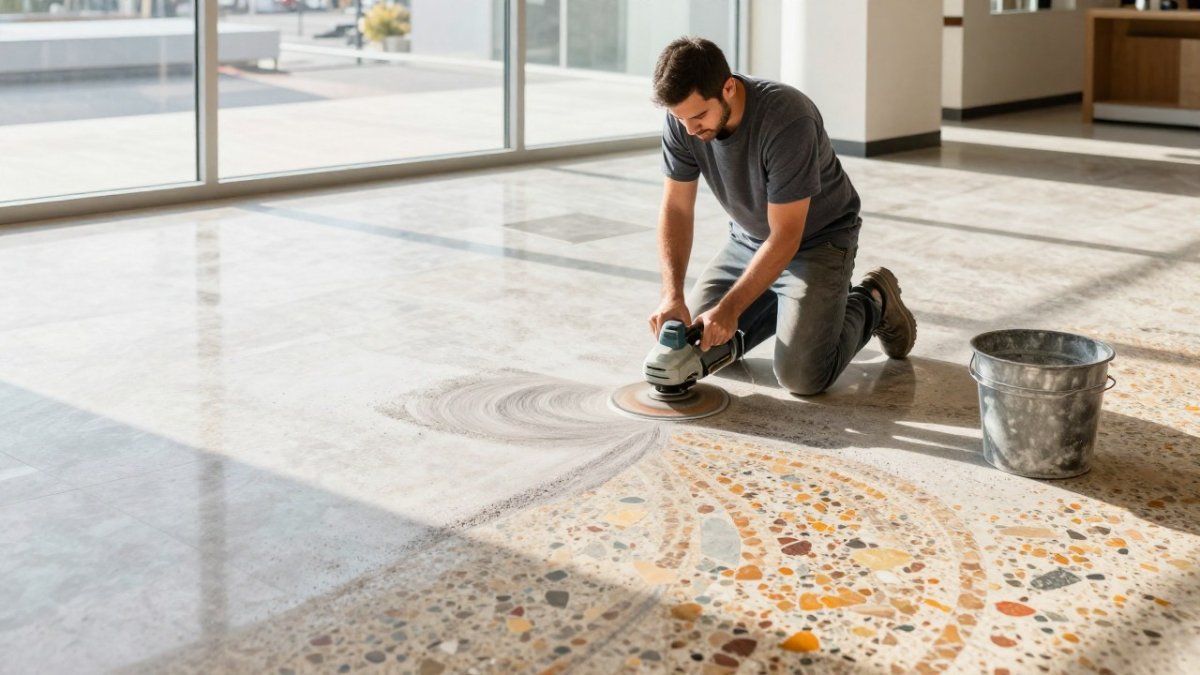
Terrazzo is a composite of marble, quartz or glass chips set in a cement or epoxy binder, then ground and polished. See a direct epoxy versus cement terrazzo comparison to choose between the two binders.
Pros: Very high durability, seamless surface, low long-term repair needs, suits hygiene-focused spaces. Cons: Higher upfront cost, longer installation time, and cracks can form if the substrate moves.
Concrete, Porcelain and Carpet Tile
Pros of this group: Concrete is economical for large areas, porcelain is durable and hygienic, and carpet tile is flexible and quiet. Cons of this group: Concrete can be hard and dusty, porcelain grout can stain, and carpet tile wears faster under heavy use.
Choosing the Best Flooring for High-Traffic Commercial Areas
High-traffic areas need a surface that resists wear before it looks worn. Lobbies, corridors, cafeterias and entrances usually take the most punishment. The difference between a floor that lasts 15 years and one that looks tired in three is rarely the material category, it is whether the specified product meets measurable performance thresholds for the actual load.

Instead of choosing from a sample board, screen candidates against the specifications below. Ask each manufacturer for the test data behind these numbers, not just a marketing claim.
Wear layer and abrasion resistance
For resilient flooring, the wear layer thickness is the single most predictive specification for high-traffic performance. Commercial sheet vinyl and luxury vinyl tile are commonly specified in wear layers ranging from about 6 mil to 40 mil (1 mil = 0.001 inch); 20 mil and above is typical for healthcare, retail and education corridors, while 6 to 12 mil products are better suited to low-traffic offices and back-of-house areas. Because wear-layer thickness and abrasion-test results reveal how resilient flooring handles sustained use, the same performance-first approach applies when choosing high-traffic floor tiles.
Indentation and static load resistance
Rolling carts, pallets, and point loads from equipment legs cause permanent dents that abrasion ratings do not capture. Ask for indentation resistance data, commonly reported under ASTM F970 (residual indentation) for resilient products. A floor that recovers well under F970 will hold up better under rolling loads in a stockroom or cafeteria than one with a thinner wear layer and softer backing.
Slip resistance
Slip and fall risk is a safety and liability issue, not just a comfort issue. Slip resistance is commonly measured under ANSI A326.3 (the DCOF AcuTest) for hard surfaces and ASTM D2047 for coated surfaces, and many specifiers target a wet DCOF of 0.42 or higher for level interior walking surfaces. Confirm the test method and the wet condition result, because a floor that passes dry can still be slippery when mopped.
Fire and code performance
Commercial flooring in most occupancies must meet a floor class rating under ASTM E648 (critical radiant flux) and often a smoke density rating under ASTM E662. Confirm the product's published ratings match the occupancy requirements for the space, and check whether the installation method (adhesive, underlayment) changes the rating.
Repair and replacement without closure
A durable floor is also one that can be repaired in sections. Ask whether damaged areas can be patched, ground and polished, or swapped as individual tiles or planks without closing the whole area. A floor that requires full replacement after one damaged zone costs far more over its life than its purchase price suggests.
Use this screening list when comparing quotes:
- Wear layer thickness stated in mil, matched to traffic level
- Abrasion resistance reported with test method (ASTM D4060 or F510)
- Indentation resistance reported (ASTM F970) for rolling and point loads
- Wet slip resistance reported (ANSI A326.3 DCOF or ASTM D2047)
- Fire class (ASTM E648) and smoke density (ASTM E662) confirmed for the occupancy
- Repair method and section-replacement option documented
Watch out: a product can carry a "commercial" label and still fall short on wear layer or indentation for a corridor with hundreds of daily crossings, always match the specification to the traffic, not the label to the room.
When Heavy Duty Commercial Vinyl Flooring Makes Sense
The key specification is the wear layer. A thicker wear layer protects the printed design for longer under foot traffic. Compare products on wear layer thickness and the manufacturer's warranty for commercial use, not just on appearance.
Matching Commercial Office Flooring to Room Type and Subfloor
Different rooms in the same building often need different floors, and the operational demands of each industry drive the specification more than appearance does. The table below maps common commercial settings to the flooring characteristics that matter most, so you can shortlist materials before a contractor visit.
| Setting | Dominant demands | Materials that typically fit | Specifications to confirm |
|---|---|---|---|
| Healthcare (patient rooms, corridors) | Frequent disinfection, wheeled beds and carts, slip safety, seamless cleanability | Sheet vinyl with heat-welded seams, rubber, epoxy terrazzo | Wear layer 20 mil+, ASTM F970 indentation, wet DCOF 0.42+, chemical resistance to facility disinfectants |
| Food service (kitchens, dining) | Grease, spills, frequent mopping, slip resistance, sanitary seams | Quarry and porcelain tile with epoxy grout, epoxy flooring, sheet vinyl | Wet DCOF, ASTM E648 fire class, grout and sealer chemical compatibility |
| Retail (sales floor, stockroom) | Rolling loads, point loads from fixtures, appearance retention | LVT, polished concrete, porcelain tile | ASTM F970, wear layer matched to traffic, abrasion data |
| Offices (workstations, meeting rooms) | Acoustics, comfort underfoot, quiet rolling chairs | Carpet tile, LVT, sheet vinyl | Chair caster resistance, acoustic ratings, replacement method |
| Education (classrooms, corridors) | High foot traffic, spills, budget-driven lifecycle | LVT, sheet vinyl, carpet tile in quiet zones | Wear layer, ASTM F970, repairability |
| Industrial and warehouse | Forklift and pallet loads, chemical exposure, dust | Sealed or polished concrete, epoxy, hard tile | Compressive strength, chemical resistance, joint design |
Subfloor and moisture constraints
No flooring decision survives a bad substrate. Concrete slabs must be tested for moisture vapor emission before most resilient flooring goes down; the common test is ASTM F2170 (in-situ relative humidity), and many adhesive and flooring manufacturers publish a maximum allowable RH, often around 75% to 80% for resilient products, though the exact limit is product-specific. High moisture can cause adhesive failure, debonding and cupping. Uneven slabs need leveling before tile or terrazzo, and older buildings may have subfloors that cannot carry the weight of heavier systems.
Installation downtime and disruption
Installation method affects how long an area is out of service. Glue-down resilient and tile installations typically require adhesive cure time and limited foot traffic for a period after installation, while some LVT products offer faster-return-to-service options. Epoxy and terrazzo systems need longer cure and polishing windows. Phase work by floor or wing so the building stays open, and confirm the manufacturer's return-to-service time in writing before scheduling.
Safety, accessibility and code considerations
Beyond slip resistance, confirm that transitions between flooring materials meet accessibility requirements for level changes and that the product's fire performance matches the occupancy. For facilities subject to food safety or healthcare sanitation standards, confirm that the flooring and seam method support the cleaning and disinfection regime the facility actually uses.
Watch out: many flooring problems that look like product failures actually start with substrate preparation or moisture, have the subfloor inspected and tested before choosing a material, not after the quote is signed.
Comparing Lifecycle Cost, Maintenance and Repairability
The cheapest flooring at installation is often the most expensive over time. Compare durability ratings for each material in our flooring durability guide before weighing lifetime cost.
Here is how the main options compare on the factors that matter most over time:
| Flooring Type | Durability (high traffic) | Maintenance Level | Repairability | Typical Lifespan Driver |
|---|---|---|---|---|
| Cement terrazzo | Very high | Low to moderate | Good (grind and polish) | Substrate stability |
| Epoxy terrazzo | High | Low | Moderate | Surface preparation |
| Commercial vinyl (sheet/LVT) | Moderate to high | Low | Good for single planks | Wear layer thickness |
| Porcelain tile | High | Low to moderate | Moderate (grout repair) | Grout and installation |
| Carpet tile | Moderate | Moderate to high | Very good (swap squares) | Traffic and spills |
| Polished concrete | High | Low to moderate | Moderate | Sealer maintenance |
Use this table to narrow the field, then ask each contractor for written maintenance guidance and warranty terms. Our terrazzo and marble care guide explains the upkeep each material will demand over time.
Repairability matters as much as durability. Learn how terrazzo floors fail and how that failure is fixed in our guide to terrazzo floor debonding and repair.
Scheduling a Site Assessment and Installation Plan
A reliable flooring decision starts with a site assessment. Ask a qualified contractor to walk the space, test the subfloor for moisture and levelness, and review the traffic and cleaning plan with your facility team.
A practical process looks like this:
- Document traffic patterns, loads and cleaning methods for each area.
- Request a subfloor and moisture test for slabs.
- Shortlist two or three materials per area based on the checklist above.
- Ask for installed references in comparable buildings.
- Compare written quotes on the same scope, including surface preparation, warranty and maintenance guidance.
- Schedule installation to limit disruption, phasing work by floor or wing where possible.
Request quotes based on the same scope so you can compare them fairly. Pricing depends on material, square footage, substrate condition and phasing, so contact A1 Terrazzo directly for a current quote tailored to your building.
Once the assessment is complete, you will know which materials suit each area and what the full lifecycle will cost. For a step-by-step view of how a business repair or installation is handled, see our terrazzo floor repair guide for businesses.
Frequently Asked Questions
What is the most durable flooring for commercial use?
Terrazzo and epoxy systems are commonly specified for heavy commercial traffic, and their performance depends on proper installation on a sound, dry substrate. The right choice depends on traffic volume, cleaning chemicals used and how much downtime the space can tolerate during installation.
Which flooring is best for commercial office spaces?
Commercial office flooring is selected based on acoustics, comfort and maintenance needs. Confirm the slip resistance rating and wear layer thickness with any flooring provider before selecting a product for a specific office layout.
How do you choose flooring for a high-traffic commercial area?
Start by estimating daily foot traffic, rolling loads and the cleaning method used. Look for materials with a rated wear layer, strong abrasion resistance and a slip-resistant surface that suits wet areas. Confirm the subfloor is flat and dry before installation, since moisture is a common cause of failure in any system. Request written maintenance guidance from the installer so cleaning products do not damage the finish.
What should businesses ask a flooring contractor before installation?
Ask how the subfloor will be prepared and tested for moisture, what warranty covers installation and materials, and which maintenance products are approved for the chosen floor. Request references from projects of similar size and traffic level. Ask for a schedule that fits your operating hours and a plan for protecting occupied areas during work. A detailed written proposal makes it easier to compare bids on equal terms.