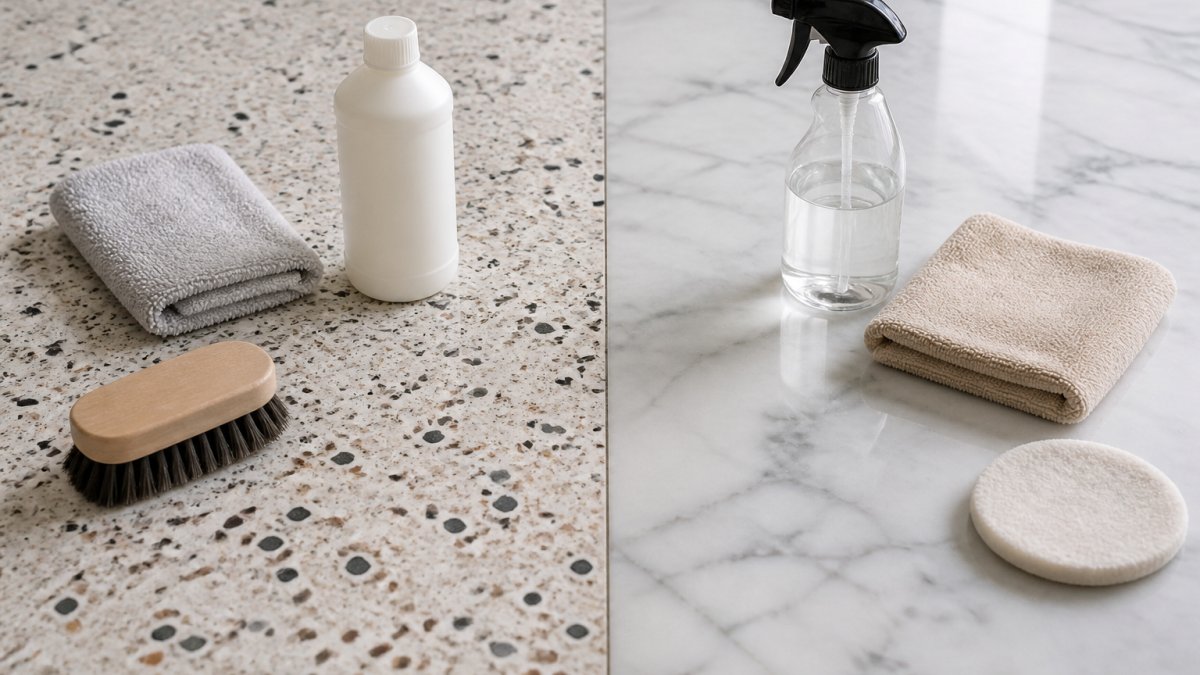
 comparison
Terrazzo vs Marble Floor Care: Maintenance Guide
Table of Contents
- Terrazzo vs Marble Floor Care: Quick Comparison
- Terrazzo vs Marble Durability in High-Traffic Environments
- Daily Cleaning and Maintenance Routines
- Marble Floor Etching Repair and Prevention
- Sealing, Polishing, and Restoration
- Chemical Compatibility and Stain Resistance
- Long-Term Cost of Ownership
- Frequently Asked Questions
Last Updated: September 30, 2026
Terrazzo vs Marble Floor Care: Quick Comparison
When it comes to terrazzo vs marble floor care, the two demand fundamentally different maintenance approaches. Terrazzo, a composite of marble chips bound in cement or resin, behaves differently than solid marble under the same cleaning products and techniques. The wrong cleaner can etch marble in minutes, while terrazzo tolerates more aggressive maintenance but still requires pH-neutral care to prevent dulling. This guide from A1 Terrazzo breaks down exactly what each floor needs and how to avoid costly mistakes that facility managers and property owners make repeatedly.
| Characteristic | Terrazzo | Marble |
|---|---|---|
| Durability in Heavy Traffic | Excellent (aggregate composition resists wear) | Good (polished surface dulls faster) |
| Stain Resistance | Moderate (porous substrate, needs sealing) | Low (highly porous, etches easily) |
| Chemical Sensitivity | Moderate (pH-neutral required) | High (acids etch immediately) |
| Sealing Frequency | Every 1-2 years | Every 6-12 months |
| Daily Cleaning | Dust-mop, pH-neutral cleaner | Dust-mop, pH-neutral cleaner only |
| Restoration Difficulty | Moderate (honing and polishing possible) | High (etching requires professional restoration) |
| Best For | Commercial spaces, hospitals, airports | Luxury residential, historic buildings |
Terrazzo vs Marble Durability in High-Traffic Environments
Terrazzo wins in pure durability for heavy-traffic commercial spaces. The aggregate composition creates a surface that resists abrasion better than solid marble. Hospital corridors, airport terminals, and university hallways see terrazzo hold its polish longer than marble would.
Marble dulls faster under foot traffic, losing gloss within 18-24 months in high-traffic areas. This is why airports and healthcare facilities historically favored terrazzo for main corridors.
Both require sealing to prevent moisture penetration and staining. Unsealed terrazzo absorbs liquids quickly; unsealed marble is worse, as water and acidic substances cause permanent discoloration.
Terrazzo's substrate is less porous than marble's natural stone composition, resisting moisture better when properly sealed. Marble needs more frequent resealing due to higher porosity. In healthcare facilities, terrazzo performs better in demanding environments where marble would require constant restoration.
Daily Cleaning and Maintenance Routines
Most facility managers use the wrong cleaner. Acidic or alkaline products damage both surfaces, but marble suffers faster and more visibly.
Dust-mop first. Remove loose debris with a microfiber dust mop before wet cleaning. Grit acts as an abrasive when you mop, scratching the surface and causing micro-scratches that accumulate over months.
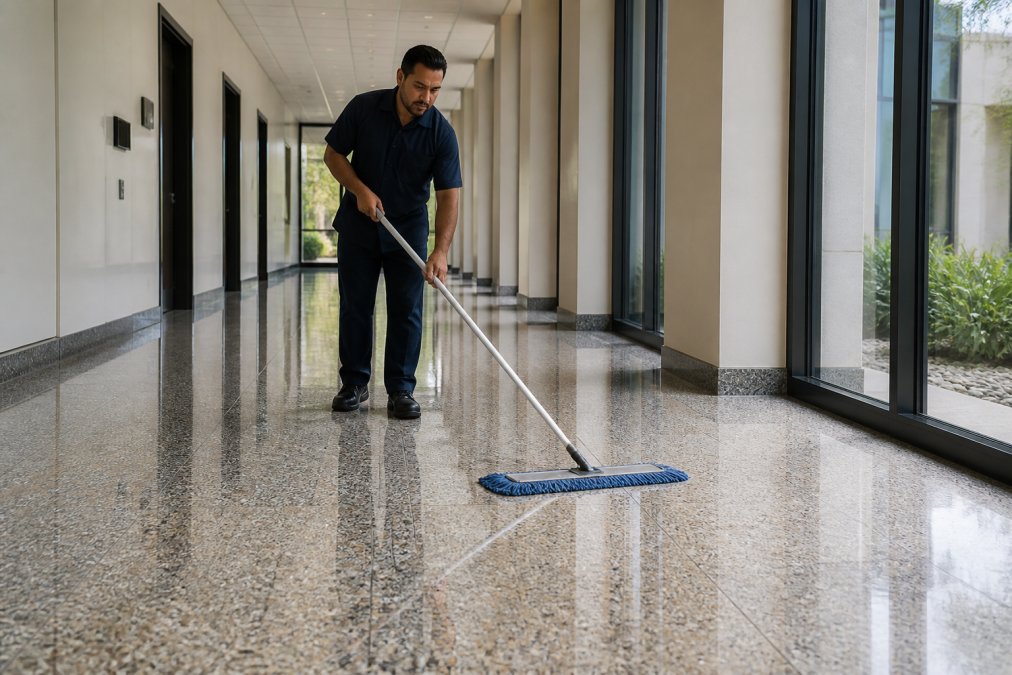
pH-neutral cleaner is mandatory. Acidic all-purpose cleaners etch marble immediately; alkaline cleaners strip sealers and dull both surfaces. StoneTech Neutral Floor Cleaner and Simple Green Stone Cleaner are both pH-neutral options. Mix according to instructions, concentration matters.
Never use vinegar, lemon juice, or bathroom cleaners on marble, these etch the surface within minutes and cause permanent damage. For terrazzo, acidic cleaners cause dulling but damage is slower.
Mop with a damp microfiber pad and dry immediately with a clean cloth to prevent water spots and moisture penetration.
High-traffic commercial spaces need daily dust-mopping and 2-3 times weekly wet cleaning. Lower-traffic areas can go weekly.
pH-Neutral Terrazzo Floor Cleaner Selection
Terrazzo tolerates a wider range of products than marble, but pH-neutral remains the standard.
StoneTech Neutral Floor Cleaner is specifically formulated for terrazzo and marble. The no-rinse formula saves time and reduces water use. Pricing depends on quantity, dates, and delivery; contact A1 Terrazzo for current prices or a quote.
Simple Green Stone Cleaner is ready-to-use in a spray bottle, convenient for spot cleaning. Pricing depends on quantity, dates, and delivery; contact A1 Terrazzo for current prices or a quote.
Avoid products labeled "terrazzo stripper" or "heavy-duty floor cleaner" for daily use, these damage the current protective layer.
Safe Marble Cleaning Practices
Marble requires more caution than terrazzo. Acids etch it, and even some neutral products can leave residue.
pH-neutral cleaner is the only option for marble. StoneTech Neutral Floor Cleaner and Simple Green Stone Cleaner are both safe options.
Never use these on marble:
- Vinegar or lemon juice (etch immediately)
- Bathroom cleaners or tile cleaners (acidic)
- Dish soap or all-purpose cleaners (often acidic or leave residue)
- Oxygen-based stain removers (too harsh for the substrate)
For spills, response time matters. Acidic liquids etch marble within minutes if left sitting. Blot immediately; etching is permanent without professional restoration.
Marble's porosity means stains penetrate deeper than on terrazzo. A spill sitting for an hour can cause permanent discoloration, making marble less suitable for high-traffic commercial spaces.
Dust-mop daily, wet-clean with pH-neutral cleaner 1-2 times weekly, and dry immediately. Keep the sealer refreshed and train staff to respond quickly to spills.
Marble Floor Etching Repair and Prevention
Etching is marble's most common damage. Acidic liquids dissolve the calcium carbonate, leaving dull spots or white marks that are permanent chemical damage.
Prevention is far easier than repair. Keep acidic substances off marble and train staff on proper handling.
Light etching can sometimes be improved with professional polishing, though it doesn't always fully restore the original finish. Deep etching requires honing the entire floor, which is more costly.
Terrazzo is more resistant to etching because its substrate is harder and the sealer protects the aggregate. The surface itself doesn't etch like marble does.
Prevention means using pH-neutral cleaner only, sealing every 6-12 months, responding immediately to spills, and training staff on proper care. One professional etching repair exceeds years of preventive maintenance costs.
Sealing, Polishing, and Restoration
Both terrazzo and marble require sealing to function properly. The sealer fills the substrate's pores and creates a barrier against moisture, stains, and chemical damage.
Sealing Requirements and Frequency
Terrazzo needs resealing every 1-2 years depending on traffic. High-traffic commercial spaces may need annual sealing; lower-traffic areas can go 2 years.
Marble needs more frequent sealing: every 6-12 months due to higher porosity. Annual sealing is standard in healthcare facilities.
The sealer is failing when water no longer beads on the surface, spills absorb into the stone, or dull spots appear in high-traffic areas.
Professional sealing takes 24-48 hours per application, during which the floor must be closed to traffic. For large facilities, this requires planning during off-hours or in phases.
The cost of professional sealing depends on square footage and sealer type. Get a quote from your contractor, pricing varies by region and product. A1 Terrazzo can assess your floor's sealing condition and recommend a schedule based on your specific traffic patterns and usage.
Professional Polishing and Honing
Polishing restores gloss to a dull surface. Honing removes surface damage and creates a matte finish. Both are professional-grade services that require specialized equipment and expertise.
Polishing uses diamond-pad equipment or polishing compounds (like Tenax Marble and Terrazzo Polishing Powder) to buff the surface to a high gloss. This works on both terrazzo and marble and is effective for restoring shine that dulled from wear or improper cleaning. A professional polish lasts 6-12 months depending on traffic.
Honing removes the top layer of the substrate to expose fresh stone or aggregate underneath. It's used when the surface is damaged (etching, deep scratches) or when a matte finish is preferred. Honing is more aggressive than polishing and removes material, so it can only be done a limited number of times before the floor becomes too thin. It should be done by professionals only.
For terrazzo, professional restoration can extend floor life indefinitely. The aggregate is stable, and polishing removes surface dulling without compromising structural integrity. For marble, honing is riskier because you're removing the calcium carbonate substrate itself. Once it's gone, it's gone.
Chemical Compatibility and Stain Resistance
Both terrazzo and marble are vulnerable to certain chemicals, but in different ways. Understanding what damages each surface prevents costly mistakes.
Terrazzo's main vulnerability is moisture penetration. If the sealer fails, water soaks into the cement or epoxy binder and causes staining, efflorescence (white powder on the surface), and eventually structural failure. Acidic spills damage the sealer over time but don't etch the aggregate like they do marble.
Marble is chemically reactive. Acidic substances (vinegar, wine, citrus, soda, stomach acid) dissolve the calcium carbonate and etch the surface. Alkaline substances strip the sealer and dull the finish. Even neutral products can cause problems if they leave residue that hardens over time.
For both surfaces, the rule is simple: pH-neutral cleaner only. Avoid:
- All-purpose cleaners (usually acidic)
- Bathroom cleaners (acidic)
- Vinegar or lemon-based products (acidic)
- Bleach or ammonia (alkaline, strips sealers)
- Wax-based products (can trap moisture)
- Oil-based products (can stain)
Stain resistance depends on sealing.
Long-Term Cost of Ownership
The upfront cost of installation is only the beginning. The true cost of ownership includes sealing, cleaning, maintenance, and occasional restoration over 20+ years.
Frequently Asked Questions
Is terrazzo easier to maintain than marble in commercial spaces?
Terrazzo is generally more forgiving in high-traffic commercial settings. Its composite structure of marble chips, glass, and synthetic resin makes it more resistant to etching from acidic spills compared to pure marble. Terrazzo requires pH-neutral cleaner and periodic sealing, but tolerates heavier foot traffic without developing the micro-scratches that marble shows quickly. Marble demands more frequent professional restoration and careful chemical management to prevent etching damage.
What cleaning agents should be avoided on both terrazzo and marble?
Never use acidic cleaners, vinegar, lemon juice, or alkaline products on either surface. These damage the surface finish and can etch marble permanently. Avoid ammonia-based window cleaners and bleach solutions. Acidic spills on marble create visible dull spots within minutes. Both materials require pH-neutral cleaners specifically formulated for stone. Always test any new product on a hidden area first, and follow manufacturer guidance for dilution ratios and contact time.
Does terrazzo require the same sealing process as natural marble?
Both terrazzo and marble benefit from sealing, but the process differs slightly. Marble typically needs penetrating sealer applied to the substrate to prevent moisture sensitivity and staining. Terrazzo's porosity is lower due to its synthetic resin binder, so sealing focuses on maintaining surface protection and gloss retention. Professional assessment determines the right sealing frequency, usually every 1-3 years depending on traffic volume and maintenance protocol.
Which flooring material is more resistant to staining and etching?
Terrazzo resists staining and etching better than marble. Its synthetic resin matrix provides a protective barrier around the aggregate, reducing porosity and moisture sensitivity. Marble, being natural calcium carbonate, is susceptible to etching from acidic substances and stains from oils and spills. Terrazzo's surface integrity relies heavily on sealer maintenance. In healthcare and hospitality environments where chemical exposure is frequent, terrazzo's stain resistance makes it the more practical choice.