 listicle
Best Alternatives to Carpet for Commercial Offices
Table of Contents
- Why Businesses Are Moving Away From Carpet
- Best Flooring for High-Traffic Office Areas
- Luxury Vinyl Tile (LVT) and Plank (LVP) Options
- Epoxy Terrazzo Flooring Benefits
- Commercial Flooring Maintenance Costs and Long-Term Value
- Stone Plastic Composite, Polished Concrete, and Glue-Down Vinyl
- Choosing the Right Alternative to Carpet for Your Office
- Frequently Asked Questions
Last Updated: September 18, 2026
Why Businesses Are Moving Away From Carpet
Carpet has dominated commercial offices for decades, but that era is ending. Facility managers increasingly recognize that traditional carpet creates maintenance headaches, harbors allergens, and fails to withstand high-traffic demands. The real cost of carpet ownership extends far beyond the initial purchase.
A carpet installed in a busy hallway shows visible wear within 18 months as stains accumulate and odors settle in. For healthcare facilities, airports, and universities managing thousands of daily visitors, carpet becomes a liability rather than an asset.
Facility managers now prioritize durability, hygiene, and total cost of ownership over aesthetic appeal alone. This is where alternatives to carpet for commercial offices shine. At A1 Terrazzo, we've watched this transition accelerate across hospitals requiring sanitary surfaces, airports handling massive foot traffic, and schools managing budget constraints.
The best alternatives to carpet for commercial offices deliver what carpet cannot: longevity, ease of cleaning, moisture resistance, and performance under extreme conditions. Understanding your options is the first step toward choosing flooring that actually serves your business.
Best Flooring for High-Traffic Office Areas
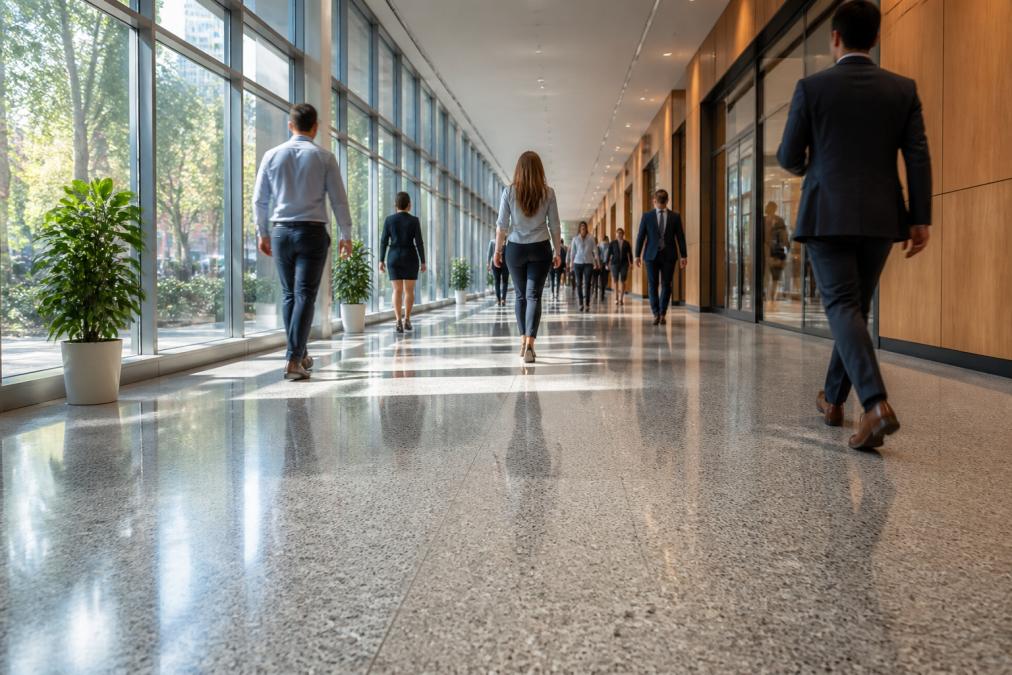
Corridors, lobbies, and reception areas see hundreds of footsteps daily. Regular carpet cannot survive this environment without accelerating toward replacement.
Luxury Vinyl Tile (LVT) resists constant foot traffic while maintaining a professional appearance. The wear layer protects the decorative surface, and the resilient core absorbs impact. Installation is straightforward with floating or glue-down options depending on subfloor condition.
Stone Plastic Composite (SPC) offers superior rigidity with an ultra-dense core that prevents denting from chair wheels, equipment, or dropped objects, critical in hospitals and airports. SPC's 100% waterproof construction handles spills without warping.
Glue-down vinyl provides maximum stability for corridors and entryways where seamless appearance and moisture resistance matter.
Polished concrete delivers industrial durability, requires minimal maintenance, and enhances lighting efficiency through its reflective surface.
Luxury Vinyl Tile (LVT) and Plank (LVP) Options
Luxury Vinyl represents the closest competitor to carpet in terms of comfort and aesthetic flexibility. Both LVT and LVP mimic natural materials, wood, stone, or tile, while delivering commercial-grade performance.
LVT comes in individual tiles (typically 12x24 or 18x36 inches), allowing targeted replacement of damaged pieces. The variety of wood-grain and stone finishes eliminates institutional-looking surfaces.
Luxury Vinyl Plank (LVP) uses longer planks resembling hardwood flooring, delivering warmth without hardwood's maintenance burden.
Both formats offer water resistance, impact absorption, and click-lock systems that minimize business disruption during installation.
Subfloor Preparation: The Hidden Cost and Timeline
Subfloor preparation is the critical limitation that derails many LVT/LVP installations, creating unexpected costs and delays.
LVT and LVP require extremely flat substrates with maximum variance of 3/16 inch over 10 linear feet. Even minor irregularities telegraph through the surface, requiring sanding or leveling before installation.
Assessing Your Subfloor: Conduct a professional flatness survey using a 10-foot straightedge. For concrete slabs, moisture testing is critical, levels above 3 pounds per 1,000 square feet per 24 hours can cause adhesive failure. Many offices discover moisture issues only after installation begins.
Leveling and Preparation Costs: Leveling costs range from $0.50-$4.00 per square foot depending on condition. For a 5,000-square-foot space with moderate unevenness, leveling can add $5,000-$15,000 to the budget, a cost rarely quoted upfront.
Timeline Impact: Subfloor preparation extends timelines significantly. Moisture testing requires 24-72 hours, leveling adds 3-7 days, and self-leveling compounds need 24-48 hours cure time. A 2-week project can stretch to 4 weeks if subfloor issues emerge mid-project.
Moisture Barriers and Existing Conditions
Moisture barriers ($0.75-$1.50 per square foot) are essential in basements, ground-floor spaces, or humid climates, yet many budget estimates omit them.
Carpet removal may reveal adhesive residue, staples, or tack strips requiring additional labor and repair.
Installation Methods and Flexibility
Click-lock (floating) systems are faster but can shift in high-traffic areas with heavy rolling equipment. Glue-down installations provide maximum stability but require 24-48 hours cure time.
Lifespan and Repairability
LVT and LVP typically last 15-20 years with modular replacement possible, though matching tiles becomes difficult if product lines are discontinued.
Epoxy Terrazzo Flooring Benefits
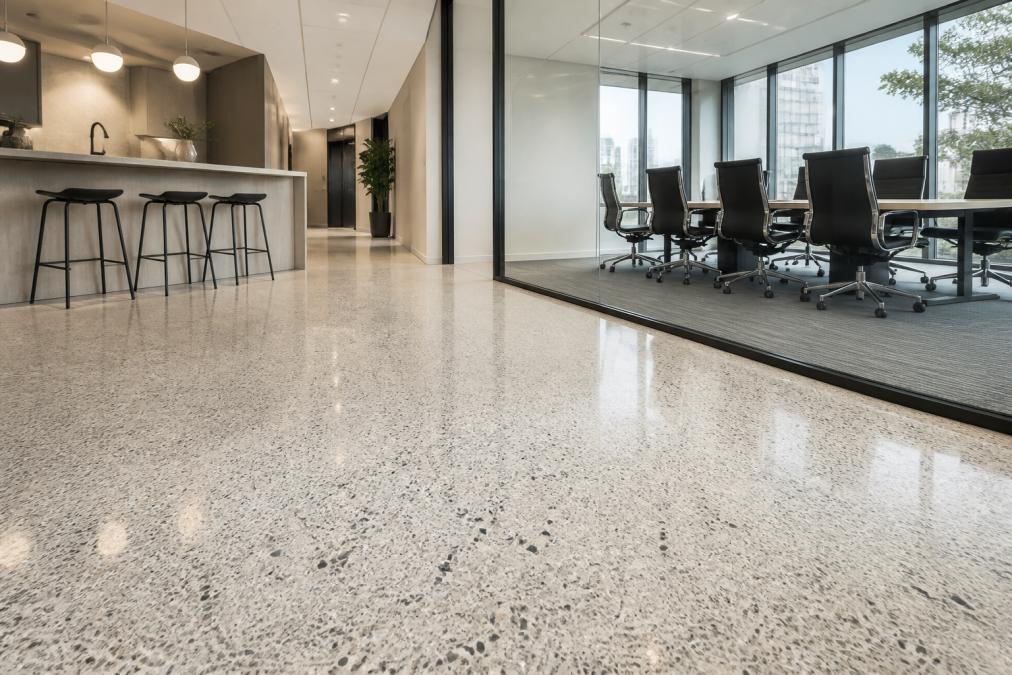
Terrazzo combines marble or granite chips suspended in a binder, then polished to a high gloss, a surface that's both beautiful and virtually indestructible.
Epoxy terrazzo flooring offers exceptional durability with non-porous surfaces that resist staining, wipe clean instantly, and prevent bacterial embedding unlike carpet fibers.
Acoustic Performance: A Quantifiable Advantage
Unlike carpet, which degrades as fibers compress and accumulate debris, terrazzo maintains consistent acoustic performance for 30+ years.
Maintenance and Lifecycle Value
Maintenance costs drop dramatically, terrazzo needs only routine sweeping and occasional sealing versus carpet's regular deep cleaning and replacement cycles. Professional maintenance services ensure optimal performance.
Aesthetic and Functional Versatility
Custom color combinations, aggregate sizes, and finishes create unique floors reflecting brand identity. The polished surface enhances lighting efficiency, reducing energy costs.
Installation and Substrate Expertise
Installation quality determines everything. Proper substrate assessment, moisture barriers, and installation methodology prevent cracking and failure.
Commercial Flooring Maintenance Costs and Long-Term Value
Carpet requires quarterly professional cleaning, spot treatments, and complete replacement after 5-7 years, creating substantial cumulative costs.
Luxury Vinyl demands minimal maintenance, sweeping and occasional damp mopping with no replacement cycles for decades.
Polished concrete requires only sweeping and occasional resealing, with a 20+ year lifespan creating exceptional value.
Terrazzo maintenance requires professional expertise. A1 Terrazzo's professional maintenance services ensure proper care.
| Flooring Type | Maintenance Frequency | Typical Cleaning Cost | Expected Lifespan |
|---|---|---|---|
| Carpet | Weekly vacuuming + quarterly deep clean | High (specialized equipment) | 5-7 years |
| LVT/LVP | Weekly sweep + monthly damp mop | Low (standard supplies) | 15-20 years |
| SPC | Weekly sweep + monthly damp mop | Low (standard supplies) | 20-25 years |
| Polished Concrete | Weekly sweep + annual sealing | Very low (minimal products) | 20+ years |
| Terrazzo | Professional maintenance program | Moderate (expert service) | 30+ years |
Stone Plastic Composite, Polished Concrete, and Glue-Down Vinyl
Stone Plastic Composite (SPC) excels where impact resistance matters most, hospitals, airports, and manufacturing facilities benefit from its rigid core and waterproof construction. Floating systems reduce preparation costs.
Polished concrete suits facilities with industrial aesthetics or budget constraints. Grinding and sealing transform concrete into a beautiful, durable surface with minimal maintenance.
Glue-down vinyl provides seamless coverage, eliminating gaps and creating unified aesthetics in entryways and corridors, though removal is difficult.
All three options require proper subfloor preparation, moisture barriers, and leveling. A1 Terrazzo's expertise prevents failures from inadequate preparation.
Choosing the Right Alternative to Carpet for Your Office
Assess foot traffic patterns, corridors and lobbies demand abrasion-resistant surfaces like LVT, SPC, or terrazzo, while reception areas might prioritize aesthetics.
Moisture exposure determines waterproof needs. Kitchens, bathrooms, and entryways require 100% waterproof materials, while healthcare facilities demand non-porous surfaces.
Aesthetic requirements, terrazzo's custom finishes, vinyl's wood-grain mimicry, or concrete's industrial look, should align with brand identity and existing décor.
Budget constraints include installation and maintenance. Carpet appears cheaper upfront but costs more over time.
Subfloor condition matters significantly. A1 Terrazzo's assessment process identifies moisture issues and preparation needs before installation, preventing substrate-related failures.
The best alternatives to carpet for commercial offices solve real problems that carpet cannot address. Whether you prioritize durability, ease of maintenance, acoustic performance, or aesthetic customization, options exist that outperform carpet across every meaningful measure.
Frequently Asked Questions
What is the best alternative to carpet for commercial offices?
The best alternative depends on your specific needs. Luxury vinyl tile (LVT) and terrazzo excel in high-traffic areas requiring durability and easy maintenance. Polished concrete suits industrial-style offices prioritizing sustainability, while stone plastic composite (SPC) offers superior impact resistance. Epoxy terrazzo flooring benefits include exceptional longevity, aesthetic versatility, and superior hygiene, making it ideal for healthcare and hospitality spaces. Evaluate foot traffic volume, maintenance capacity, and design preferences before deciding.
Why are businesses moving away from carpet in office spaces?
Carpet harbors allergens, dust, and bacteria, concerns especially critical in healthcare and food-service facilities. It requires frequent deep cleaning and stains are permanent, increasing commercial flooring maintenance costs over time. Resilient alternatives like LVT and terrazzo resist moisture, spills, and wear from heavy foot traffic. They're easier to sanitize and maintain, offer better acoustic control when specified correctly, and provide superior durability in high-traffic corridors and entryways. Many facilities find the long-term operational savings justify switching.
Is luxury vinyl tile a good alternative to commercial carpet?
Yes. LVT provides excellent water resistance, abrasion resistance, and slip resistance, critical for commercial environments. It mimics natural materials aesthetically while resisting heavy foot traffic and moisture. Installation is faster than terrazzo, and individual tiles can be replaced if damaged. However, LVT offers less acoustic insulation than carpet and requires a very flat subfloor for optimal performance. For offices prioritizing durability and low maintenance over sound dampening, LVT is a practical choice.
What are the maintenance benefits of epoxy terrazzo flooring?
Epoxy terrazzo flooring benefits include seamless, non-porous surfaces that resist stains, bacteria, and chemical spills, essential for healthcare facilities and laboratories. Unlike carpet, terrazzo requires no deep cleaning cycles and handles moisture exposure without degradation. Its wear layer provides decades of durability, reducing replacement frequency and long-term costs. Professional maintenance preserves the finish and extends lifespan further. The sealed surface prevents VOC emissions and supports better indoor air quality, making it ideal for sensitive environments.
How do hard surface floors impact office acoustics?
Hard surfaces like polished concrete, LVT, and terrazzo reflect sound rather than absorb it, potentially increasing noise in open offices. However, this can be mitigated through acoustic underlayment during installation or by adding sound-absorbing wall treatments and furnishings. Some commercial flooring designs incorporate acoustic properties through specialized wear layers or installation methods. If noise control is critical, specify acoustic-rated products during selection or pair hard floors with sound management strategies. Carpet remains superior for acoustic dampening but sacrifices durability and maintenance benefits.
Choosing the right flooring requires expertise in substrate preparation, material performance, and long-term maintenance. A1 Terrazzo combines 35 years of specialized commercial terrazzo installation with professional maintenance services that ensure your investment performs flawlessly. Contact A1 Terrazzo to assess your facility's specific needs and discover how terrazzo can transform your space while eliminating the maintenance burden that carpet creates.