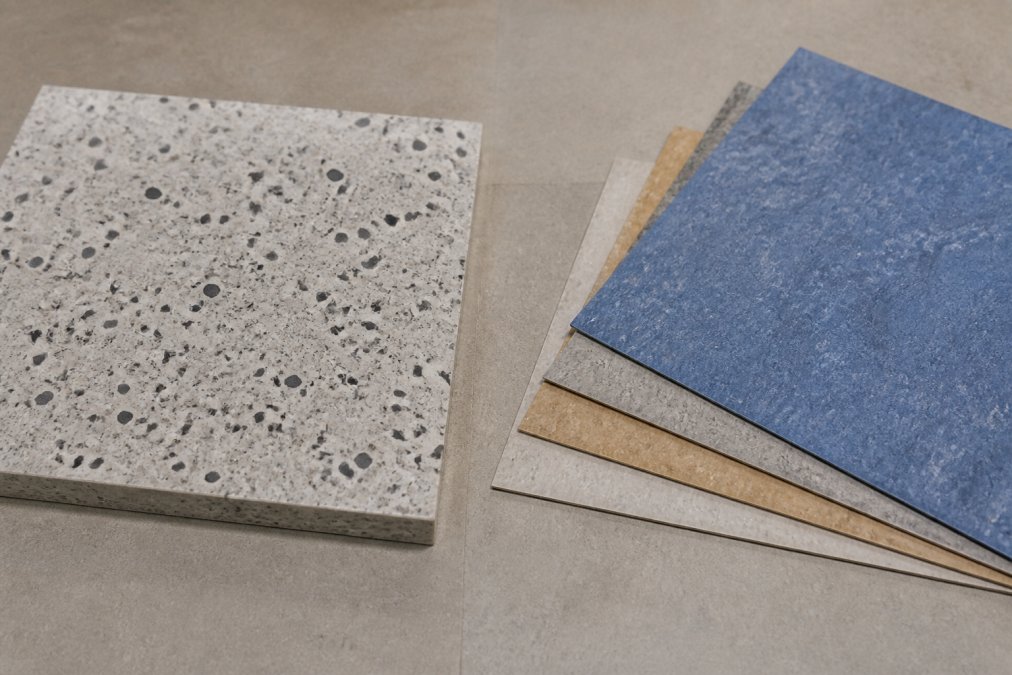
 comparison
Terrazzo vs Vinyl Flooring for Florida Schools (2026)
Table of Contents
- Terrazzo vs Vinyl Flooring: Quick Comparison for Florida Schools
- Terrazzo Flooring Lifecycle Cost Analysis in Florida Schools
- Durability and Performance Under Florida's Humidity and Foot Traffic
- Slip Resistance Standards for Educational Facilities: Terrazzo vs Vinyl
- Commercial Flooring Maintenance Best Practices for K-12 and University Campuses
- Indoor Air Quality, Acoustics, and Health Considerations for School Flooring
- Emergency Repair Protocols and Restoration: What Happens When Damage Occurs
- Frequently Asked Questions
Last Updated: September 13, 2026
Terrazzo vs Vinyl Flooring: Quick Comparison for Florida Schools
Choosing between terrazzo flooring vs vinyl for schools in Florida comes down to one hard truth: vinyl costs less on day one, and terrazzo costs far less over forty years. At A1 Terrazzo, we have installed and maintained commercial terrazzo across the state for over 35 years, and the pattern is consistent. Districts that budget only for capital expenditure end up paying again through operational expenditure, usually within a decade.
Terrazzo is a monolithic system of marble, granite, or glass aggregate set in a cement or epoxy matrix, ground and polished into a seamless surface. Vinyl is a resilient layered product, either tile or sheet, glued to a prepared subfloor. That structural difference explains nearly every performance gap that follows.
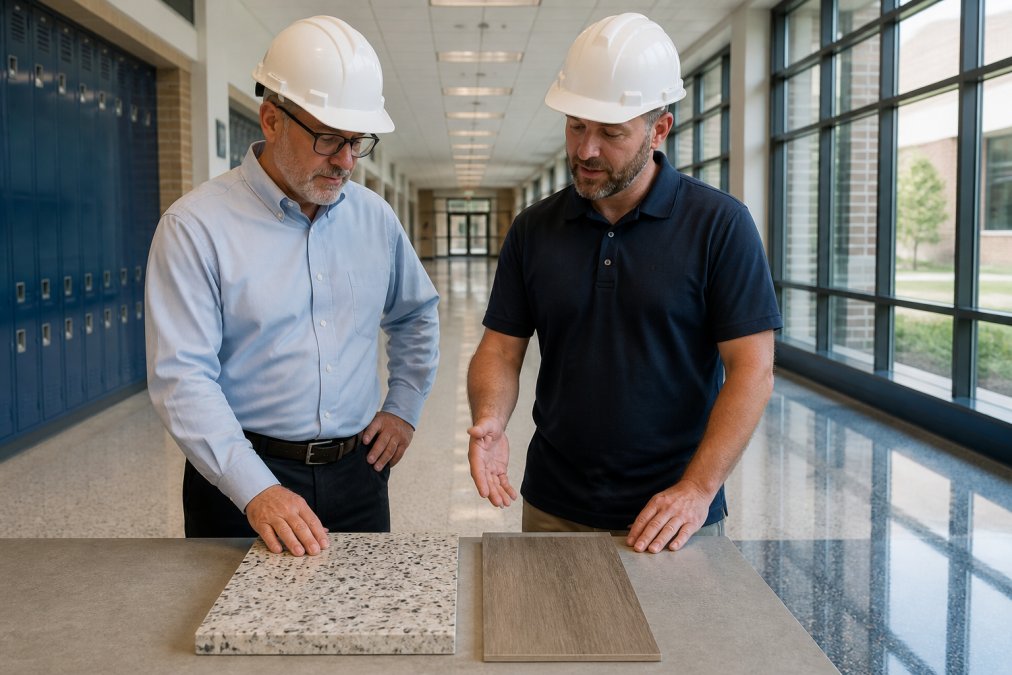
| Factor | Terrazzo | Vinyl (LVT / Sheet) |
|---|---|---|
| Upfront cost | Higher capital expenditure | Lower capital expenditure |
| Lifespan | Several decades with restoration | Roughly 10-20 years |
| Seams | None, monolithic | Grout lines or seams |
| Moisture behavior | Tolerates slab moisture when properly prepped | Adhesive failure risk |
| Repair method | Re-polishing and patching | Section replacement |
| Best for | High-traffic corridors, cafeterias | Classrooms, offices |
Winner: Terrazzo for corridors, cafeterias, and any space with heavy foot traffic. Choose vinyl only for classrooms and offices where upfront budget and installation speed outweigh lifecycle cost.
Terrazzo Flooring Lifecycle Cost Analysis in Florida Schools
Lifecycle cost analysis (LCA) totals every dollar a floor costs from the day it is installed to the day the building is demolished or renovated. For a school, the honest comparison window is 40 years, because that is the typical service life of a K-12 or university building before a major renovation. A bid sheet that only shows installed cost per square foot is not an LCA, it is a fraction of one.
The math splits into four buckets that facility managers should require from every vendor:
- Initial capital cost, material, labor, subfloor prep, moisture mitigation, and any temporary relocation of students during installation.
- Recurring maintenance cost, daily labor, consumables (cleaner, pads, finish), and equipment.
- Restoration or replacement cost, re-polishing and re-sealing for terrazzo; full tear-out and re-install for vinyl at end of life.
- Operational disruption cost, the cost of closing classrooms, moving students, and running swing space during replacement.
Capital Expenditure vs Operational Expenditure Over 40 Years
Across a 40-year horizon, a vinyl floor in a high-traffic school is typically replaced two to three times. Each replacement cycle carries its own capital cost, its own subfloor prep cost, and its own disruption cost. Terrazzo is installed once and then restored, re-polished and re-sealed on a scheduled cycle, rather than torn out and landfilled.
The pattern is that vinyl's lower first cost is real, but it is repaid within the first replacement cycle. After that, the terrazzo floor is operating on maintenance dollars only, while the vinyl floor is back on the capital budget asking for another full installation.
The Cost Drivers Competitors Leave Out
Three line items separate a real LCA from a marketing comparison:
- Subfloor moisture mitigation. In slab-on-grade construction common across Florida, a vapor retarder or moisture-mitigation coating is often required under vinyl to protect the adhesive. That cost is frequently omitted from vinyl bids and then added as a change order. Under a properly specified terrazzo system, the same slab is addressed as part of the bonded matrix.
- Adhesive and seam failure. Vinyl's seams and grout lines are where water and soil collect, and where adhesive failure typically begins. Each patch is a small cost, but they accumulate, and they leave visible seams that affect the floor's appearance long before the floor is functionally worn out.
- Disruption cost. Replacing vinyl in an occupied school means moving students, covering furniture, and managing noise and dust. That cost rarely appears on a flooring bid, but it appears on the district's books.
How to Present the Numbers to a Budget Committee
A budget committee does not need a 40-year spreadsheet, it needs three numbers side by side: first cost, 10-year cost of ownership, and 40-year cost of ownership. Ask every vendor for all three, in writing, with the assumptions listed. If a vendor cannot produce a 40-year total cost of ownership, that is a signal the product does not have a 40-year story to tell.
U.S. Environmental Protection Agency guidance on life-cycle cost analysis for buildings
Durability and Performance Under Florida's Humidity and Foot Traffic
Most flooring guides treat climate as a footnote. In this market, climate is the variable that decides which floor survives. Sustained humidity, slab-on-grade construction, salt air near the coast, and seasonal storm events put constant pressure on any adhesive-bonded floor. Terrazzo handles that pressure better because it is poured and ground in place as a monolithic system, not glued down in sheets or planks.
Moisture Resistance and Subfloor Conditions in Coastal Climates
Moisture resistance starts below the surface. A concrete slab emits water vapor continuously, and that vapor has to go somewhere. Under vinyl, trapped vapor attacks the adhesive from below, causing adhesive failure, curling edges, bubbling, and seam separation. Under a properly prepped terrazzo system, the same slab is addressed with a moisture barrier and a bonded matrix that tolerates the conditions.
The mechanism matters more than the marketing claim. Vinyl is a thin, flexible layer bonded to concrete with adhesive. When vapor pressure builds, it pushes against the weakest point in the assembly, usually the adhesive bond or a seam. Terrazzo is a thick, rigid, cementitious or epoxy matrix that is mechanically and chemically bonded to the slab. There is no adhesive layer to fail and no seam to separate.
Subfloor preparation is where most terrazzo failures actually begin. A common mistake is skipping or shortcutting vapor testing before installation. Any contractor who cannot explain their moisture testing protocol, how they test, where they test, and what thresholds they use, is a risk.
Salt Air, Storm Events, and the Local Failure Modes Competitors Ignore
Two local conditions rarely appear in generic flooring comparisons:
- Salt air near the coast. Salt-laden air accelerates corrosion of metal trim, transition strips, and fasteners. Vinyl relies on these metal components at doorways and transitions; terrazzo is a continuous surface that minimizes them. Fewer metal components means fewer corrosion points.
- Storm-driven water intrusion. When a roof leaks, a pipe bursts, or a storm pushes water into a corridor, the floor's response determines how fast the school reopens. Vinyl's adhesive bond is the weak link, water that gets under the sheet or tile can lift it across a wide area. Terrazzo, being monolithic and non-porous, sheds surface water and can usually be dried and returned to service without replacement.
Foot Traffic Performance in Corridors and Cafeterias
Foot traffic in a school is not uniform. Corridors, cafeterias, gymnasiums, and main entries see the highest loads, and they are also the spaces where grit, water, and food spills concentrate. Terrazzo's abrasion resistance comes from the aggregate itself, marble, granite, or glass, which is harder than the wear layer on most resilient products. Vinyl's wear layer is a thin factory-applied film; once it wears through, the printed pattern is exposed and the floor is functionally finished.
That is why the practical specification rule is to match the material to the space: terrazzo in corridors, cafeterias, entries, and other high-traffic, wet-prone areas; vinyl in classrooms and offices where upfront budget and installation speed matter more than a 40-year service life.
American Society for Testing and Materials standards for moisture vapor testing
Slip Resistance Standards for Educational Facilities: Terrazzo vs Vinyl
Slip resistance is measured by a coefficient of friction, and both materials can meet school safety thresholds when specified correctly. The difference is control: terrazzo's finish is determined by the grit and polish level the installer applies, while vinyl's slip rating is fixed at the factory.
For educational facilities, the practical rule is to specify a matte or satin finish on terrazzo in wet-prone areas such as entryways and cafeterias, and to verify the vinyl manufacturer's rating for the same space. Neither material is automatically safer. Specification is what protects students and limits liability.
Commercial Flooring Maintenance Best Practices for K-12 and University Campuses
Commercial flooring maintenance best practices for schools come down to three habits: daily dust removal, prompt spill response, and periodic deep restoration. Terrazzo rewards all three. Vinyl tolerates the first two and struggles with the third.
Cleaning Protocols That Protect Floor Finish and Prevent Adhesive Failure
The single most expensive mistake is the wrong cleaning product. Abrasive or highly acidic cleaners dull terrazzo and strip its sealer. On vinyl, excess water seeps into seams and grout lines, weakening adhesive from below.
- Use neutral-pH cleaner on terrazzo, diluted per the label
- Use a microfiber mop or auto-scrubber, never a soaking wet mop
- Dry-mop high-traffic corridors daily to remove grit
- Schedule re-polishing on a set cycle, not after damage appears
- Train custodial staff on which products are prohibited
Indoor Air Quality, Acoustics, and Health Considerations for School Flooring
Indoor air quality and acoustics rarely appear in flooring bids, yet both affect student outcomes and staff comfort. Terrazzo is non-porous and seam-free, so it does not trap moisture, dust, or microbial growth in seams the way a seamed floor can. Vinyl's seams and grout lines are the places where moisture and soil collect.
Acoustically, hard surfaces reflect sound. Terrazzo in a corridor will echo unless the design includes acoustic ceiling tile, wall panels, or walk-off mats. Vinyl is marginally quieter underfoot but does not solve the problem on its own. Any school planning a hard-surface floor should budget acoustic treatment alongside it.
U.S. Environmental Protection Agency guidance on indoor air quality in schools
Emergency Repair Protocols and Restoration: What Happens When Damage Occurs
Emergency repair protocols differ sharply between the two materials. A gouged vinyl tile is cut out and replaced, which is fast and cheap but leaves a visible patch and a seam. A damaged terrazzo section is ground out, re-poured with matching aggregate, and re-polished until the repair disappears.
That is the core advantage of restoration: terrazzo returns to a seamless, monolithic surface, while vinyl accumulates patches over its life. For a university managing multiple buildings, restoration also means the floor never needs a full replacement cycle, which keeps capital dollars free for other projects.
National Terrazzo and Mosaic Association technical resources
Frequently Asked Questions
What are the primary maintenance differences between terrazzo and vinyl in schools?
Terrazzo requires periodic re-polishing and sealing every few years, but daily maintenance is simple: dust mopping and occasional neutral-pH cleaning. Vinyl needs regular stripping and waxing, which adds labor hours for custodial staff. Terrazzo's non-porous surface resists microbial growth and stains, while vinyl seams and wear layers can trap dirt and moisture. Over a 40-year span, terrazzo's annual maintenance cost is significantly lower than vinyl's, making it a better long-term investment for high-traffic K-12 corridors.
How does the lifecycle cost of terrazzo compare to vinyl flooring?
Although terrazzo installation costs more upfront, its 50-year lifespan with restoration and re-polishing eliminates the need for full replacement every 10-15 years. For Florida schools managing tight capital expenditure budgets, terrazzo's lower operational expenditure over decades often justifies the higher initial investment. Pricing depends on the specific project scope, materials, and maintenance schedule. Contact A1 Terrazzo for a detailed quote.
Is terrazzo flooring more slip-resistant than vinyl for high-traffic hallways?
Terrazzo can be specified with a slip-resistant finish that meets ADA and educational facility standards, and its hard, non-porous surface does not develop the worn, slick spots that vinyl can after years of foot traffic. Vinyl's wear layer may become polished or damaged, reducing traction. In Florida's humid climate, where condensation and wet shoes are common, terrazzo's ability to maintain consistent slip resistance without wax buildup gives it an edge for high-traffic corridors and entryways.
How does Florida's climate impact the performance of school flooring materials?
Florida's high humidity and frequent moisture events stress flooring differently than drier climates. Vinyl can trap moisture beneath the subfloor, leading to adhesive failure, mold, and delamination. Terrazzo's monolithic system bonds directly to the substrate and resists moisture infiltration, making it less prone to buckling or microbial growth. For slab-on-grade schools, terrazzo's moisture resistance and thermal comfort properties help maintain a stable, healthy indoor environment without the risk of warping or seam separation.
What are the environmental benefits of choosing terrazzo for new school construction?
Terrazzo is a sustainable option because it uses natural aggregates and can be restored and re-polished repeatedly, extending its lifespan to 50 years or more. This reduces waste from tear-outs and replacements. Epoxy terrazzo also has low VOC emissions compared to some vinyl products, supporting better indoor air quality. For K-12 facilities pursuing green building certifications, terrazzo's durability and low lifecycle environmental impact align with sustainability goals while reducing long-term material consumption.
Every school district eventually faces the same budget question: pay less now and replace sooner, or pay more once and restore for decades. A1 Terrazzo has handled commercial terrazzo installation and professional maintenance across Florida for over 35 years, including large-scale campus work. We handle subfloor moisture testing, seamless installation, and ongoing re-polishing so the floor outlasts the bond that paid for it. Contact A1 Terrazzo to get a lifecycle cost comparison for your campus.