 How-to
Choosing High Performance Flooring for Airport Concourses
Last Updated: November 7, 2026
Quick Summary
Choosing high performance flooring for airport concourses starts with mapping passenger traffic and load profiles, then comparing systems on measured wear and slip resistance, maintenance, installation downtime, and whole-life cost. Epoxy and cement terrazzo lead on durability because they are poured in place as a single, dense surface with no seams for grit to collect in.
- Map peak-hour passenger counts, rolling loads, static loads, vehicle intrusion, and chemical exposure before comparing products.
- Most terminal flooring failures trace back to substrate moisture and prep, not the wear layer.
- Cement terrazzo is a thicker system that typically takes longer to cure than epoxy terrazzo.
- Luxury vinyl tile does not belong in a main concourse with luggage carts and ground-service traffic.
- Acidic and high-alkaline cleaners etch terrazzo over time, so train crews on approved products.
Table of Contents
- Start With Passenger Traffic and Load Profiles
- Airport Flooring Material Options Compared
- Why Airport Terrazzo Flooring Leads on Durability
- Epoxy Terrazzo Flooring Cost and Value
- Low-Maintenance Airport Flooring and Cleaning Plans
- Phased Installation Without Shutting Down the Concourse
- Plan Your Concourse Flooring With A1 Terrazzo
- Frequently Asked Questions
Start With Passenger Traffic and Load Profiles
Choosing high performance flooring for airport concourses starts with one question: what will actually roll, walk, and sit on it? Get that wrong and even a premium floor fails early.
A1 Terrazzo has more than 35 years of experience with commercial terrazzo flooring. Floors often fail when the load profile was never mapped, not only because of the material chosen.
Here is what to map before you compare products:
- Foot traffic volume. Peak-hour passenger counts per gate and per concourse.
- Rolling loads. Luggage carts, wheelchairs, cleaning machines, food service carts.
- Static loads. Seating banks, kiosks, retail fixtures, gate counters.
- Vehicle intrusion. Ground-service vehicles where they cross into terminal space.
- Chemical exposure. Deicing fluid tracked in, cleaning agents, food and beverage spills.
Watch out: most flooring failures in terminals trace back to substrate moisture and prep, not the wear layer. If your last floor cracked within a year, ask what the contractor did about slab moisture before pouring.
Airport Flooring Material Options Compared
Five flooring systems dominate airport terminal work. Each one solves a different problem, and none wins on every measure. The table below adds the criteria that actually decide a concourse specification: measured performance, maintenance burden, installation disruption, and lifecycle cost drivers.
| System | Wear Resistance | Slip Resistance | Maintenance | Installation Disruption | Lifecycle Cost Driver | Best For |
|---|---|---|---|---|---|---|
| Epoxy terrazzo | High | Good to high | Low | Moderate, thin-set, fast cure | Repolish cycles; few repairs | Concourses, ticket halls, baggage claim |
| Cement terrazzo | Very high | Good to high | Low | High, thicker pour, longer cure | Longest service life; lowest replacement frequency | Heavy traffic, long service life |
| Resinous coatings | Moderate | Varies by finish | Moderate | Low to moderate | Recoating intervals | Back-of-house, service corridors |
| Luxury vinyl tile | Low to moderate | Good | Moderate | Low | Replacement frequency; seam failure | Offices, small tenant spaces |
| Polished concrete | High | Varies by finish | Low to moderate | Moderate, grinding, curing | Joint repair; stain management | Back-of-house, hangars |
Epoxy terrazzo is a thin-set option that generally cures faster than cement terrazzo, which can shorten the window a concourse is out of service.
Cement terrazzo is a thicker system that typically takes longer to cure. Plan pours around longer cure times when schedule is a constraint.
Resinous flooring systems are used where chemical resistance or a seamless surface is needed, such as service corridors and back-of-house areas. Finish choice affects slip resistance, so specify the profile against the actual wet and dry conditions of the area.
Luxury vinyl tile suits small tenant spaces and offices. It does not belong in a main concourse with luggage carts and ground-service traffic; seam failure and indentation are the common failure modes.
Polished concrete is a durable option that offers less design flexibility and needs attention at joints, where spalling and staining can start.
Engineered hardwood is generally unsuited to concourse traffic, where moisture, grit, and rolling loads can damage it quickly.
To compare options on paper rather than by preference, score each system against the same criteria: measured wear resistance, wet and dry slip resistance, cleaning hours per square foot, installation downtime, and expected replacement interval. A system that wins on initial price but loses on downtime and replacement frequency rarely wins on whole-life cost.
For a design guide specific to airport terrazzo, see our guide to custom terrazzo for airports.
Why Airport Terrazzo Flooring Leads on Durability
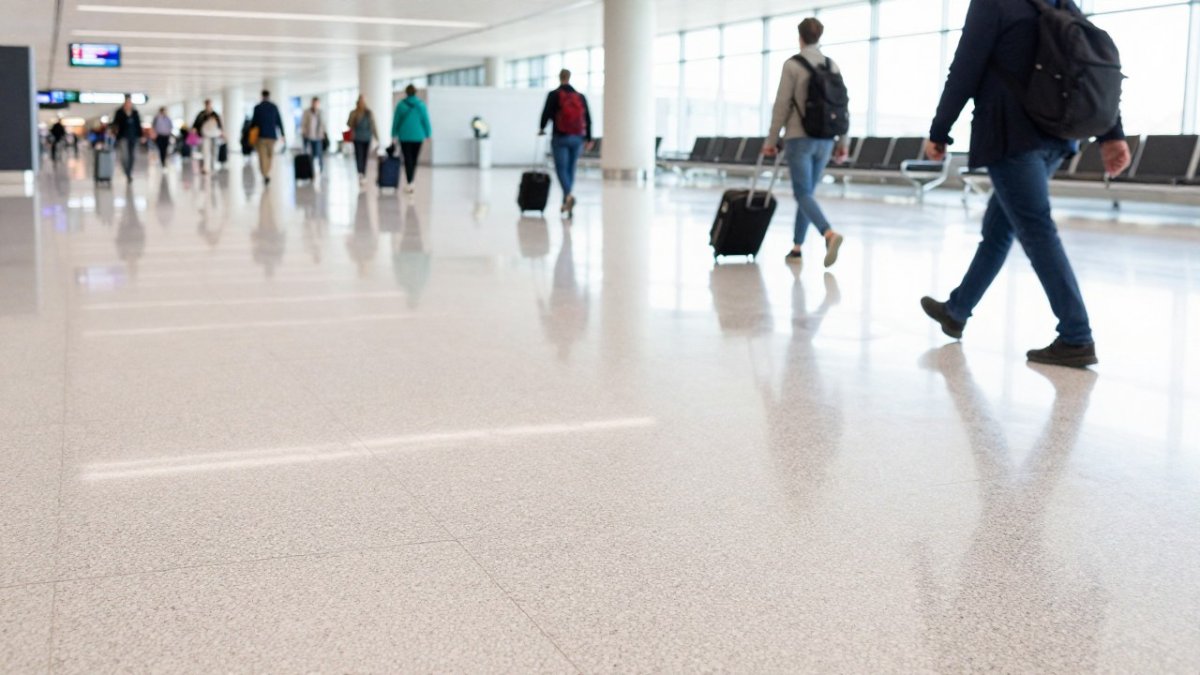
Airport terrazzo flooring wins on durability because it is poured in place as a single, dense surface. There are no seams for grit to collect in and no edges to lift.
The performance comes from three things:
- High compressive strength. Terrazzo handles static loads from seating banks and kiosks without denting.
- Impact resistance. Dropped bags and cart wheels do not chip a properly cured terrazzo floor.
- Crack resistance. A correct substrate and control-joint plan keeps shrinkage cracks in check.
A common mistake is judging terrazzo by its finish instead of its base. The matrix, aggregate, and substrate decide how the floor performs. The polish only decides how it looks.
The National Terrazzo and Mosaic Association publishes installation standards that separate a floor that lasts from one that delaminates. Ask any contractor which standards they build to.
Epoxy Terrazzo Flooring Cost and Value
Epoxy terrazzo flooring cost can differ from cement terrazzo up front, but the better question is whole-life cost, including installation, cleaning, and repairs over the floor's service life.
What drives the price:
- Square footage and the number of pours
- Substrate prep and moisture mitigation
- Aggregate type and color complexity
- Pattern work, borders, and logos
- Phasing and after-hours work premiums
A thin-set epoxy system generally cures faster than cement terrazzo, which can return a concourse to service sooner.
Watch out: low bids sometimes omit moisture testing or substrate repair, and those costs can reappear later as delamination and repairs.
For a direct comparison of the two systems, read epoxy vs cement terrazzo flooring.
Low-Maintenance Airport Flooring and Cleaning Plans
Low-maintenance airport flooring still needs a written cleaning plan. Terrazzo can be cleaned routinely, but the wrong products can dull or damage it.
A workable routine looks like this:
- Daily: dust mop or clean with a neutral cleaner.
- Periodically: burnish and re-polish high-traffic zones as the wear pattern requires.
- Annually: review the cleaning plan against actual wear patterns.
What most guides miss is the chemistry. Acidic and high-alkaline cleaners etch terrazzo over time. Train your cleaning crew on approved products and post the list where supplies are stored.
For a deeper look at upkeep, see our low-maintenance flooring guide for airports. Facility managers comparing upkeep options can also review professional maintenance services for airport terminals.
Phased Installation Without Shutting Down the Concourse
Phased installation can keep a terminal open while the floor goes in. Sequencing work around flight schedules, gate activity, passenger routes, and cure times is the general approach to planning this work.
A practical phasing plan:
- Map gate activity and passenger flow by hour. Identify the lowest-traffic windows per zone and confirm them with airport operations before scheduling.
- Divide the concourse into work zones with clear barricades. Size zones to what can be poured, cured, and reopened within one closure window.
- Pour during low-traffic windows and overnight. Match the pour sequence to cure time so a zone is never reopened before it can carry rolling loads.
- Cure, polish, and reopen one zone at a time. Keep at least one continuous accessible route open at all times.
- Keep wayfinding clear around every closed zone. Temporary signage must match the permanent system so passengers are not redirected into dead ends.
Accessibility matters during phased work. Temporary routes should stay wide enough for wheelchairs and luggage carts.
Agreeing on closure windows, dust and noise controls, contingency routes, and tenant coordination in advance helps phased work run smoothly. Reopening a zone before the floor has cured enough to carry rolling loads can cause early damage, so build cure time into the schedule.
For a step-by-step view, read our commercial terrazzo installation process.
Plan Your Concourse Flooring With A1 Terrazzo
The right floor for a concourse balances wear resistance, slip resistance, maintenance, and whole-life cost. Get the substrate and phasing right and the finish will hold for decades.
That is where we come in. A1 Terrazzo brings more than 35 years of experience with commercial terrazzo flooring. We specialize in commercial terrazzo installation and offer professional maintenance services.
Contact A1 Terrazzo to discuss your concourse flooring project and request a quote.
Your concourse floor should outlast the fixtures around it. A1 Terrazzo installs commercial terrazzo built for heavy loads and easy cleaning, backed by 35 years of specialized experience and ongoing maintenance support.
Frequently Asked Questions
What flooring is best for airport concourses?
Epoxy terrazzo is one option many airport projects consider for concourses because it is designed for heavy foot traffic and rolling loads. Other flooring systems are used in back-of-house and lower-traffic areas. Contact A1 Terrazzo to discuss which system suits your terminal.
How long can airport terrazzo flooring last?
Service life depends on installation quality, substrate preparation, and routine maintenance. A1 Terrazzo has more than 35 years of experience with commercial terrazzo flooring; contact us to discuss expected service life for your project.
How does terrazzo compare with epoxy flooring in an airport?
Terrazzo and epoxy coatings both use resin binders, but terrazzo includes marble or granite aggregate that adds wear resistance and a decorative finish. Epoxy coatings and terrazzo both use resin binders, and terrazzo adds aggregate for a decorative finish. The right choice depends on traffic levels, maintenance plans, and budget.
How can airport flooring withstand heavy foot traffic and rolling luggage?
The floor must have high compressive strength, impact resistance, and a surface finish that resists abrasion from wheels and carts. Finish selection and substrate detailing should be specified against the traffic and conditions of each area. Routine maintenance with appropriate cleaners helps protect the surface.