 ultimate-guide
Cost of Commercial Terrazzo Installation: 2026 Pricing Guide
Table of Contents
- What Drives Commercial Terrazzo Cost Per Square Foot
- Epoxy vs. Cementitious Terrazzo Cost: A Direct Comparison
- How Design Complexity and Custom Patterns Impact Installation Labor
- Terrazzo Installation Timeline: What to Expect from Prep to Polish
- Best Commercial Flooring for Healthcare Facilities: Why Terrazzo Wins on Sanitation
- Total Cost of Ownership: Maintenance, Longevity, and LEED Certification
- Procurement and Bidding Best Practices for Commercial Terrazzo Projects
- Frequently Asked Questions
Last Updated: September 12, 2026
What Drives Commercial Terrazzo Cost Per Square Foot
The cost of commercial terrazzo installation is driven by four variables: system type, substrate condition, design complexity, and project scale. Material and labor make up the bulk of every quote, but substrate preparation and moisture mitigation are where budgets quietly break.
Terrazzo combines marble, granite, or glass aggregate with a binder, then gets ground and polished to a hard, seamless finish, which is why healthcare systems, airports, and universities keep specifying it.
At A1 Terrazzo, we've priced and installed these systems for more than 35 years, and the pattern holds: owners who understand the cost drivers before bidding get tighter numbers and fewer change orders. Below, we break down what moves the price, where epoxy and cementitious systems diverge, and how to compare bids on equal footing.
Labor vs. Material Breakdown
Installation labor typically outweighs material cost on commercial terrazzo projects, and the gap widens with design complexity. Material pricing is predictable once the aggregate blend and binder are set; labor is where quotes swing.
The labor-heavy line items usually include:
- Substrate preparation and floor leveling, grinding, patching, and crack repair before anything is poured
- Moisture mitigation, vapor barriers or primers where slab readings demand them
- Mixing and placement, crew size scales with square footage and pour sequence
- Abrasive grinding and polishing, multiple passes with progressively finer grits
- Grouting and sealing, filling pinholes, then applying the floor finish
A common mistake is comparing bids on the material spec alone. Two contractors can quote the same aggregate blend and land thousands apart because one priced three grinding passes and the other six.
How Substrate Preparation and Moisture Mitigation Affect Pricing
Substrate preparation is the most underestimated cost in commercial terrazzo work, and moisture mitigation is the line item owners most often cut. Both determine whether the floor lasts decades or cracks within a year.
Concrete slabs move and hold moisture, and terrazzo is a thin, rigid topping that transfers every slab defect to the surface. Site conditions drive the scope:
- Slab moisture readings above the system manufacturer's limit require a mitigation membrane
- Out-of-flat slabs need floor leveling before placement
- Existing coatings, adhesives, or failed flooring must be removed by grinding
- Control joints and cracks need treatment to isolate movement
This is the substrate requirement most generic pricing guides skip. A dry, flat slab is a cheap substrate; one with high moisture and poor flatness is not, and no honest contractor can quote the second at the first's price.
ACI concrete slab moisture guidance
Epoxy vs. Cementitious Terrazzo Cost: A Direct Comparison
Epoxy terrazzo and cementitious terrazzo are priced differently because they are built differently. Epoxy uses a resin binder that cures fast and goes down thin, often 1/4-inch to 3/8-inch. Cementitious uses a Portland cement binder, cures over a longer window, and builds thicker, often 1/2 inch or more. That thickness difference changes material volume, cure schedule, and grinding labor.
The cost gap is real but not fixed. On a simple single-color floor in a climate-controlled interior, epoxy usually prices lower per square foot because the schedule is shorter and placement thinner. On a complex multi-color design, the gap narrows, because layout, divider strip setting, color batching, and grinding labor dominate the quote, and those costs are similar for both systems.
| Factor | Epoxy Terrazzo | Cementitious Terrazzo |
|---|---|---|
| Binder | Epoxy resin | Portland cement |
| Placement thickness | Thin-set, often 1/4"-3/8" | Thicker build, often 1/2"+ |
| Curing time | Fast, hours to a short window | Extended, days to weeks |
| Color range | Broad, including decorative chips | Broad, earthier palette |
| Moisture sensitivity | Higher, slab must read dry | Lower, tolerates more slab moisture |
| Best for | Fast-turnaround interiors | Heavy wear, exterior, wet areas |
| Schedule impact | Shorter cure, faster turnover | Longer cure, more sequencing |
When Epoxy Makes Sense for Your Facility
Epoxy terrazzo is the better choice when schedule pressure and design flexibility matter more than moisture tolerance. Retail, hospitality, and healthcare interiors with tight turnover windows usually land here.
Choose epoxy when:
- The slab is verified dry and within moisture limits
- The project needs a fast installation timeline
- The design calls for intricate custom patterns and multiple aggregate colors
- The space is interior and climate-controlled
Choose cementitious when the floor will see heavy traffic, exterior exposure, or wet conditions. Airports, cruise terminals, and institutional corridors often specify cementitious for exactly this reason.
The Cost Mechanics Behind the Gap
Three mechanisms explain most of the price difference:
- Placement thickness. Cementitious terrazzo builds thicker, so it uses more material per square foot and takes longer to cure before grinding can start. Epoxy goes down thin, which cuts material volume and shortens the schedule.
- Cure schedule. A cementitious floor cannot be ground until the binder reaches working strength, which can take days to weeks depending on mix design and ambient conditions. Epoxy cures fast, so the crew can move to grinding sooner. On a commercial job with a hard turnover date, that schedule difference has a dollar value.
- Moisture tolerance. Cementitious systems tolerate more slab moisture than epoxy. If a slab reads high, the mitigation scope for an epoxy floor is larger, and that cost can erase the epoxy material savings.
When you compare epoxy and cementitious bids, ask each contractor to state the placement thickness, the cure duration, and the moisture mitigation scope in writing. Those three numbers explain most of the price difference between the two systems.
National Terrazzo and Mosaic Association technical resources
How Design Complexity and Custom Patterns Impact Installation Labor
Design complexity is the biggest swing factor in installation labor after substrate condition. A single-color floor with a standard divider strip installs far faster than a multi-color logo, compass rose, or custom border, not because of material, but because of the labor hours layout, strip setting, and color batching consume.
Custom patterns add cost through:
- Layout time. Full-scale layout and template work before placement. A complex pattern can take a crew days to lay out before a single batch is mixed.
- Divider strips. Zinc, brass, or plastic strips set by hand to define color fields. The more color fields, the more strip, and the more hand labor.
- Color batching. Separate mixes for each field, with material waste on small runs. A five-color logo means five batches, five cleanups, and five opportunities for a color mismatch.
- Grouting and detailing. More edges and transitions to finish. Every color boundary is a place where pinholes and voids have to be filled and polished.
Project scale cuts the other way. Large, repetitive floor plates let crews work efficiently, spreading fixed setup costs across more square footage. A 40,000-square-foot airport concourse and a 2,000-square-foot lobby may carry similar mobilization costs, but the larger job absorbs them better per square foot.
Why Design Complexity Breaks Apples-to-Apples Bidding
When two contractors bid the same project and one comes in far lower, the difference is usually not the aggregate or binder, it is the pattern scope.
A bidder pricing a single-color field with a simple border is not bidding the same floor as one pricing a multi-color logo with hand-set divider strips. The quotes look comparable on a summary sheet; they are not.
The fix is to force pattern scope into the bid documents. Require every bidder to state:
- The number of distinct color fields
- The divider strip material and total linear footage
- The layout method (full-scale template vs. field layout)
- The number of grinding and polishing passes planned for the pattern areas
- The mockup panel scope and location
When those five items are itemized, the low bid usually stops looking low. It starts looking like a different floor.
Require a mockup panel before full mobilization. A small installed sample reveals the crew's grinding and polishing standard, and it gives you a reference surface for the final punch list. On a complex pattern, the mockup should include at least one color transition and one divider strip so you can judge the detailing.
National [Terrazzo and(/terrazzo-vs-epoxy-flooring-comparison) Mosaic Association technical resources | ntma.com]
Terrazzo Installation Timeline: What to Expect from Prep to Polish
A commercial terrazzo installation typically runs several weeks from mobilization to final polish, with curing time and site conditions driving the schedule. Moisture mitigation and grinding passes cannot be rushed without risking the finish.
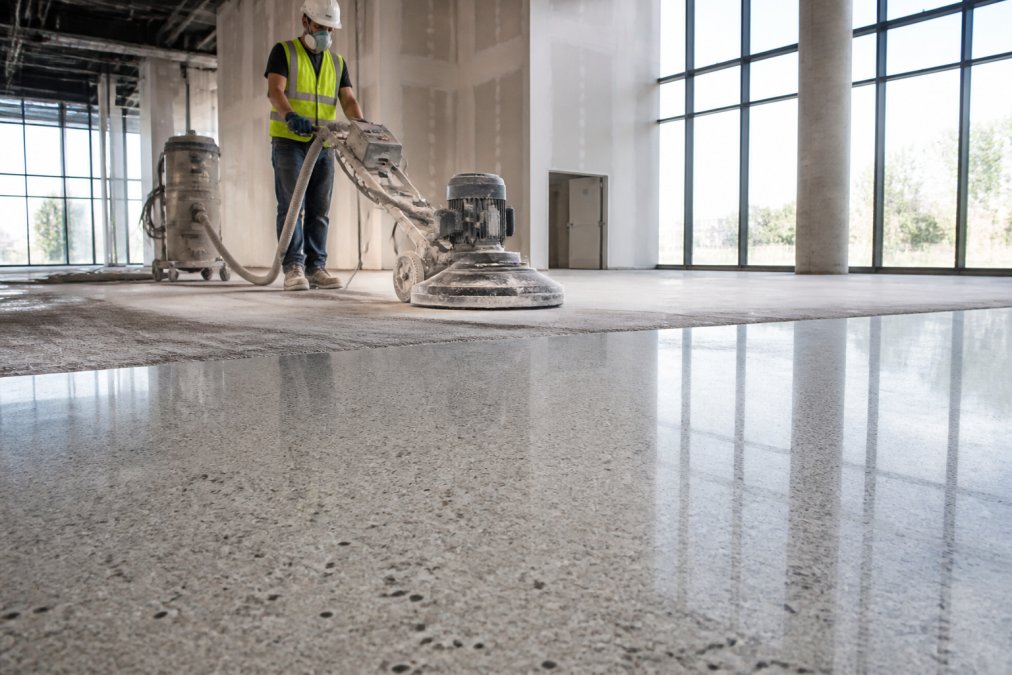
The sequence rarely changes:
- Substrate assessment and moisture testing, slab readings and flatness survey
- Preparation and mitigation, grinding, crack repair, leveling, moisture barrier
- Layout and divider strips, pattern setout before any material is placed
- Mixing and placement, pour, spread, and compact the terrazzo mix
- Curing, the binder reaches working strength
- Abrasive grinding, successive passes expose the aggregate
- Grouting, fill pinholes and voids
- Polishing and sealing, final floor finish with slip resistance verified
The two stages owners try to compress are curing and grinding. Compressing either one shows up later as aggregate pull-out or an uneven sheen.
Best Commercial Flooring for Healthcare Facilities: Why Terrazzo Wins on Sanitation
Terrazzo is the best commercial flooring for healthcare facilities because its seamless surface leaves bacteria nowhere to colonize, no seams, no grout lines, no lifted edges. For hospitals, surgical suites, and long-term care corridors, that matters more than aesthetics.
Healthcare facility managers weigh three things: infection control, high-traffic durability, and maintenance costs. Terrazzo answers all three.
- Sanitation, the seamless finish resists moisture and supports routine disinfection
- Durability, a properly installed floor handles gurney traffic and rolling equipment for decades
- Maintenance, routine cleaning with pH-neutral products keeps the finish intact
Alkaline or acidic cleaners strip the floor finish and dull the surface over time. Specify neutral-pH cleaners in your maintenance protocol from day one, and train custodial staff on them.
For healthcare buyers, the deciding factor is not the installed price. It's whether the floor can be cleaned aggressively without degrading, and whether the substrate was prepped well enough to keep it seamless.
Total Cost of Ownership: Maintenance, Longevity, and LEED Certification
Total cost of ownership is where terrazzo separates from vinyl, carpet, and sheet goods. The installed price is higher. The lifecycle cost is usually lower, because the floor does not need replacement on a short cycle.
A lifecycle cost analysis compares three numbers over a 20- to 30-year horizon:
| Floor Type | Replacement Cycle | Routine Maintenance | Longevity |
|---|---|---|---|
| Terrazzo | Rarely replaced | Neutral-pH cleaning, periodic polish | Decades |
| Vinyl (LVT) | Frequent | Stripping and re-waxing | Years |
| Carpet tile | Frequent | Deep cleaning, replacement | Years |
Terrazzo also contributes to sustainability goals. The system uses natural aggregate, and cementitious terrazzo can incorporate recycled glass or marble chips. That supports points in the U.S. Green Building Council LEED rating system, which matters for owners pursuing LEED certification on public and institutional projects.
VOC compliance is part of the same conversation. Low-emitting sealers and binders help projects meet indoor air quality requirements in occupied buildings.
EPA indoor air quality and VOC guidance
Procurement and Bidding Best Practices for Commercial Terrazzo Projects
Competitive bidding on terrazzo fails when quotes are not scoped identically. The fix is bid leveling: require every contractor to price the same line items, then compare.
Use this checklist to level bids:
- Substrate preparation itemized separately from placement
- Moisture testing method and mitigation scope defined
- Aggregate blend and binder type specified by name
- Number of grinding and polishing passes stated
- Divider strip material and pattern layout included
- Sealer product and VOC rating named
- Curing time and schedule assumptions written down
- Maintenance protocol and cleaning products specified
A contractor who resists itemizing is telling you something; the ones who welcome it usually plan to do the work properly.
Terrazzo rewards owners who plan the substrate, schedule, and maintenance protocol before the first quote arrives. Get any wrong, and the savings disappear into repairs.
A1 Terrazzo brings 35 years of commercial terrazzo installation and maintenance experience to hospitals, airports, universities, and government buildings, with the substrate expertise and moisture mitigation discipline that keep floors seamless for decades. If you're budgeting a project and want a quote built on itemized scope rather than a lump sum, contact A1 Terrazzo and let our team walk your facility.
Frequently Asked Questions
How much does commercial terrazzo cost per square foot to install?
Commercial terrazzo cost per square foot varies widely based on system type, substrate condition, and design complexity. Epoxy terrazzo typically costs less than cementitious because it uses a thinner pour and cures faster. Cementitious terrazzo costs more due to thicker installation, longer curing time, and heavier aggregate. Pricing also depends on square footage, site conditions, and whether moisture mitigation or floor leveling is needed. A1 Terrazzo recommends requesting a detailed quote for your specific project.
What factors drive the price variance in commercial terrazzo projects?
The biggest cost drivers are substrate preparation requirements, moisture mitigation, design complexity, and project scale. Floors needing extensive floor leveling or crack repair add labor hours. Custom patterns with decorative chips and multiple divider strips increase material and installation labor. Site conditions, such as occupied buildings with limited access, also raise costs. For healthcare facilities and airports, slip resistance and VOC compliance requirements can affect material selection and pricing.
Does the cost of terrazzo installation include surface preparation?
Surface preparation is almost always a separate line item because it depends entirely on existing site conditions. Substrate preparation can include abrasive grinding, crack repair, moisture mitigation, and floor leveling. Skipping or underestimating prep leads to cracking, delamination, and costly repairs within the first year. A1 Terrazzo includes a thorough substrate assessment in every proposal so facility managers can see exactly what prep work is required before installation begins.
How does the complexity of terrazzo design impact installation labor costs?
Complex designs with custom patterns, multiple colors, and intricate divider strip layouts require more skilled labor hours and generate more material waste. A simple single-color floor with a standard aggregate blend costs significantly less to install than a multi-color logo or geometric pattern. Design complexity also extends the polishing process and may require additional grouting steps. For budget-conscious projects, simplifying the pattern while keeping the terrazzo system can reduce labor costs without sacrificing durability.