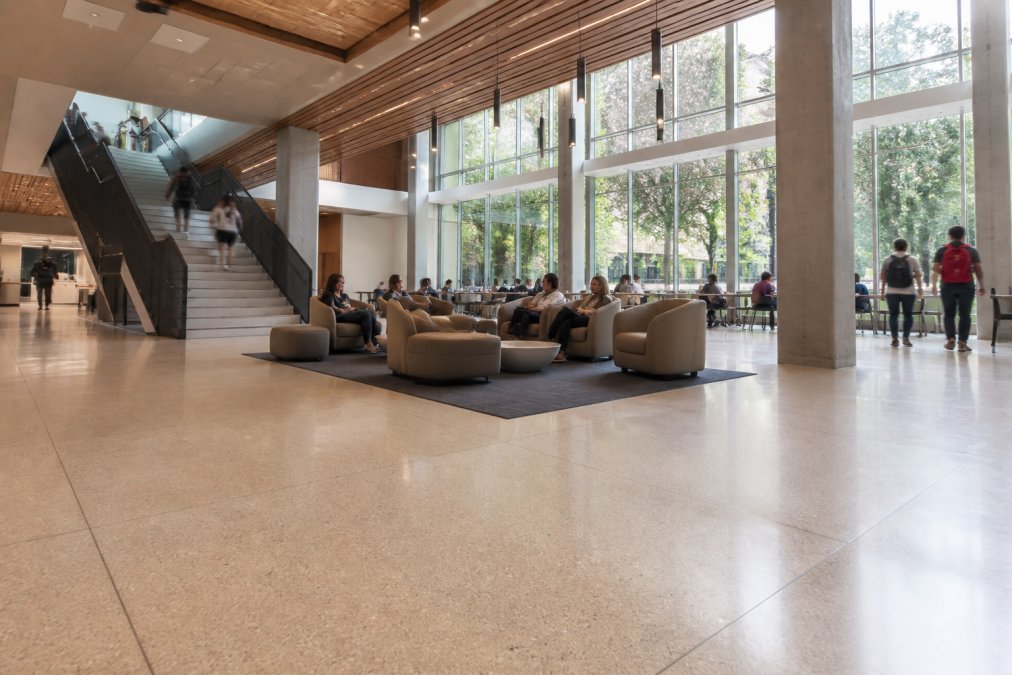
 comparison
Artistic Terrazzo Alternatives for University Floors
Table of Contents
- Why Universities Are Moving Beyond Traditional Terrazzo
- Quick Comparison: Top Terrazzo Alternatives for Campus Buildings
- Epoxy Flooring for Schools: The Seamless Workhorse
- Epoxy Terrazzo Systems: Artistic Look, Lower Life-Cycle Cost
- Terrazzo vs Polished Concrete for Universities
- Rubber Flooring and VCT: Budget Options With Trade-Offs
- Cost of Terrazzo Installation per Square Foot vs. Alternatives
- Acoustics, Slip Resistance, and Safety Compliance
- Frequently Asked Questions
Last Updated: September 6, 2026
Traditional terrazzo has defined the monumental aesthetic of university campuses for over a century, but facility managers are increasingly evaluating artistic terrazzo alternatives for universities that deliver the same visual impact with better budget alignment. When assessing flooring options for academic buildings, the conversation rarely starts with aesthetics alone. It starts with total cost of ownership, maintenance staffing, acoustic performance, and safety compliance. This guide compares the leading alternatives and helps you match each system to the demands of specific campus spaces.
A university floor must survive decades of foot traffic, rolling carts, chemical exposure, and evolving design standards. Below, we break down the top systems and give you the criteria to make a defensible choice for your budget committee.
Why Universities Are Moving Beyond Traditional Terrazzo
Cement-based terrazzo remains the gold standard for longevity, but its installation timeline and upfront cost create friction for institutions managing multiple buildings and tight fiscal years. Traditional poured terrazzo requires extensive substrate preparation, embedded divider strips, and a multi-stage grinding and polishing process that can disrupt campus operations for weeks. Many universities now prioritize systems that install faster, allow phased renovation, or offer a lower initial capital outlay.
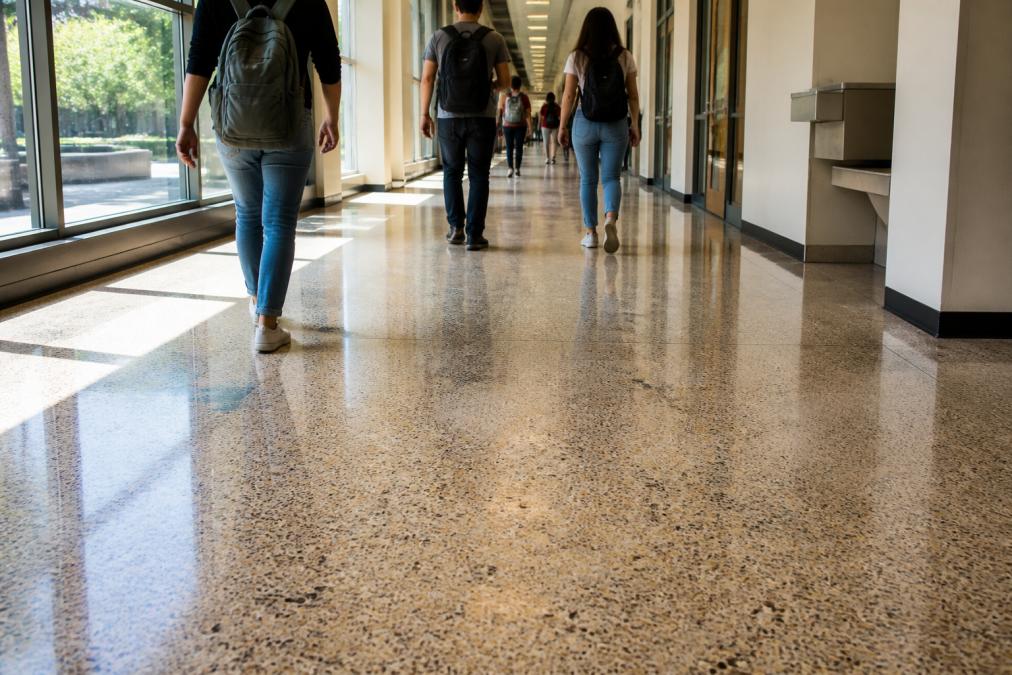
Another driver is maintenance capacity. Custodial teams are often stretched thin, and some alternative systems tolerate periodic neglect better than traditional terrazzo, which requires specific pH-neutral cleaners and periodic re-polishing to maintain its gloss. Facility managers are really weighing the predictability of their annual maintenance budget against the upfront construction cost.
Quick Comparison: Top Terrazzo Alternatives for Campus Buildings
The four main contenders for university floors are epoxy flooring systems, epoxy terrazzo, polished concrete, and resilient options like rubber flooring and vinyl composition tile (VCT). Each occupies a different position on the cost-durability-maintenance spectrum.
| Flooring System | Initial Cost | Lifespan | Maintenance Demand | Best Fit |
|---|---|---|---|---|
| Epoxy Terrazzo | High | 40+ years | Low | High-traffic corridors, lobbies |
| Epoxy Flooring (Seamless) | Moderate | 15-25 years | Low | Labs, cafeterias, restrooms |
| Polished Concrete | Moderate | 30+ years | Low-Medium | Atriums, retail spaces |
| Rubber Flooring | Moderate | 20+ years | Low | Libraries, music halls, gyms |
| Vinyl Composition Tile (VCT) | Low | 10-15 years | Very High | Administrative offices |
Epoxy Flooring for Schools: The Seamless Workhorse
Epoxy flooring for schools is not a single product but a family of resinous systems with distinct thicknesses, performance profiles, and price points. The most common systems specified for academic buildings are thin-film coatings, self-leveling epoxies, and heavy-duty mortar systems.
Thin-film coatings are applied at 10-15 mils and are primarily a protective layer over a sound concrete slab. They offer good chemical resistance and a clean, glossy finish but provide minimal impact resistance and will not bridge cracks in the substrate. They are best suited for light-traffic administrative areas or as a temporary solution where budget is the primary constraint.
Self-leveling epoxy systems, typically applied at 1/8 to 1/4 inch, are the most common choice for university cafeterias, restrooms, and corridors. They flow into a smooth, seamless surface that is easier to keep clean than tile or VCT. These systems can be broadcast with colored quartz or vinyl chips to create a textured, decorative finish that hides foot traffic patterns. A key mechanism to understand is that self-leveling epoxies are not flexible; they require a crack-free substrate or an appropriate crack-suppression membrane to perform reliably over time.
Heavy-duty mortar systems, applied at 1/4 inch or greater, incorporate silica sand or aggregate into the resin. This gives them exceptional impact and thermal shock resistance, making them the standard for science laboratories, maintenance shops, and loading docks where heavy equipment and chemical spills are routine. Mortar systems are the most expensive epoxy option but are still typically less costly than a poured terrazzo topping.
A common point of confusion is the difference between an epoxy coating and an epoxy terrazzo. The distinction is the aggregate. A self-leveling epoxy is a solid color or lightly broadcast surface. An epoxy terrazzo system is a thick matrix of aggregate (marble, granite, glass) bound by the resin, then ground flat to expose the stone. If the design intent is a stone-like, aggregate-rich surface, a standard epoxy floor will not deliver that look.
The primary advantage of epoxy systems is the seamless, non-porous surface. The absence of grout lines and seams removes the primary collection points for dirt and pathogens, making epoxy the default specification for food preparation areas and wet labs. The trade-off is aesthetic depth: standard epoxy coatings rarely replicate the rich aggregate exposure of genuine terrazzo. For a university that wants durability with a clean, modern look, epoxy systems deliver reliable performance at a lower cost than poured terrazzo.
Epoxy Terrazzo Systems: Artistic Look, Lower Life-Cycle Cost
Epoxy terrazzo systems offer the closest visual match to traditional terrazzo among all artistic terrazzo alternatives for universities, and they do it with a thinner, faster-installing profile. Instead of a cement matrix, these systems use a clear epoxy resin binder mixed with marble, granite, or glass aggregate, then ground and polished to a smooth finish. The result is a seamless floor with the same depth and sparkle as traditional terrazzo, but with greater flexibility for custom logos, wayfinding patterns, and color banding.
The life-cycle cost advantage is substantial. Industry analysis of institutional flooring indicates that epoxy terrazzo systems carry a low-maintenance lifecycle cost of approximately $0.80 per square foot annually, compared to roughly $1.57 per square foot for VCT, which requires constant stripping and waxing Terrazzo vs VCT lifecycle cost analysis for educational facilities. Over a 20-year period, that difference compounds into millions of dollars for a large campus. Epoxy terrazzo is the right choice when the design team wants the terrazzo look and the institution wants a 40-year floor without the higher installation cost of cement-based systems.
Terrazzo vs Polished Concrete for Universities
Polished concrete is the most common budget-conscious alternative to terrazzo, and the comparison comes down to aesthetics versus substrate limitations. Polished concrete is achieved by mechanically grinding and densifying the existing concrete slab, eliminating the cost of installing a new topping. It offers a clean, industrial aesthetic that suits modern architecture and performs well in open atriums and ground-floor retail spaces.
However, polished concrete only looks as good as the slab beneath it. Existing slabs with cracks, patches, or uneven aggregate will show those flaws after polishing. Terrazzo, by contrast, is a new surface installed over the substrate, allowing designers to specify exact aggregate blends and colors. For renovation projects where the existing slab is in poor condition, epoxy terrazzo or a bonded terrazzo topping is often the more reliable path to a pristine finish.
Rubber Flooring and VCT: Budget Options With Trade-Offs
When the budget is the primary constraint, rubber flooring and vinyl composition tile (VCT) are the default options, but each carries compromises that surface over time. Institutional-grade rubber flooring offers a minimum 20-year performance life, superior sound absorption, and a slip-resistant texture, making it an excellent choice for libraries, lecture halls, and music practice rooms where acoustics matter more than a stone aesthetic Flooring selection guidance for educational facilities. It is comfortable underfoot and quieter than hard surfaces.
VCT is the lowest-cost option upfront, but its maintenance burden is relentless. VCT requires regular stripping, sealing, and waxing to maintain its appearance, and in high-traffic areas it shows wear quickly. The annual maintenance cost of VCT can exceed the amortized installation cost of a more durable system within the first decade. For administrative areas with light traffic, VCT is a defensible choice. For main corridors and student gathering spaces, it is a false economy. flooring for schools.
Cost of Terrazzo Installation per Square Foot vs. Alternatives
The cost of terrazzo installation per square foot varies widely based on aggregate selection, divider strip design, project size, and geographic region, so precise figures require a project-specific quote. Traditional cement-based terrazzo and epoxy terrazzo sit at the higher end of initial installation costs, while polished concrete, rubber, and VCT are progressively less expensive to purchase and install.
The calculation that flips the decision is total cost of ownership. A floor that costs more to install but requires only routine cleaning for 40 years often beats a cheap floor that demands annual waxing and replacement after 15 years. When presenting options to a budget committee, model the full lifecycle cost rather than comparing only the initial price per square foot.
To make that case, facility managers need a defensible model that goes beyond the per-square-foot price. A practical approach is to build a 20-year total cost of ownership (TCO) projection for each candidate system. The model should include four components: initial installation cost, annual maintenance labor and materials, periodic restoration or replacement, and downtime or disruption costs.
A representative TCO model for a 50,000-square-foot academic building might look like this:
| Cost Component | Epoxy Terrazzo | Polished Concrete | VCT |
|---|---|---|---|
| Initial Installation (50,000 sq ft) | $1,750,000 | $650,000 | $400,000 |
| Annual Maintenance Labor & Materials | $40,000 | $75,000 | $150,000 |
| 20-Year Maintenance Total | $800,000 | $1,500,000 | $3,000,000 |
| Expected Replacement (Year) | None (40+ yr life) | None (30+ yr life) | Year 12 |
| Replacement Cost (Year 12) | $0 | $0 | $450,000 |
| 20-Year Total Cost of Ownership | $2,550,000 | $2,150,000 | $3,850,000 |
Note: Figures are illustrative planning estimates based on typical institutional pricing ranges. Actual costs vary by region, specification, and contractor. A project-specific estimate is required for budget approval.
This model reveals the critical insight that competitors often miss: the initial cost advantage of a budget system like VCT disappears by year 10. The annual maintenance burden of VCT, which requires stripping and refinishing one to two times per year, exceeds the amortized cost of a more durable system within the first decade. Polished concrete appears attractive on paper, but the model must account for the cost of densifiers, the labor for periodic re-polishing, and the fact that the floor will only look as good as the original slab.
A second frequently overlooked factor is the cost of downtime. Replacing a VCT floor in an occupied academic building requires moving furniture, closing sections of the building, and disrupting classes. A terrazzo or epoxy terrazzo installation, while disruptive during construction, is a one-time event with a 40-year service life, whereas the VCT replacement cycle recurs every 10-15 years.
Acoustics, Slip Resistance, and Safety Compliance
Hard flooring systems like terrazzo and polished concrete reflect sound, which can create problematic noise levels in lecture halls, libraries, and open study areas. Rubber flooring excels in these environments because it absorbs impact noise and reduces ambient sound. For mixed-use buildings, a common strategy is to specify hard, seamless flooring in circulation spaces and resilient flooring in noise-sensitive rooms.
Slip resistance is another critical differentiator. Polished stone and concrete surfaces can become slippery when wet, particularly at building entrances. Epoxy systems can be formulated with added aggregate or textured topcoats to improve traction, and rubber flooring provides inherent slip resistance. Facility managers should verify that any specified system meets the slip-resistance standards required by building codes and their institution's risk management policies.
Choosing the right floor for a campus building is a balance of upfront budget, maintenance capacity, and the aesthetic identity of the institution. A1 Terrazzo brings over 35 years of specialized experience in commercial terrazzo flooring installation and professional maintenance services to help you specify the right solution for each space. Contact A1 Terrazzo to discuss your project.
Frequently Asked Questions
What is the most durable alternative to terrazzo for university hallways?
Epoxy terrazzo systems offer the best durability for high-traffic academic corridors, with a 40+ year lifespan. They resist abrasion, chemicals, and impact better than VCT or rubber. Polished concrete also performs well but lacks the design flexibility of epoxy terrazzo. For spaces needing artistic patterns, epoxy terrazzo delivers the look of traditional terrazzo with a seamless, non-porous surface that stands up to daily foot traffic.
How does epoxy flooring for schools compare to traditional terrazzo on maintenance?
Epoxy flooring for schools requires significantly less maintenance than traditional cement-based terrazzo. A seamless epoxy surface eliminates grout lines where bacteria and dirt collect. Annual maintenance costs run lower than VCT, which requires frequent stripping and waxing. Epoxy floors need only routine cleaning and occasional re-coating, making them a practical choice for facility managers balancing tight custodial budgets.
Is polished concrete a good substitute for artistic terrazzo in university buildings?
Polished concrete works well for modern, minimalist campus designs and costs less upfront than terrazzo. However, it offers limited color and aggregate options compared to artistic terrazzo. Polished concrete also requires periodic re-polishing to maintain its gloss in heavy traffic zones. If your project demands custom patterns, logos, or a wide color palette, epoxy terrazzo systems provide more design freedom while keeping similar maintenance benefits.
What factors affect the cost of terrazzo installation per square foot?
The cost of terrazzo installation per square foot varies with aggregate selection, complexity of design, substrate condition, and project size. Epoxy terrazzo generally costs less than cement-based systems due to a thinner pour. While upfront costs exceed VCT or rubber, terrazzo's 40+ year lifespan and low annual maintenance (around $0.80 per square foot) deliver better value over time. Contact A1 Terrazzo for project-specific pricing.
Which flooring materials meet ADA compliance standards for university buildings?
Epoxy terrazzo, polished concrete, rubber flooring, and VCT can all meet ADA compliance when properly installed. Key factors include slip resistance, surface firmness, and visual contrast for wayfinding. Epoxy systems can incorporate slip-resistant aggregates without sacrificing the seamless look. Rubber flooring offers excellent slip resistance and acoustic benefits for lecture halls. Always verify the coefficient of friction for your specific product and finish.