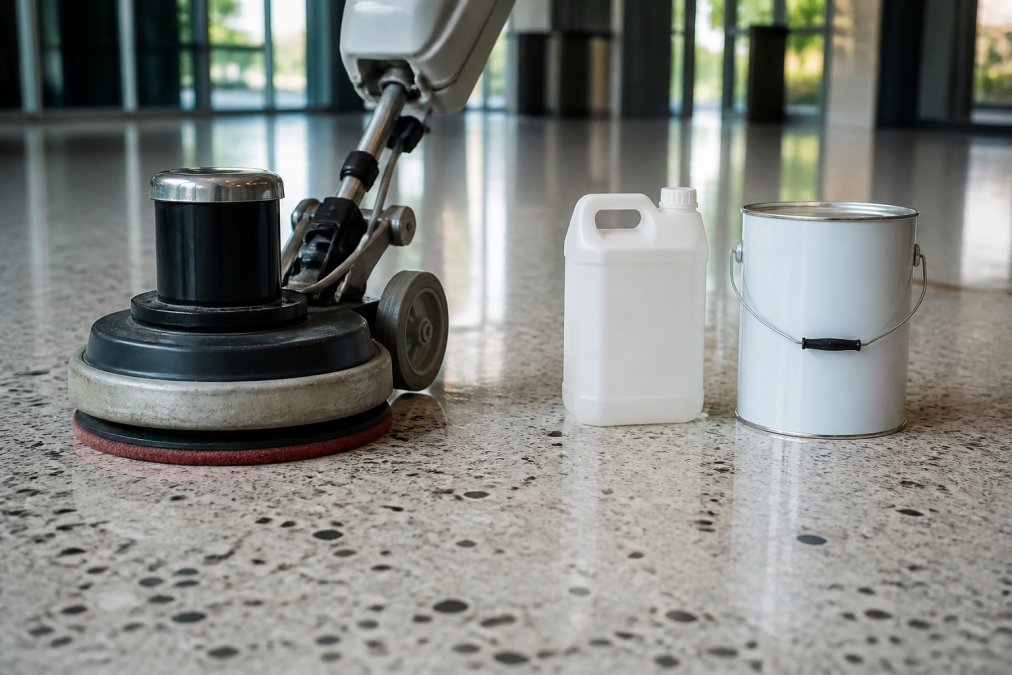
 comparison
Terrazzo Floor Polishing vs Sealing for Commercial Spaces
Table of Contents
- How Terrazzo Polishing and Sealing Differ
- Side-by-Side Comparison: Cost, Durability, and Appearance
- Terrazzo Floor Sealer Types and Where Each Works Best
- Slip Resistance, Safety, and Compliance in High-Traffic Facilities
- Building a Terrazzo Floor Maintenance Schedule That Protects Your Investment
- Commercial Terrazzo Restoration Cost: What Drives the Number
- Common Failures and How to Avoid Them
- Conclusion
- Frequently Asked Questions
Last Updated: September 16, 2026
How Terrazzo Polishing and Sealing Differ
Terrazzo floor polishing vs sealing commercial is a decision that shapes your maintenance budget for the next decade. Polishing mechanically refines the stone surface itself with diamond abrasive pads, while sealing applies a topical or penetrating sealer that sits on or inside the surface. At A1 Terrazzo, we've walked facility managers through this choice for 35 years, and the answer is rarely "one or the other forever."
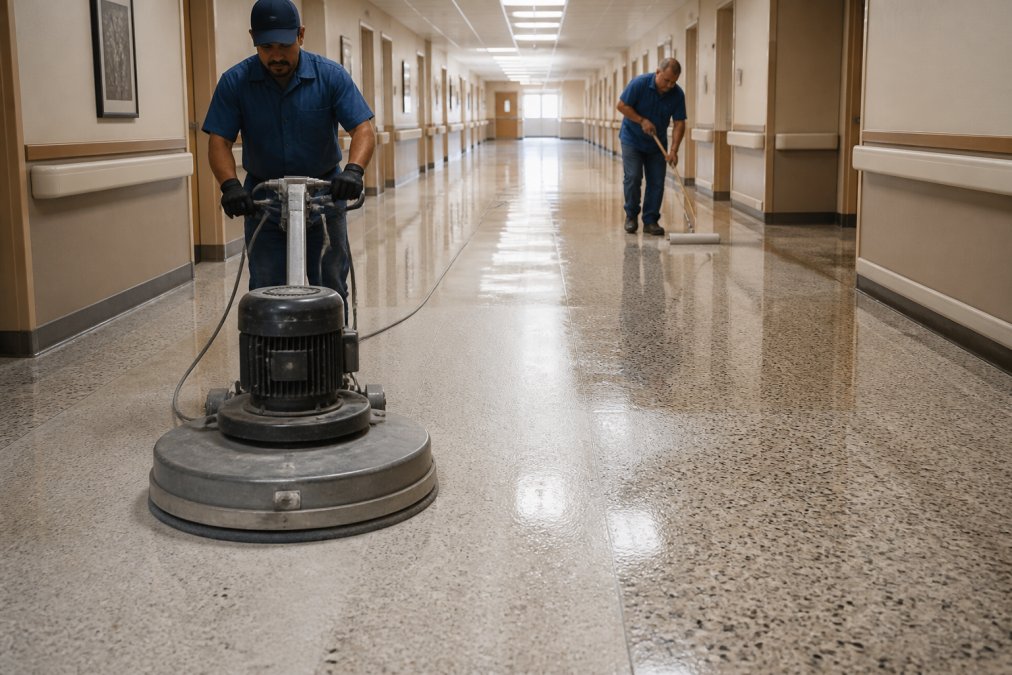
Mechanical Polishing Explained
Mechanical polishing uses diamond-impregnated pads on heavy equipment to grind, hone, and refine terrazzo. The process moves through coarse to fine grits, then finishes with buffing or burnishing for reflectivity. It restores the floor rather than covering it, which is why polished terrazzo holds its appearance far longer in high-traffic areas.
Topical Sealing and Penetrating Sealers
Topical sealers are sacrificial coatings. They protect against stain protection failures and wear, but they scratch, dull, and require stripping and reapplication on a maintenance cycle. Penetrating sealers offer chemical resistance and stain blocking without a film, but they won't deliver the mirror finish many lobbies want.
Side-by-Side Comparison: Cost, Durability, and Appearance
The right method depends on traffic, appearance goals, and how much downtime your facility can absorb. Here's how the two approaches stack up.
| Factor | Mechanical Polishing | Topical Sealing |
|---|---|---|
| Durability | Years between refinishing | Months between recoats |
| Appearance | High-gloss, permanent | Gloss fades with wear |
| Ongoing cost | Periodic restoration | Frequent stripping and reapplication |
| Downtime | Scheduled, longer per event | Shorter, more frequent |
| Best for | Airports, hospitals, schools | Lower-traffic retail, offices |
Terrazzo Floor Sealer Types and Where Each Works Best
Terrazzo floor sealer types fall into three practical categories, and each fits different conditions. Penetrating sealers suit polished terrazzo where you want stain protection without a film. Topical sealers work well in lower-traffic spaces where recoating is easy to schedule. Densifiers harden the surface and pair with polishing, not sealing.
Slip Resistance, Safety, and Compliance in High-Traffic Facilities
Slip resistance is where polishing and sealing diverge in ways that matter to safety officers. A coefficient of friction that meets slip resistance standards is non-negotiable in hospitals, terminals, and schools. Over-applied topical sealer creates a slick film, especially when wet. Properly polished terrazzo maintains reliable traction because the surface itself is refined, not coated.
Building a Terrazzo Floor Maintenance Schedule That Protects Your Investment
A terrazzo floor maintenance schedule determines whether your floor looks new in year ten or tired in year three. The schedule should match your traffic load, not a generic calendar.
- Daily: dust mop or auto-scrub with a neutral cleaner
- Weekly: machine scrubbing in high-traffic areas
- Quarterly: buffing to restore gloss level
- Annually: professional honing or polishing evaluation
- As needed: recoat or strip if a topical sealer is in use
Commercial Terrazzo Restoration Cost: What Drives the Number
Commercial terrazzo restoration cost is the question facility managers actually need answered, and most guides dodge it. The honest answer is that terrazzo pricing is quoted per square foot and varies widely by region, floor condition, and finish target, but the structure of the cost is predictable, and understanding it is what lets you compare polishing against sealing on equal terms.
The Four Cost Drivers
- Square footage and layout. Cost per square foot drops as area increases, but tight corridors, elevator lobbies, and rooms full of fixtures slow production and raise the unit price. Open retail floors and airport concourses are the cheapest per foot to restore.
- Existing condition. A floor that has only been mopped for a decade is a different project than one under fifteen years of wax buildup, with cracks, or with moisture vapor transmission issues. Surface preparation, grinding, crack repair, patching, and moisture mitigation, is usually the single largest line item.
- Finish target. A matte hone costs less than a high-gloss polish because it requires fewer grit levels and less burnishing time. Specify the gloss level you actually need, not the shiniest one available.
- Access and schedule. Night work, occupied healthcare space, and phased schedules carry labor premiums. A facility that can shut down a wing for a week pays less than one that needs the floor back by 6 a.m.
Polishing vs. Sealing: The Cost Curve
The two methods trade upfront cost against ongoing cost, and the crossover point is what matters.
- Mechanical polishing carries a higher initial investment because it is labor- and equipment-intensive. In return, the finish is part of the floor, so the recurring cost is maintenance, dust mopping, auto-scrubbing with a neutral cleaner, and periodic buffing or honing, rather than recoating.
- Topical sealing has a lower upfront cost and can be applied by in-house staff. The recurring cost is the killer: sealers scratch, dull, and soil, so they need stripping and reapplication on a maintenance cycle that in high-traffic space can mean multiple events per year.
- Penetrating sealers sit between the two. They cost more than a topical sealer upfront but far less than a full mechanical polish, and they do not need stripping, only reapplication when the surface stops beading water.
How to Build the Comparison for Your Facility
Ask every contractor for the same three numbers, so the bids are comparable:
- First-year cost, preparation, application, and any cure or downtime.
- Five-year cost, including every recoat, strip, buff, or hone the method will require at your traffic level.
- Downtime hours per year, because in a hospital or terminal, lost operating hours are a real cost even when the invoice is small.
What to Ask Before You Sign
- Who is doing the surface preparation, and is moisture testing included?
- What coefficient of friction will the finished floor deliver, and how will it be verified?
- What is the written maintenance schedule for the finish you are buying?
- What cleaning products are approved, and what will void the finish?
Skipping preparation is why some terrazzo projects fail within a year. It is also the question every facility manager should ask a contractor before signing, because no finish, polished or sealed, survives a floor that was not prepped for it.
National Terrazzo and Mosaic Association technical resources
Common Failures and How to Avoid Them
Most guides tell you how to polish or seal terrazzo. Almost none tell you what to do when the finish fails, which is the search a maintenance supervisor runs at 7 a.m. when the lobby floor has gone yellow. Here is a diagnostic approach to the failures we see most often in commercial terrazzo.
Failure 1: The Sealer Turns Yellow or Amber
Symptom: A topical sealer that looked clear at application develops a yellow or amber cast, usually in traffic lanes or near entries.
Failure 2: Cloudy, Blistered, or Peeling Coating
Symptom: White haze, bubbles, or sheets of coating lifting from the surface.
Failure 3: Patchy Gloss and Traffic-Lane Dulling
Symptom: The floor looks great at the edges and dull in the walking path.
Failure 4: Slippery Spots After Recoating
Symptom: A floor that passed slip resistance testing at handover now feels slick when wet.
Failure 5: Efflorescence and White Powdering
Symptom: A white, powdery bloom on the surface, often near exterior doors or on slab-on-grade floors.
The method matters less than the preparation. A well-prepped floor with the wrong finish outlasts a poorly prepped floor with the right one, every time, and almost every failure above traces back to moisture, residue, or film buildup, not to the choice between polishing and sealing.
Conclusion
Choosing between polishing and sealing isn't permanent, but it does set your maintenance trajectory for years. Get it wrong, and you'll pay for it in recoats, downtime, and premature floor restoration.
Frequently Asked Questions
How much does it cost to polish a terrazzo floor?
Polishing costs depend on square footage, floor condition, and whether restoration is needed first. A floor in good shape with intact terrazzo needs only a maintenance polish, which is less expensive than a full restoration. Commercial terrazzo restoration cost rises when grinding, honing, and patching are required. A1 Terrazzo provides project-specific quotes based on an on-site assessment rather than flat per-square-foot pricing, since substrate condition and access vary widely.
How often should commercial terrazzo be professionally polished?
Most commercial terrazzo floors benefit from professional mechanical polishing every 12 to 24 months, depending on foot traffic. High-traffic areas like airport terminals and hospital corridors may need polishing every 6 to 12 months. Between professional visits, a terrazzo floor maintenance schedule with daily dust mopping and weekly neutral cleaner scrubbing keeps the surface clear of grit that dulls the finish. Burnishing with diamond-impregnated pads extends the interval between full polishing cycles.
Does sealing terrazzo change its appearance?
Penetrating sealers soak into the surface and leave appearance unchanged while blocking stains. Topical sealers form a film that can add gloss but may yellow over time and require stripping. For commercial spaces where the original terrazzo look matters, a penetrating sealer paired with mechanical polishing preserves the natural aggregate appearance without a plastic-looking coating. Sealing does not replace polishing; it adds stain protection on top of a properly polished surface.
What should never be used on terrazzo floors?
Avoid acidic cleaners, bleach-based products, and abrasive powders. These attack the cement matrix that binds the aggregate and etch the surface. Wax-based products cause wax buildup that dulls the floor and requires chemical stripping to remove. High-pH or highly acidic cleaners also void most sealer warranties. Stick to neutral cleaner formulated for stone and terrazzo, and train custodial staff on dilution ratios. The wrong product can undo years of polishing in a few months.
Is polishing or sealing better for high-traffic commercial floors?
Mechanical polishing wins for high-traffic commercial floors because it hardens the surface through densifier application and diamond abrasive pads, creating a finish that resists wear without a coating to peel. Sealing alone adds stain protection but does not build wear resistance. The strongest approach combines both: polish the terrazzo to a high gloss level, then apply a penetrating sealer for stain protection. This pairing delivers the floor longevity that airports, hospitals, and universities need.
Terrazzo decisions get expensive when they're made on guesswork. A1 Terrazzo installs and maintains commercial terrazzo with 35 years of specialized experience and service coverage across Florida, so your floor performs for decades, not seasons. Get started with A1 Terrazzo and build a flooring plan that holds up to real traffic.