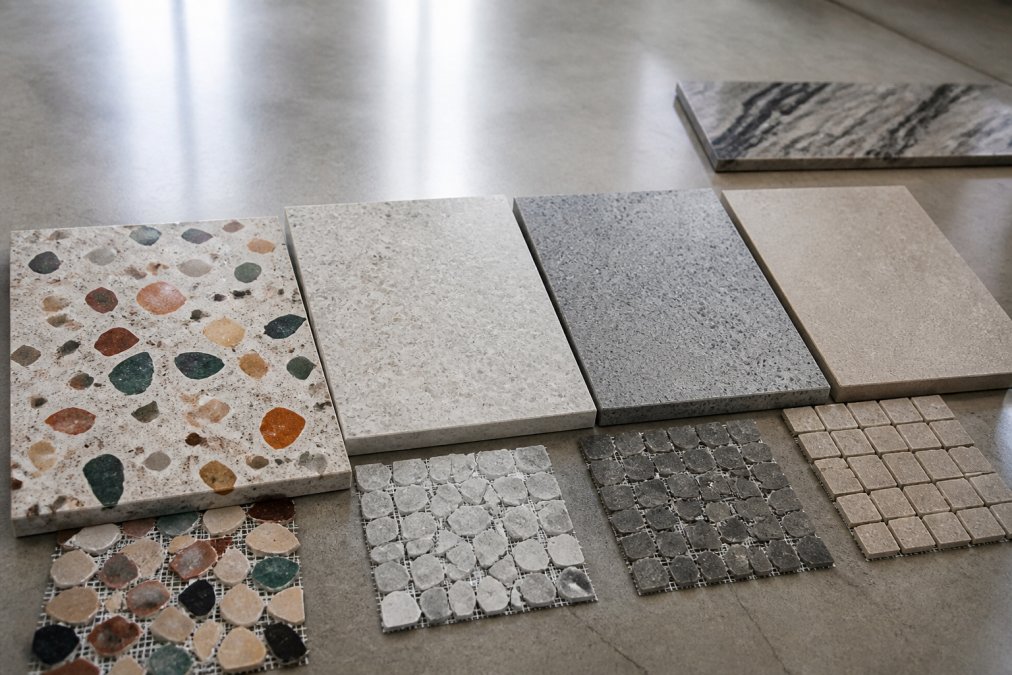
 comparison
Artistic Terrazzo vs Competitors: A 2026 Flooring Guide
Table of Contents
- Artistic Terrazzo vs. Tile Alternatives: What Drives the Price Gap?
- Feature Comparison: Terrazzo, Porcelain, and Ceramic Tile
- Lifecycle Costs and ROI: Why Initial Investment Is Only Half the Story
- Design Flexibility: Matching Patterns, Aggregates, and Finishes
- Installation Complexity: The Terrazzo Floor Installation Process Explained
- Environmental Impact and Performance: Acoustic, Thermal, and Sustainability Factors
- A Terrazzo Contractor Vetting Checklist for Commercial Projects
- Conclusion: Choosing the Right Floor for Your Building's Future
- Frequently Asked Questions
Last Updated: September 8, 2026
The decision between artistic terrazzo and tile alternatives is a financial and operational commitment that plays out over decades. While porcelain and ceramic tile offer lower upfront numbers, the lifecycle cost of a properly installed terrazzo floor often tells a different story for high-traffic commercial buildings. This guide from A1 Terrazzo, a commercial flooring specialist with over 35 years of experience, breaks down the real differences.
Artistic Terrazzo vs. Tile Alternatives: What Drives the Price Gap?
The price gap between artistic terrazzo and tile alternatives comes down to three factors: material composition, labor skill requirements, and the absence of grout lines. Terrazzo is a composite material poured, cured, and ground smooth on site. Porcelain and ceramic tiles are mass-manufactured in factories, keeping material costs predictable and installation labor relatively standard.
The initial investment for terrazzo reflects a permanent asset rather than a disposable surface. While tile installation requires setting individual units with thin-set mortar, artistic terrazzo demands a specialized crew to manage the pour, curing time, and grinding and polishing phases. This complexity drives the higher upfront price but also produces its seamless surface and superior wear resistance.
Feature Comparison: Terrazzo, Porcelain, and Ceramic Tile
When evaluating floor finishes, the specification sheet tells you what you get on day one, but the performance data reveals what you still have in twenty years.
| Feature | Poured Terrazzo | Porcelain Tile | Ceramic Tile |
|---|---|---|---|
| Surface | Seamless, no grout lines | Grout lines present | Grout lines present |
| Durability | Extremely high | High | Moderate |
| Maintenance | Periodic polishing | Grout cleaning, sealing | Grout cleaning, sealing |
| Design Flexibility | Unlimited custom patterns | Fixed by mold | Fixed by mold |
| Moisture Resistance | Excellent (epoxy) | Good | Moderate |
| Repair | Difficult, local | Replace individual tiles | Replace individual tiles |
| Typical Lifespan | Life of building | 20-30 years | 10-20 years |
The most significant operational difference is the seamless surface. In healthcare facilities, the absence of grout lines eliminates harborage points where bacteria and mold accumulate. Porcelain and ceramic tile, while durable on the surface, are structurally weakened by their grout joints, which require ongoing maintenance and re-sealing to prevent moisture intrusion and staining.
Lifecycle Costs and ROI: Why Initial Investment Is Only Half the Story
A common mistake in flooring budgets is treating the installation invoice as the total cost. The real financial picture requires a lifecycle cost analysis that accounts for cleaning supplies, replacement frequency, and downtime during renovations. For a continuously operating facility, the cost of closing a wing to replace failed tile is often several times the material cost itself.
Here is a practical framework you can take to a budget committee, built on standard industry assumptions for a 20,000-square-foot high-traffic corridor.
A 20-Year Cost Model: Terrazzo vs. Porcelain Tile
| Cost Component | Poured Terrazzo | Porcelain Tile | Notes on Assumptions |
|---|---|---|---|
| Initial Installation (per sq ft) | $25.00 | $15.00 | Terrazzo includes specialized labor and curing; tile includes material, setting, and grout. |
| Initial Cost (20,000 sq ft) | $500,000 | $300,000 | |
| Annual Maintenance (per sq ft) | $0.35 | $0.85 | Terrazzo requires neutral pH cleaning and periodic burnishing. Tile requires grout scrubbing, re-sealing every 2-3 years, and stain management. |
| Annual Maintenance Cost | $7,000 | $17,000 | |
| 20-Year Maintenance Total | $140,000 | $340,000 | |
| Replacement Cycle (years) | None (life of building) | 15 years | Tile in high-traffic corridors typically shows grout failure and surface wear by year 15. |
| Replacement Cost (per sq ft) | $0 | $18.00 | Includes demolition, disposal, and new installation. |
| Replacement Cost (20,000 sq ft) | $0 | $360,000 | |
| 20-Year Total Cost of Ownership | $640,000 | $1,000,000 |
The delta is $360,000, a 56% higher total cost for the tile installation over two decades. Even if the tile never needs replacement within the 20-year window, the annual maintenance gap alone ($10,000 per year) adds up to $200,000, which nearly erases the initial $200,000 price advantage.
The Hidden Cost: Operational Downtime
The model above excludes the single most expensive variable: downtime. When a tile floor fails in a working hospital corridor or a retail concourse, the area must be closed. For a busy outpatient clinic, a two-week tile replacement project can mean rescheduling hundreds of patient appointments.
Terrazzo restoration, by contrast, is often performed in phases. A contractor can grind and polish one section at a time, typically during off-hours or weekends, without ever closing the facility.
Why the 'Cheaper' Tile Often Costs More in Year 10
The most common failure mode for porcelain tile in commercial settings is not the tile itself, it is the grout. Once grout cracks or erodes, water migrates beneath the tile, causing the thin-set bond to fail. Repairing a section is rarely a simple 'replace one tile' job; surrounding tiles are often damaged during removal, and matching the original dye lot is frequently impossible.
Terrazzo does not have this failure mode. Because it is a monolithic slab, there is no grout to fail and no substrate for water to migrate through. When surface wear appears, typically after decades of service, a diamond grind and polish restores the original finish at a fraction of the replacement cost.
Design Flexibility: Matching Patterns, Aggregates, and Finishes
Artistic terrazzo is one of the few floor finishes that can be fully custom-designed. The architect or designer specifies the binder type, aggregate blend, chip size, and layout, allowing for logos, wayfinding paths, and intricate patterns that become a permanent part of the building fabric. This is why terrazzo remains the preferred choice for courthouses, university campuses, and corporate headquarters. floor access panels.
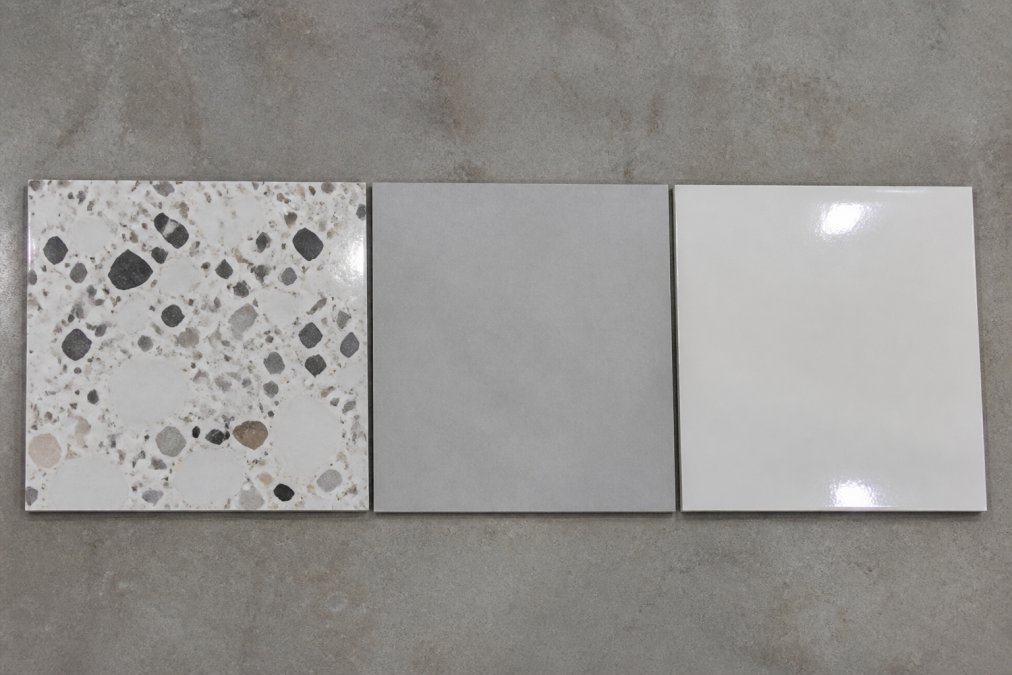
Tile manufacturers have attempted to replicate this aesthetic with porcelain tiles that mimic the look of terrazzo, but they remain a flat, repetitive reproduction. A true terrazzo surface has depth; the aggregates are exposed through grinding, catching light differently as the viewing angle changes. The difference is immediately visible.
Installation Complexity: The Terrazzo Floor Installation Process Explained
Understanding the terrazzo floor installation process is critical for planning project timelines. Unlike tile, which can be installed in a matter of days, a poured terrazzo system requires a sequence of steps that cannot be rushed.
The process begins with subfloor preparation. The concrete slab must be clean, dry, and free of cracks; any moisture issues must be resolved before the pour begins. Divider strips are installed to control cracking and define color transitions. The terrazzo mixture is then poured and screeded, followed by a curing time during which the floor must be protected from traffic and moisture loss. After curing, the surface undergoes multiple passes of grinding with progressively finer diamond abrasives, followed by sealing and polishing.
Side-by-Side Timeline: Terrazzo vs. Porcelain Tile
Here is a realistic week-by-week timeline for a commercial lobby project, assuming a prepared, level concrete subfloor is already in place.
| Week | Poured Terrazzo | Porcelain Tile |
|---|---|---|
| Week 1 | Subfloor moisture testing, crack repair, and divider strip layout | Tile delivery and layout planning |
| Week 2 | Divider strip installation and terrazzo mix pour | Tile setting begins (thin-set application) |
| Week 3 | Curing period, floor is off-limits to all traffic | Tile setting continues; grout application begins |
| Week 4 | Curing continues; initial coarse grinding pass | Grout curing and sealing |
| Week 5 | Fine grinding and polishing passes | Final cleaning and walkthrough |
| Week 6 | Sealing, polishing, and final inspection | , |
| Total Duration | 6 weeks | 5 weeks |
The raw timeline difference is only one week. The perception that terrazzo takes 'months longer' is outdated. Modern epoxy terrazzo systems cure faster than traditional cementitious mixes. The real scheduling challenge is the curing period in Week 3, during which the floor is completely inaccessible.
The Curing Constraint: Planning Around the 'Dead Week'
For a facility manager, the critical planning question is not 'how long does the whole project take?' but 'when is the floor unusable?' With terrazzo, the answer is a contiguous block of roughly 7-10 days during curing. With tile, the floor is walkable in 24 hours, but the grout requires another 24-48 hours before light traffic.
In practice, this means:
- Terrazzo: Schedule the pour at the end of a work week. The curing period covers a weekend, reducing operational downtime to 5-7 business days.
- Tile: The floor can be partially used sooner, but the grout lines remain vulnerable to staining and damage for the first week. Full protection requires limiting traffic regardless.
Phased Installation: The Terrazzo Advantage for Renovations
Rushing the curing phase leads to a weaker surface prone to cracking. The choice is between a longer installation that yields a seamless, monolithic floor, or a faster tile installation that introduces thousands of grout lines and a shorter service life.
Terrazzo offers a renovation advantage that tile cannot: phased installation. Because terrazzo is poured in sections separated by divider strips, a contractor can close and restore one zone at a time. A hospital corridor can be divided into three phases; each phase takes two weeks from pour to polish, and the corridor remains open for the other two-thirds of the project. Tile replacement typically requires closing the entire affected area.
Environmental Impact and Performance: Acoustic, Thermal, and Sustainability Factors
Beyond durability, terrazzo offers performance characteristics that tile alternatives struggle to match. The thermal mass of a terrazzo slab helps stabilize indoor temperatures, reducing heating and cooling loads (energy.gov). Its dense composition also provides superior acoustic performance, reducing sound transmission between floors.
From a sustainability perspective, terrazzo is one of the most environmentally responsible floor finishes available. The aggregates used are frequently recycled materials, including glass, stone, and even industrial byproducts. Because the floor lasts for the life of the building, it eliminates the waste associated with repeated tile replacement (the EPA). When a building is eventually demolished, the terrazzo can be crushed and reused as aggregate in new construction.
A Terrazzo Contractor Vetting Checklist for Commercial Projects
Selecting the right installation partner is as important as selecting the material. The quality of the final floor depends entirely on the skill of the crew and the integrity of their process. Use this checklist when vetting a commercial terrazzo contractor:
- Verify commercial experience: Request a portfolio of completed healthcare, airport, or educational projects. Ask for references from facility managers who oversee the buildings daily.
- Confirm in-house crews: Subcontracted labor introduces variability. Confirm the contractor employs its own trained installers.
- Ask about subfloor moisture testing: A contractor who skips moisture vapor testing is setting the project up for failure.
- Review the maintenance plan: The contractor should provide a written care schedule and specify the correct cleaning products.
- Check for restoration capability: Confirm the contractor can grind and polish the floor to restore its finish after years of wear.
Conclusion: Choosing the Right Floor for Your Building's Future
The choice between artistic terrazzo and tile is a decision between a short-term budget line item and a long-term capital asset. Tile offers a lower entry price, but the recurring costs of grout maintenance, replacement, and operational downtime accumulate quickly. Terrazzo demands a higher initial investment and a specialized installation partner, but it returns a seamless, durable floor that can be restored rather than replaced.
For facility managers and developers who prioritize long-term value, sustainability, and design distinction, A1 Terrazzo provides the high-quality installation and professional maintenance services needed to protect that investment. With over 35 years of experience in commercial terrazzo flooring across Florida, the team has the expertise to manage complex projects from subfloor preparation through final polishing. Contact A1 Terrazzo to discuss how a seamless terrazzo floor can serve your building for decades to come.
Frequently Asked Questions
Is terrazzo still trendy in 2026?
Yes. Design trends in 2026 continue to favor terrazzo, but the focus has shifted from the monochromatic chips of the past to bold, artistic patterns and custom aggregate blends. This evolution allows architects and designers to create unique, branded spaces. Beyond its aesthetic appeal, its durability and low maintenance requirements make it a practical choice for commercial facilities. The long-term value and design flexibility ensure terrazzo remains a relevant and sought-after floor finish for high-end projects.
What are the main differences between artistic terrazzo and porcelain tile?
The core difference comes down to the surface. Artistic terrazzo offers a seamless, monolithic surface with no grout lines, which is a major advantage for sanitation in healthcare settings. Porcelain tile, while durable, has grout lines that can harbor bacteria and require more intensive cleaning. Terrazzo also offers far greater design flexibility with custom patterns and aggregate choices. While porcelain has a lower initial cost, terrazzo's lifespan and lower lifecycle cost often make it the more economical choice over a building's life.
What should be included in a commercial terrazzo installation quote?
A comprehensive quote from a terrazzo contractor should detail the full scope of work. This includes subfloor preparation, the type of binder (cementitious or epoxy resin), the specific aggregates and color palette, and the number of divider strips needed for your design. It should also outline the installation timeline, including curing time, grinding, and sealing. Ask for a breakdown of costs for materials versus labor and verify that the quote specifies the square footage pricing. This clarity prevents budget overruns.
How do I vet a terrazzo contractor for a large-scale project?
Use a vetting checklist that goes beyond basic licensing. Ask for a portfolio of completed commercial projects similar in scale to yours, such as hospitals, airports, or schools. Verify their experience with the specific installation process, including subfloor preparation and polishing. Request references and follow up on them. Confirm they offer a warranty on their workmanship. A contractor with 35 years of experience will have a track record that speaks to their ability to handle complex installations and deliver long-lasting results.