 listicle
Commercial Terrazzo Restoration Before and After
Table of Contents
- What Commercial Terrazzo Restoration Before and After Really Shows
- The Step-by-Step Restoration Process: From Grinding to Final Polish
- Repairing Holes, Cracks, and Stains in Commercial Terrazzo
- Terrazzo Restoration Equipment: What Professionals Actually Use
- Terrazzo Floor Repair Cost: What Facility Managers Should Budget
- Choosing the Right Terrazzo Floor Cleaner for Long-Term Maintenance
- Restore or Replace? Making the Case for Commercial Terrazzo Restoration
- Frequently Asked Questions
Last Updated: September 14, 2026
What Commercial Terrazzo Restoration Before and After Really Shows
Commercial terrazzo restoration before and after tells a simple story: a floor most facility managers assume is beyond saving comes back looking newly poured. At A1 Terrazzo, we've spent 35 years watching that transformation repeat in hospitals, airports, courthouses, and university buildings across Florida. The floor rarely needs replacing, it needs the right mechanical process.
Terrazzo restoration is the mechanical process of grinding away damaged surface layers, repairing structural defects, and polishing the exposed aggregate back to a uniform, sealed finish without replacing the floor. Replacement means demolition, downtime, and disposal; restoration keeps the floor serving the building.
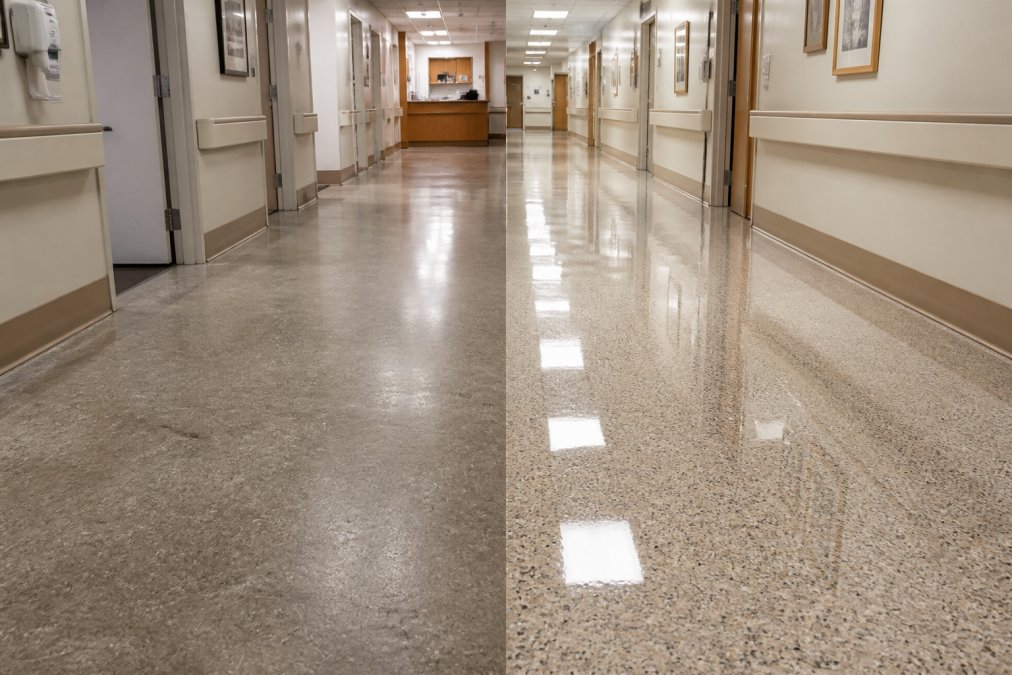
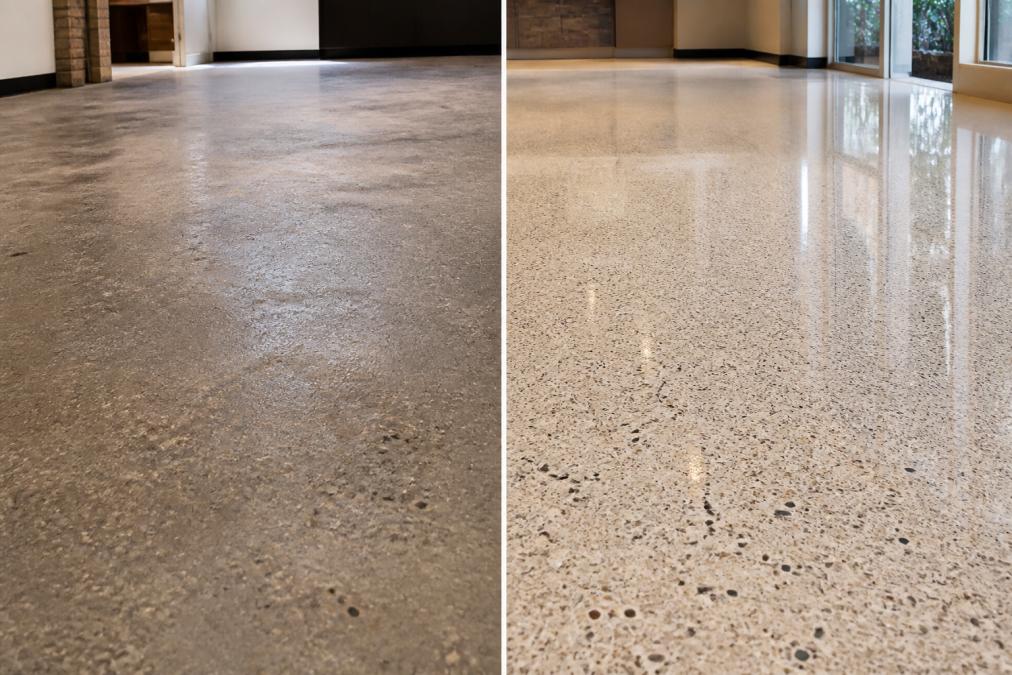
The Visual Difference: Dull, Worn Floors vs. Restored Finish
Worn terrazzo fails predictably: wax buildup turns yellow, traffic lanes develop gray wear patterns, cracks radiate from expansion joints, and spills stain the surface pores.
A restored floor reverses all of it: diamond grinding removes the top layer of coating and damage, honing smooths the surface, polishing restores gloss, and a densifier hardens what's underneath, the four steps the before-and-after photos record.
The Step-by-Step Restoration Process: From Grinding to Final Polish
The restoration sequence follows a fixed order, and skipping a step shows up in the final result: assessment, coating removal, grinding, honing, repair, polishing, and sealing.
Total time: Varies by square footage and floor condition, typically several days for a mid-size commercial space. Difficulty: Professional equipment required.
Here's how the stages break down:
- Condition assessment - Map cracks, stains, coating thickness, and wear patterns before touching the floor.
- Coating and wax removal - Strip old finishes so the grinding heads reach the actual terrazzo surface.
- Diamond grinding - Cut back the damaged layer and expose fresh aggregate.
- Honing - Refine the surface with progressively finer abrasives.
- Crack and hole repair - Fill and match defects to the surrounding matrix.
- Polishing - Build the gloss in stages, from matte to high-gloss.
- Sealing and densifying - Protect the finished surface and harden the substrate.
Diamond Grinding and Honing: Removing Damage and Old Coatings
Diamond grinding is where restoration succeeds or fails. It uses progressively finer diamond abrasives, from coarse grits that remove coatings and surface damage to fine grits that prepare the floor for polishing.
The common mistake is starting too fine: a grit that's too light leaves coating residue trapped in the surface, which shows through the final polish as a cloudy patch. A proper sequence removes old epoxy, wax, and surface imperfections in stages, then hands off to honing.
Honing sits between grinding and polishing, refining the scratch pattern so polishing can build an even gloss. Skip it, and the floor polishes unevenly.
Repairing Holes, Cracks, and Stains in Commercial Terrazzo
Crack repair and patching separate a cosmetic refresh from a structural restoration. Terrazzo cracks for a reason: substrate movement, moisture, or impact. Filling the crack without addressing the cause means it returns.
The repair workflow professionals follow:
- Crack repair - Route the crack open, clean it, and fill with a matching epoxy or cementitious patch.
- Hole and spall patching - Rebuild missing sections and match the aggregate color and chip distribution.
- Stain removal - Treat oil, rust, and organic stains before grinding so they don't get driven deeper into the surface.
- Grout and joint repair - Restore divider strips and joints that have opened up.
- Floor leveling - Correct lippage and uneven sections that create trip hazards.
Matching is the hard part: cementitious and resin-based terrazzo take different patch materials, and a mismatched patch stands out permanently. Historic preservation work is most demanding, matching original patterns and finishes in a decades-old building.
Terrazzo Restoration Equipment: What Professionals Actually Use
Terrazzo restoration equipment is heavy, specialized, and expensive, which is why this isn't a DIY project. The core machines are planetary grinders, edge grinders, wet/dry vacuums, and floor buffers.
What the equipment list actually includes:
- Planetary grinding machines - Multi-head units that grind evenly and remove coatings fast.
- Edge and corner grinders - Reach walls, columns, and tight spaces the main machine can't.
- Diamond abrasive tooling - The grit sequence that does the actual cutting.
- Honing and polishing pads - Resin-bonded pads for the finishing stages.
- Densifiers and sealers - Applied after polishing to harden and protect the surface.
- HEPA dust containment - Captures silica dust during dry grinding.
That last item matters more than most facility managers realize. Dry grinding terrazzo generates respirable crystalline silica, and the OSHA silica dust standards for construction set clear exposure limits and control requirements for exactly this kind of work. A contractor who doesn't bring containment equipment isn't just making a mess. They're creating a compliance problem for the building owner.
Terrazzo Floor Repair Cost: What Facility Managers Should Budget
Terrazzo floor repair cost depends on square footage, floor condition, and how much repair work sits underneath the cosmetic restoration. Any contractor who quotes a single number before walking the floor is guessing. Build a defensible budget model before the first bid arrives.
The Cost Drivers That Actually Move the Number
| Cost Driver | What It Changes | Why It Matters |
|---|---|---|
| Square footage | Total labor and machine hours | Larger floors lower the per-foot rate because setup and mobilization spread across more area |
| Coating thickness | Number of grinding passes | Heavy epoxy or wax buildup can add a full day of coarse grinding per zone |
| Crack and hole count | Patch material and labor | Extensive repair can rival grinding time on a badly damaged floor |
| Finish target | Matte vs. high-gloss | High-gloss needs more honing and polishing steps, each with its own pad progression |
| Access and downtime | After-hours or phased work | Night and weekend schedules carry labor premiums and longer project calendars |
| Aggregate matching | Custom chip and color blending | Historic or custom terrazzo requires sample matching before patching begins |
For budgeting, ask for a line-item quote that separates grinding, repair, polishing, and sealing rather than a single lump sum. That structure lets you see where the money actually goes and compare bids on equal footing. For current pricing on your specific building, A1 Terrazzo's commercial restoration services can scope the work directly.
Modeling Restoration Against Replacement
The comparison that matters to a capital budget isn't restoration cost versus zero, it's restoration cost versus the fully loaded cost of replacement: demolition, disposal, substrate prep, a new pour or tile installation, and the downtime that comes with all of it. For a structurally sound floor, restoration lands well below replacement per square foot, and the gap widens with avoided downtime and disposal fees.
A useful way to frame it for ownership:
- Capital cost - Restoration is a maintenance-level expense; replacement is a capital project that competes with every other capital request in the building.
- Useful life - A properly restored terrazzo floor is built to serve for decades with correct maintenance, so the cost amortizes over a long horizon.
- Disruption cost - For a hospital, airport, or school, the value of keeping the building open during the work often exceeds the difference in hard costs.
- Deferred replacement - Restoring now pushes the replacement decision years into the future, which preserves optionality if the space's use changes.
What to Ask Before You Sign
- How many grit steps run between the first grind and the final polish?
- Is dust containment included, or billed separately?
- How are cracks diagnosed before patching, and what happens if the substrate is the cause?
- What does the maintenance plan look like after handoff, and who trains the custodial crew?
- Is the quote phased by zone so the building can stay open?
Choosing the Right Terrazzo Floor Cleaner for Long-Term Maintenance
The right terrazzo floor cleaner is a pH-neutral product, the one most facilities get wrong.
Wrong cleaning products are the most common cause of premature terrazzo failure: acidic cleaners etch the surface, abrasive pads scratch the polish, and harsh strippers pull the sealer. A floor that took days to restore can lose its finish in months under the wrong routine.
What a maintenance plan should include:
- Daily: Dust mop or microfiber mop with a neutral pH cleaner.
- Weekly: Auto-scrub with a soft pad and fresh water.
- Quarterly: Buff to maintain gloss and address wear patterns.
- Annually: Evaluate whether light honing or re-polishing is needed.
The National Terrazzo and Mosaic Association maintenance guidance is the industry reference for cleaner selection and pad types, and it's worth handing to whoever manages your custodial contract.
Restore or Replace? Making the Case for Commercial Terrazzo Restoration
Restoration wins on cost, downtime, and sustainability in most commercial cases. Replacement means demolition, disposal, a new substrate, a new pour, and the disruption that comes with all of it. But "restoration usually wins" isn't a budget argument, here's how to build one that survives a capital committee.
The Financial Case
The comparison that matters isn't restoration cost versus zero, but versus the fully loaded cost of replacement:
- Demolition and disposal - Tearing out terrazzo generates heavy debris and tipping fees, and in older buildings it can trigger additional abatement or handling requirements.
- Substrate work - A new pour requires a sound, prepared substrate. If the existing slab has issues, replacement doesn't avoid them; it exposes them.
- New material and installation - A new terrazzo pour or tile installation carries material, labor, and cure time that restoration doesn't.
- Downtime - Demolition and re-pour take longer than grinding and polishing, and the building disruption scales with the schedule.
- Deferred capital - Restoration is typically a maintenance-level expense, which keeps the replacement decision off the capital calendar for years.
For a structurally sound floor, restoration lands well below replacement per square foot, and the gap widens once downtime and disposal are counted. A properly restored terrazzo floor serves for decades with correct maintenance, so the cost amortizes over a long horizon. Consistent professional floor maintenance ensures that these surfaces retain their structural integrity and aesthetic value throughout their extended lifecycle.
The Sustainability Case
Sustainability is no longer a soft talking point for commercial properties, it's a procurement criterion. Keeping the existing floor avoids demolition waste, the embodied carbon of new material, and the disposal stream entirely. For facility managers tracking waste diversion or embodied-carbon metrics, restoration is the lower-impact option by a wide margin, and the documentation is straightforward: no demolition debris, no new material, no disposal tickets.
The Safety and Compliance Case
This is the part most restoration content skips, and the part commercial clients can't afford to ignore.
- Slip resistance - Terrazzo's coefficient of friction (COF) changes with finish. A high-gloss polish can be more slippery than a honed or matte finish, especially when wet. Ask the contractor how the finish target affects COF and whether an anti-slip treatment is needed for entries, ramps, and lobbies.
- Accessibility - Under the Americans with Disabilities Act (ADA), walking surfaces must meet accessibility requirements, and changes in level or lippage can create compliance issues. Restoration that corrects lippage and uneven sections can resolve trip hazards that a cosmetic refresh would leave in place.
- Air quality during work - Dry grinding terrazzo generates respirable crystalline silica. The OSHA silica dust standards for construction set exposure limits and control requirements, and containment is part of a compliant job, not an upgrade.
- Post-restoration maintenance - A restored floor only holds its COF and finish if it's maintained with the right products. Hand the custodial crew a written plan before the contractor leaves the site.
When Replacement Is the Right Call
Restoration isn't always the answer. Replacement makes sense when:
- The substrate is failing and the slab can't support a restored surface.
- The floor is structurally compromised beyond surface damage.
- The design or use of the space is changing and the existing terrazzo no longer fits.
- Moisture intrusion is chronic and can't be resolved without addressing the slab.
For a sound floor with surface damage, restoration is almost always the better financial decision. For a failing substrate, patching the surface just delays the inevitable.
Frequently Asked Questions
How much does commercial terrazzo restoration cost per square foot?
Pricing depends on floor condition, square footage, and the level of repair needed. A1 Terrazzo provides project-specific quotes after a site assessment. Contact them directly for current pricing.
Can severely damaged terrazzo be fully restored to its original look?
Yes, in most cases. Diamond grinding removes surface damage, stains, and old coatings. Crack and hole repair uses matched aggregate and cementitious or resin-based patching. Professionals can match original aggregate during repairs. Floors with structural damage or widespread delamination may need partial replacement, but restoration typically brings severely worn terrazzo back to a high-gloss finish that looks close to original.
How long does a professional terrazzo restoration last in high-traffic areas?
A properly restored and sealed terrazzo floor lasts 10 to 20 years in high-traffic commercial spaces like airports, hospitals, and schools. Longevity depends on maintenance. Using the right terrazzo floor cleaner, avoiding acidic products, and scheduling periodic honing and polishing extend the finish. Floors without proper maintenance may show wear patterns within 3 to 5 years.
What are the benefits of restoring existing terrazzo versus replacing it?
Restoration costs less than replacement, reduces landfill waste, and preserves historic character. It also causes less operational disruption because crews work in phases. Replacement requires demolition, new substrate prep, and full cure time. For facilities with original terrazzo, restoration maintains architectural integrity while delivering a durable, sanitary surface. A1 Terrazzo specializes in both restoration and new installation.
How do professionals match original aggregate during terrazzo repairs?
Contractors take core samples or chip out small sections to identify the original aggregate type, size, color, and binder. They then mix a matching batch of cementitious or resin-based terrazzo. After curing, the patch is ground and polished to blend with the surrounding floor. Experienced crews can match most historic terrazzo, though extremely rare aggregates may require custom sourcing.