 how-to
How to Repair Damaged Terrazzo Floors in Schools
Table of Contents
- Assess the Damage Before Planning Terrazzo Floor Repair
- Terrazzo Crack Repair Techniques for Fine-Line and Structural Damage
- Matching Terrazzo Aggregate for a Seamless Finish
- Surface Preparation and Diamond Grinding
- Restoring Divider Strips and Addressing Subfloor Integrity
- Terrazzo Floor Restoration Cost and Phased Scheduling
- Commercial Terrazzo Maintenance Schedule for High-Traffic Hallways
- Frequently Asked Questions
Last Updated: September 4, 2026
Assess the Damage Before Planning Terrazzo Floor Repair
Terrazzo floor repair in educational buildings fails more often from rushed diagnosis than from poor technique. Facility managers must classify each defect, since the repair method for a hairline crack differs entirely from that for a delaminated slab, and knowing whether the floor is cement-based or epoxy-based determines which repair products will bond.
Begin with a systematic walkthrough, mapping every crack, chip, stained zone, and loose tile on a floor plan. Moisture intrusion, subfloor movement, and impact damage each demand different interventions; treating the symptom without the cause guarantees the damage returns. This assessment also matters for safety planning, since repair zones will need temporary barriers.
Terrazzo Crack Repair Techniques for Fine-Line and Structural Damage
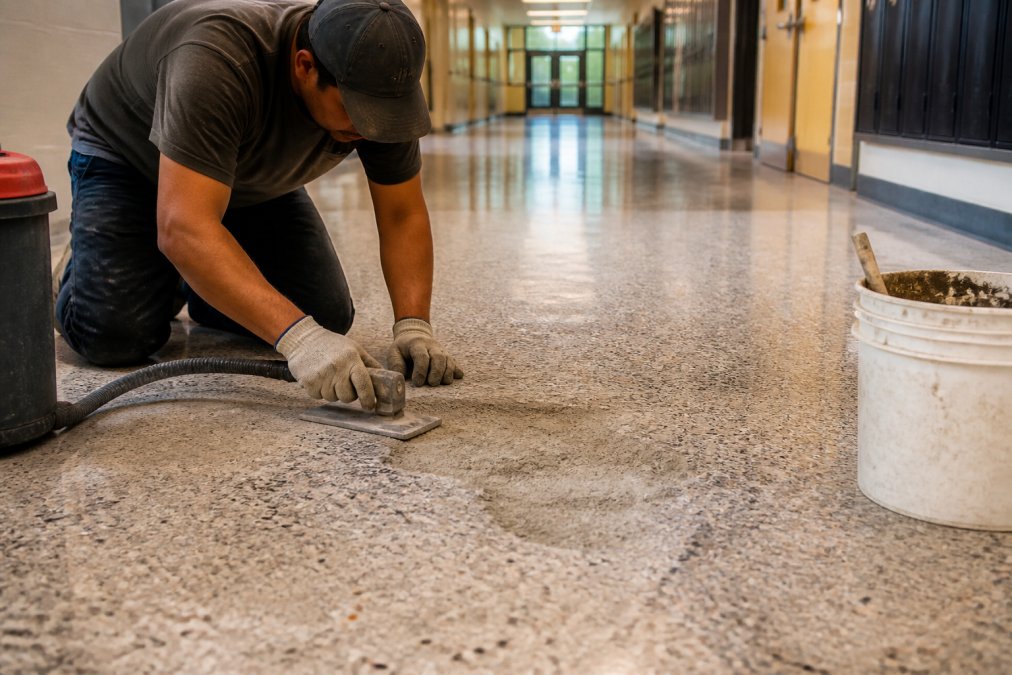
Crack repair techniques for terrazzo fall into two categories: cosmetic and structural. Fine-line cracks, under roughly 1/16 inch wide with no vertical displacement, respond well to resin-based repair. The technician cleans the crack, forces a low-viscosity epoxy or acrylic resin deep into the fissure using crack injection, and allows it to cure before grinding the surface flush.
Structural damage tells a different story. When cracks show vertical offset, tiles sound hollow when tapped, or cracks run continuously along divider strips, the subfloor has likely moved. These conditions require opening the affected area, addressing the underlying cause, and reinstalling terrazzo by saw-cutting clean edges, removing loose material, and pouring a new mix that matches the surrounding matrix.
| Damage Type | Typical Cause | Repair Method | Downtime |
|---|---|---|---|
| Fine-line crack | Shrinkage, minor settling | Resin injection, grind flush | 1-2 days |
| Chipped edge | Impact from carts or furniture | Epoxy filler, color matched | 1 day |
| Hollow tile | Subfloor failure, moisture | Full removal and re-pour | 3-5 days |
| Cracked divider strip | Structural movement | Replace strip, reseal joint | 2-3 days |
Matching Terrazzo Aggregate for a Seamless Finish
Matching terrazzo aggregate is where repair work earns its keep, because a visible patch in a school lobby undermines the entire restoration. The goal is a repair that disappears into the surrounding floor, requiring replication of both the aggregate type and binder color. Original installations often used marble, granite, or glass chips in specific size ranges, and the ratio of chips to matrix varies by installer.
Start by documenting the existing floor's aggregate: photograph a clean section up close, note the dominant chip size, and identify the binder color. For older installations, particularly in historic buildings, the original aggregate source may no longer be quarried, but suppliers can often blend available aggregates to approximate the original look.
Surface Preparation and Diamond Grinding
Surface preparation determines whether a terrazzo floor repair blends in or stands out. After any crack injection or patching compound has fully cured, the entire affected zone must be ground flat using diamond grinding equipment. Handheld grinders work for small patches, but larger areas benefit from a walk-behind planetary grinder that distributes pressure evenly.
The grinding process moves through progressively finer diamond grits. Coarse metal-bonded diamonds remove excess patch material and level the surface, then resin-bonded diamonds refine the finish. Between grit changes, clean the floor thoroughly to prevent loose abrasive from scratching. The final steps, honing and polishing, restore the floor's sheen and prepare it for sealer application.
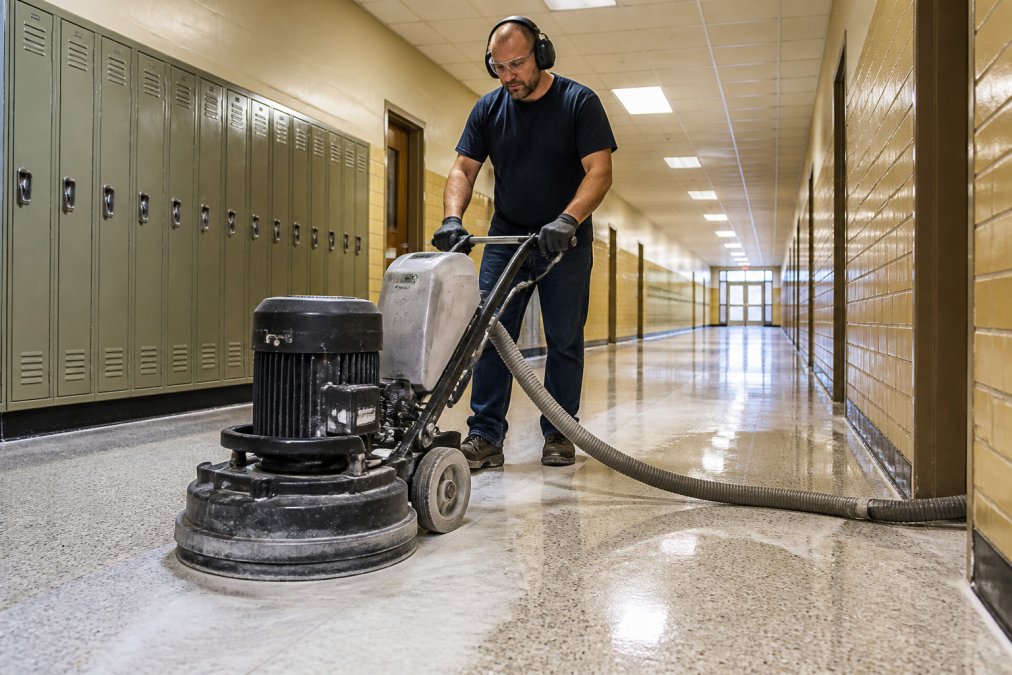
Grinding also addresses surface porosity. Terrazzo is naturally porous, and old floors that have lost their sealer absorb spills and stains. Grinding opens the surface uniformly, allowing a fresh sealer to penetrate evenly and restore stain resistance, which is the first line of defense in educational buildings where spills are routine.
Restoring Divider Strips and Addressing Subfloor Integrity
Divider strips, the metal bands that segment terrazzo into panels, serve both aesthetic and functional roles by accommodating minor movement and providing a visual grid. Over decades of traffic, these strips can loosen, corrode, or become damaged. Restoring them requires removing the damaged strip, cleaning the channel, and setting a new strip in fresh binder before grinding the surrounding area flush.
Subfloor integrity sits beneath every successful terrazzo floor repair. Terrazzo is installed over a concrete slab, and any movement in that slab transmits directly to the surface. Before committing to an expensive restoration, verify that the subfloor is stable. Look for cracks in adjacent walls, doors that stick, or uneven settling patterns. If the slab is still shifting, no surface repair will hold.
For historic school buildings, the restoration lifecycle often involves preserving original divider strip patterns that are no longer manufactured. In these cases, a metal fabricator can replicate the profile, or the restoration team can carefully salvage and reset existing strips. This preservation work requires patience, but it maintains the architectural character that makes many older educational campuses distinctive.
Terrazzo Floor Restoration Cost and Phased Scheduling
Restoration cost is the first question a school board asks, but the answer is rarely a single number. The real financial question is lifecycle cost: restore now versus replace later, compared to doing nothing while damage accelerates. For institutional budgets, a defensible answer requires a framework, not a quote.
Building a Restoration vs. Replacement Cost Model
A basic cost model for a school district compares three scenarios over a 20-year horizon: full replacement, phased restoration, and deferred maintenance. The inputs are:
- Replacement cost: Includes demolition, subfloor preparation, new terrazzo installation, and disruption. This is typically 3 to 5 times the cost of restoration per square foot.
- Restoration cost: Includes crack repair, diamond grinding, polishing, and resealing. This is the baseline for the phased approach.
- Deferred maintenance cost: Includes the compounding damage from unsealed surfaces, which accelerates staining and cracking, plus the safety risk of trip hazards from spalled edges.
Most facility managers find that a phased restoration program costs 40-60% less than full replacement over a 20-year window, while extending the floor's service life by 15-25 years. The key is to present this as a capital planning document to the finance committee, not as a maintenance request.
Phased Scheduling Around the Academic Calendar
The operational constraint that separates school work from commercial work is the calendar. Classrooms cannot be shut down mid-semester, and hallways cannot be blocked during school hours. A phased restoration plan must be built around three work windows:
- Summer recess (8-12 weeks): This is the primary window for large-zone restoration. A typical plan restores 20,000-30,000 square feet per summer, working in 5,000-10,000 square foot segments that are completed, cured, and sealed before the next segment begins.
- Winter break (2-3 weeks): Suitable for crack injection, chip repair, and spot grinding in low-traffic zones like administrative wings or libraries. These repairs cure fully during the break and require no classroom disruption.
- Spring break (1 week): Reserved for surface maintenance: stripping old wax, burnishing, and applying a fresh sealer. This window is too short for grinding work but ideal for protective maintenance.
A critical scheduling rule is to sequence work from the building's interior outward, restoring the deepest classrooms first. This prevents finished floors from being crossed by workers and equipment moving to unfinished zones.
Budgeting Across Fiscal Years
A multi-year restoration program lets a district spread cost across budget cycles rather than seeking one large capital appropriation. A typical plan might look like this:
- Year 1: Assessment, binder identification, and emergency repairs to eliminate trip hazards. Budget: smallest allocation.
- Year 2: Restore the most heavily damaged wing (often the oldest or highest-traffic area).
- Year 3: Restore the second wing and begin preventive maintenance on Year 1 zones.
- Year 4: Restore remaining zones and establish a recurring annual maintenance line item.
This approach also creates a predictable maintenance cadence. Once the initial restoration cycle is complete, the annual budget shifts from capital restoration to routine maintenance, which is a smaller, more predictable line item that finance committees approve more readily.
The Hidden Cost of Neglect
A common pattern is to defer restoration until damage is visible from the building entrance. By that point, the floor has lost its sealer, stains have penetrated, and cracks have widened. The cost shows up in increased repair scope, safety liability from trip hazards, and the aesthetic signal that the building is not maintained.
For districts that need to justify the investment, the calculation is simple: a phased restoration program costs less per year than the interest on a bond issue for full replacement, and it preserves an existing asset. Presenting this as a lifecycle cost analysis with a clear schedule tied to the academic calendar is the difference between a funded project and a deferred one.
Commercial Terrazzo Maintenance Schedule for High-Traffic Hallways
A maintenance schedule for school terrazzo is not just about keeping the floor shiny. It must meet three institutional requirements that commercial offices never face: slip-resistance standards for student safety, indoor air quality (IAQ) limits during occupied hours, and ADA compliance for accessible routes. A schedule that ignores these constraints will fail an inspection or cause an injury.
Slip Resistance and the DCOF Standard
Terrazzo is naturally slip-resistant when properly finished, but polishing to a high gloss can reduce the wet coefficient of friction (DCOF) below the safety threshold. The ADA requires accessible routes to have a slip-resistant surface, and the industry benchmark for wet-area safety is a DCOF of 0.42 or higher when measured with a tribometer per ANSI A137.1 (ada.gov). School hallways must be tested after any polishing or resealing job.
A common pattern is for a crew to over-polish a hallway to a mirror finish, only to find the floor becomes slippery when wet. The fix is not to dull the floor but to select the correct sealer. Penetrating sealers that bond chemically with the terrazzo matrix maintain slip resistance better than film-forming topical waxes. Facility managers should specify a sealer with published DCOF data and verify the finish with a tribometer test after application.
Indoor Air Quality During Maintenance
Schools are occupied by children, many of whom have asthma or chemical sensitivities. The EPA recommends that schools follow IAQ management practices, meaning maintenance products must be low-VOC and applied during unoccupied hours (the EPA). A hallway sealed with a high-VOC product on a Friday afternoon will still off-gas on Monday morning when students return.
The maintenance schedule must therefore specify:
- Low-VOC cleaners and sealers: Use products certified by third-party programs like GREENGUARD or meeting California's CDPH Standard Method v1.2 for VOC emissions.
- Ventilation during application: Run the building's HVAC system on full fresh-air intake for 24-48 hours after any sealing or stripping job.
- Schedule around occupancy: All stripping, sealing, and burnishing work happens after school hours or during breaks, with adequate cure time before students return.
ADA Compliance for Repair Zones
Any repair or maintenance activity that blocks a hallway creates an ADA compliance issue. Temporary barriers, equipment cords, and wet floor signs must not narrow an accessible route below the 36-inch minimum width. When a repair zone requires closing a hallway, the facility manager must provide an alternate accessible route that meets ADA requirements.
The Maintenance Calendar for Schools
A school-specific maintenance calendar aligns tasks with the academic year and traffic patterns:
- Daily (during school hours): Dust mopping with a treated microfiber mop to remove abrasive grit. This is the single most important task; grit from shoes is what scratches terrazzo, not foot traffic itself.
- Weekly (after school): Auto-scrubbing with a pH-neutral cleaner (pH 7-8) at a low speed, followed by a clean water rinse. Never use acidic or alkaline strippers on a routine basis.
- Monthly (weekend): Burnishing with a high-speed machine (1500-2000 RPM) to restore gloss without adding a topical coating. This maintains appearance without affecting slip resistance.
- Quarterly (break): Inspect divider strips for looseness, check for new hairline cracks, and test a small area for sealer wear using a water droplet test. If water soaks in within 30 seconds, the sealer is failing.
- Annually (summer): Full inspection, crack injection for any new fissures, and a fresh application of penetrating sealer. This is also the time to schedule a DCOF test on high-traffic zones.
The Ban on Acidic Cleaners
A hard rule for school terrazzo is the permanent ban on acidic cleaners. Citrus-based degreasers, vinegar solutions, and many bathroom cleaners have a pH below 5, which etches the calcium carbonate in marble and cement-based terrazzo (peer-reviewed research). One pass can dull a hallway finish permanently, requiring a full regrind. Custodial staff must check the pH of every product before use.
The long-term durability of terrazzo is one reason it remains a preferred institutional flooring choice. With proper care, a terrazzo floor can outlast the building that houses it, but that durability depends on a consistent maintenance program that respects both the material and the regulatory environment of a school. A1 Terrazzo offers expert commercial terrazzo flooring installation and professional maintenance services across Florida, leveraging over 35 years of specialized experience to deliver durable and beautiful flooring solutions.
Frequently Asked Questions
Can damaged terrazzo floors in school hallways be repaired during summer break?
Yes. Phased restoration scheduling allows work to happen in sections during summer or holiday breaks. A professional terrazzo contractor can assess the full scope, then sequence crack repair, grinding, and polishing so classrooms and corridors remain accessible. This approach minimizes disruption to classes and avoids the safety concerns of active work zones near students.
How much does terrazzo floor restoration cost for a school building?
Terrazzo floor restoration cost depends on the square footage, the extent of damage, aggregate matching requirements, and whether divider strips need replacement. A full restoration involving diamond grinding and sealing costs more than a basic clean and recoat. Contact A1 Terrazzo for a site evaluation and a detailed quote tailored to your building's conditions and budget.
Can epoxy be used to repair cracks in terrazzo flooring?
Yes. Epoxy is the standard material for terrazzo crack repair. For fine-line cracks, a low-viscosity resin is injected to bond the surrounding material. For larger chips or spalls, a resin-based repair compound mixed with matching aggregate fills the void. The repair is then ground and polished flush with the surrounding floor.
What causes terrazzo damage in educational buildings?
Common causes include heavy foot traffic, dropped equipment, furniture movement, and improper cleaning with acidic chemicals that etch the surface. Structural issues like subfloor movement or moisture can also lead to cracking. Identifying the root cause is essential before repair, otherwise the damage will reappear.
This article was written using GrandRanker
Frequently Asked Questions
Q: Can damaged terrazzo floors in school hallways be repaired during summer break?
A: Yes. Phased restoration scheduling allows work to happen in sections during summer or holiday breaks. A professional terrazzo contractor can assess the full scope, then sequence crack repair, grinding, and polishing so classrooms and corridors remain accessible. This approach minimizes disruption to classes and avoids the safety concerns of active work zones near students.
Q: How much does terrazzo floor restoration cost for a school building?
A: Terrazzo floor restoration cost depends on the square footage, the extent of damage, aggregate matching requirements, and whether divider strips need replacement. A full restoration involving diamond grinding and sealing costs more than a basic clean and recoat. Contact A1 Terrazzo for a site evaluation and a detailed quote tailored to your building's conditions and budget.
Q: Can epoxy be used to repair cracks in terrazzo flooring?
A: Yes. Epoxy is the standard material for terrazzo crack repair. For fine-line cracks, a low-viscosity resin is injected to bond the surrounding material. For larger chips or spalls, a resin-based repair compound mixed with matching aggregate fills the void. The repair is then ground and polished flush with the surrounding floor.
Q: What causes terrazzo damage in educational buildings?
A: Common causes include heavy foot traffic, dropped equipment, furniture movement, and improper cleaning with acidic chemicals that etch the surface. Structural issues like subfloor movement or moisture can also lead to cracking. Identifying the root cause is essential before repair, otherwise the damage will reappear.